Author: haymest (Page 5 of 12)

Writing With AI: Transcendence or Replacement?

Originally Posted March 21, 2024 

Give a man a book, you entertain him for a night. Teach a man to write, you give him crippling self-doubt for life. – Andy Weir

I’ve been thinking a lot lately about my qualities as a writer. Andy Weir’s statement has a deep resonance with me. It is difficult to step outside yourself enough to appreciate the quality of your writing. Getting other people to read my work in a busy world is half the battle. I’ve had my writing described as “deep,“ “thoughtful,“ “too negative,“ and many other things. However, my greatest critic is myself as I struggle to get my points across as a writer, photographer, and visual communicator.

I consider writing an artistic process, not a technical exercise. In some ways, it both competes with, and complements, my work as a photographer. I must be in the mood to write. There are certain times of the day where I write well and other times of the day where I’m better off doing other things. I only seem to have enough in the creative tank to focus on one at a time. That’s not entirely true, but my writing output negatively correlates with my photographic output.

 Over the last year, I’ve been playing with AI to realize both my visual and textual ideas. The impact of technology on my writing has increased over the years. I’ve written extensively about how word processing shaped my writing in the early years.

 Since then, however, I’ve gone from using a spellchecker to grammar checkers to style checkers. My book, Discovering Digital Humanity, was copy edited using ProWritingAid as I did not have the funds to hire a human editor. That program also subtly changed the way I write by making me more self-aware as a writer.

 Generative AI has taken the automation involved in my writing to a whole new level. I started out using it to create drafts for blogs to break bouts of writer’s block. Over the last year, however, I’ve experimented with several techniques that shape the writing itself. The results have been a mixed bag.

 I started out trying to improve the criticism that my ideas were too hard to follow in text. I asked ChatGPT to rewrite blogs and other materials to appeal to a higher Flesch reading ease score. The raw result was often misleading.

 However, by putting it side to side with my original text, I could edit the original to make it more approachable. At least that’s what I think I was doing. As with every writer, I think I’m making perfect sense and struggle to understand why others struggle with my text. That’s where that crippling self-doubt comes into play for me.

 After these experiments, I asked ChatGPT to alter the tone of my arguments and make them more positive. The result was a bit more useful and figured heavily into the writing of a blog I published about a month ago, called “In the Beginning.”

 I’ve also learned that I can feed my blogs and other writing into ChatGPT and have it summarize my arguments. If the summary aligns with my intent, I at least know that another filter understands what I’m trying to say (helping with my “crippling self-doubt”). This was a useful check, but it didn’t really change my writing style very much.

 Writing itself is a technology for communicating thoughts and ideas. The technical means by which we produce it have always acted as an intermediary between the communicator and the receiver.

Text requires literacy to appreciate. Literacy is a variable, not a constant. This factor is crucial to whether the reader understands what I’m trying to say.

If I use Generative AI to make my writing more understandable, is it still my writing? If I ask a Generative AI to write a letter or blog for me, I think it’s clear that unedited those are not my words. But are they my ideas?

This blog started using an AI because I dictated it into my phone as I walked. The words are all mine, but they’re often garbled and require editing after the fact. But the ideas were in my head at that moment.

But what if I run it through ChatGPT to make it more understandable or organized? Is that still mine? Is this only controversial because we haven’t worked our way through it yet? Even grammar and spelling checkers are making judgment calls. With language, humans are also always making judgment calls. For instance, there is the endless debate over the Oxford comma (pro tip: you can’t write the word “comma” while dictating). So, is it illegal to use a grammar checker?

 Plagiarism inevitably comes up in this context. We don’t know where many of the generative AI tools get their raw materials from. They mash it up just like humans do.

The ideas in this blog also come from dozens of teachers, books and articles I’ve read over the years, many of which I have forgotten, but whose ideas I’ve internalized while forgetting their original source.

This blog would not be possible without the thinking of McLuhan, Foucault, Engelbart, Nelson, and many, many others. One reason that I’m wanting an AI tool like a Generative Augmented Perspective is to make a map of where my ideas come from.

I started this blog out musing whether my writing was truly mine. I must balance that out against the reality that no one’s writing is truly theirs because many teachers, both alive and dead, have influenced it over the years. Am I teaching the AI to replace me as a writer? Is my thinking replacing any of the thinkers I referenced above? It is not.

I can’t see AI replacing our thinking. I am a different writer because of technology, but so was Shakespeare. The idea of writing downplays for publication was as revolutionary as his prose. This hasn’t changed.

Writing is always going to be hard, but that’s because thinking is always going to be hard. Writing that doesn’t require thinking is a technical exercise. AI can replace that. But if AI helps me think and communicate what I’m thinking and gives others fuel for their own thinking and creativity, that’s useful.

Generative AI’s impact on human writing might represent a shift of the magnitude of Gutenberg’s press. Everybody seems to be worried about AI replacing human thought. I’m excited to see where it takes human thought.

  • The first draft of this blog was 1580 words.
  • The final draft of this is 1085 words
  • I’ve used the following filters: Siri dictation, Google Grammar, MS Word Grammar, and ProWritingAid

Creativity vs. Conformity and Our AI-Augmented Future

Originally Posted February 29, 2024

This semester, I am once again struggling with the demons of conformity in our educational systems. We like to tout how education encourages creativity and critical thinking. Those students who rise above its deadening mechanics of grades and bounded knowledge are often lauded as its stars. Yet most of them have learned the lessons of conformity that the system teaches. This puts them at a severe disadvantage in a world where AI is increasingly good at meeting conformist expectations.

In my design-based government classes, I have always worked to give my students the tools to design processes to understand, explain, and creatively approach the government process. This bewilders many of them.

I had one student complain about me last year because I didn’t give her precise rails to follow for every assignment. She wanted me to give her a problem with a single solution, explain the solution, and grade how well she conformed to my expectations.

She didn’t like it when I asked her to investigate and create her own problem, find approaches to it, and design creative approaches to implement those approaches. In short, she wanted me to treat her like a Generative AI.

Many of my students struggle with the idea that they must understand a societal problem before they can dictate “solutions” to that problem (as do many of our politicians). Students are used to being given a problem and graded on how well they conform to the proscribed solution. The real world doesn’t work that way.

Grades are also a mechanism for conformity. For them to work, you must define “A” work and they have to conform to those expectations. This often leads to “minimum necessary” approaches to the work and what I refer to as “transactional teaching.” You do a trick and I pay you for it with a grade.

This year, for the first time, I’m teaching a creative topic, photography. I am teaching it at a “college prep” school with a huge emphasis on “making the grade” so that you can get into competitive colleges.

There is a chunk of my students who yearn to break from these shackles, but many of them are marking time for their other classes. I must grade in this class as well, but I’ve very much approached it as completion grades, like I do in my government classes: You do the task and meet the minimum requirements and you get the points.

The problem is that in a creative endeavor, minimum necessary almost always leads to mediocre results. Every student in my class can make extraordinary images. They all have at least one quality image in their portfolios, but they don’t stretch their vision consistently.

Good photography requires that you slow down and contemplate what you are doing. I have tried many tricks this year to get them to do just that, like breaking assignments into two parts with a requirement that they go back and reshoot the subject after a critiquing session.

However, they often lump both halves together, defeating the purpose. My only recourse is to be punitive with grades to force them to follow the system.

Relying on grades for compliance undermines my goal of getting them to slow down and think about what they are doing as they contemplate a scene. Like the government student, they’re just “fetching” images like Dall-e and Mid-journey most of the time.

The emergence of generative AI elicited a negative reaction from the artistic community. There were fears it would create and pass off its creations as “human” and that it was getting its creative inputs from human creations without respecting copyright or creative licensing.

This misses the point. All artists steal other artists’ work. AI replicates this part of the process pretty well. What it doesn’t replicate well is the value added by adding human creativity to that theft. Sure, it can replace artists, but those who have the most to fear are those that create art that is easily replicated.

The dirty little secret of the art world is that the industrial processes that have taken it over demand a level of conformity to maximize art’s profit potential. There are also a lot of low-level artists that survive on churning out content based on artistic techniques that have lost their creative roots, but they must do this to make money in the system.

Current Generative AIs can replicate many of those derivative techniques because they require little creative thought, just rote repetition. The sudden proliferation of AI-generated images on YouTube and elsewhere is one demonstration of that.

Generative AI, however, is not creative. Sure, it can “create” a level of novelty. Sometimes that novelty can be truly Daliesque. However, the root of AI images is always the of the prompt created by a human. Bad prompts accepted without a critical eye make for bad images, even in generative AI.

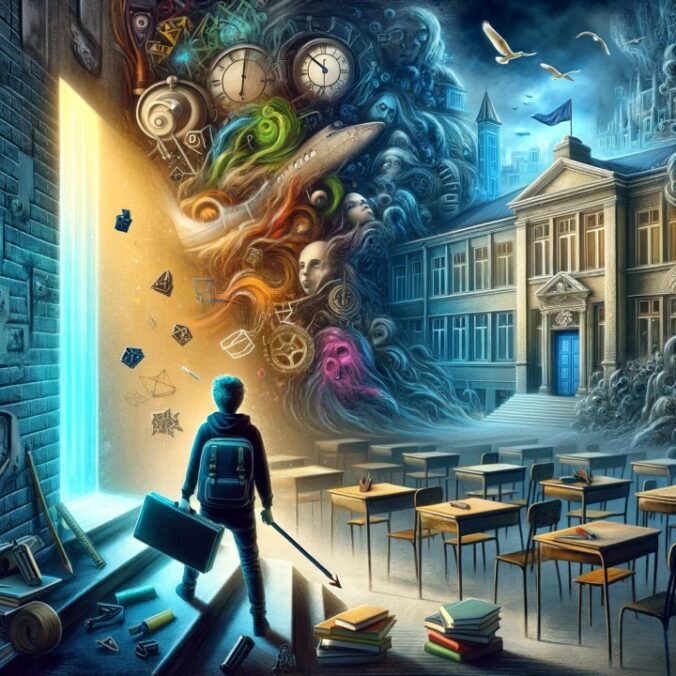
For the header image of this blog, I asked it to create me an image of a “student torn between creativity and conformity in their learning.” Then, I asked it to change the image to “add to it the element of a school pushing him toward conformity.”

My prompts required a level of creative thinking. They also required me to define a problem set I wanted illustrated and to look critically at the image that it generated.

As I have played with Dall-e over the last few months, one thing I’ve discovered is that it illustrates abstract concepts remarkably well. As in my photography, I have many ideas in my head struggling to get out, but I struggle to execute them so that they resonate with others.

Text is a complicated business (I’ve found ChatGPT helpful there as well) and images require a high degree of technical proficiency (and time) to create. For over a decade, I’ve used concept mapping software as simple (and collaborative) illustration tools. However, even with these powerful tools, it’s still a lot of work to express complex sets of ideas.

AI can be a tremendous partner to help humans create and analyze complex ideas. The jobs it replaces are those that emphasize conformity.

All my students will need to think creatively as they interact with AI going into the future. I can manufacture conformity using AI tools with ease, but for AI to augment what I’m doing, I need to approach it with refined creativity and critical thinking skills.

Conformity was a trait valued in the Industrial Age, so we designed our systems of education to meet that need. There are many studies that show how educational processes drum creativity out of our students. By the time they get to me in college and high school, they are very resistant to exploring ideas creatively. My students seek answers, not questions.

It is imperative that we identify why this happens and transform the philosophical underpinning of what we’re doing in education. AI will punish conformity and reward creativity. If we don’t stop churning out conformists, we are doing our students a tremendous disservice.

Art, Technology, and Simplicity

Originally Posted February 12, 2024

Life is an ongoing journey to unravel the complexities of the world. Despite the increasing intricacies, we persistently seek anchors and waypoints to navigate through it all. In today’s technologically driven era, we find ourselves inundated with vast amounts of information and choices, which can sometimes overwhelm us.

It takes a certain humility to admit that the more you know, the less you know, you know. Toddlers have an enviable certainty about the way the world works. Most of us recognize over time that our imaginations inherently limit our ability to understand and process. Our imaginations are simultaneously the outlet that gives us art, which is an imagining of a more ordered state of the world.

Having dedicated over four decades pursuing the photographic art, I’m intimately familiar with this struggle. While most art requires addition, photography requires subtraction. It is about ordering the world in a frame. It is about taking a three-dimensional world and transforming it into a two-dimensional one. The art of photography is a process of simplification.

Good photographers recognize how to make sense out of a complex world. Photography is the constant battle to refine images that resonate with us and our audiences emotionally and intellectually.

I employ similar techniques when delving into the realms of politics, technology, or history. As an educator, I struggle to teach the need to confront the complex and make sense of it to my students, who exude a youthful confidence in their understanding of the world. They know little. Therefore, they think they know a lot.

In the realm of technology, we see a perpetual tug-of-war between complexity and understanding. There is a difference between perceiving simplicity and inventing it, however.

Some pundits maintain AI is merely an enhancement of what currently we use. Others see it as an existential threat to humanity. Both viewpoints stem from a desire to grapple with complexity. Yet, nestled between these two extremes lies a middle ground, where simplicity can offer us a guide to exploration rather than dismissal or fear.

Large language models, such as AI, neither operate through sheer simplicity nor magic. Instead, they offer a means of simplifying the intricate fabric of our technological landscape.

Simplification, like composing a captivating photograph, involves removing noise, drawing connections, and discerning patterns. AI can provide us with a critical tool in creating understandable patterns from the noise. It is not the technology itself; it is what the technology does that should fascinate and inspire us.

I get impatient with those who would wield complexity as a tool for dominance. For instance, I find little attraction in the obsession over equipment in the photography space. Gear is a distraction from the truly difficult task of artistic vision. Similarly, in the realm of technology, our aim should be to demystify rather than obfuscate.

Complex technology is a necessary evil, not an end. We must always strive to simplify our tools as much as possible. Our tasks are inherently complex and addressing those should be the focus of our efforts, not the tools necessary to get there.

My focus as a technologist lies not on the technology itself but in its potential applications. How can it enrich creativity? How can it facilitate learning and knowledge-sharing? Those are hard enough without adding overly complex technology on top of them.

Approaching AI with a similar mindset, I view it as a catalyst for simplification—a mechanism to illuminate the intricacies of our world. However, context is paramount.

Every piece of knowledge requires a framework, just as every photograph requires a frame. AI could construct those frameworks for us, allowing us to perceive patterns of knowledge more quickly.

The economist E.F. Schumacher once wrote, “Any intelligent fool can make things bigger, more complex, and more violent. It takes a touch of genius — and a lot of courage — to move in the opposite direction.” I would add to this insight and say genius is about exploring the edges of complexity and creating simple, yet dynamic, and evolving visions of reality.

AI, while promising in its ability to simplify, is not immune to pitfalls. Hidden complexities breed biases and manipulation, often with an underlying profit motive. Ignorance has always been a component of capitalist growth. Transparency is therefore imperative, enabling users to comprehend the processes underlying all technological systems, particularly AI algorithms.

I need AI to simplify the world for me. I need pictures I can explore with my mind and my eyes. I want to know where those pictures came from and how they what went into constructing them. That is itself a picture of connections and causalities.

In my quest for understanding, I hold books and AI to similar standards for providing pathways for further exploration, such as connections to sources and related maps of information. This requires clear evidence and transparency.

No one book or AI query can provide a complete map, even if they are transparent. Transparency itself is necessary to simplify our pathways through information.

I always strive to be a simplifier—a superpower laboriously honed through years of distilling complexity. Instead of viewing AI as a threat, I see it as a complementary tool—an enhancer of our innate ability to simplify and understand.

AI could provide a powerful new tool in our quest for simplification. However, that will require careful design and a focus on that goal, not the complexity of the tool. I haven’t been this excited about the potential for this tool to expand our horizons and wisdom in a long time.

This is the time to advocate for open systems of understanding, both of and by the tools we create. AI could do both and provide us with a simple view of the complex world we all confront so that we can get on with the process of being human, not just statistics on an industrial scale.

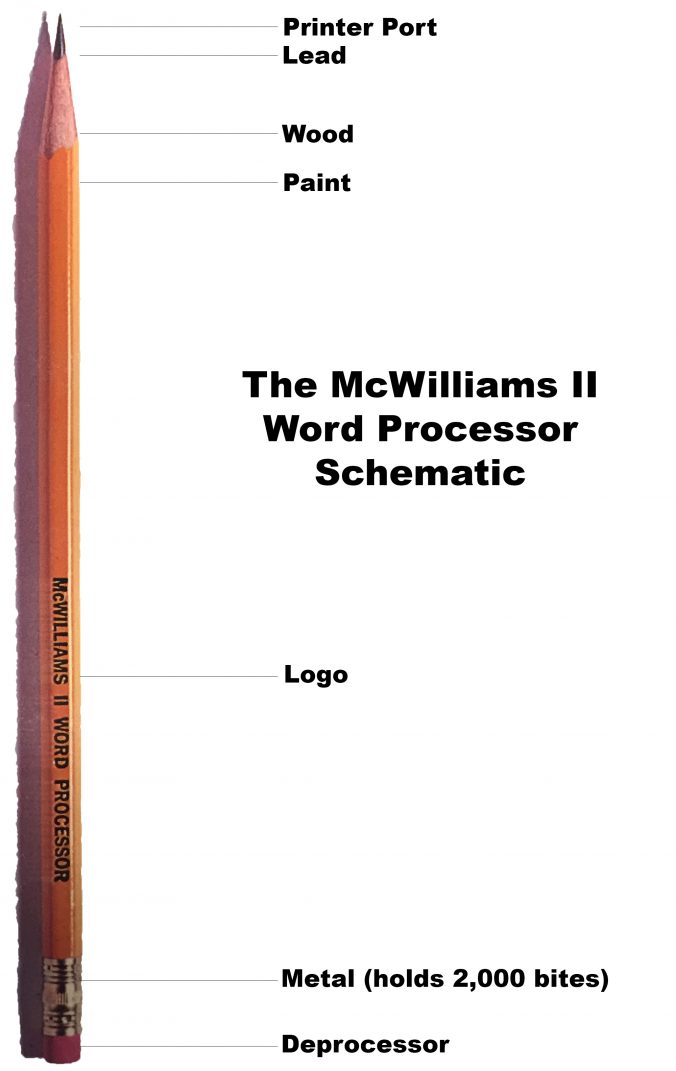
I leave you with this quote from a BBC report on Word Processors from the dawn of the personal computing revolution (1979) which I think also speaks to our current moment in AI:

“If we do it all wrong, then it could be an absolute disaster. It’s the biggest aid to totalitarianism you could ever come across if you think about it and that must be avoided at all costs. On the other hand, it’s the greatest boon to decentralization and people fulfilling themselves and that’s sort of the way we’ve got to go, but it’s up to us. Being an optimist, I’m quite excited.”

— SOURCE: BBC, 1979 report on “Word Processors” at https://youtu.be/b6URa-PTqfA

Rethinking Carbonized Systems of Education

Originally Posted August 31, 2023

Last week, I took part in Bryan Alexander’s Future Trends Forum thought exercise about Solarpunk campuses. There was a lot of discussion about how to redesign campuses to be more efficient and to limit carbon emissions. The discussion centered on how to make those campuses antifragile[1] [2] , and more resistant to the severe weather events that will be more common under climate change.

However, campuses don’t live in a vacuum and, while they need to be concerned about their carbon emissions, the impact that institutional policies and practices have on the carbon emissions of their students, employees[3] [4] , and the larger community are perhaps even more significant than internal efforts to “go green.”

I have been arguing for years that we need to look more critically at our systems of learning for pedagogical and technological reasons. However, there is a strong carbon emissions benefit to doing this as well.

NetZero building construction is a laudable goal. However, this approach won’t radically alter the carbon footprint of a campus because so much of the built infrastructure is decades old. Almost 70% of buildings on a typical campus are over 10 years old.

Institutions could retrofit some buildings to make them more efficient, but the idea of wholesale campus rebuilds is outside the conception of most cash-strapped institutions. Instead, budgetary pressures often motivate colleges to focus on challenges presented by congestion and parking. These are cost drivers because they eat up valuable land and reduce enrollment as potential students reason that it’s hard to get to campus.

Some colleges have attempted to restrict cars on campus or access to campus parking resources for this reason alone. However, by doing this, they are shifting the burden of carbon mitigation onto the individual student or employee who face economic barriers over which they have little control.

These kinds of policies shift responsibility away from institutional drivers of carbon emissions. Institutional inflexibility forces too many students and employees to travel to and from campuses far too often.

Around 85% of all college students are commuter students. Their collective impact on carbon emissions is significant. We can eliminate a lot of those planetary costs if we rethink how our industrial-based systems of education work to drive transportation costs.

Educational systems are not immutable. The pandemic proved just how much flexibility was possible during an extreme event.

Climate change is a slow rolling version of Covid. Like the pandemic, it is up to institutions, from government to business to education, to create the conditions necessary for individuals to adapt to flexible, remote modalities of work and learning.

Cal Polytechnic did an experiment [5] [6] [7] on the eve of the pandemic to reduce the number of students driving to the campus every day. They found that by banning freshman parking they reduced the number of students driving to campus by a considerable margin, at least at first. Unfortunately, they also discovered a backlash effect as sophomores and up drove even more.

When they reduced restrictions, freshmen drove more than well, resulting in a net increase in miles driven by students to reach the institution. Coupled with the expensive California housing market, students had to drive more and drive further to reach affordable housing.

Neither students nor institutions can control the macroeconomic factors that drive off-campus housing costs. Institutions can impact the burdens those realities impose on their students (and employees).

College’s attempted to restrict parking is an example of putting the burden of change on the individual. The system rewrote the rules that were easiest to rewrite. A captive student population has little choice but to go along with that decision.

The average car in the United States emits 4.6 metric tons of CO2 in the atmosphere every year, according to the United States Environmental Protection Agency. This translates into around 400 g of CO2 per mile driven.

In 2020, the Cal Poly students in their study drove almost 7 miles per student or 14 miles per trip. That’s 5.6 kg per student per day going to campus.

Sixty percent of Cal Poly students commute to campus, according to US News and World Report. That means 13,200 students drive 14 miles every day on average. Every day the college forces those 13,200 students to commute to campus puts 74,000 kg of CO2 into the air.

If institutions converted classes to hybrid or blended learning, they could cut these emissions in half or more. Again, a little math.

If we assume a typical class meets twice a week during a regular academic 16-week term, and four times a week for 10 weeks in the summer, this saves 42 student trips to campus. 42 trips X 5.6 kg X 13,200 students means that doing this conversion results in over 3000 metric tons of CO2 saved from Cal Poly’s carbon ledger.

Imagine the carbon savings when you extend this line of thinking to the millions of commuter students in the US alone. Cal Poly is just one institution and far from the worst. The community college where I teach has almost five times the number of commuter students and probably similar average commute distances.

There are other direct benefits from this one policy shift. Institutions could reduce building utilization. The resultant savings in heating and electricity would save millions and cut carbon emissions.

Campuses could be strategic and shut down the least efficient buildings first, achieving an even greater net gain to their carbon balance sheets. This would also reduce pressures on room assignments and overcrowding in classrooms for those institutions that have that problem.

I outlined how we could reconstruct and reconfigure campuses to support hybrid learning last year in my blog “Classrooms of the Mind.” This is education without compromise. It leverages technology, where appropriate, to augment more targeted and substantial face-to-face interactions than is the current practice.

Sometimes, 100% online classes are appropriate, especially for more advanced learners. However, the over 50% of American students that attend community colleges and a significant chunk of students who attend four-year institutions require a lot of instruction on how to learn to be effective students. This requires a high degree of personalized attention, much of which benefits from face-to-face interactions.

Physical campuses still have a role. There is something to be said for the spontaneity of putting groups of people in a room together to explore ideas and information, but this does not happen in the same manner for every class session in most classes.

Educating our students in this manner also prepares them for hybrid or remote work environments, which are increasingly common and have similar carbon benefits. Schools must prepare students to succeed in all technological modalities. Forcing them to learn based on industrial modalities does not do this.

We can create systemic environments that limit carbon outcomes. Coupled with efforts to make existing infrastructure more carbon neutral, these can have a multiplier effect on how we address carbon change.

We should not ignore the elephant in the room because human systems “have always worked that way.“ This is a fallacy. Most of the systems we work under are only 100 to 150 years old, if that. We developed them to satisfy industrial norms.

It is these norms that gave us climate change. It’s high time we shifted our paradigms to meet new technological realities of working and learning. Doing so will also contribute to mitigating the effects of the Anthropocene and result in a more diverse, accessible, and quality educational experience for our students.

Thank you to Bryan Alexander for contributing his reactions to this blog

In The Beginning

Originally Published January 29, 2024

ChatGPT 4.0 was used to alter the tone of this blog from the original draft. I edited the text significantly for the final draft you see here. The content of the text is 100% mine.


I’ve come up with a set of rules that describe our reactions to technologies:

Anything that is in the world when you’re born is normal and ordinary and is just a natural part of the way that the world works.

Anything that is invented between when you’re fifteen and thirty-five is new and exciting and revolutionary and you can probably get a career in it.

Anything invented after you’re thirty-five is against the natural order of things. – Douglas Adams

In the exciting dawn of any technology, there is a natural sense of wonder about the direction it will take and how it will impact our day-to-day lives. Initially, people may feel cautious, but this is a common response to the unknown. As we delve deeper, the second reaction is to explore how this new technology can integrate into our existing technological landscape. The third reaction is to align it with our systems of control.

While these reactions are understandable, they don’t always lead to the most constructive outcomes. At best, they offer incremental progress. At worst, they can reinforce existing systems, such as emphasizing their flaws and dehumanizing aspects.

Over the past year, I have been sharing a vision of harnessing the power of AI to create entirely new perspectives on the world. This vision, which I call Generative Augmented Perspective, involves the fusion of Generative Language Models (LLMs) with visualization to automate the generation of information and conceptual maps of ideas.

However, I seem to be well outside the dominant conversations in articulating this potential aspect of AI. Depending on the audience, my vision can sometimes get overshadowed by discussions about adapting existing systems to the new reality or concerns about corporate dominance. Most of the people having these reactions fall into the third category Douglas Adams mentions in his discerning observation in the quote above.

No one says that the pathway I’m suggesting is technically impossible. However, I am greeted with a lot of skepticism. The assumption that AI will follow pathways that so many technologies have followed drives this line of thinking.

Web 2.0 and social media are the most recent examples of this. However, neither of these have transformed education, business, or government systems in any meaningful way, even as they consolidated into a few large corporate entities.

I see an alternative future. I think AI is more disruptive than Web 2.0 ever was. The better analogy is the PC Revolution of the 1980s. Looking back at this example, my work emphasizes AI’s potential as a disruptive tool that tackles information overload. It could help us navigate the complexities of our interconnected world. This vision has profound implications for both education and practical problem-solving across all fields.

I understand that I’m not in the majority when championing this vision. Instead of envisioning how AI could revolutionize the way we teach and learn, much of the educational discourse revolves around using AI to enhance students’ adaptation to the current, somewhat flawed, industrial education system. Similarly, discussions about AI’s impact on businesses often focus on short-term profit gains, rather than addressing the deeper challenges it presents, such as our current vision of copyright and the impact of the automation of routine tasks on employment and required employee skills.

 It’s not surprising that these conversations lean towards short-term goals. It’s human nature to be slow in adapting to paradigm-shifting realities.

When personal computers emerged in the 1980s, there was a mix of overly optimistic ideas (e.g., the belief that schools would become obsolete) and apocalyptic predictions (as seen in the movie “WarGames”). Similarly, the popularization of the internet in the 1990s brought about additional concerns over media and music business models.

The response to these darker views of the implications of new technology led to legislation like the Computer Fraud and Abuse Act of 1984 and the Digital Millennium Copyright Act in 1996, both of which sought to enshrine elements of the older paradigm even as the technological world shifted out from under them. We are still living with the implications of these choices today as they reinforce monopolies at the expense of individual creative rights.

These discussions inevitably focus on immediate concerns, rather than considering the deeper implications of the technology and leveraging opportunities that emerge through a new paradigm. These reactions are reactive, not proactive.

AI challenges our systems because it highlights the need for higher cognitive standards among students and employees. One of these cognitive standards is learning how to think proactively, systemically, and strategically about problems. Even current AI systems are pretty good at reactive thinking.

These capabilities highlight the risk of training students and employees for roles that increasingly sophisticated generative systems will replace. This challenge is not new; it is the consequence of ignoring industrialized learning processes that emphasize conformity over creativity. Conformist thinkers are inevitably reactive. It takes creativity to think proactively.

Ironically, it’s the creative thinkers that can benefit from generative AI the most. It can create scenarios and games to predict outcomes or allow humans to simulate them. I’ve used it myself to create graphics to illustrate complex ideas that are beyond my artistic skills and to brainstorm ideas that are not gelling in my imagination (aka overcoming writer’s block).

These applications show how AI can help humans frame questions. They allow us to express ideas in ways that were much more difficult without large language models. I plan to use it in my classes this semester as a teaching tool to help students develop the right questions for their assignments (my assignments emphasize questioning over responding).

The early days of the computer revolution in the 1980s have many interesting parallels to what’s happening with AI today. However, AI’s rapid progress gives us less time to adapt. In just one year, the AI landscape has transformed as much as it did in the first decade of the computing revolution.

Graham Allison’s classic line about bureaucracy “you stand where you sit” applies here. We are all attached to our usual paradigms. There is a lot of fear attached to thinking through the implications of as disruptive a technology as Generative AI on the systems in which we operate. Many of the changes that need to be made, both in education and business, are long overdue. The difference now is that Generative AI has made them much harder to ignore.

I’m about as excited about the possibilities for where this might take us as when I got my first personal computer and started using it as a creation engine. Millions of words and hundreds of thousands of images later, I’m still creating. AI has taken this exploration to a whole new level in the last year (and every day I’m finding new uses for it).

The computer opened doors of creative exploration to more and more diverse groups of people, Web 2.0 opened those doors even more, and AI will once again expand that exponentially. We just need to perceive its possibilities instead of mourning its destruction of outdated systems of thought.

Transparency: Generative Augmented Perspective

Up to this point in our discussion of transparency, we have been talking about things that are very real technologies. Today, I want to take a small step into near term reality based on current tools.

So far, we proposed opening the doors of information locked away in proprietary boxes, putting that information into perspective through concept mapping, and constructing linked canvases of ideas through layered concept mapping. This week, I want to fuse these ideas with the technology of the moment, Generative AI.

Information processing is a labor-intensive process. Whether we’re creating documents for large companies, or just trying to keep a handle on our own thought processes. I have filing cabinets of semi-sorted paper, hard disk drives of data, and thousands of pages of my writing.

Since the days of HyperCard, one of my chief struggles in life has been making logical sense out of all the information I collect. I have found very few shortcuts and have massive data forests to contend with.

Even more frustrating is when my brain tells me I need a particular piece of data and I can no longer find it. I have tried various tools over the years to organize that data going all the way back to HyperCard, but maintaining those tools was a labor-intensive process. Even after I put the data into the tool, it quickly became dated and sometimes inaccessible.

When I write, I know I am getting knowledge from a vast range of sources. Sometimes those are explicit, such as my current recollection of Vannevar Bush’s Memex,. Often, however, years of research shape my writing in subtle ways. Sometimes I can figure out those connections with a great deal of work, but sometimes it’s just too hard to backtrack my thinking that far back. Even if I can, it’s a major effort to locate the original source.

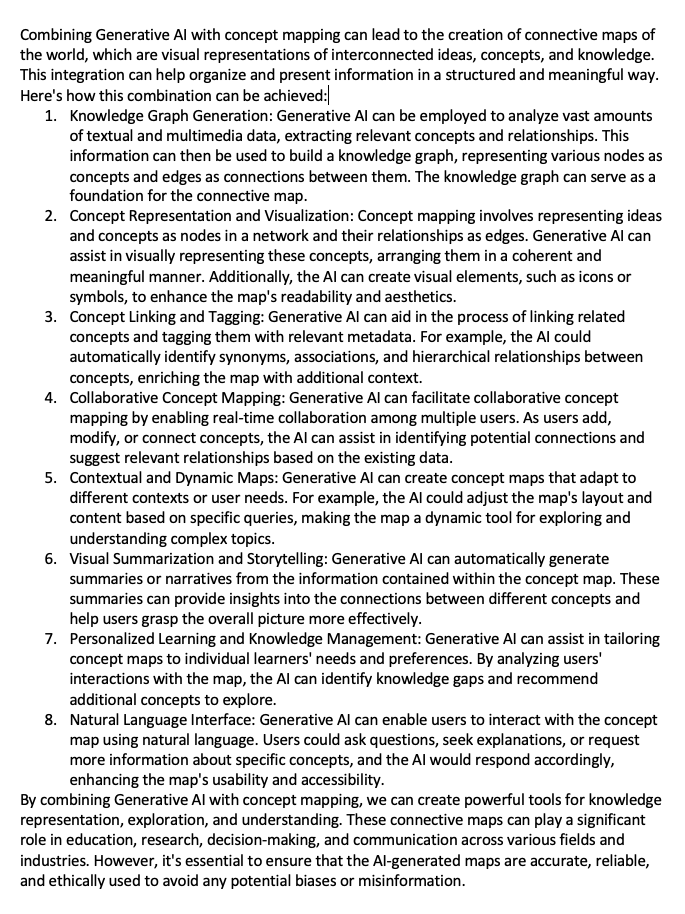
Generative AI is making a vast array of connections as it creates documents. It does this by scraping data from a range of sources. Like the bread crumbs on the web, the connections to these sources are hidden. This practice has caused considerable controversy among content creators. I asked ChatGPT “How can we combine Generative AI with concept mapping to create connective maps of the world?” This was its response in text form:

ChatGPT response

ChatGPT has produced some interesting responses, but I want to explore where it’s getting its information from and how we might connect those ideas into a more comprehensive approach to mapping ideas.

This should be possible. Generative AI is an augmented connection device. However, like the web, ChatGPT hides those connections.

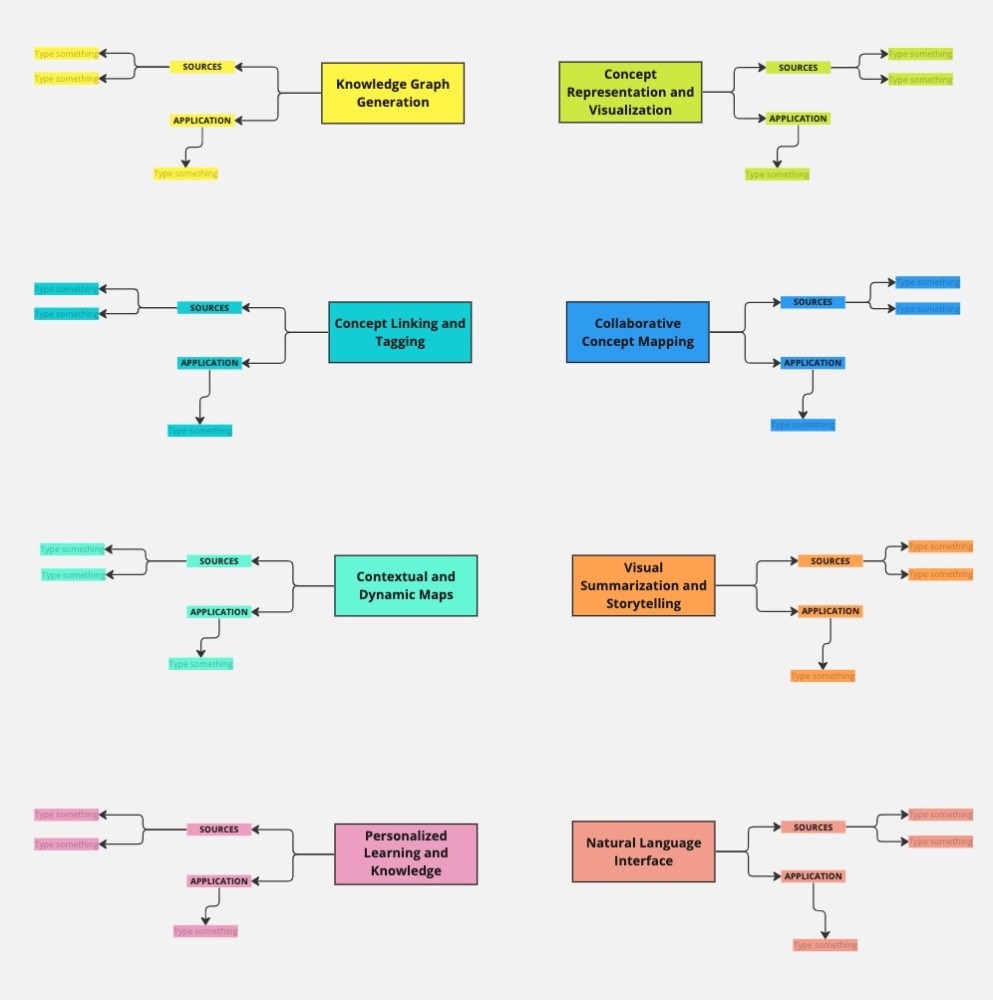
If we made Generative AI transparent, it could also be an augmented perspective device. I took those ChatGPT results and plotted them on a Miro concept map.

Miro copy of what might be possible with visual generative AI

This map represents an iterative step. There is nothing new being added to the map compared to the ChatGPT response. I Generative AI could generate this kind of map. A further iteration would add sources and applications as well as suggest connections between items on the list. Right now, humans (like me) must do this part.

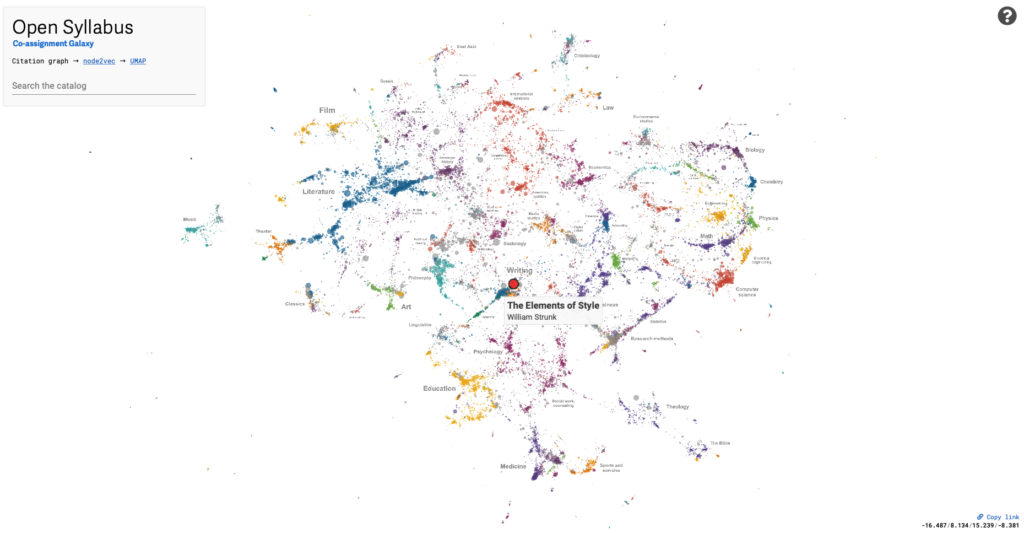
Coming at this from complex to simple patterns, one of the more interesting tools I found in recent years is the Open Syllabus Project. It plots a heat map of all the readings from open college syllabi. It forms a knowledge heatmap of what we teach in higher education through the materials on our collective syllabi.

Open Syllabus Project

There’s a lot about this diagram that is automated, but it still requires a fair amount of labor to set up and maintain. However, I could see this kind of tool being fused with AI to create automatic heatmaps from any collection of data.

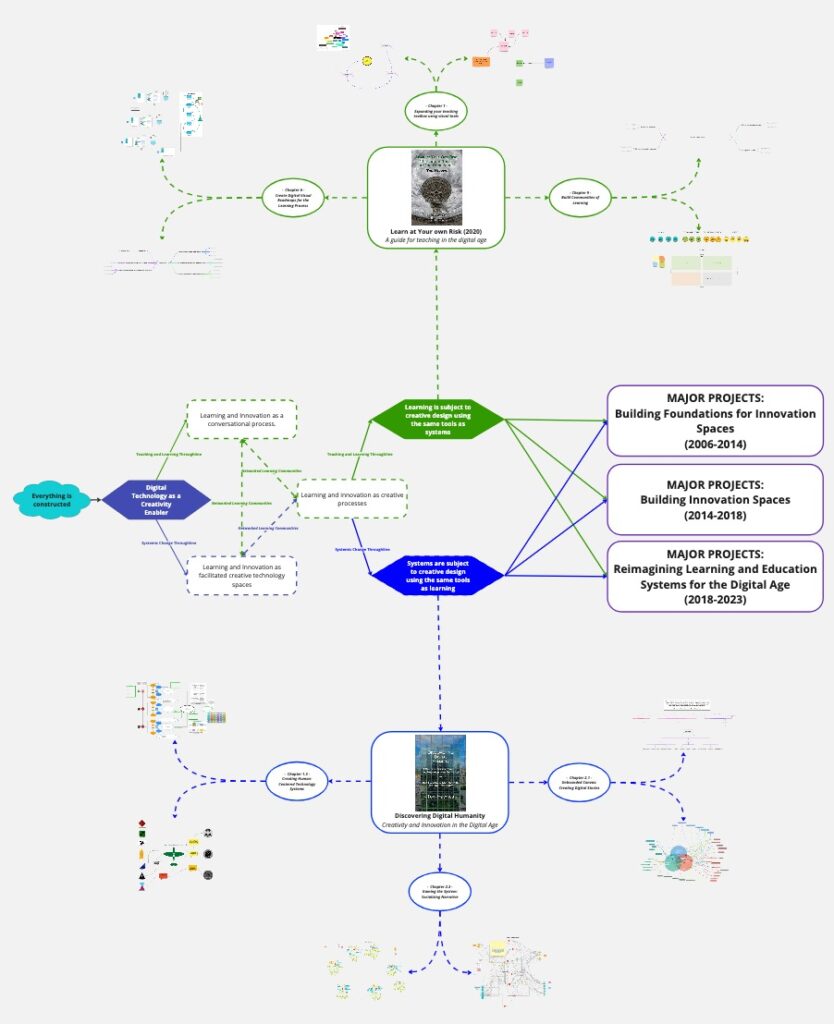
I can imagine a host of uses for this kind of tool. As you may recall from the previous blog, I created a connected set of ideas and projects for my Miro resume.

This was a tedious and labor-intensive process, even though I had all the data I needed from IdeaSpaces. Computation excels at replacing tedious labor.

These are just three examples of what is possible with AI tools that automatically aggregate datasets and propose linkages. Consider for a moment just how much of today’s professional work is spent doing just that.

I used to work at an architecture firm. Most new architects spend huge amounts of time creating what are called construction documents. These connect the design to the materials, furniture, fittings, and equipment necessary to build the building.

This is tedious work. It is also a task that consists almost entirely of making connections between various bits of data. Generative AI is made for these are the kinds of tasks.

This would disrupt the architectural practice as it exists today. Creating construction documents is a central part of the process for breaking in new architects. Demand for junior architects would decrease.

However, this is also an opportunity for firms and schools to up their game and bring architects into practice at a higher level than is currently the case. Also, someone is going to have to manage this AI process.

On a personal level, I would love a Large Language Model AI that would look at my writing and suggest where I’m getting my ideas from or to provide suggestions for additional exploration of adjacent ideas.

This would automate that frustration I described earlier. Probably 90% of the resources I have accumulated over the years have been digitized, either by me or by some other entity. Connecting them is the real challenge.

This kind of tool would also tell me if someone else has explored the same territory. I can’t tell you how many times I’ve been writing and thinking “surely, someone has thought of this before.”

Concept maps are an ideal tool for surfacing the connections that the AI finds. Instead of providing a list of sources or materials, an AI coupled with a concept mapping tool like Miro could give us a connective heat map that is both live and evolving. Humans could then focus on creativity and novelty.

This brings us full circle back to the blog from the beginning of this series. Imagine an AI that creates a concept map or a heat map of all the connections, while constantly pulling from live data. We could use this to fine-tune the AIs. Visualization also creates opportunities for oversight to mitigate bias or other kinds of intellectual corruption from occurring.

We could use these kinds of maps for regulatory oversight to spot areas of mistakes or deliberate gaming of the system. A generative system, coupled with a visual output, could create these kinds of documents automatically, making compliance with government oversight much less onerous and labor-intensive than today.

If we can get past the alarmist rhetoric and look at the possibilities for human augmentation that these tools provide, we can unlock stores of overlooked or hidden information to improve our societies, to advance science and knowledge, and to help us overcome the very real challenges we face as a species today.

Information is at the core of everything. Learning has always been the killer app for the human species. It’s what gave us key advantages in our revolutionary struggle. The explosion of information over the last 40 years or more has made comprehending what we’re seeing more difficult, not easier. This is because we optimized technology to distribute information, not connections.

It is time to take the next step and connect that store of information to our human abilities to make connections and find patterns. For that, we need to think differently about the tools at hand, and the tools we should prioritize building. Perspective creates wisdom. Wisdom is in short supply these days.

Transparency: Creating Perspective Through Layered Concept Mapping

The real issue in software design is the design of ideas. But most people are looking at the wrong levels, fixating on particulars, and not seeing the immensity of option – or the imperative of cleanly condensed structure. – Ted Nelson Dream Machines, 2nd ed., p. 70

Ted Nelson is interested in modeling ideas. Building on the work of Vannevar Bush, he saw the potential of computing technology to transform how we see and manipulate information. As I argued in a previous blog, seeing information in context is at least as important as having access to it. Information is not transparency. Perspective is.

Nelson understood this key facet of transparency. His lifetime of work has reimagined connections between different parts of our atomized information network. In his vision of the web, which he calls Xanadu, he sees a floating network of ideas connected bidirectionally through a series of hyperlinks, a term which he coined.

However, when Tim Berners-Lee invented the World Wide Web in the late 80s, these connections became buried. The web that emerged after Berners-Lee lost the critical trail of breadcrumbs which were central to Bush’s and Nelson’s vision of a network of ideas.

On the World Wide Web, the information itself took precedence over its connections to other information. The paper metaphor also persisted, and with it, the limitations of text. Berners-Lee recognized this shortcoming (see his book, Weaving the Web). The technology of the time limited the web he created.

Xanadu represents a practical implementation to realize Nelson’s vision of free-floating information bits and the mapping of the hidden connections between them. This is both conceptually and technically difficult. Nelson was ahead of his time, but I can imagine that it could be possible with AI and XR augmentation to approach his ideal of information transparency (more on this next week).

Concept mapping, however, excels in highlighting connections between disparate pieces of information and ideas. By putting things into perspective, and then allowing us to shift that perspective on a canvas, concept mapping can provide powerful insights into the workings of our own brains and the collective workings of brains in a distributed group.

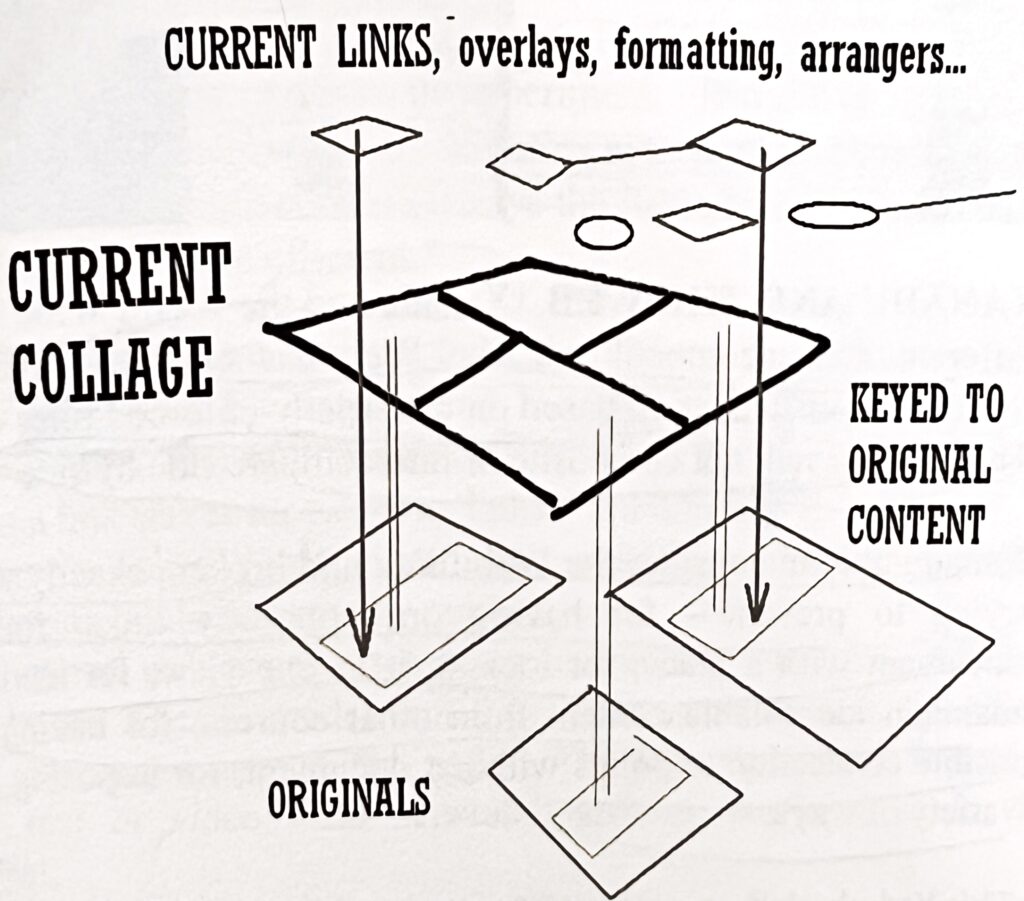
Perhaps concept mapping can form a bridge between how we now manage our information stew and Nelson’s network of connected ideas. Note this illustration from Nelson’s Geeks Bearing Gifts (Mindful Press, 2008, 2009). Nelson seems to envision a concept map at the top of the graphic, but the connections extend vertically instead of just horizontally.


The Generalization of Documents from Nelson, Geeks Bearing Gifts

The Generalization of Documents from Nelson, Geeks Bearing Gifts

The limitations of concept mapping is that it represents a two-dimensional canvas, instead of the three-dimensional space that Nelson envisioned. And unless you engaged in the exercise with a group in a room, the technology limited concept mapping to mapping your own ideas.

I discovered a new trick with Miro that allows you to make links out of objects. We can use this technique to link to outside references like documents on the web but, more interestingly, we can also link to additional canvases within Miro. Using this trick, you can create interconnected canvases of connections. I have done this with my resume.

We can use this third dimension of interlinked canvases to explore and flesh out different subsets or rabbit holes of ideas. We can also link these to the outside web (knowing that’s a one-way street).

As in Nelson’s diagram, we can extend a two-dimensional idea space downward or upward into infinite interlinked two-dimensional idea spaces. This resembles the web as we understand it today.

However, there are two critical differences. First, it makes creating “pages” of connections almost effortless and accessible to non-technological users.

Platforms such as Miro are accessible with minimal instruction. I’ve worked with groups that created complex maps in an hour with no prior knowledge of how to use the software or even the idea of concept mapping.

Second, if you create a root level that requires the illustration of connections between these subsets of ideas, you have begun to create what Vannevar Bush referred to as breadcrumbs.

Concept mapping brings the pathways and connections to the forefront. A root guide or group of guides can create the top layer of the nested idea diagram. Other group members can then expand that core map horizontally or into linked canvases. You can even label these connections so you know who created them.

This highlights another unique aspect of a tool, like Miro. It is a collaborative and asynchronous activity. Groups of people can work together on root-level documents, subgroups of people can work on connected subsidiary documents, and all groups have the choice of working synchronously or asynchronously on a persistent canvas or sets of canvases.

I realize this only goes halfway to the environment Ted Nelson envisioned for Xanadu (again, for that we need AI and XR). However, it uses a tool that already exists, is accessible, and enhances the connections and perspective essential for achieving the transparency I wrote about in my last blog.

There is also a fourth dimension possible here. By creating persistent, adaptive idea spaces, we can see how ideas and systems evolve. I’m pretty sure that Miro does not have a history feature, but that might be something the company should design.

One of the key elements identified by Vannevar Bush in “As We May Think” is understanding how we got to where we are. Perspective over time is at least as important as perspective in space when making connections. Both aspects are critical to transparency.

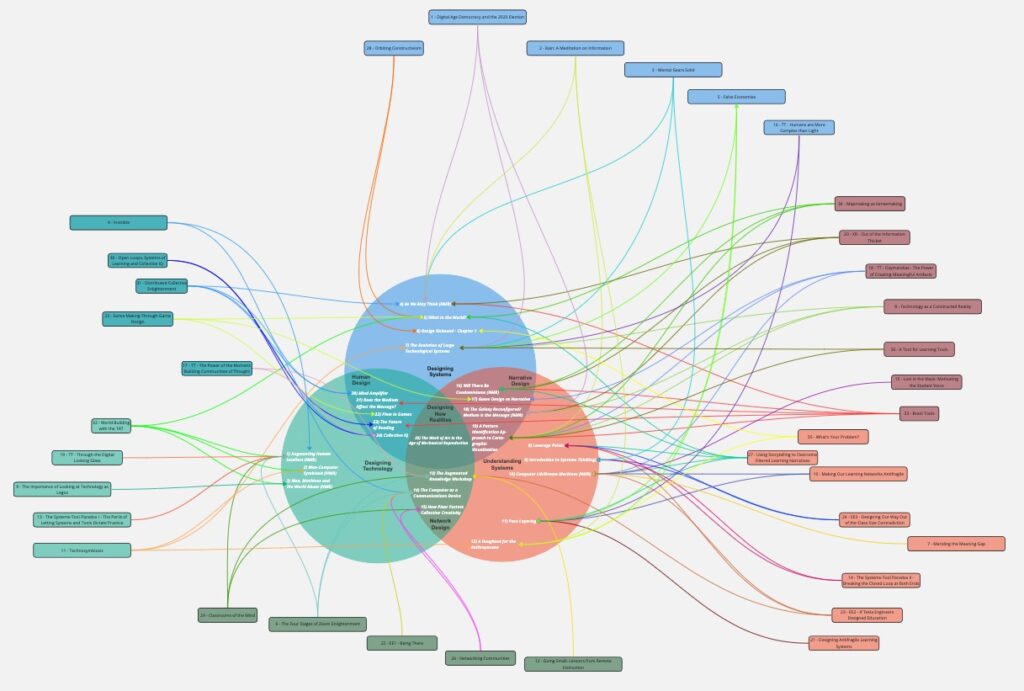
As an example of how this is done, let me return to the blog map of my writing that I created earlier this year. If you go to the map now, you see that I have turned each blog title into a link linking back to the original blog.

Article List

I have also turned the reference list in the center into live links as well. What I have done here is to trace pathways anyone can follow between my work and the ideas of others.

It is up to the reader which pathway to follow. The visualization makes the connections obvious. This example doesn’t illustrate the potential for groups to create similar documents, but that is a question of scaling.

Transparency requires seeing. Seeing requires perspective. We now have tools that help us weed through that complexity, but we need to be creative about how we apply them to achieve our goals.

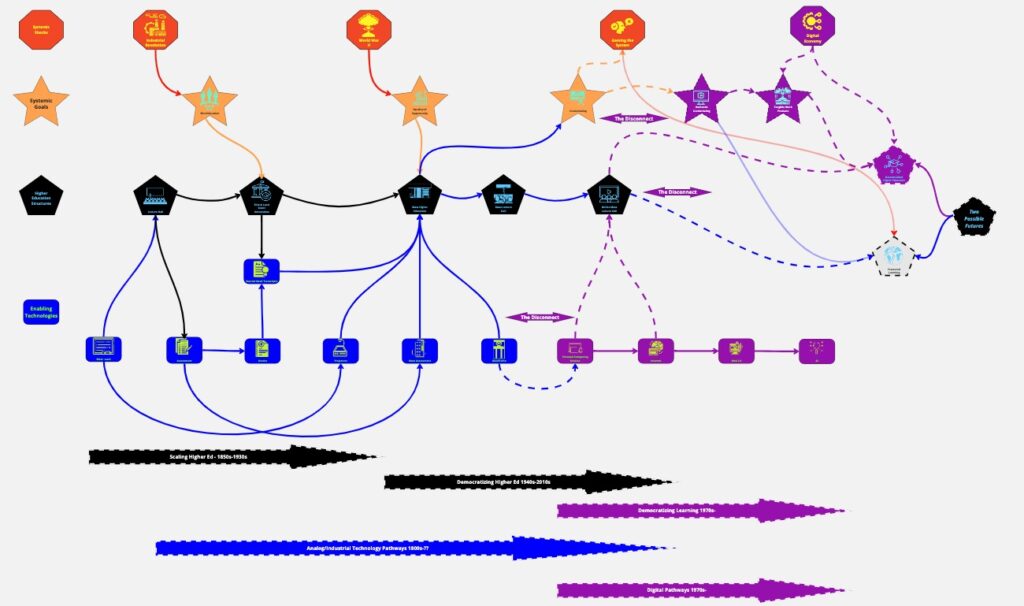
There are a lot of ways to assemble these interconnected idea maps. We could start with a central goal, and then have groups or individuals work outward from that goal. We could create a node of shared understanding and then work backwards from that understanding to its roots. Or we could start with a complex system map like this one and then use it to explore how that system came to be and where it lost connection its connections to human learning.

The Disconnect in Higher Education

The Disconnect in Higher Education

These explorations can become very meta quickly. Groups could explore how they explore, for instance.

Before we can find our way out of the information thicket, we need to make maps that help us navigate the forest. Layered concept mapping could turn into a very useful tool for mapmaking.

New tools are on the horizon, which could augment this effort even further. Generative AI is all about making connections. I could envision mapmaking AIs that could form basic maps which groups of humans could enhance further in a symbiotic partnership. But that’s the subject for the final (at least for now) transparency blog.

Transparency: Seeing a Wider World

I argued last week that one of the chief challenges in today’s world is a lack of transparency in our complex systems of information. However, even if we regulate to create transparency, we will need to develop tools for navigating the resultant deluge of new information.

We have those tools at hand, but most of us don’t use them. We miss opportunities, such as using the tools of mapmaking to help us learn. Instead, we persist in the learned behavior of following textual narrative pathways.

Learning and innovation are about perceiving information in new ways. We miss so much context when we never deviate from linear textual narratives.

Visualizing our ideas changes what we see. It allows us to cut through information soup and perceive what’s important in complex systems.

Humans excel at pattern recognition. “The speed of this kind of human visual processing contrasts dramatically with relatively slow and error-prone performance in strictly logical analysis (such as mathematics).” (MacEachren and Ganter, 1990, p. 67) Pattern recognition is the human strength that visualization unlocks.

I use maps to help my students grasp complex ideas and patterns as they navigate the political systems of Texas and the United States. We can use the same technique to navigate the complex information environment that we face today.

In Discovering Digital Humanity, I noted many groups found their voice because of the democratization of the network through technology. We heard voices that were ignored, relegated, or suppressed because they didn’t have to pass through the filters of “mass” media. However, that same technology democratized the spread of misinformation and deliberate manipulation of information streams.

All stories lack context. We have been conditioned through our use of text in education to accept linear, text-based narratives as being the most legitimate forms of communication. Challenges to that supremacy, such as comics or “hot” McLuhanesque media, have traditionally been characterized as less legitimate.

Text introduces a set of blinders. A careful author will list sources to describe the constellation of ideas that influenced his or her book or article. This is a good start, but it’s still looking outward from inside a linear narrative. The choices that the author makes are never linear, but once he commits them to text, they look that way.

In the last blog, I advocated for a high level of transparency as the first step toward gaining traction on the complex problems facing our societies, both inside and outside of technology. This is only the first step. Assuming for a moment that this strategy is effective, what we have done is unlock a whole new stack of information to add to the flood we are already confronted with.

Most of this information will be textual. A stack of papers or even PDF files is not transparent. Search tools are very useful for digital documents, but they also have limitations if you don’t know the words to search for. Adding AI assistants will help a lot, but visualizations of complex systems will reveal hidden patterns.

I have been using concept mapping for over a decade to decode my own thoughts. I also use it in brainstorming and teaching activities as a mechanism for discovering new ideas and fostering the exploration of ideas.

It is one thing to write down your thoughts, and it has great value, but I have pages of ideas and thoughts that are buried on my hard drive or a box somewhere. I have forgotten what was in many of them. I can’t even keep up with the stuff I’ve published half the time.

Article List

A map of the blogs and articles I’ve written since 2022
and how they relate to
a model of thinking about technology that I developed last year.

There is a connective tissue to all of this, but I often take that for granted, because it is so implicit in the way I approach the world. However, I like to think that my thinking evolves. Understanding that evolution (and my shifting biases), while understanding common elements of my thinking, leads me to new ideas that do not follow a linear path.

A recent attempt to connect and map my thinking

When I’m working with groups, I have the same problem but multiplied. Now I am mapping the collective evolution of multiple minds. As MacEachren and Ganter point out, this has deep neurocognitive roots, “[visualization] utilizes ‘preconscious’ processes to sort out patterns before conscious (i.e., logical) processing of the information is required.”

The technology to create these kinds of maps was limited to a small group who developed special talents and were blessed with a high level of artistic skill. My friend, Karina Branson, does amazing work capturing the thoughts of groups visually, but she possesses unique cognitive and dexterous talents.

For the last decade, however, we have had tools available to us that allow us to create our own cognitive maps. They are much more accessible.

We have moved away from the need to have technical proficiency with pen and ink to create graphics to perceive patterns of information.

Karina was one of the people who exposed me to Miro, which adds a collaborative element to concept mapping. Miro made my pivot to remote teaching possible because it opened so many possibilities for collaborative active learning and seeing.

A course map I created in Miro to help my students navigate my US Government class

The pandemic further narrowed our vision. Suddenly, we were communicating through digital pinholes, whether we were teaching classes or conducting business. Many bemoaned the loss of context and interactivity that this process of “Zoomification” created.

There is a power and spontaneity in having groups of humans gather in a physical space and toss ideas around. There are limitations to that model as well. We lose a lot in the process of debate. We leave good ideas on the table. Very little actionable material remains after the fact unless the brainstorming activity is well-designed and structured.

Tools like Miro, however, create a persistent object that users can access asynchronously. This is a power that I have been using for concept mapping my own ideas for years. Now groups can go back and look at where they were going yesterday or last week. They can also change it.

This is an incredibly useful teaching tool. But almost no one uses it.

However useful this tool is for mapping our own ideas, we can also use it to map complex systems and allow us to see outside narratives much more clearly. Imagine teaching US history, for instance, as an interlinked concept map rather than a linear narrative. You wouldn’t have to choose between competing narratives, you could see them all.

Teaching would be about finding the connections between narratives and understanding how context produces bias. Instead of a textbook, we would have a visual map to guide us.

These maps could also guide us in understanding complex systems, such as climate change or computational algorithms. For instance, to regulate AI and social media algorithms, companies could be forced to provide visual maps detailing their sources of information and how they connected them into creating text, graphics, or media streams.

As Erasmus wrote 500 years ago, “in the kingdom of the blind, the one in eyed man is king.” We are the kingdom of the blind.

The one-eyed men of today are those that control the narrative, but even they only see imperfectly. Visual mapping can open many eyes and democratize our stories in the process.

We have it in our power to restore our sight, but it will require tools we haven’t grasped yet. These tools are out there. With them, we can map the information we already have and use them to see the context and complexity that we may be missing.

Transparency means nothing without context. Maps provide context.

Next Up: The Promise of Layered Concept Mapping

Transparency: A Way to Regulate Technology

“On one hand, information wants to be expensive, because it’s so valuable. The right information in the right place just changes your life. On the other hand, information wants to be free, because the cost of getting it out is getting lower and lower all the time. So you have these two fighting against each other.”
– Stewart Brand (Quoted in Levy Hackers, p. 360)

Debates over AI have dominated the first half of 2023. The US Congress held hearings, and regulation has been demanded from many quarters. This kind of furor is not a new thing. We have been debating similar regulations for social media for years now.

The technology community has often reacted to these debates with a mixture of fear and derision. If legislators who don’t understand the difference between Twitter and Wi-Fi were to create regulations about social media or AI algorithms, the results are likely to be hilarious but also harmful to innovation.

The speed of politics is also out of sync with the speed of technological change. Technology moves so fast and most political systems are slow by design. It is hard to imagine regulations that aren’t outdated even before they are discussed in a congressional committee, much less implemented.

Even enforcing existing regulations is a challenge for bureaucracies and law-enforcement. Microsoft was punished for Internet Explorer long after the questions that prompted the original antitrust lawsuit were irrelevant.

It’s important to step back from technology and ask more fundamental questions about what’s really going on here and where the roots of potential abuses lie. We live in a complex world with lots of moving pieces and rapidly shifting environments. It’s often difficult to see the core issues through the confusing noise. Ironically, it is here that an AI designed around information legitimacy could be transformative.

Transparency should be a cornerstone of all technology regulations. A recurring theme I hear in the AI debate is that we don’t know what’s going on. Some of that is internal to the technology itself (which doesn’t make it undiscoverable), but much of that is hidden behind the veil of corporate secrets.

In the AI world, almost no one understands how ChatGPT gets from a query to answer because OpenAI locks almost all that process in a proprietary box. In the social media world, the same is true for the algorithms that bias newsfeeds on Facebook and Twitter.

My dog is smart enough to understand that if something interesting is going on underneath a blanket, the solution is to pull the blanket off. It’s high time we pulled the blanket off these processes.

Ignorance is a way to make money. The digital age has threatened this tried-and-true practice. If you don’t know that you can get a product down the street for less money, I can sell you that same product at an increased profit to myself. If you can access all this information on your computer or phone, it undermines my profit potential.

Over the last 30 years, economic actors have had to adjust to this reality. The solutions have ranged from adding layers of complexity to the product, to make it difficult to compare to other products to creating proprietary black boxes that conceal some sort of “secret sauce.“

Much of today’s industry, and I include the tech industry in this, operates behind a hall of mirrors as a way of protecting profit. Complexity has replaced scarcity as a profit screen. The practice of deception hasn’t changed.

As those of you who have read my work know, I am a vigorous proponent of technology as a creativity enabler. When I spend half my time dodging around unseen obstacles in various platforms as I try to create, I waste valuable creative time.

Imagine being a regulator, trying to decode the code that drives these processes. AI could streamline decoding complexity. It’s good at looking for patterns and connections.

As I discussed in a previous blog, AI is a powerful tool, but it needs to be supported by open systems in order to fulfill its potential. Systems of openness are a key to keeping AI systems firmly in check.

Those who say that innovation will be crippled if we create open systems haven’t read the literature on what drives innovation. Generative AI is also showing that hiding stuff is a fool’s errand as AI crawlers find their way into more and more systems.

There are plenty of ways to generate profit from open systems. As systems become more complex, even if they are open, people will need help to maximize their own usage of technology. This is a far deeper well of profit because they can tie it to productivity and growth, not a temporary state of ignorance.

Once you lock something up, it stagnates. While you may make a marginal profit at the beginning by having a technology that no one else has, hiding it is not a sustainable profit model.

Transparency is evergreen. You don’t have to make special regulations for this technology or that technology. You just insist that all technologies and businesses follow clear and open rules.

The job of the regulator becomes much simpler and focused when it is targeted at opening doors to public scrutiny. Societies can enforce existing regulations much more easily because people can figure out what’s going on. Transparency smashes the hall of mirrors.

We need to use the technologies that currently exist and are being developed to police the technologies of the future. For instance, we can design AIs to look for patterns of suspicious activity in technological systems.

I’m not talking about policing the users. I’m talking about policing the algorithms. AIs could investigate companies suspected of nefarious practices.

These kinds of investigations could gradually reshape a destructive paradigm of exploitation if they are part of a culture of public watchfulness and are legally protected. This runs against current business culture.

Transparency represents a paradigm shift for American business. However, in the long run, it is a more profitable strategy for success.

This strategy of technology development gives open societies a competitive advantage over economies that refuse to follow suit. If we’re worried about AI competition from China, the best way to win that competition is to leverage advantages that closed societies find difficult to replicate. This is how we won the Cold War. This is how we can win going forward.

Transparency also represents a rallying cause for proponents of effective regulation. Right now, it’s easy, or at least it seems to be easy, for people to understand what they’re against, but very difficult to understand what they are for.

As a student of systems thinking, I understand how this challenges certain paradigms. Those paradigms are already being challenged by the march of technology.

Stewart Brand’s quote that leads off this blog is not inaccurate. Just because information wants to be free doesn’t mean it is.

We need to stop making a political prisoner out of information or a revolution will occur in which that prisoner reeks revenge on an unprepared society. It is humans and the systems that they create that pose the real danger in a world of technological amplification.

Open is progress. Closed stagnates. Let’s choose the open path.

This is the first in a series of blogs on the power of transparency in technology.

Idea Fences: How They Will Shape the Future of the AI World

“On one hand, information wants to be expensive, because it’s so valuable…. The right information in the right place just changes your life. On the other hand, information wants to be free, because the cost of getting it out is getting lower and lower all the time. So you have these two fighting against each other.” – Stewart Brand quoted in Hackers(p. 360)

Why do we build fences? We build fences to control nature. We build them to protect scarcity. However, we build fences for intangible assets as well. We use them to control knowledge and information.

These are the kinds of fences that AI threatens. This is a good thing. We can either hoard knowledge or profit from wisdom. It’s our choice. One path is dangerous, the other is liberating. Universities will play a key role in deciding which path AI follows going forward.

Recently, AI has dominated debates in the media and academic discourse. Much of the rhetoric has been about how AI impacts the flows of information and knowledge in our societies and how it threatens certain fences.

We can take a lesson from the early hackers because this was also a central concern in the early years of the computing revolution. Steven Levy, in his classic book Hackers, describes a crucial fork in how we view information between closed and open systems. He writes that, “crucial to the Hacker Ethic was the fact that computers, by nature, do not consider information proprietary.” (Levy p. 323).

The public face of AI follows the hacker ethic, at least in its execution. However, most of the AI systems in the news today have at their core the other side of Levy’s quote from Stewart Brand that led off this blog: they hide information to give it value. AI’s value, as seen by most AI companies, lies in its proprietary algorithms.

Which produces more value, the closed or open approach to information? Without the Hacker Ethic we would never have had: the personal computer, the internet, the graphical user interface, and a host of applications that have had an undeniable effect on augmenting human intellect. The proprietary model gave us competing operating systems, incompatible applications, proprietary algorithms, and fenced-off knowledge systems.

It is no accident that the initial crop of hackers emerged from the post-World War II mass university environment, particularly at MIT. Their ethic of knowledge distribution goes back at least as far as the Enlightenment. This ethos is central to what universities are. However, even within their respective universities, these hackers ran into systems that tried to contain their explorations.

Levy’s book is filled with stories of hackers running up against barriers as humble as physical locks and going around them to get what they needed. They did this out of a quest for knowledge, not profit, so the universities tolerated it (to a point).

To a hacker, a closed door is an insult, and a locked door is an outrage. Just as information should be clearly and elegantly transported within a computer, and just as software should be freely disseminated, hackers believed people should be allowed access to files or tools which might promote the hacker quest to find out and improve the way the world works. When a hacker needed something to help him create, explore, or fix, he did not bother with such ridiculous concepts as property rights. (Levy, p. 78)

These tensions never went away. Over the last 40 years, we’ve seen the gradual encroachment of closed technological systems on the digital idea space, even in academia. Hacking is now confined to specific “safe” places. The larger technological and information environment became more and more locked down as proprietary software platforms took over the digital world.

Despite these barriers, information insists on becoming more accessible. When I started my learning journey, I spent long hours sifting through stacks of books in various libraries. Now, I rarely go to a physical library. My first instinct is to see what I can find online. Usually, it’s enough to get the job done.

However, even here I am constantly confronted by locked doors. Some of them I can pick with my college’s subscriptions. There are others that become too difficult. I bypass them when I can’t access them. This choice has little to do with their intrinsic value as ideas and everything to with their extrinsic value to a publisher.

The hacker in me finds these fences to be incredibly frustrating. I can say the same thing about opening files created by proprietary software I don’t own. In both cases, commercial forces have constructed fences around ideas.

Richard Stallman told Levy that, “American society is already a dog-eat-dog jungle, and its rules maintain it that way. We [hackers] wish to replace those rules with a concern for constructive cooperation.” (Levy, p. 360)

Universities are a nexus for constructive cooperation. They will be essential if we hope to solve the complex problems facing humanity. Constructive cooperation is also essential for the future development of AI.

On the surface, LLM AI weaponizes the Hacker Ethic. In its current state, it’s capable of raiding informational cupboards and reassembling them into weird creative stews. New knowledge happens when we reconstruct old information into unexpected paradigms. This has traditionally been the role of scholarship.

GPT helps me work my way out of creative funks by repurposing existing knowledge into novel pathways. It helps me play with ideas like a good scholarly article or debate does, but in a more dynamic fashion. AI doesn’t replace academic debate; it complements it.

Digital technologies have helped us play with ideas in ways that were difficult, if not impossible, before the digital world. Play creates knowledge by letting us explore alternative realities. AI is just the latest toy in our idea-generating cupboard.

Every technology brings with it dangers. AI is no exception, although I think we often overestimate just how much has changed. The danger in AI comes from hiding the “valuable” algorithms that drive its creations.

This is not a new debate. My chapter “Living in the Panopticon” in Discovering Digital Humanity argues that the problem with these algorithms isn’t the technology but their lack of transparency.

The companies that control large swathes of the social media and AI landscape see value in hiding the calculations that take place within these algorithms. They use them to manipulate our preferences. Generative AI has the same potential.

This brings us back again to Stewart Brand’s dichotomy between free and valuable information. By treating these algorithms as a “proprietary business secret”, we are introducing a false scarcity into the equation.

Companies can use algorithms to facilitate work or to track and direct human activity (or both). However, without access to their workings, we will never know what they were designed for.

The dangers of AI do not lie in the technology’s advancement itself. The dangers lie in the “proprietary business secret” aspect of their development. This is where government regulation should concentrate.

Trying to control the technology is futile and counterproductive. However, we can insist that the underlying processes be transparent. Those who argue that this would eliminate the business logic that drives its development miss the glaring example of the effects of the open development of digital technology since the 1960s.

Creative platforms must be open for them to work collaboratively. If we’re worried about competing with other actors like the Chinese, we must have more faith in the power of openness in driving knowledge development.

Sure, the Chinese will have access to that information too, but we’ll be better at figuring out how to use it. Open systems of knowledge have an inherent collaborative advantage, a central feature of all innovation.

Universities are natural places to create that kind of environment. We just need to nurture the chaos, much like MIT, Stanford, and other institutions did for the computer hackers in the 1960s. Systems create realities. Open systems will create open realities. On one path lies danger, on the other, progress. Technology is not the deciding factor here, humans are.

« Older posts Newer posts »

© 2026 IdeaSpaces

Theme by Anders Noren — Up ↑