“It is an epistemological mystery why traditional education has so often emphasized extensiveness and coverage over intensiveness and depth.” – Jerome S. Bruner
As I continue to integrate AI into my teaching practice, I’m discovering that it can help me create experiences for students that go far beyond the usual ask and tell. We do those things because they are easy. However, they don’t really “educate” students in the skills they will need to have to thrive in a world dominated by AI-driven tools.
It’s one thing to talk about critical thinking, but it’s another to create activities to force students into critical thinking modes. These activities cannot be divorced from the flow of the class. Up until now, I’ve struggled to find or build activities that are in the right place and at the right moment for my students to engage with them critically.
AI helps me with this in two transformative ways. First, I can pick up on what things my students are struggling to figure out and immediately create an exercise with AI tools. Secondly, I can use these tools to create activities that are far more interactive than your usual pen and paper or whiteboard exercise.
As I argue in Learn at Your Own Risk, we don’t learn on a schedule. Systemically, classes are bounded by time and space availability. Within those constraints, good teachers know that they must flex to maximize learning.
However, the logistics of running a classroom make it very difficult to flex the class on the fly. But that’s exactly what we need in order to create the conversational spaces needed for deep learning. That’s where having access to a tool like AI not only helps me adapt but invites me to experiment, often in unexpected ways.
I’ve just started to scratch the surface of the possibility here. I describe some of these in my series of blogs on the maker world this summer, but AI is like an onion. I keep finding new ways to apply it to my practice.
This week, I was afflicted by the Amazon Web Service (AWS) outage in interesting ways. Several years ago, I created a board game to teach my students the complex process of getting bills through a legislature. However, this exercise was very time-consuming, and I wasn’t happy with the probabilities of success.
I therefore asked ChatGPT and Gemini to analyze the probabilities on the board and make them better align with the actual chances a bill had to get through the US Congress and the Texas legislature. It gave me updated values and I went to alter the board.
However, I created the board in Miro, and it was down due to the AWS outage. I tried to get both ChatGPT and Gemini to replicate the board with the new values on it, but they were illegible.
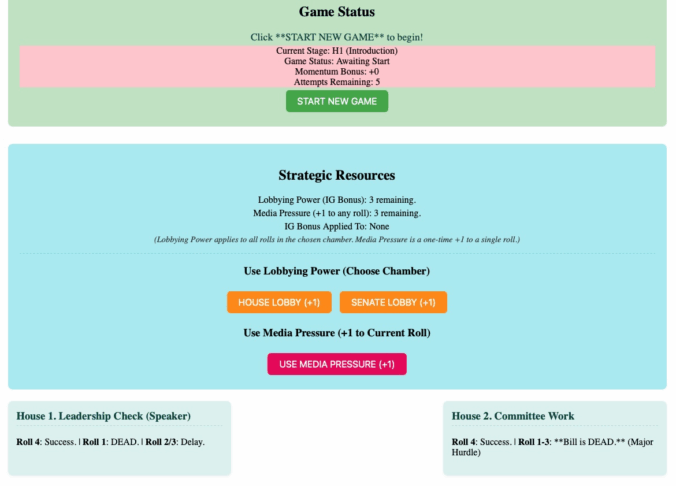
Crisis inspires. It occurred to me that I didn’t really need a board. I could create a web application to simulate the process. Within about an hour, I had a working website that simulated both the US Congress and Texas legislature. Gemini generated HTML, CSS, and Java code to build the site. I was then able to post it onto CodePen to get it working.
The next day in class, I broke the students up into groups and had them attempt to get bills through. The Texas simulation worked beautifully. Some groups spent the equivalent of 50 years in game time struggling to get their bill through the process.
The US simulation was a little too easy and two of the four groups succeeded in getting their bills passed. One of my tasks for today is to adjust the difficulty level by ramping up partisanship. That will be relatively easy.
This is where we need to go in education. Memorizing content has its place, but it should not be the central focus of our activities in the classroom. Computers will always beat us when it comes to information retrieval. Where they can’t match us is in interpreting and applying that information.
Teaching must reflect that reality. Focusing on information retrieval does a disservice to our students who are going to be forced to compete with AIs optimized for information retrieval.
At the same time, I’ve always argued that technology is fundamentally democratizing. Its diffusion through the personal computer and, more recently, large language model chat bots has opened new opportunities for humans to think. When you put powerful tools into the hands of creative people, you create opportunities for them to grow.
However, I run up against a philosophical challenge. Historically, intellectual elites, whose status often came from their ability to access high-quality education, have dominated creation and discovery. In a world where creation and discovery are minimum qualifications for success, this slice cannot remain at 10%.
We like to think in the United States that we have achieved mass education. We haven’t. We have scaled at the expense of quality and this is the crisis afflicting our institutions today.
I am part of a community of creative and brilliant educators who are constantly pushing the boundaries of what’s possible in the classroom. I also recognize that we are a pretty small group at any institution (maybe 10%). This creates tremendous headwinds for change.
The real question is whether we can lower barriers with technology to overcome those headwinds. Will giving more powerful creation tools release everyone’s natural creativity or will our systems crush it before it has a chance to emerge? Are our students capable of engaging in that advanced thinking after being subject to a system of education that has never valued it?
I continue to be an optimist that AI will open these doors and by making difficult tasks easier, creating opportunities for us to do ever more fulfilling tasks. I saw a brief spark in my class yesterday as they struggled with an activity that forced them to think critically about a problem they needed to solve.
Without AI, the experience would not have been as rich for them. Let’s just hope it’s enough to set them down a path toward thinking for themselves.