For newcomers then the purpose is not to learn from talk as a substitute for legitimate peripheral participation; it is to learn to talk as a key to legitimate peripheral participation. – Jean Lavé and Etienne Wenger, 1992
Having to express an idea clarifies for learners what they do not fully understand, especially if their interlocutor is prepared to argue and question. – Diana Laurillard, 2002
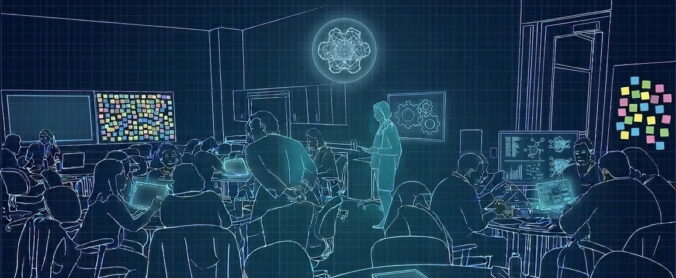
Learning is a conversation. Large language models are dialogue machines. We can dialogue with them about the design of our classes. Our students must dialogue with them as part of their learning. Our “AI-challenges” are rhetorical challenges, not technological ones.
Whether or not a technology is useful doesn’t come down to how good the teacher is at using technology. It turns on whether the teacher was able to use it to stimulate human dialogue with and among their students.
Good technologies facilitate conversation. Bad ones retard it.
Not All Technologies Facilitate Conversation
Modern education has always been technologically-based. Essays, blackboards, blue books, and classrooms themselves are all technologies. We just don’t recognize them as such because they seem “normal” to us.
Over the last 30-40 years, education has been buffeted by waves of technology, from the CD-ROM to Web 3.0. Many of those degraded conversation because they ignored pedagogy in favor of dreams of efficiency. Artificial Intelligence seems like another in the same litany of complex technologies that further isolate student conversations.
AI’s negative uses have been to try to automate the existing assembly-line methods of instruction, like automated grading or assignment creation. These seem like, at best, another attempt to make learning more efficient at the expense of authentic conversations. At worst, it’s an excuse to replace teachers.
AI is Different Because it Surfaces Tasks
AI is different because it does one thing better than any other computing technology: it lowers, and even eliminates, technical barriers to tasks. No longer do you need to know how to use Illustrator to create graphics. You don’t have to know how to code to create applications.
AI reverses teaching’s recent relationship with technologies. The task can drive the technology, not the other way around.
As you can see from the earlier blogs in this series, I have used AI to reinvent and deepen the quality of my courses. I have used it to synthesize the best of the pedagogical literature and to think deeply about the impact of my assignments on student learning.
I don’t have to be a programmer or a master of complex software systems to achieve these goals. I just have to be a good thinker and questioner.
This lesson should be extended to our students. We must teach our students to be good thinkers and questioners, not coders for them to remain competitive in the job market.
This means stripping learning down to its studs. AI is a humanities problem, not a technical one.
The humanities teach us to be better pedagogues. That makes us better prepared to teach humanity to our students.
We can either teach conformity or creativity. AIs reduce everything to a norm. If your class is normative, it can be defeated by an AI. If your class encourages human flourishing, it cannot.
The same goes for your class design. If you reduce your class to mechanical functions, you can be replaced. If you make it more human, then it will be evergreen. Learning is forever. Education is not.
My new/old approach to pedagogy was designed in conversation with texts on learning, not technology. It is not based on organizational logic. It is based on surfacing their humanity. If we surface the human, we will teach them how to surface themselves in a world where authenticity and humanity matter more, not less.
Strategy 1: Focus on Processes for Thinking
Our first goal in human learning is to develop processes for thinking. Disorganized, or sloppy, thinking undermines so many projects and products. AI is an efficient “thinker” but in the end, it requires humans to design for humans. Effective design is impossible if humans lack the scaffolding of structured thinking.
Modern education is based on evaluating products. Bowen and Watson, however, note that we need to teach dialogue(Plato would approve) as a mechanism for getting what we need out of our technological systems. This is not a technical exercise; it is a rhetorical one.
- The Old Way: “Write a 5-page essay on Hamlet.” (AI gets an A).
- The AI-Proof Way: “Have a conversation with ChatGPT about Hamlet. Argue that Hamlet was actually the villain. Submit the transcript of your debate and a 1-page reflection on where the AI beat you.”
We need to stop grading the essay (which is now a commodity). We should be assessing the student’s ability to steerand critique an intelligence.
Strategy 2: Use AI to Focus on Learning, not Education
We must teach our students to leverage AI tools. Banning them is counter-productive. Instead, we must use AI to teach higher level thinking skills. Bowen and Watson argue for the idea of treating AI as a “Naive intern.”
Ask the language model to generate content. It’s good at that. The student’s job is to evaluate that content. Have them generate an AI answer to your assignment. Then, their job is to vet whether that response meets all of the requirements.
Effective critiques require a deep understanding of the subject. The AI can provide a superficial (or seemingly deep) response. Even if it is substantially correct, it is still subject to confirmation and bias checks.
This shifts the cognitive load from Task Execution (writing words) to Task Stewardship (verifying truth). You don’t need to understand the code behind the bot (or even model weighting) to be able to do this. You just have to ask good questions.
Strategy 3: Reintroduce the Human Premium
Even before AI, I struggled to get my students to connect meaning with what they were doing. They operated as the cogs in the educational machine that they were. Anything that humanized that was, at best, at distraction.
However, humanity is the thing that separates us from the machines. Agentic AIs like the recent Einstein agent, exploit this mechanistic structure of education. If the class is a checking-the-box exercise, an agent can take it for them.
In the workforce, as Emad Mostaque pointed out in a recent interview, if your job is to be a machine, you will be replaced. Most office jobs are mechanical and require relatively little creativity on a day-to-day basis. Humans are expensive, especially when you can “replace” them with a bot that costs a couple hundred dollars a year.
It is our humanity that will save us from this fate. Therefore, we need to stress human connection as central to our pedagogy. In my classes, the Gold level reintroduces the “human premium.” To get to this level (equivalent to a “B”), they must relate human issues directly to the more abstract debates that dominate our political discourse.
Machines cannot replicate their lived experience, much less the combined lived experience of a group of students. This is why the insights of Lavé and Wenger’s Situated Learning and Diana Laurillard’s “Conversational Spaces” are so powerful and even more relevant in an AI-driven world.
This World is More Human
One of the things I’ve experienced as a teacher is that, by offloading so much of the logistical load of running a class, I have that much more time to focus on the human element of teaching. The conversations I’m having with my students are deeper and more meaningful than ever.
These are the things that matter in teaching. I have only given up the things that frustrate me: the assessment gaps, the lesson planning, the assignment programming, etc.
Instead, I’m digging back into pedagogical roots stretching back to Socrates. I have created a “cheat sheet” to get you started on that journey. Also, use the OER Pedagogical library I’ve assembled in NotebookLM. Even better, make your own.
AI makes so much more possible. We can reinvent the world through dialogue, not code. We just need to dig the score sheet out of our dusty pedagogical cupboards.
Our job is to be conductors of learning. I can’t wait to hear what beautiful music our students will create with their new AI-powered instruments. We just have to teach them how to make their own music.
- Building New Learning (Part 4 of 5): Navigating Conflicting Currents (March 6, 2026)
- Building New Learning (Part 3 of 5): Teaching Augmented Humanity (February 24, 2026)
- Building New Learning (Part 2 of 5): Beyond the Mimicry Trap (February 16, 2026)
- Building New Learning Part 1 (of 5): Why I Blew Up My Class (February 10, 2026)