Originally Posted February 29, 2024
This semester, I am once again struggling with the demons of conformity in our educational systems. We like to tout how education encourages creativity and critical thinking. Those students who rise above its deadening mechanics of grades and bounded knowledge are often lauded as its stars. Yet most of them have learned the lessons of conformity that the system teaches. This puts them at a severe disadvantage in a world where AI is increasingly good at meeting conformist expectations.
In my design-based government classes, I have always worked to give my students the tools to design processes to understand, explain, and creatively approach the government process. This bewilders many of them.
I had one student complain about me last year because I didn’t give her precise rails to follow for every assignment. She wanted me to give her a problem with a single solution, explain the solution, and grade how well she conformed to my expectations.
She didn’t like it when I asked her to investigate and create her own problem, find approaches to it, and design creative approaches to implement those approaches. In short, she wanted me to treat her like a Generative AI.
Many of my students struggle with the idea that they must understand a societal problem before they can dictate “solutions” to that problem (as do many of our politicians). Students are used to being given a problem and graded on how well they conform to the proscribed solution. The real world doesn’t work that way.
Grades are also a mechanism for conformity. For them to work, you must define “A” work and they have to conform to those expectations. This often leads to “minimum necessary” approaches to the work and what I refer to as “transactional teaching.” You do a trick and I pay you for it with a grade.
This year, for the first time, I’m teaching a creative topic, photography. I am teaching it at a “college prep” school with a huge emphasis on “making the grade” so that you can get into competitive colleges.
There is a chunk of my students who yearn to break from these shackles, but many of them are marking time for their other classes. I must grade in this class as well, but I’ve very much approached it as completion grades, like I do in my government classes: You do the task and meet the minimum requirements and you get the points.
The problem is that in a creative endeavor, minimum necessary almost always leads to mediocre results. Every student in my class can make extraordinary images. They all have at least one quality image in their portfolios, but they don’t stretch their vision consistently.
Good photography requires that you slow down and contemplate what you are doing. I have tried many tricks this year to get them to do just that, like breaking assignments into two parts with a requirement that they go back and reshoot the subject after a critiquing session.
However, they often lump both halves together, defeating the purpose. My only recourse is to be punitive with grades to force them to follow the system.
Relying on grades for compliance undermines my goal of getting them to slow down and think about what they are doing as they contemplate a scene. Like the government student, they’re just “fetching” images like Dall-e and Mid-journey most of the time.
The emergence of generative AI elicited a negative reaction from the artistic community. There were fears it would create and pass off its creations as “human” and that it was getting its creative inputs from human creations without respecting copyright or creative licensing.
This misses the point. All artists steal other artists’ work. AI replicates this part of the process pretty well. What it doesn’t replicate well is the value added by adding human creativity to that theft. Sure, it can replace artists, but those who have the most to fear are those that create art that is easily replicated.
The dirty little secret of the art world is that the industrial processes that have taken it over demand a level of conformity to maximize art’s profit potential. There are also a lot of low-level artists that survive on churning out content based on artistic techniques that have lost their creative roots, but they must do this to make money in the system.
Current Generative AIs can replicate many of those derivative techniques because they require little creative thought, just rote repetition. The sudden proliferation of AI-generated images on YouTube and elsewhere is one demonstration of that.
Generative AI, however, is not creative. Sure, it can “create” a level of novelty. Sometimes that novelty can be truly Daliesque. However, the root of AI images is always the of the prompt created by a human. Bad prompts accepted without a critical eye make for bad images, even in generative AI.
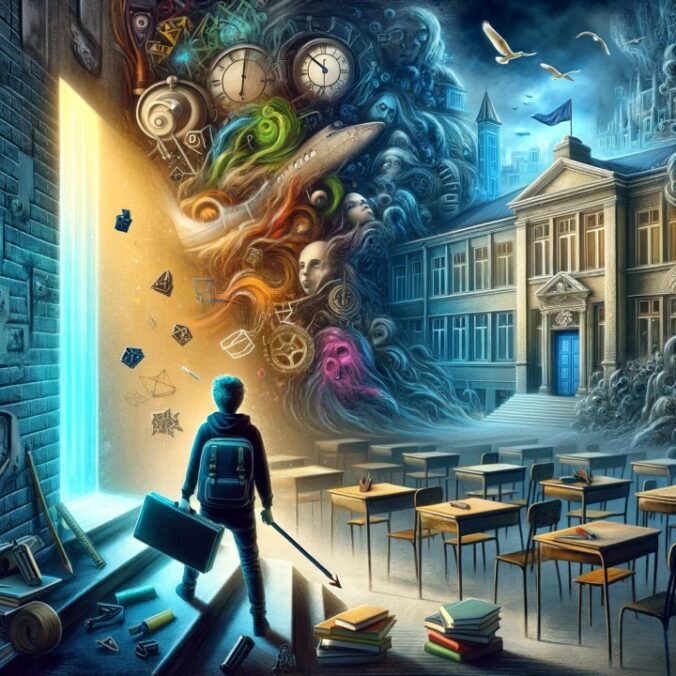
For the header image of this blog, I asked it to create me an image of a “student torn between creativity and conformity in their learning.” Then, I asked it to change the image to “add to it the element of a school pushing him toward conformity.”
My prompts required a level of creative thinking. They also required me to define a problem set I wanted illustrated and to look critically at the image that it generated.
As I have played with Dall-e over the last few months, one thing I’ve discovered is that it illustrates abstract concepts remarkably well. As in my photography, I have many ideas in my head struggling to get out, but I struggle to execute them so that they resonate with others.
Text is a complicated business (I’ve found ChatGPT helpful there as well) and images require a high degree of technical proficiency (and time) to create. For over a decade, I’ve used concept mapping software as simple (and collaborative) illustration tools. However, even with these powerful tools, it’s still a lot of work to express complex sets of ideas.
AI can be a tremendous partner to help humans create and analyze complex ideas. The jobs it replaces are those that emphasize conformity.
All my students will need to think creatively as they interact with AI going into the future. I can manufacture conformity using AI tools with ease, but for AI to augment what I’m doing, I need to approach it with refined creativity and critical thinking skills.
Conformity was a trait valued in the Industrial Age, so we designed our systems of education to meet that need. There are many studies that show how educational processes drum creativity out of our students. By the time they get to me in college and high school, they are very resistant to exploring ideas creatively. My students seek answers, not questions.
It is imperative that we identify why this happens and transform the philosophical underpinning of what we’re doing in education. AI will punish conformity and reward creativity. If we don’t stop churning out conformists, we are doing our students a tremendous disservice.