“It’s the questions we can’t answer that teach us the most. They teach us how to think. If you give a man an answer, all he gains is a little fact. But give him a question and he’ll look for his own answers.” – Patrick Rothfuss
The Currency of Compliance
If questions teach us how to think, our current grading system does the opposite: it pays students to stop wondering. Wondering is at a premium in a world where AI does so much of the thinking for us.
Grades are the greatest frustration I suffer as a teacher. They kill wonder. They reduce learning to an endless conveyor belt of frustration and stress for the students.
In Learn at Your Own Risk, I call this frustration “transactional teaching.” You give me work and I give you a token grade. You can take these tokens to your certification bank.
This would make sense if grades reflected the process of learning. Standard grading often falls into the mimicry trap. We mistake a student’s ability to mirror our own voice or the textbook’s structure for actual mastery. In a world where LLMs are the ultimate mimics, mirroring is no longer a high-value skill.
The good students mimic well and are rewarded with gold coins. Those who see this as fool’s gold do the minimum necessary to get by. Those who don’t play by the rules are sent home and forced to repeat the dance.
The key term here is good/bad/indifferent “students.” What they are performing is their capacity to play the role of student, not their real talents. After all, why bother unless it makes your life easier?
This is not learning. This is performance.
Performance vs. Process
Learning is a process, not an event. Deep learning requires process. If you don’t follow it, the actual value the student carries away from the experience is almost zero. The students know this.
By the time they get to me, they’ve been trained for 12 or more years in this game. It has robbed them of the joy of learning and replaced it with the anxiety of pleasing the teacher. I don’t want to be catered to. My joy comes from their growth.
Designing for Flow and Mastery
When I redesigned my course, the two top criteria I gave my AI partner was that I wanted to make sure the course combined Flow and Formative Assessment (and gamification and constructionism). Grading interrupts Flow because students obsess about the (for some impossibly steep) mountain and miss the point of the climb entirely.
Mihalyi Csikszentmihalyi’s Flow approach requires the balancing of challenge and boredom. Tests aren’t challenging, they’re boring. They’re just part of the endless box-checking that education has become.
“As soon as a student gets a grade, the learning stops.” – Dylan Wiliam
Formative assessment requires students to respond to feedback and practice tasks accordingly. As Dylan Wiliam writes, “As soon as a student gets a grade, the learning stops.” Feedback is usually ignored or, at best, used to complain about the assessment already taken. It’s only the next assessment that matters now.
Getting past this “peak and valley” rhythm of the class has always been the chief challenge of my learning design process. Therefore, this was a central focus of my course redesign effort.
I built this through a “leveling up” model based loosely on Scott Nicholson’s article on gamifying his class. In this model, the better learners level up to the harder assignments while those who are struggling more can at least get to the passable assignments.
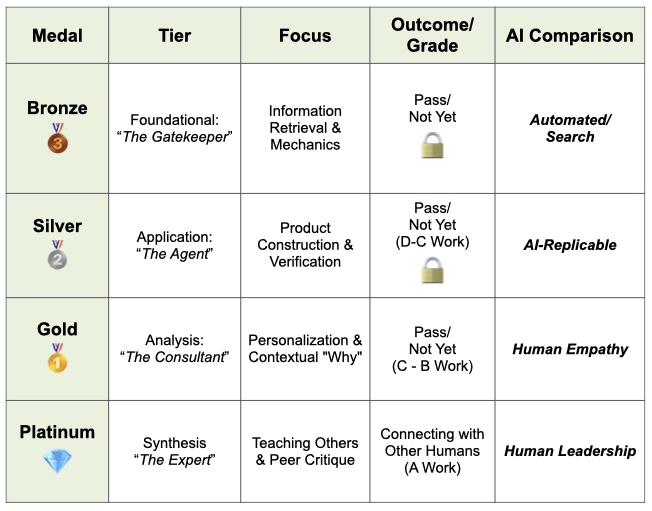
My course uses a modification of the medaling system developed by Scott Nicholson. In my version, there are four medals: Bronze, Silver, Gold, and Platinum.
The Medal System
Silver is the New Floor
The Bronze level is the foundational level. It just means you know how to find the information you need to proceed. The Silver level is the AI-level. What I mean by that is that Silver involves constructing products, it could theoretically be replicated by an AI tool.
The point structure in the class is set up so that if you just do Bronze and Silver, you will get a D in the class. I make it clear to them that this level of work is likely to be replaced by machines in an AI world. This is where most classes end their learning process (and why I’m so fearful about the consequences of that for our students).
Emad Mostaque argues that the value of “cognitive work” rapidly approaches zero in an AI-driven world. AI is good at producing products, but you must make it produce products that reflect your value to set yourself apart from assembly-line thinking. Silver level work operates at this level. This is no longer good enough.
Gold requires a level of personalization. What does this work mean to me, specifically? How does it help me move my goals forward? The AI has no empathy so it can’t do this authentically.
Finally, Platinum is about teaching others. Those of us who teach, know that the best way to learn something is to teach it. This is the A-level of the class.
All these assignments except for Platinum are all-or-not yet. What that means is that, within a certain boundary of time, the students can redo assignments to achieve that plateau. Silver is the minimum necessary to proceed to the higher levels but also the minimum necessary to proceed to the next course section.
I have noticed that a lot of students stalled at Silver in the first module. More, but not all, got to Gold in the second, and only a select few got to Platinum. You cannot get points for higher medals until you’ve done the lower ones.
This is still somewhat a work in progress, but the preliminary (small sample-size alert) results are encouraging. I think it will need to be tweaked a little bit in future iterations in terms of the mechanics of advancing through the levels (Canvas is not my friend here).
I’m also still learning how to teach this way. My feedback is critical to making the system work. After that, I also need to get my students to read the feedback.
This system does at least two things. First, it reinforces the idea of failure leading to iteration, not quitting. This is a radical departure from what they are used to but very much reinforces the modulating nature of Flow as well as the feedback loop required for formative assessment.
Second, once they get used to it, the students see this as an “easy A” (it’s not) because it looks like I’ve made their incentive mountain easy to climb. Gamification requires levels to be difficult but not too difficult, while at the same time keeping you engaged with the game.
From “Spinach” to Significance
This last part is the most difficult to achieve. My students don’t want to play this game in the first place.
Engaging them in something related to the course is like trying to get them excited about a spinach-eating contest. The system has taught them that learning is often unpleasant, especially if it’s a course you must take (mine is required of all students).
This is where connecting their learning to something they care about really matters. By researching a social issue that impacts them directly (and I make them reflect on that early on), they learn that learning and politics are struggles that must be engaged with for there to be any growth toward viable outcomes.
The design process can also be viewed as a game. The core of design is failure and iteration. These are the same mechanics that underlie any successful game. This also forms the basis of my Constructionist activity.
While my system may not be perfect, it’s clearly heading in the right direction. Flow, Formative Assessment, Gamification, and Constructionism teach essential skills necessary to work in tandem with the machines to create better versions of ourselves and our communities. This is how we use AI to become more human, not less. Next time, we will talk about teaching the students to use AI as a partner in the class.
- Building New Learning (Part 5 of 5): Back to Basics (March 11, 2026)
- Building New Learning (Part 4 of 5): Navigating Conflicting Currents (March 6, 2026)
- Building New Learning (Part 3 of 5): Teaching Augmented Humanity (February 24, 2026)
- Building New Learning Part 1 (of 5): Why I Blew Up My Class (February 10, 2026)