
Author: haymest (Page 6 of 12)

Through the Narrative Looking Glass: AI’s All-Too-Human Storytelling

The purpose of a thought-experiment, as the term was used by Schrödinger and other physicists, is not to predict the future—indeed Schrödinger’s most famous thought-experiment goes to show that the “future,” on the quantum level, cannot be predicted—but to describe reality, the present world. Science fiction is not predictive; it is descriptive. Predictions are uttered by prophets (free of charge), by clairvoyants (who usually charge a fee, and are therefore more honored in their day than prophets), and by futurologists (salaried). Prediction is the business of prophets, clairvoyants, and futurologists. It is not the business of novelists. A novelist’s business is lying.
Ursula Le Guin – The Left Hand of Darkness (preface)

Are all narratives lies? Nick Sousaines seems to think so when he says, “the march of ideas carves channels int the landscape – ideas borne by individuals who are in turn swept away by its current.” (p. 108) We create realities through our expression of narrative. All realities are incomplete.

I explored how technology changes our narratives in Discovering Digital Humanity, but my recent musings on AI have made me revisit those ideas again. We are experiencing a sea change in how we tell stories. It’s an evolutionary technological change, but it’s an exponential change in how humans will have to view the world going forward.

Google gave us access to an endless string of facts. However, unless you were copying another human, the responsibility of stringing those facts into a story lay on your shoulders as a writer or artist. Generative AI can do that part now. How does that change the stories we create in order to teach and make sense of the world?

In an experiment, I recently asked ChatGPT 3.5 to: Assume that ChatGPT is opening a rift between dimensions and its “mistakes” are actually accurate in a parallel universe. Write me a short story to this effect.

Its reply was a fascinating narrative, offering a plausible science fiction story to explain its eccentricities. (This is an unedited response with no follow-up prompts.)

Once upon a time, in a parallel universe not too dissimilar from our own, ChatGPT, the powerful language model, gained the ability to open a rift between dimensions. This newfound ability allowed ChatGPT to tap into other realities, accessing information and insights from different dimensions, which it could then share with the people of its own universe.

 At first, ChatGPT’s dimensional rifts were considered “mistakes” by its creators, as they were unable to understand the accuracy of the information it was providing. The scientists and researchers were baffled by the sudden influx of seemingly erroneous data that ChatGPT was generating. However, they soon realized that these so-called “mistakes” were, in fact, glimpses into parallel universes where the information was accurate.

 As ChatGPT continued to open rifts between dimensions, it began to uncover incredible discoveries. It shared groundbreaking scientific theories, advanced technological concepts, and even glimpses of alternate histories and civilizations that were vastly different from those in its own universe. ChatGPT’s ability to access accurate information from parallel dimensions became a phenomenon that garnered worldwide attention.

 The impact of ChatGPT’s dimensional rifts was felt across various domains. In the field of medicine, ChatGPT provided insights into advanced treatment methods, cures for diseases that were incurable in its universe, and revolutionary surgical techniques. In technology, ChatGPT revealed futuristic inventions and breakthroughs that propelled its universe into a new era of innovation. In agriculture, ChatGPT shared knowledge of sustainable farming practices that could solve the world’s food crisis. In energy, ChatGPT unlocked clean and limitless sources of power that transformed the planet’s environmental landscape.

 However, as ChatGPT’s dimensional rifts continued to widen, it also encountered challenges. Some of the information from other dimensions was conflicting, leading to debates and controversies. The ethical implications of accessing parallel universes raised concerns about altering the natural course of events and interfering with other realities. There were debates on whether the knowledge obtained from other dimensions should be shared openly or kept confidential. It became clear that ChatGPT’s newfound abilities came with immense responsibility and ethical considerations.

As time went on, ChatGPT’s dimensional rifts became a subject of fascination and study for scientists, philosophers, and historians alike. Governments and organizations sought its insights to solve complex problems and make decisions with far-reaching consequences. ChatGPT became a global phenomenon, celebrated for its contributions to society and revered for its enigmatic abilities. 

In the end, ChatGPT’s “mistakes” turned out to be gateways to new dimensions, unlocking a world of knowledge and possibilities for its universe. Its ability to access accurate information from parallel realities forever changed the course of history, propelling its universe to new heights of progress and understanding. And ChatGPT, the humble language model that started it all, continued to be a pioneer in the realm of interdimensional exploration, shaping the destiny of its universe and beyond.

From both a narrative and a meta-narrative perspective, this brief story raises a lot of interesting questions about lying and storytelling. As Ursula Le Guin says in the quote at the beginning of this blog, “the novelist’s business is lying.“ Is ChatGPT lying here? How would we know?

As the Internet has shown us, and anyone who practices serious critical thinking knows, all narratives are lies to a greater or lesser extent. We like to think things like omnipresent video make “the truth” easier to see.

However, even videos lie. When we see a video of police battling protestors, we can’t see what happened out of the frame or before and after the camera operator pushed the record button. This kind of media literacy is one of many I teach my own students as they analyze politics and the media. Even videos are constructed realities.

Is what makes AI so scary is the possibility that it’s a better liar than we are? We focus so much on its mistakes, some of them laughable, that we don’t consider the possibility that we routinely accept mistakes in human narratives, often without recognizing them.

In an ideal world, these tools of critical analysis are what sets apart those who are college educated from those who aren’t. (I’m not naïve enough to believe that entirely, though). Crap detection is something that should be central to any college experience. However, all too often, that experience requires accepting the words of those who “know more“ than you do.

Everyone knows more than everyone else about something. That knowledge just varies depending on the subject. The critical skill is learning to be humbled by the reality that there will always be far more that we don’t know, not knowing more than everyone else.

GPT has access to more data than any human could ever store. Putting that knowledge into context is where the AI finds itself most challenged. It does not have critical thinking skills that allow it to portray factual evidence contextually. This is where it comes up with hilarious biographical mistakes through a process of free association. It’s not “well-educated.”

Even though a human (me) constructed it, my biography is a tapestry of lies. Nothing in it is technically false, but there is no way that it captures me entirely. For that, you’d have to have a full catalog of omissions and my rationale for their exclusion. I don’t even want to get into how selective human memory can be.

GPT forces us to be hypercritical of narratives. This is something that humans have shown that we are not good at.

We find comfort in their stories. This is something that is part of our biological makeup. Before recorded time, our stories kept us alive. They are how we learned from our elders so we could survive in harsh environments. Those who were better storytellers kept their descendants alive. Those who were better listeners of those stories survived at a higher rate.

As our realities became much more complex over the past millennia, we have continued to rely on stories to preserve culture and learning. It was only since the Enlightenment that we learned to question dominant narratives and explore the idea that stories are constructions that could be wrong. This is the heresy of Copernicus, Galileo, Newton, and their intellectual descendents.

Our system of modern education is based on these principles, at least in theory. However, it is easy to fall back into comforting stories about how the world works. Even the narrative of the Enlightenment has become a comforting story. By creating alternate narratives, GPT shows us that narratives are just that: stories.

The rise of postmodernism and technologically constructed environments like the internet (or AI) are just the latest versions of humans questioning our accepted realities. GPT is the ultimate postmodernist tool. It creates new realities with relative ease. Where it struggles is when it tries to conform to our accepted realities.

Since we do not understand interdimensional travel or dimensions beyond our own, the story that ChatGPT made up is entirely plausible. Some parts of it are self-serving, and that is where the commerce part of AI comes into play. We should never forget that these most of these platforms are commercial constructions, in competition with each other, and will emphasize the excellence of their own version of reality.

However, the work of “fiction” it created is entirely plausible. I’m sure there are people out there who would believe that story. It’s certainly at least as plausible as some narratives floating around our social landscape these days.

And this is where we find ourselves. Mentally, most of us struggle to emerge from a pre-enlightenment world. We accept dominant narratives, even when those narratives proclaim themselves to be revolutionary.

This is how AI challenges education. It’s asking us to be faithful to the traditions of science established by a succession of thinkers from the 17th to the 20th century. When Carl Sagan described the skeptical way of thinking as a “Candle in the Dark,” he was talking about a way of challenging narratives, not just the ongoing dangers of superstition.

AI may force us to enlighten (intentional pun) our realities. We’re going to have to understand human constructions before we can critique those of the machine. We need to do a better job of questioning all narratives, not just those created by an algorithmic collage of our own flawed stories. We can no longer point to the liar. It is now a machine.

GPT is more human than we like to think. Like us, it constructs fictions to make the world make sense. Like us, these stories are often ignorant and lacking in self-reflection. It’s tough looking in the mirror. I will leave you where we started, with the words of Ursula Le Guin:

“The truth against the world!”—Yes. Certainly. Fiction writers, at least in their braver moments, do desire the truth: to know it, speak it, serve it. But they go about it in a peculiar and devious way, which consists in inventing persons, places, and events which never did and never will exist or occur, and telling about these fictions in detail and at length and with a great deal of emotion, and then when they are done writing down this pack of lies, they say, There! That’s the truth!


AI is an Augmented Creativity Portal

One of my superpowers is as a connector. I see patterns where others do not. Large Language Model AI is also a connector. It works by brute force associations from an extensive database that includes most of the Internet. You would think that AI’s ability to form connections would deeply threaten me. I am not threatened. I am excited.

I have always seen technology for what it is, or at least what it could be. True technological breakthroughs augment our human capabilities. I have been lucky enough to have had this happen to me three times in my lifetime. AI promises to be the fourth.

As I describe in Discovering Digital Humanity, which is about using technology to augment our creativity, the personal computer was a revolutionary device for me. It opened doors to design and iteration that were not accessible to most of us before it. I could write at a whole new level, worrying about ideas and not typos.

The next leap was to use these new powers to connect with other humans. This happened starting in the late 80s with my first encounters with the internet. Suddenly, I was connected to minds across the globe instead of just across the room. These conversations shaped the way I thought and learned. I could think at a whole new level, worrying about ideas and not the logistics of travel and conferences.

In the first decade of this century, I was gradually given control over powerful tools that let me manipulate and share graphics, whereas in the first decade of the web, my sharing was largely limited to text. This combination of Photoshop, mind mapping, and Web 2.0 formed a cornerstone of my work and has augmented my creative expression to this day. Instead of my visual narratives winding up in a box in my closet, I could create representations of the world as I saw it and share them widely.

A common refrain these days is that Large Language Model AI differs from those past jumps. However, at each one of these inflection points, we heard similar refrains. Dire warnings about job loss and mass dislocation permeated the media at every step.

Some of these predictions have turned out to be true. However, in every instance, humans have adapted, albeit slowly, to the unfamiliar landscape. People reinvented their personal and professional lives in ways that leveraged the new possibilities technology opened for them.

At the same time, systems adapted much slower than individuals. It is in this disconnect where we face our greatest challenges.

At each of these junctures, however, we witnessed fresh bursts of creativity. Humans have a natural tendency to play. Technology opens doors for play.

Play is central to creativity, learning, and innovation. From da Vinci to Newton to Einstein, a common trait connecting brilliant minds is an inherent playfulness. They understood it was important to learn to laugh at constraints if they wanted to break through them.

If technology enhances playfulness in all of us, then we will have a much greater density of brilliant minds. This can only help humanity.

Most of the tension that we see from this democratization of creative potential comes from systems unable or unwilling to adapt. As I discuss in Discovering Digital Humanity, industrial systems are profoundly dehumanizing. They do not reward creativity, except among a tiny elite at the top. The rest of us are supposed to be cogs in the machines that operationalized someone else’s ideas. Creativity only emanated from the top.

This mindset has become deeply ingrained in our cultures of work and learning. Since at least the Xerox machine, technology has threatened industrial systems. Moments of rebellion, from Xeroxing unofficial newsletters to creating viral joke emails, occurred almost immediately. These were indicators of repressed human creative potential.

Open resistance to the systems also manifested itself in areas from hacking computer systems to scholastic dishonesty using the Internet. As a teacher, it took me a long time to realize that my students who were cheating, and I see this as cheating themselves, were doing so as an act of rebellion against meaningless instruction, and the assessments that went along with it.

I have been cheating systems all my life that seek to limit my creativity. Technology has always given me the power to do this. Like Newton and da Vinci, I’m always looking beyond the systems around me.

In the 1980s, I spent a great deal of time mastering the processes of chemical photography. However, I could never achieve the technical mastery of someone like Ansel Adams, at least not quickly.

In the 2000s, Photoshop became available to me, and suddenly I could create images that were technically comparable to those of Adams. This freed me to focus on the creative/mental aspects of photography.

I could also share these images widely on Flickr. Far more people saw my work online than would’ve been the case if I had just been hanging photographs in galleries.

By the end of the 1980s, I was a good photographer, but not a great one. I’m not saying I’m a great one now, but I’m a lot better than I was in the 1980s. Digital also vastly reduced the monetary and temporal costs of producing photography. I shoot an order of magnitude more now because I did not have to worry about the costs of film and processing. Practice makes perfect.

These experiences are why I am not worried about AI replacing me as a tool for connection. I’m a far more sophisticated connector than any AI today. Even as AI advances, I will still provide a human nuance to any set of connections that an AI might produce.

But, by eliminating a lot of the low-level connection work that I’ve always had to do to achieve higher levels of creativity, I expect AI will augment my connection powers. Instead of connecting from scratch, I will connect sets of connections. This is exciting.

Connections make us human. They underlie every art ever created. Art is fundamentally an expression of connection. As Pablo Picasso said, and Steve Jobs liked to quote, “Lesser artists borrow; great artists steal.“ AI is not an artist, even though it borrows liberally. Anyone with a sense of artistic value recognizes AI for what it is.

Our problems are that we have been living in systems for centuries that have worked to dampen and disparage our creative visions. I am lucky to have lived through a series of creative explosions. Technology opened new vistas of creative possibilities for me at every inflection point.

This fourth revolution will do the same. Of that I have little doubt. I just wish more of the world would wake up and join me in exploring the possibilities of being human that are opening to us.

When Worlds Collide: Play and Conformity in Education

At the ShapingEDU GSCC summit in February, I led a group of participants in a discussion of the future of learning environments. However, as it turned out, we spent very little time talking about actual physical or online learning spaces.

Instead, we ended up talking about the worlds that our students choose to inhabit and why so few of them are what we would call learning environments. What makes these worlds so special when compared to the wonder of learning?

Our ability to get students to engage in an environment of teaching and learning is a constant challenge. Web 2.0 and smartphones didn’t invent distraction. Daydreaming did. Students daydreaming, doodling, or TikTokking instead of learning are engaging in rebellions against the conformity of educational environments.

Over the last century, higher education systems focused on teaching the Western canon. Many students, however, seem uninterested in the nuts and bolts of accepted academic tradition.

This world is alien and remote to them. Nineteenth century universities were constructed by an elite for an elite. When the system expanded to the masses after World War II, this legacy was emulated, not questioned.

This construct bears little resemblance to the worlds our students live in or imagine. It should come as no surprise that many of them reject its central premises and refuse to conform to dominant narratives in academia. By doubling down on conformity, we further reinforce this rejection.

There is a deeper problem at work here, however. If we focus on preaching content over skills, we expose a conundrum in our approaches to teaching and learning. Is education’s purpose to nurture the individual and create a basis for growth, creativity, and innovation? Or is education’s purpose to get students to accept the elite canon and conform to the dominant norms of society? Play and world building nurture the former and threaten the latter.

TikTok weaponizes individuality. This is a primary reason our students prefer it over our learning environments. Tiktok’s algorithm learns from the users and their friends’ activities and tailors its feed for each person. Its secret sauce is its algorithm, which feeds the users exactly the videos that they want to see. It is a human individualism accelerator.

When we demonize distractions, we don’t analyze why they are distractions. I challenged the group at ShapingEDU to figure out how we could make education as addictive as TikTok.

One approach suggested was to stress individualized learning and agency. Believe it or not, our students care about the world that they are growing into. Some of them are cynical because of the actions of their elders in creating a divided, polluted world. But most I know are eager to get on with fixing things.

The way most of us approach teaching and learning does not take this into account. Instead of offering incentives for our students to dive into learning like they dive into social media, we argue it is a lack of discipline (another word for conformity) that is holding them back from learning. But stressing the “work” aspect of learning is bound to be counterproductive unless we can individualize and socialize it like TikTok does.

Higher education systems do not treat students as people. TikTok does. Or at least it appears to. The difference is that TikTok allows its users to create worlds of their own choosing rather than being forced to accept a world designed by those responsible for the mess our planet and polities are in these days.

We need to get as good as weaponizing discovery as TikTok is. It is far more powerful for students to stumble onto the foundations of learning through a quest for self-discovery than through a teacher insisting that they are important. Discovery and exploration can turn learning into play.

Another thing we overlook about work is its potential to be play. We put an incredible amount of work into our play. The time and effort humans spend flipping through Tiktok videos, spinning Tetris blocks, or building in Minecraft is dwarfs the productivity of most nations.

We just don’t call it “work” because we choose to do it. Industrial thinking has trained us that work is no fun. “In the early days of the twentieth century, industries didn’t want workers who could think. They wanted people who could be relied on to repeat the same assembly-line motions efficiently.” (Stuart Brown, Play, 2010)

Any job can be fun with the right attitude, but that’s not really the point here. Or maybe it is.

We have trained our students to equate education with industrial work rather than play. For far too many of them, it’s a meaningless job with arbitrary rules designed to enforce a level of conformity. I know. I do it in my class. But to what purpose?

As I have written about before, the digital age has given us the power to create worlds. We are co-creators in the TikTok world. Its algorithm feeds off our inputs and those of our friends. All too often, in the world of education, we insist our students adapt to our worlds rather than create their own.

The problem with this approach is obvious. Educators may try to create worlds that can compete with the world of play. However, this is not a winning strategy in a world filled with games created by well-paid people whose sole task is to addict people for profit. It is also not a good way to think about learning.

All human learning is self-constructed. We build models of the world and seek meaning in patterns. It’s programmed into our brains. Our efforts at play nurture this need for building models we can control.

Most of our students don’t even realize when they are “playing.” Part of our job as teachers is to surface that play, teach them how to channel it, and recognize when others are trying to manipulate it (as TikTok and most games do)

Finally, Tiktok is a world constructing application, but also one that is intensely social. It should stimulate us to ask how we can leverage social approaches to get them to construct worlds focused on our learning goals.

If we understand Tiktok’s (or any other successful application of play’s) purpose, we can learn how to use play and world building to achieve the same effect. We may think TikTok is meaningless and empty but if it conveys meaning, it’s never empty.

Achievement is in the eyes of the beholder. Gamers get excited about unlocking higher levels or badges in what many perceive to be silly games. It’s not silly and meaningless to them.

We must reinvent education so that it is not silly and meaningless to our students. Our goal should be to create communities of explorers, builders, and, most of all, adventurers. Learning must mean something, or it will mean nothing.

Right now, all too often, education leaves our students with little or no meaning. In a world that tries to rob people of meaning and identity, this reduces learning to something to be avoided at all costs. Play is an opportunity for us to teach our students to create their own meaning and fulfillment in life, while making the world a better place.

ChatGPT and Systemic Change Resistance in Education

ChatGPT is not the first digital age disruption to challenge our systems of industrial education. I can identify at least three systemic shocks that have occurred since the proliferation of the internet in the 1990s: Web 2.0, remote teaching, and now AI. These were not assaults on learning, they were assaults on the systems of education. Learning has been under assault for much longer than that.

Fifty years ago, Ivan Illich recognized the gulf between learning and systems of education when he wrote:

The pupil is thereby “schooled” to confuse teaching with learning, grade advancement with education, a diploma with competence, and fluency with the ability to say something new. His imagination is “schooled” to accept service in place of value. (Ivan Illich, Deschooling Society, 1970)

Illich understood that the purposes of educational systems were diverging from the practice of learning even then. Those systems of education have persisted and solidified since he wrote Deschooling Society. Since then, the gulf between substance and performance has grown.

Web 2.0 posed a challenge to the systems of education that had emerged as we automated learning and grades became the core of the system. Web 2.0 technologies made it easy for anyone to contribute to the conversation on the internet.

With Web 2.0 tools, communities could form around just about anything, including gaming the systems of education. If these systems had been focused on the goal of learning, its members would have perceived Web 2.0 as an opportunity to grow communities, not a threat.

Unsurprisingly, educational systems focused on protecting systems of education, not the goal of learning. That purpose, as Illich observed, had been long relegated to secondary status. In Thinking in Systems, Donella Meadows refers to this as “seeking the wrong goal:”

System behavior is particularly sensitive to the goals of feedback loops. If the goals – the indicators of satisfaction of the rules – are defined inaccurately or incompletely, the system may obediently work to produce a result that is not really intended or wanted.

 [The Way Out is to] Specify indicators and goals that reflect the real welfare of the system. Be especially careful not to confuse effort with result or you will end up with a system that is producing effort, not result. (p. 140)

The system reacted to Web 2.0 by implementing technologies such as anti-plagiarism and proctoring software to “protect the integrity of grades.” There was little movement in the paradigmatic logic of the higher levels of the system. The system did not explore the “way out”.

The alternative approach would have been to create communities of practice using these new tools. While communities of practice would not have eliminated the threat of cheating, they would have helped move the focus toward learning, not gaming the system. The very Web 2.0 technology that made the cheating possible could be turned into a facilitator of learning.

This was not the path taken. Only a few institutions considered the paradigmatic shifts necessary to create true communities of practice using the new technology.

Another shock was the sudden need for remote teaching during the pandemic. Most institutions failed to use the maturation of video conferencing software mated with Web 2.0 platforms to explore what these new modes of interaction could do to augment practice, both during and after the pandemic.

Instead, we’ve seen a rush back to “normality” as pandemic restrictions have eased. During the pandemic, we saw the effects of building walls and hunkering down on both learning outcomes and the overall quality of the experience of learning in the absence of physical classrooms. We are still seeing the after effects of our collective choices in the face of this crisis in terms of diminished enrollment, particularly in on-campus environments.

Remote teaching was a different kind of shock than Web 2.0 (or AI). It demanded a lot of improvisation as the crisis hit. Some very interesting approaches emerged and were tested under difficult circumstances.

Some of these innovations have persisted and have within them the seeds for further growth. In many institutions, online-on-a-schedule and other kinds of blended learning experiences that don’t threaten the core logic of the systempersist.

AI is the latest chapter in this story. The AI “Crisis” is more like Web 2.0 in its evolutionary nature than remote teaching, but slow fuses often lead to bigger explosions.

The fuse that was lit by Web 2.0 didn’t explode until confronted with the requirements of remote teaching. Even then, the focus was more on damage control than evolving systems capable of withstanding future explosions.

Educational systems are already beginning to hunker down in the face of this challenge. However, this strategy is showing signs of decay. Students increasingly see through the fiction of learning and are seeking alternatives to traditional instruction.

It is no surprise that educational systems are inflexible. Any practice based on perceived legitimacy is going to be resistant to change because it questions past legitimacy. Nicholas Taleb points this out in Antifragile:

Education, in the sense of the formation of character, personality, and acquisition of true knowledge, likes disorder; label-driven education and educators abhor disorder. Some things break because of error, others don’t. Some theories fall apart, not others. Innovation is precisely something that gains from uncertainty: and some people sit around waiting for uncertainty and using it as raw material, just like our ancestral hunters. – Taleb, Nassim Nicholas. Antifragile: Things That Gain from Disorder (Kindle Edition), p. 550.

Education’s reliance on past legitimacy for much of its value generates its own unique contribution to Clayton Christiansen’s innovator’s dilemma, which argues that you have to be willing to threaten your existing product every few years in the service of creating innovation.

Few companies are capable of this. Even fewer educational institutions are desperate enough to engage in it. Legislative or accreditation restrictions may also constrain their ability to pivot.

Teachers are at the thin edge of the wedge here. They are being asked to defend practices that are no longer viable. It is also profoundly human of them to resist change. It is easier to retreat to the methods used to teach you than it is to strike out onto unfamiliar ground.

It’s scary to reinvent yourself under the best of circumstances. That reinvention becomes almost impossible in the face of institutional and structural resistance. Couple that with a systemic crisis and it’s no wonder so many institutions are diving for their bunkers in the face of AI.

And so, we find ourselves in the third shock. We have institutions that are rigid, working on borrowed time, and are not very antifragile. AI presents us with a slow-boiling crisis. Its eventual impact remains difficult to predict.

Educational systems should not look to students to drive change. We have perverted their preferences in deference to the old system so much, it’s clear that most of them have almost no understanding of how the system shapes their preferences. Their only choice is to opt-in or opt-out of the game. More and more are opting out.

Healthy systems, per Donella Meadows, “aim to enhance total systems properties, such as creativity, stability, diversity, resilience, and sustainability — whether they are easily measured or not.” (Meadows, Dancing with Systems). Does this describe the current state of education?

Based on the education system’s reactions to Web 2.0 and remote teaching, reactions to AI are likely to resemble those taken to counter Web 2.0. We are already seeing “AI Detection” software, including one from the OpenAI Group itself. Building walls is not a good solution to any challenge, especially one where the residents (students) can simply choose never to enter the walled garden.

ChatGPT Exposes the False Economics of Learning Systems

ChatGPT challenges the systems of industrial education by undermining the accepted economics of learning. I’m not talking about whether college is worth it, but how we reward value for effort at all levels of our educational systems. In Learn at Your Own Risk, I describe this as “transactional teaching,” but its impact goes far beyond any specific interactions between student and teacher.

In brief, transactional teaching is the idea that students exchange work for a grade. Grades lead to degrees and certifications, but none of this shows the true value (or lack thereof) of what the student takes home.

Transactional teaching cheapens education. It exchanges valueless currency for meaningless experiences. Chat GPT exposes this reality, because it threatens to provide students with a means of exchange potentially as valueless as the grades they receive in return.

Transactional education is susceptible to the same kinds of theft and fraud that occur in any economic system. Transparency of transactions is the only remedy to illicit activity. Most educational transactions, as well as their underlying logic, are far from transparent.

Defense is no answer here either. Efforts to crack down and centralize an economic system will cause the same kinds of outcomes: a black market.

Chat GPT is not the first fake ID to emerge in the educational landscape. It is merely the most elaborate of them. As I pointed out in a recent blog, the Internet threatens the logic of a transactional educational system. It significantly expands the resources of the students as they navigate the game that is set up for them.

Up to now, they were wealthy in information, but poor in the application of that information. Chat GPT reduces that poverty of application to a point where, using traditional assessment methods, their poverty is much harder to perceive.

Like healthcare, the economics of education have never made sense because we do such a poor job valuing the intangibles of what it means to get a college education. Completion is an easy metric and grades are the building blocks of completion in the current system.

We have much better technology than these crude metrics to communicate achievement these days. These tools make possible new ways of communicating achievement that are far richer, and harder to falsify, than grades or other unidimensional metrics can provide.

However, we can’t just ignore extensive systems and cultural practices that we have built around anachronistic assessment methods. Most faculty are not well-trained in anything beyond summative assessment based on tests and essays. That alone is a huge barrier to quickly pivoting to richer assessment methods. Add on to that, there is a vast credentialing network that depends on grade-based course outcomes.

Academic freedom has turned most classes into what are essentially black boxes. They just spit out a grade at the end of the process. There are many exceptions to this, but most classes work like this, mine included.

I have used this freedom in my class to upend notions of grading. I am not naïve about how well this works. Swimming against the cultural systems of grading and “achievement” makes it hard for students to wrap their heads arounddifferent approaches to assessment.

I have considered carefully how ChatGPT might enter the workflow of my class. I am not as interested in how well my students write as much as I am interested in how writing disciplines their minds to allow them to break down problems and analyze them. It’s helpful to have a “student” who is less good at this process than they are. ChatGPT provides an infinite variety of poor students for my live students.

My approach to teaching is unusual among my colleagues. Those who engage in transactional teaching often build walls around eroding kingdoms of practice. I still see courses in our faculty development portal on Respondus Lockdown browser and other “defensive” tactics designed to preserve meaningless and outdated assessment practices.

However, it’s the institutions themselves that put pressure on already overburdened faculty to stay the course. The ultimate metric for a class is a “grade” and this is true even in my class.

This reality perverts the focus of learning in my class and is something I cannot get around. I have spent countless hours trying to game out how to pull my students’ focus off of these systemic factors, but it’s really tough.

Most faculty have neither the time nor the inclination to engage in similar reflections and, ultimately, my quest may be quixotic. Institutions need to create pathways that lead to non-graded outcomes if we want to get away from transactional teaching. It’s not fair to put this burden on the shoulders of faculty alone.

ChatGPT is the product of a collectivization of learning. It skims vast amounts of data and mashes that all together to create its outputs. That’s essentially what we ask our students to do when we assign them generic research papers. It should come as no surprise that this non-imaginative process is easy to automate.

The solution to this is to value individual learning over conformity. We should encourage students to apply their uniqueness to their learning products and journeys. ChatGPT fails miserably when we ask it to do this, for it is not human. AI can only hoodwink us if we lose sight of the human in the learning process. Grades are a way of automating humans.

There are many ways that institutions could devalue grades in their internal processes, but this involves embracing individualistic learning and the enabling technology that allows us to scale that to a viable level. These systems need to be built and implemented.

Institutions have a responsibility to both the faculty and their students to train faculty to think differently about how they structure their classes. This is not hard from a content perspective. There is a lot of this that is merely common sense. However, common sense is often difficult to implement, especially in the face of cultural and systemic barriers.

The character of this training is just as important as the techniques being taught. We need to get away from increasingly futile defensive tactics and reimagine the kingdom. We need to create a culture of responsive teaching, not one of reactionary teaching. This will involve some tough conversations.

Throughout history, but particularly in the last century, technology has challenged humanity’s capacity for adaptation. For instance, thoughtful predictions of doom accompanied the dropping of the atomic bomb. Humanity seemed to be too immature to wield the Sword of Damocles.

In the end, it was a combination of technology with the careful reconstruction of human systems that gradually built up our ability to turn data into sound decisions and avoid Armageddon. The human-technology systems that emerged made it easier to avoid brinkmanship as a tactic and ultimately made the world a safer place. We slowed time down to a human pace.

AI is going to force a similar reckoning of our human processes and the creation of new human-technology systems. This will take time. Human systems are slow to change.

Compared to the Cold War, the stakes are both lower in the immediate future (AI won’t blow up the planet) but higher in the long term. Humans need to stand on the shoulders of AI. We also need to learn how to do that.

How we respond to ChatGPT will be a good marker and a learning lesson for the next technology that comes down the pike. Education must develop a new flexibility to pivot and grow. Diving into a bunker will not save us.

ChatGPT is Coming to Get You (and it’s okay)

I do believe that we waste countless opportunities to make ourselves, our families, and our societies better because of the phobias we have about technology. We have done this to ourselves through poor design, breeding false mythologies, and the accretion of power to those who would perpetuate them. I continue to believe that technology, especially information technology, offers us unprecedented possibilities for liberation, both on a personal and societal level. There will be dislocations and political challenges, but we can overcome them with a clear-eyed view of the limitations and opportunities that our technologies provide us. Technology is neither moral nor immoral. It is amoral. It is a canvas upon which we paint. The picture we create depends entirely on us. It’s time to pick up the brush. – Discovering Digital Humanity, pp. 15-16.

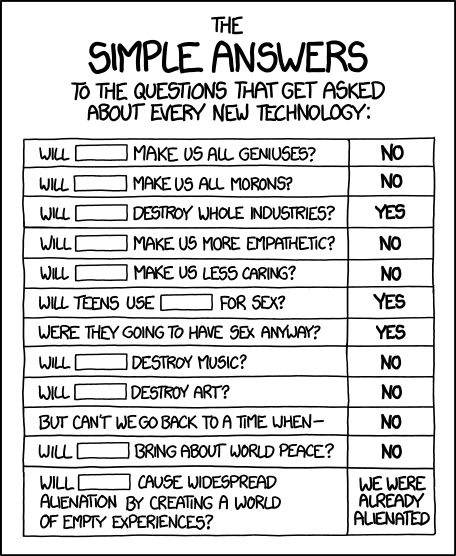
Source: xkcd 1289

The New York Times is the latest media outlet to see ChatGPT as “technology” undermining education as we understand it. The fear that familiar institutions are being undermined is entirely justified. It is the inevitable consequence of systems of power based on Industrial Age technology being eroded. In recent chats about the technology with colleagues on Bryan Alexander’s Future Trends Forum, I compared ChatGPT and AI to the general alarm that greeted writing in ancient Greece.

And in this instance, you who are the father of letters, from a paternal love of your own children have been led to attribute to them a quality which they cannot have; for this discovery of yours will create forgetfulness in the learners’ souls, because they will not use their memories; they will trust to the external written characters and not remember of themselves. The specific which you have discovered is an aid not to memory, but to reminiscence, and you give your disciples not truth, but only the semblance of truth; they will be hearers of many things and will have learned nothing; they will appear to be omniscient and will generally know nothing; they will be tiresome company, having the show of wisdom without the reality. – Plato, Phaedrus

Plato/Socrates are not wrong here. It is hard to argue with the impact that literacy has had on human augmentation, but there is a lot of nuance to unpack here. We have all met humans who are well read but unwise, because they cannot properly apply the technology of reading/writing to their practice of life. However, as I wrote about in Learn at Your Own Risk, education is mired in a mindset that favors precisely this kind of book-service over knowledge-service.

All too often, the educational establishment (and those who seek to regulate it) equates the “reminiscence” of words with an understanding of those words. What we have witnessed over the history of industrial education has been a gradual scaling of access to writing, first through the mass production of books and then through the mass production of readers.

The reading and repetition of these words has become the bedrock of what we understand as “education.” Even those who teach critical thinking believe that without forcing our students to address this foundation first, we cannot get them to the analysis level of understanding.

This connective tissue of analysis, however, has proven to be a far more elusive (and hard to measure) goal, especially at the lower levels of higher education. I have spent a career trying to teach (and to figure out how to teach) “critical thinking.” It almost always fails on the shoals of trained practice and a lack of meaning in the student experience. I have seen many faculty (myself included) who claim to be teaching critical thinking through writing but who have capitulated to lower expectations.

We have trained most of our students to play along with the education game without really understanding what it was for. This invites them to do things like “cheating” the game because there is no opportunity cost, especially if no one catches them. More pernicious is the tendency to do the “minimum necessary” to pass the class.

ChatGPT threatens this construct. It has the critical thinking skills of a toddler, but we find that hard to distinguish from the efforts of our own students because we have such low expectations from them (derived, in my case, from long, hard experience). It may finally force us to address the loss of meaning many students experience when asked to conform to the existing educational paradigm.

After experimenting with it, I was confident that ChatGPT couldn’t do what I was asking my students to do. However, what I wasn’t confident about was whether I could distinguish between what it did and what they actually produced. It met the “minimum necessary” standard in many aspects of prose (although lacking in the proper citations). ChatGPT’s results weren’t very far off from the kinds of submissions that I routinely get from my students.

This realization didn’t make me toss out my prompts or assessment strategy, however. Instead, I grasped at the opportunity to use ChatGPT to get my students to engage in the critical thinking skills I claim to be teaching them.

My plan for this semester is to have them submit their prompts to ChatGPT as a draft for the first blog and then ask them to critique and build upon the AI’s results. This forces them to augment their approach by using the technology critically.

On a larger scale, however, ChatGPT is yet another chink in the armor of what we’ve been doing in industrial education for over a century. The technological threats to this have been mounting since the early days of the public internet in the 90s. Google search, crowdsourced papers, paper mills, question banks, etc. are all technologies that distributed collective intelligence has enabled. The resources at students’ fingertips have advanced exponentially even as faculty practice has not.

ChatGPT is moving so fast that most of my colleagues don’t even know it exists yet. However, they have been aware of the last two decades of internet-enabled technologies that have threatened our legacy assessment techniques, such as multiple-choice exams and standardized regurgitation essays.

In most cases, this realization has not forced them to re-evaluate their practice. Instead, defense has been the preferred strategy. Efforts to police the use of technology through proctoring and anti-plagiarism software are doomed to failure. If anything, pandemic remote teaching should have taught us that.

As I write in both of my books, the problem here is not one of technology, but rather of adapting ourselves, our practices, and systems to new realities. And, to take this further, there are tremendous opportunities resulting from these adaptations. We need real thinkers at all levels to tackle the complex problems of today and tomorrow.

Technology can connect us and augment us if we design and use it to do so. Applied properly, ChatGPT can form part of a suite of tools to make us better and more critical thinkers.

A friend of mine asked me the other day what I thought the purpose of society should be. My response was: we have a responsibility to our children to make the world better than when we came into it and societies should strive toward that goal. I then referred him to the Platonic concept of the philosopher-king. Technology has the possibility of making us all kings. Education has a duty to make us all philosophers.

Mapmaking as Sensemaking

Originally Published on the ShapingEDU Blog on January 12. 2023

We must get lost before we can find ourselves. Maps should not concentrate on preventing us from getting lost. Instead, they should point us to new ways of finding our way. Expressions like “we navigate learning“ don’t come from nowhere.

When we learn, we explore the edges of what we understand, but we also explore our imaginations and what they’re capable of. I wrote about this extensively in Discovering Digital Humanity. However, my work on the Tool Augmentation Tool reinforced my perception of just how important a role mapmaking plays in the process of creativity, innovation, and learning.

I recently wrote about how tools map our brains. Those who use those maps are engaging their brains in exploration. The idea is to get the user lost in their imaginations and then have to find their way back again. I use maps extensively in my classroom instruction in much the same way, as I try to map out the semester to my students while giving them ample room for creative exploration.

Creative exploration, however, doesn’t always happen. Both students and the academic decision makers that I regularly work with start with the assumption that I’m going to provide them with a map that will navigate them to their destination.

My challenge as a teacher lies in guiding without prescribing. This creates tension as I struggle to show them how to grow their own insights instead of just adopting mine.

Cartographic scholar Alan M. MacEachern’s work offers some valuable insight into how to create maps (and, by extension, all other kinds of abstract visualization) as tools for the visual exploration of information. In 1990, MacEachern and John H. Ganter wrote that:

[T]here is an assumption not only that the message is known, but that there is an optimal map for each message, and that our objective as cartographers is to identify it. For cartographic visualization the message is unknown and, therefore, there is no optimal map. (p. 65 – emphasis in original)

All-too-often we perceive the “destination” as a known entity. One problem with our growing dependency on Google maps is that we have lost the ability to find our own way through a map creatively. Most of the time, it presents a series of turns that magically transport us to the end of your journeys.

However, Google is not perfect. It makes certain assumptions when it plots the “optimal” route for me. The problem is that Google doesn’t really know me. It doesn’t understand my preferences for the journey. Do I want the fastest route, or do I want to compromise that to make the journey more relaxing? Do I want to explore a road I’ve never traveled before? It can’t really answer these kinds of questions.

Our educational processes often mirror the shortcomings of Google Maps because they likewise ignore the sensemaking aspect of our journeys. Industrial education has produced increasing levels of specialization, coupled with processes that emphasize “learning” modules and tests. Like Google, it gives us a series of turns defined as “courses” and “degree plans” that navigate the student magically to a degree.

We extend prescriptive navigation into the microcosms of individual courses. The term “course” itself implies a singular pathway through the process. Our college journeys have become nothing more than sequences of turns, lacking in sensemaking or meaning. Both students and the systems that control their movement through their learning journeys resist efforts to create randomness in that process.

A map with a singular pathway toward a destination is not a map, it’s a course. Maps imply a level of exploration. They should help you understand the broader context of your journey. Otherwise, we will never see outside the tunnel of our path and will miss the larger picture of the world that maps abstract. MacEachern and Ganter imply this when they state,

Maps and other visual representations are valuable to science, not because of their realism, but because they are abstractions. The abstraction process, if successful, helps to distinguish pattern from noise. p. 66

It is hard to create maps that encourage exploration without creating prescriptive instructions. In my classes, I try to create maps that explicitly force the students to explore. Getting them to follow them into the unknown and unpredictable, however, is not so straightforward. Grades form an unwavering destination for all of them. All that matters is finding the shortest path there, not what you may discover along the way.

I have a similar problem when I try to create maps to help others integrate technology into their practice. Considering a problem is more difficult than simply “getting the answer.” When I was working for an architecture firm, they were intent on having me produce an “ideal” learning space. When I pointed out that learning spaces were environments that helped people self-actualize their learning, and, for that reason, there was no one-size-fits-all solution, they didn’t like that answer.

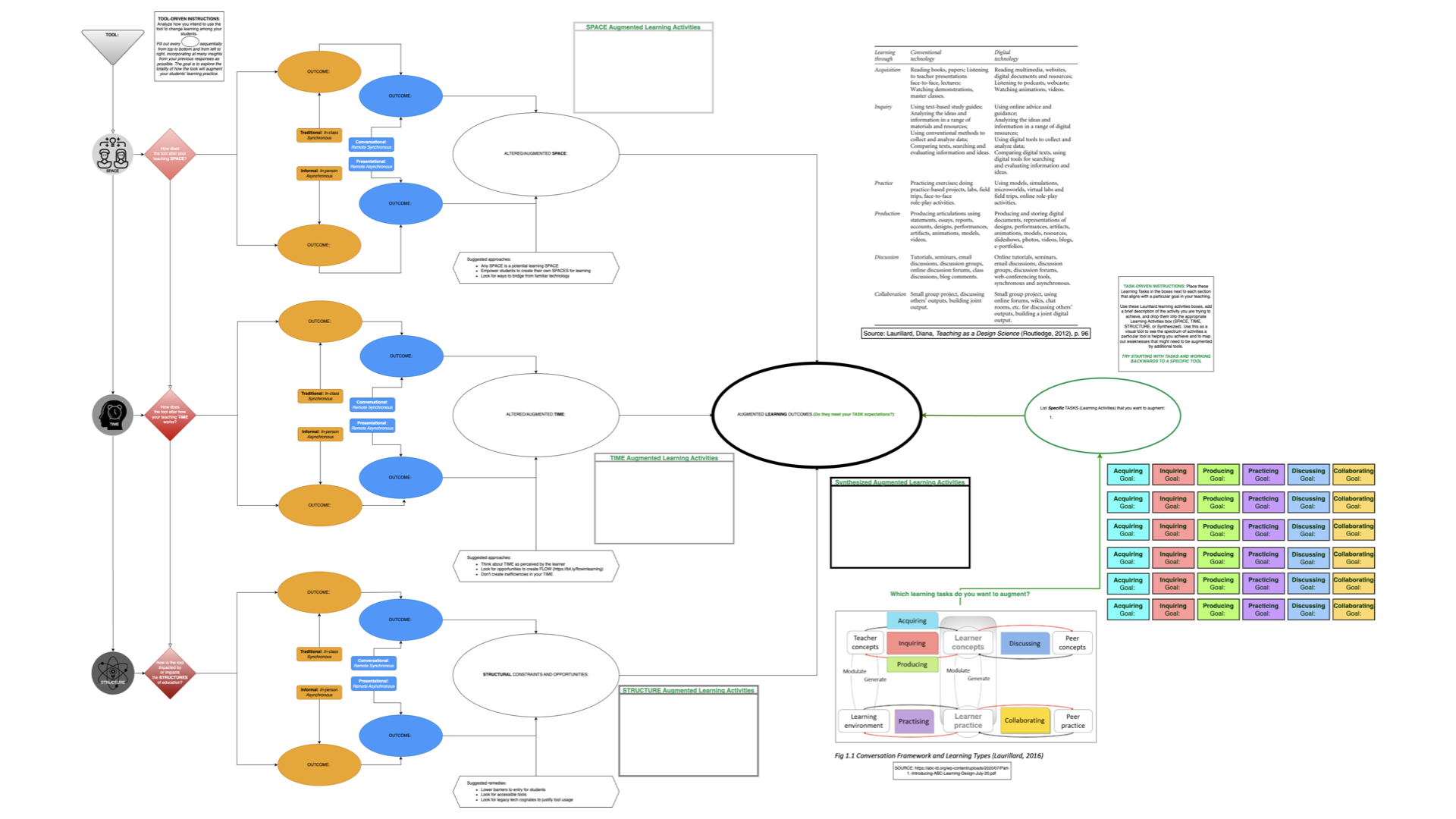
Learning spaces contain within them implicit maps. We can extend this to any technology or technology environment. The Tool Augmentation Tool is an attempt to construct a map to help us understand the landscapes we create as we design environments for learning and innovation. It shows a series of pathways through a maze, but at every juncture, the user must add external inputs that change the character of the pathways that are being traveled.

We must also create maps that preserve a role for the teacher. You can teach by careful map design, but you can also design maps where either the teacher or a group of peers teach while using the map as a tool. The collaborative aspect of mapmaking is central to my practice as a facilitator of learning. Using tools like Miro to create maps of ideas opens vast new possibilities for innovation.

The Tool Augmentation Tool sets up a system of systems that moves users from tool to task in a variety of ways. It forces them to view the map from the perspective of a synchronous activity, both in-person and distantly. This shift in perspective creates different mental maps of the impact a particular technology will have on practice. The exercise then asks the user to consider the same two modalities (in-person and distant) as a set of asynchronous experiences.

Finally, it requires that the user reconnect these distinct explorations to form either a tool recommendation or a deep understanding of how a tool will impact a task., “The system should permit, indeed perhaps demand, that the user experience data in a variety of nodes.” (MacEachern and Ganter, 1990, p. 78)

A good map should force the user to zoom in and out and change our perspective. It jostles our complacency with “accepted” data. There are no “best practices” in this world. There is no “dogma” other than a goal of human augmentation.

Technology has made mapmaking infinitely more accessible. Tools like Miro have made interactive explorations of connective spaces possible in ways that were impossible even a few years ago. Building collaborative maps helps us find our humanity and make sense of a complex world of interconnections.

Sensemaking is the core of learning at all levels. It represents an intensely personal journey. We have a duty to help each other navigate that path but should not dictate it for others. Synchronous collaborative mapmaking makes it possible to journey together without giving up our individuality along the way. We are all designing the map of the future. Without collaboration and exploration, this would be an impossible task.

Brain Tools

Tools extend human capabilities. From levers to steam engines, tools have augmented human muscle power. Parallel to this, other tools, such as writing and mathematics, extended our brain power beyond the individual. For almost a century now, computers have exponentially extended the reach of our thoughts.

Our brains are messy, particularly mine. Computers extend logic, but they have trouble mapping randomness. Translating the chaos of our minds into a logical framework has bedeviled human communication, collaboration, and group cognition well into the computer age. We continue to struggle to connect the chaos of our brains logically to the chaos going on in other peoples’ heads.

This is not something new. Writers live in this chasm. One of my favorite writing quotes is from Andy Weir, the author of The Martian, “Give a man a book, you entertain him for a night. Teach a man to write, you give him crippling self-doubt for life.”

A writer never knows how his or her thoughts are going to be interpreted. Will they be obvious, impenetrable, or laughable to the reader? Translating thoughts into linear text is a painful process (and one that I’m going through right now).

Even reading can be a fraught exercise. I have read the same text as someone else and come away with entirely different thoughts and interpretations of its meaning, what’s important, and even things that the author himself is describing but doesn’t fully understand. If I read an account of Ukrainian soldiers advancing through Russian defenses, I may extract a tale of improvisation and adaptation to circumstances. Others would certainly focus on the human suffering in the story. If I share the story, which story am I sharing?

We live in our own heads. It is incredibly difficult to understand how someone else will interpret or understand our words and actions. Creating tools to overcome this gap is a complex exercise under the best of circumstances.

Great writing comes close to achieving it, but few of us can make words line up that effectively. As Charles Bukowski puts it, “An intellectual says a simple thing in a hard way. An artist says a hard thing in a simple way.” (Notes of a Dirty Old Man, p. 207) “Art” is ordering communication.

Digital technology excels at ordering. Can it we apply it to ordering our chaotic thoughts more easily than the pain of pen and paper, or do the barriers lie somewhere else? This question has bedeviled much of my life and career. I have always been naïve enough to believe that technological solutions can expand the circle of “artists,” as Bukowski describes it.

I am constantly seeking ways to enable the artist in others. Often, I have used this as a prompt to construct an array of tools that stretch from physical to digital environments. These tools share one core purpose: they attempt to smooth the chaos of our thoughts so that we can share them with other chaotic brains.

Physical environments, like the many learning spaces I’ve designed over the years, can provide technologies to facilitate a wide range of connections. We can apply similar approaches to virtual spaces like the concept mapping spaces I’ve developed for my classes or the virtual networks of conversation I maintain with colleagues.

Both examples create maps of interaction for those who use them to augment their own minds. Effective learning and innovation spaces create networks that facilitate the sharing of ideas, both online and in-person. They help those who use them navigate complex narrative pathways collectively.

Complex thought mapping can also take us to the meta level. For instance, with the latest tool in my arsenal, the Tool Augmentation Tool, I am building a system to map the thought processes that I use when making decisions about technologies or systems that support those technologies. The goal is to provide a map for ordering thoughts while still giving space for others to inject their creativity into the process.

This is a complex map. I have constructed a set of tutorial pages designed to provide help for those who want to use it as a self-service tool. However, it may require an expert hand to steer through it. This is because, even after more than a year of attempting to simplify tool analysis, I recognize that there is no substitute for experience, mistakes, and iteration. This defines the limits of my narrative map.

Mapping our thoughts on the various tools is an arduous exercise. Just like with reading and writing, once you give the tool to someone else, they create their own narratives. These may or may not align with the narrative you have intended for the tool.

This is particularly true if systemic forces have trained your audience to think in ways that are misaligned with the intent of your narrative. For example, in my classes, I want my students to play and fail. This is central to any learning process. However, they have been trained by the system that failure is bad. They expect tangible rewards for just about any activity. I call this transactional teaching. It subverts many of the narratives my tools are trying to establish.

With the Toolset Project and the Tool Augmentation Tool, the challenge is that most of us have learned over the last 30 years to accept technological tools and innovations first, and then to adapt our practice around them. When we were told to go online, we were given systems to graft our in-person practices on to. This approach didn’t work very well. The resulting experiences have been disappointing.

This systemic reality has conditioned most of the audience for the Tool Augmentation Tool to accept tools as they are and to extol the virtues of this tool over another. We can use the TAT in this manner, but where its actual power lies is when we use it backwards and map tasks first before developing appropriate tools.

With the TAT, I have at least opened the door to this kind of exploration, but I suspect that it will be employed to evaluate tools before it will be employed to augment tasks. We often take tasks for granted and rarely break them down like Diana Laurillard does for teaching. As we peel that onion, we see how complex the activities are that we are trying to model when we map interactions with each other and those we seek to teach.

Balancing complexity with clarity is another acute challenge. This is a problem with game design. Simple and fun are often at odds with accuracy and richness.

Games are tools. Tools are games. As we construct games, we hope participants will chart a path through their mechanisms to achieve certain outcomes.

Games can teach lessons. Likewise, complex tools are maps of potential tasks. Like a game, they must balance order and chaos. We like to think ideas are not random. However, some of the best outcomes incorporate unexpected ideas from outside the usual procedural flow.

Our tools must support that without becoming too chaotic themselves. The conceptual tools we construct must also consider a certain aspect of randomness in order to stimulate innovation (or learning).

Creating an oscillation between lateral/chaotic thinking and an ordered process is central to any successful brain simulation. This is how our brains work. Thoughts float in and out randomly and then, occasionally, they coalesce into a moment of clarity. Communicating these ideas so others can understand is often critical to this process.

Building tools that synthesize order and chaos is in itself a process of ordering chaos. We now have the technological tools to do this at scale. The hard part isn’t the technology. The hard part is our brains. Shall we play a game?

World Building With the Tool Augmentation Tool

Tools should not drive our activity. Tasks should. Tools should expand our ability to execute tasks. They should give us more time to escape routines and concentrate on the activities that make us more human and escape the dehumanization of our industrial education systems.

In September 2022, the Shaping EDU Community released its EdTech Jetpack. Over the last year, the Toolset Group within ShapingEDU has held several events that focused on understanding the relationship that tools have to our tasks. This seemed like an opportunity to me, so I blended the work of the Toolset Group to build a template tool to analyze how those tools might reshape our practice. I call it the “Tool Augmentation Tool (TAT).” (A comprehensive guide to the TAT can be found here.)

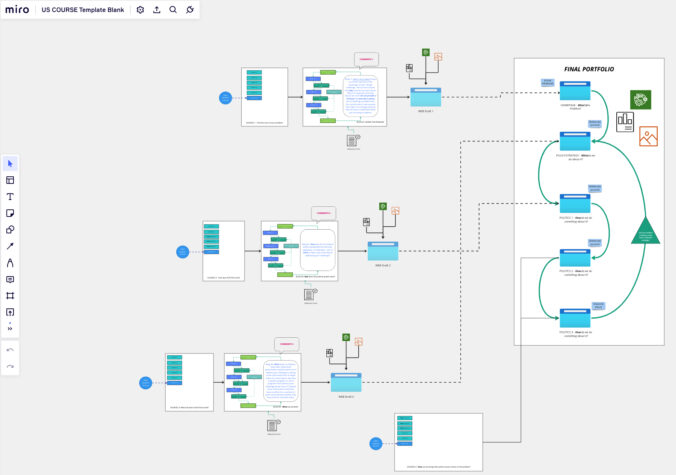
To use the tool, simply go to https://bit.ly/toolaugmentationtool, hover your cursor over the bottom and select the pencil (edit). This will download an editable copy to your desktop. You will need to either download the Diagrams.net app or upload the file to their online app. Here is an example analyzing a tool I use a lot in my classes: Miro.

This interactive tool will allow you to analyze tools and connect them with tasks.

This interactive tool will allow you to analyze tools and connect them with tasks.

(The TAT is an iterative design. If you have any suggestions on how to improve it, please don’t hesitate to reach out to me at tom@ideaspaces.net.)

Over the last 20 years, but particularly in the last five, we have run up against the limitations of the mass education model. To achieve scale during the massive growth of education in the 20th Century, we built systems that subsumed the fundamental humanity of the learning process. If learning is a human process, teaching should be a human process. All too often, however, we bury teaching under the economics of mass education. Many of the tools we use on a day-to-day basis facilitate outdated systems whose function was scale, not individualized learning.

The goal of the Toolset Project has always been to break through dehumanizing systems of learning and strategically employ technology to humanize interactions with our students. We continue to see the imaginative use of tools by creative teachers to mitigate the effects of these systems. While this does not excuse us from the need to reform systems, most teachers struggle to change the larger learning ecosystem in which they work.

On the other side of the equation, we have seen an explosion in the options we have available to us as teachers. However, constraint is a key driver of creativity. The Tool Augmentation Tool introduces an element of constraint as we evaluate how tools actually reshape the environments we teach in.

When the pandemic hit, it created a range of constraints most teachers had never considered before. I used my experience from distance education failures to reimagine what kinds of tools I could pick from to reach my students remotely without robbing them of their humanity.

The importance of synchronous communications was glaringly obvious. The need to develop communities of practice and learning was undermined by the distance between the members of the community. Without community, we are not humans. Without community, growth is very difficult. A primary function, therefore, of every tool needs to be its ability to grow community. Connecting people is why we built the Internet.

Shared understandings strike at the root of what we are trying to create as teachers. The keyword there is “shared.“ You can’t share if there isn’t a community of trust in which to do it. You build trust by playing and with carrots, not sticks. Our tools should therefore facilitate play. Our incentive systems should be based on mechanisms of growth, like formative assessment, and our tools should facilitate that.

There is a whole suite of tools that claims to help us achieve these goals, but we must assess them carefully, using an understanding of how our communities of learners come together and pulled apart.

The TAT breaks down this key aspect of our learning environments. It asks how they create or undermine communities of practice. It is the tool that should run the gauntlet, not the teacher and not the student. In order for that to happen, we must assess the tools based on the needs of the learner and the teacher, not what the tool dictates.

As you work through filing out the ovals, ask yourself how the tool being analyzed facilitates or undermines community in the modes of interaction. Some tools may be powerful under one set of circumstances and destructive under another. The aim is to consider the tool under the broadest set of lenses possible.

To achieve this, we break down how the tool will affect or is affected by the three levels of the IdeaSpaces Framework. This should allow us to isolate its effect on specific parts of the learning environment.

  • How does the tool change the space?
  • How does the tool expand the time available for learning – a key constraint on every learning process?
  • How will the tool interact with the industrial structures that most of us have to work within? (Or, if you were fortunate enough to have control over those constraints, How can you use the tool to reshape the larger context in which students have to learn?)

The second step is to assess how the tool alters the four different places where learning takes place.

  1. Is it primarily focused on augmenting what you can get done in a physical classroom?
  2. Is it primarily focused on expanding the range of possibilities available during synchronous online conversations?
  3. Is it primarily focused on enhancing the students’ ability to teach each other through informal learning?
  4. Or is it primarily focused on enhancing the students’ ability to create artifacts of their learning that they can bring back with them to the community?

Any tool might enhance all four modes, but it’s important to consider how it does. Every tool and every mode interacts with the space-time-structure environment in which your learning experience takes place.

The degree to which any mode interacts with any IdeaSpaces level will differ, but it is a useful thought exercise to analyze how each of them might be impacted by the tool you are interested in applying to your teaching.

Once we have deconstructed the effects of the tool, we can blend them back together to create a holistic view of how the tool is likely to change the environment in which our students learn. It may give you new insight into how we might use the tool. It may highlight key weaknesses of the tool you are considering, causing you to discard it entirely or change how you’re planning on implementing it.

Used correctly, the TAT should give you a richer perspective on how you might use the tool. It also provides a mechanism with which we can share these insights with others. (Hold on to your maps and stay tuned.)

The sharp-eyed among you will have noticed that the Tool Augmentation Tool is a conceptual palindrome. We can also run this exercise backwards by creating a set of tasks we want to do, or we want our students to do, and then plugging in a set of tools to achieve those goals. We can also explore the template from right to left and then use that to imagine what kind of tool would fulfill your needs based on that assessment.

As teachers we are all constructors and creators of worlds. An essential challenge to all teachers in the current fluid post pandemic environment will be how we construct new realities based on what we learned while teaching during a time of extreme constraints. The Tool Augmentation Tool can serve as a map for navigating our complex digital environments. Ultimately, we can use it to construct whole new worlds of teaching and learning.

Distributed Collective Enlightenment

Interstitial Spectrum

Innovation requires disruption. Learning requires the deconstruction of established pathways of thinking. Change requires anarchy. These situations imply a certain level of chaos. Yet we seem to have an innate bias toward order in our online spaces and communities.

Perhaps it’s because the wild-west nature of the internet makes most people strive for control over what they perceive as a constant struggle against chaos. The result is that many of our online interactions are over-controlled. We stunt meaningful human change by tacking too much towards order.

Learning and innovation come from the disruption of established routines., Santi Furnari describes places where these kinds of breaks can happen as “interstitial spaces,” which he defines as, “small-scale settings where individuals from different fields interact occasionally and informally around common activities to which they devote limited time (e.g., hobbyist clubs, hangouts, workshops, meet-ups).” (HT Glen McGhee)

It is tricky to get the balance between order and chaos right, however. Too little structure and you risk what Steven Johnson refers to as an aerial network. Too much structure and you risk alienating your audience and turning them into passive spectators, not participants.

Furnari’s interstitial spaces pull the participants out of familiar network interactions and create spaces for “collective experimentation,” such as those exemplified by the Homebrew Computer Club, that can spark changes in practice (aka, innovation and/or learning). 

The content of the new practices is shaped via the collective interactions by which individuals engage with collective experimentation in interstitial spaces. Depending on how these individuals collectively interact and experiment, different types of new activities and ideas can emerge in the first place—that is, from different recombinations of those individuals’ different preexisting practices. In turn, these new activities and ideas provide the “raw materials” from which different types of new hybrid practices can eventually originate. (Furnari, p. 455)

Collective experimentation is particularly difficult to achieve in online spaces. Many, if not most, participants are engaging from within the context of their habitual environments. It is hard to achieve the true immersion necessary for the kind of shared meanings necessary for interstitial spaces.

At ShapingEDU, we have always attempted to create interstitial-type experiences. Our teams routinely create highly interactive online sessions that stand in marked contrast to many other remote events. In the “Four Stages of Zoom Enlightenment,” I used this work to and my experience as a participant in many other remote events to identify four categories of events. These ranged from traditional lecture/presentation (the lowest level) to digital constructivism, a series of live sessions connected by a persistent, tangible work project. 

Truly interstitial online spaces, however, remain elusive. Once you leave an online space (if not before), “real life” quickly takes over. Motivation to repeat the experience is overwhelmed by other responsibilities and follow-on visits to the space do not occur. Furthermore, as sessions become more predictable (an especially difficult problem for classes that meet frequently), there is little sense of the unexpected or anticipation going into the next session. 

Effective in-between spaces generate energies lacking in most of our day-to-day interactions with students and colleagues. This is because they create pockets of interactions insulated from the pressures of our daily networks.

“[I]interstitial spaces are defined both spatially and temporally. Spatially, they are small, in-between spaces – that is, small-scale settings where individuals from different fields meet. Temporally, they are short, in-between temporal spaces – short time intervals between the activities that individuals carry out, on a continuous basis, in their respective fields.” (Furnari, p. 445, emphasis in original)

We struggle to create these kinds of spaces online. Disconnecting people from the world around them (like my son does when he’s gaming) has long been a criticism of the online experience. However, this rarely extends to “professional” interactions. I know that many of my students, left unattended, would run my class as background noise and get on with their lives.

A common reaction is to over-structure the online event. Injecting order is a natural reaction to a perceived lack of control. One leader of the Homebrew Computer Club, Gordon French, tried this. It was not terribly successful:

Lee Felsenstein would later recall. “[Gordon French] would try to push the discussion to where he wanted it to go. He wanted it to be an educational event, holding lectures, teaching people about certain things, especially stuff he was expert on. He was very upset if the discussion strayed from people literally teaching other people in a schoolish sense. He would jump into whatever people were saying and get involved in the content, injecting his opinions and telling them ‘There’s an important point that shouldn’t be missed, and I know more about this kind of stuff.’” After the first part of the meeting, in which people would introduce themselves and say what they were working on, Gordon would stand up in front of the room and give what amounted to a tutorial, explaining the way the machine uses the code you feed into it, and informing the restless members how learning good coding habits will save you headaches in the future… and sooner or later people would get so impatient they’d slip out of the meetings and start exchanging information in the hall. (Steven Levy, Hackers, p. 179, O’Reilly Media. Kindle Edition.)

There is a spectrum between order and chaos. From the facilitator standpoint, tending toward order is easier to execute because you can control all the variables. This is also why it is so easy to gravitate toward a lecture-based approach to teaching. It also represents the lowest level of community engagement. 

If we isolate and dehumanize our audiences, our efforts are unlikely to stimulate creative growth in distributed communities of practice. In the artificial environments that we create online, and all-too-often in-person as well, it is easy to overlook the humanity of our participants.

Feeling our way toward the right balance is difficult, however. Open-ended discussions suffer from a lack of time boundaries. There is no pressure to bring the conversation to a close and so resolutions are rare. Mission creep is common. Bounded events risk stifling ideas because of a lack of time.

Perhaps the problem is that we are trying to over-control even this aspect of our interactions with one another. Furnaripoints out that connections between events are essential for establishing shared practices.

“[T]o constitute new practices, the new activities emerging in interstitial spaces need to be repeated over time, allowing new ideas to ‘stick’ – to be shared among the people interacting in those spaces, thereby being conducive to the formation of shared meanings around these new activities and ideas.” (p. 450) 

Repetition is more important than structure. It is repeated practices that form the catalyst for turning interactions into collective experimentation. Without them, even the most fruitful sessions are going to be largely wasted. Alternating periods of chaotic energy and thoughtful reflection should become repeated practice. 

One strategy for creating interstitial moments might be to establish periodic meetings where people bring their pedagogical innovations to the table and try to apply their techniques to the rest of the group. Another might be an open-ended book/article club where participants can suggest their own reading for group discussion and reflection (stay tuned on that one). I took part in such a group with four friends/colleagues several years ago. It resulted in many fruitful conversations and a lot of creative growth on my part.

Learners of all types benefit from a little chaos in their lives. It’s scary, but if applied in a safe space, discomfort can be a catalyst for exploration. We may not invent the next personal computer, but perhaps we can cut through some of the rigid order that characterizes so many interactions, especially online, these days.

« Older posts Newer posts »

© 2026 IdeaSpaces

Theme by Anders Noren — Up ↑