
Author: haymest (Page 4 of 12)

Finding the Questions We Don’t Know to Ask

Originally Posted October 9, 2024

I’ve come up with a set of rules that describe our reactions to technologies: 1. Anything that is in the world when you’re born is normal and ordinary and is just a natural part of the way the world works. 2. Anything that’s invented between when you’re fifteen and thirty-five is new and exciting and revolutionary and you can probably get a career in it. 3. Anything invented after you’re thirty-five is against the natural order of things. – Douglas Adams

We all get stuck trying to move things forward. The worst frustrations (at least for me) are not when I can’t answer a question. I know that if I know where I’m going that I can go a long way before I run out of data, especially these days. The real challenges there come from wicked questions too complex to explore in the time we have to explore them.

It’s the questions that I don’t know to ask that really bedevil me. This is especially true if I’m venturing into areas where I don’t know the landscape well.

As a writer, teacher and presenter, I am in a double bind because I’m trying to stir questions in my audience and I don’t know what paradigm they’re operating in. Some of these gulfs are severe, such as when I’m talking to an audience stuck in an analog paradigm of text and paper about the affordances of a digital paradigm. If an analog paradigm conditions the questions they ask, getting them to ask “digital” questions is almost impossible.

Our paradigms define our universe of questions. If internal combustion engines condition your paradigm, you don’t know the questions you need to ask about electric engines. This is because it’s hard to conceive of all the ways that electric engines change the paradigm of how we transport ourselves or our goods, much less how we design systems to do that transportation.

I know this intellectually through my study of technology, but putting it into practice, even for someone as self-aware as myself, is a continuous challenge. Even though I resist being stuck in paradigms, I’m always stuck in one. It may be a paradigm of my making, but it’s still a paradigm. As the Judy’s sang, “no dogma is dogma.”

And so, we get stuck. We don’t know what to do because we don’t know the right pathway to take. We don’t even know how to explore that pathway, much less lead others out of their own paradigmatic dead-ends.

This is where AI can help us. It’s the first brain augmentation tool I’ve used that actively busts my own paradigms. It is a tool that we can apply to create and that can design tools itself, including AI-related ones. People are worried about self-replicating AI, but I think this overlooks a genuine opportunity: the ability of AI to stimulate self-replicating ideas in humans.

AI does this because it helps us ask questions we aren’t thinking about yet. AI may not be “thinking,” but at least it’s processing information in a way that’s different from our own. That alone helps us find new pathways out of mental dead ends.

Advice from others is the traditional way of doing this. There are risks here, though. Mentors and advisors have paradigms too. Plus, if you are charting new ground, it’s hard to find somebody who’s on your wavelength, who doesn’t fully agree with you, and isn’t similarly stuck. That’s because their paradigm may be at odds with yours, or that they really don’t understand your paradigm.

I see my strengths are as a designer and architect. Designers must be able to exit their paradigm to be truly innovative. They must know when to copy and when to improvise. This is a very artistic process and one that I have gifts in, but it only works if I can divorce myself from my paradigm.

There’s a part of me that has been trained over the years not to do that. That’s because most people deeply embed themselves in their own paradigms, and if you challenge those too directly, you will encounter personal and systemic resistance.

Systemic resistance leads to rejection and the collapse of plans unless you are in a position of absolute power. (Even power has its downsides. You always must be willing and able to question your own paradigms. No one should be a true believer. It leads to disaster.)

It’s a delicate balance, however, because if you question yourself too much, you’ll never move forward. I often reset completely because I can’t see a way forward. In doing so, however, I also abandon the framework of thought from my old way of looking at things that might have pushed the effort forward faster.

But you can’t abandon the effort, either for yourself or for the rest of the world. I still try to get people to question their own paradigms. If I have enough time, I can be very strategic and work the problem slowly. The challenge lies in finding that time in the conversation spaces I have to operate in.

The short semester and limited class time constrain my ability to challenge paradigms in my classes. This is also constrained by the relative disinterest shown by my students in my students to engage in anything, much less something that challenges their belief systems.

In workshops, I often encounter the same resistance, but have even less time to have those conversations with other participants. I recently did a workshop for teachers on AI that asked them to reflect on their analog pedagogical paradigms and how a digital technological paradigm might challenge their preconceptions of what “teaching” is.

I spent most of the workshop attempting to make them aware of their existing paradigms. This proved a tough task. When I couldn’t offer them a solution to “protect” their paradigms from social media and generative AI, they became dissatisfied. (As I was writing this, I ran a query to see what ChatGPT might do. Here are the results.)

It’s hard to accept things that don’t agree with your paradigm, much less surf paradigms. System thinkers from Thomas Kuhn to Donella Meadows recognized this. All paradigms are flawed. This does not make me popular with those who cling to paradigms in a world of rapid change and uncertainty. It’s one thing to admit that you’re out of sync with reality. It’s another to accept it. I am a constant Cassandra.

Generative AI has no conception of paradigms. It creates its own. Sure, the models are using existing paradigms as raw material.

The remix results often verge on parody. However, even parody is a mechanism for shining light on paradigms. If we don’t reject them because of our own blindness, even the most ridiculous things can give us a completely different perspective on what we accept as “reality.”

This is the brilliance of Monty Python and Douglas Adams. They make us question “why” things are the way that they are. Generative AI has the power to do the same even when it “messes up” and creates silly outcomes.

Surfing paradigms is a powerful tool for imagining alternative realities, both present and future. If you can understand someone else’s paradigm and bring them to an understanding of yours, that is true learning. If you are aware of your own paradigms and the limitations of them, you can teach yourself.

AI can be a powerful tool for mapping perspective between ideas and realities. Instead of worrying that AI will deepen divides, we need to build tools that use its connective power to bridge and alter paradigms. This is where its real power lies.

Creativity, Iteration, and the Sunk Time Barrier

Originally Posted September 19, 2024

One advantage of digital technology is that it is pliable. You are not permanently imprinting text into a book every time you try to write something. At the same time, you are creating a durable record of the past which, if you attempt to preserve it, can be every bit as durable as most books.

50 years into this revolution, it still amazes me sometimes how few people or organizations actively leverage this new reality. When I write, I write to get my ideas out and worry about structure and logic later. I don’t write as much as I edit and that is because I’ve always written digitally (I describe this process and mindset in Discovering Digital Humanity).

But there’s a deeper layer to this. There’s a feeling in many places that once we write things down, they dictate the course of the future. We don’t assign quite the same weight to oral communication, but even there, the chances of being recorded have gone up exponentially over the analog era.

The sunk cost to creating even in the digital era may be less, but it is not zero. The mere act of going through creating and editing our text, much less the time consumed creating graphics, creates a significant investment of time. People don’t want to revisit issues because of the time investment already put into them.

This is the world we’ve lived in since the 1980s. Yes, we have fluid word processors, spreadsheets, and graphic creation software from InDesign to Photoshop to Miro. These tools are faster than analog tools that did the same thing, but we still spend considerable time creating stuff. If anything, these demands have gone up as the tools have become more accessible.

There are many times when I have looked at a photograph and the amount of editing involved in it, only to put it aside because I didn’t think the time cost was worth it. If I solely focused on that task and possessed advanced PhotoShop skills, I could reduce the opportunity cost, but it would still exist.

You also must factor in the upfront investment of time developing the skills. I remember when I was first starting out with PhotoShop, I asked a friend who was a PhotoShop expert what the quickest way to learn it was. He responded that you didn’t learn how to use PhotoShop; you lived it.

PhotoShop is such a complex piece of software that it takes considerable time and practice to master its capabilities. The more I use PhotoShop, the quicker I can create with it.

I still do a lot of photography, but I don’t invest nearly as much time into it as I used to. There are shortcuts like Snapseed that do 90% of what Photoshop does at a fraction of the time cost. I’m not always completely satisfied with the results, but I’m not trying to put my stuff in galleries these days. I can always go back and do them right in PhotoShop if the need arises, or the mood strikes me. However, there’s no getting out of the time commitment.

Generative AI changes the sunk time cost equation. You don’t need the skills in using difficult software like Photoshop to create imagery. Depending on what your purposes are, your images are probably going to be perfectly adequate. As of today, this is still somewhat of a frustrating and time-consuming process because the models are not perfect, but they’re getting better.

I worry far less about discarding an image that I’ve created with Dall-e than one that I spent an hour or two on in Photoshop. My opportunity cost in time is far lower, so I can iterate that much faster.

Despite what many in the creative community fear, there is plenty of room for art and craftsmanship. However, we must recognize art for what it is. It is not a product. It is an expression of the soul.

If you don’t put any soul into your craft, your product will reflect that. This is one struggle I encounter as I teach photography. All too often, my students don’t put any soul into their art because it’s just an assignment to them. This is part of the larger problem of school robbing us of meaning.

However, there’s a higher level of creation here. If my art, even if it is artificially created, leads me into thinking about the world differently, it changes what is possible in my creative expression.

One of the real powers of generative AI, both in text and graphic formats, has been to knock me out of my self-imposed silos of thought. When I use ChatGPT as a brainstorming device, it can often give me unexpected answers. This forces me to ask myself: Where did those answers come from?

I use this as a teaching tool, but it’s also an innovation tool. You cannot innovate if you do not challenge your perceived reality. You cannot grow if you are not critical of your own work and how things work around you. We must always be learners if we hope to change the world.

Innovation is nothing but learning at scale. Learning is an individualized process. Innovation is a collective process. Either way, you still must ask the same questions and deal with the same challenges.

Both processes benefit from iteration and practice. You learn from your mistakes, not your successes. The real limitation in both learning and innovation is the opportunity cost of time. If we are stuck in a paradigm of paper-based text, this severely limits your capacity for iteration. Too often we see the analog technology of paper as an end unto itself. Most of it is filed away, never to be seen again. It becomes bottled knowledge.

Over the last 40 years, our capacity for bottling knowledge has increased exponentially. One of my favorite jokes from the 1990s was this vision of a paperless office. Then we gave everyone a printing press. (What did we think was going to happen?)

I have crates of papers of things that I have written, going back to my undergraduate days. I’m constantly telling myself that I need to go through those and figure out what treasures are in there, yet I rarely invest the time cost to do so.

Even those in digital form are still locked away and folders on a hard drive. It would therefore involve considerable time cost to figure out where it all is. I also have no comprehensive way of seeing all of it in context.

I need an agent to go through my filing cabinets and organize those thoughts so that I can once again iterate on them. Otherwise, those are lost knowledge.

This is precisely what I intend to build with the IdeaSpaces Knowledge Navigator. It will take any corpus of knowledge that is digital and use AI models to translate it into a connected idea map.

The creative bottleneck in our current information environments, whether we’re talking about understanding our own digital footprints, those of our organizations, or the world at large, is not access. The barrier is the time sunk in turning information into creativity and innovation.

Iteration, connection, and speed are essential to liberate bottled knowledge and unleash our creative capacities. This is a job that Generative Large Language Models would be ideal for.

We have plenty of information. Sunk time is the scarcity most of us cannot afford.

Mapping Inspiration

Originally Posted on July 10, 2024

Knowing how ideas gestate is essential for understanding how to generate new ones. This is one of the key points Vannevar Bush makes in “As We May Think.” Creative journeys have always fascinated me. I think this is because I’m trying to understand my own creative process.

When we face mystery, a good instinct is to map our way out of our confusion. From time to time, I have attempted to do that, but it’s difficult and time consuming. That’s why I want to create a dynamic AI-driven mapping tool.

Every writer, musician, visual artist, and creative suffers through the same anguish of precognition. We are charting new territories. However, understanding how to set sail and what direction to take often comes with days, weeks, months, or even years of anguish.

Once we create an article, book, photograph, painting, or business, we ask ourselves why we put ourselves through the agony of uncertainty. Was this agony necessary? Is it an essential part of the creative process?

This is where the rational side of my brain takes over and I want to take apart how I got to where I was at the end of the process. One of the first things I intend to do with the IdeaSpaces mapping tool is to feed my own books and articles into it to see what associations they spin up.

I do this with blogs when I feed them into ChatGPT and ask it to summarize them for me. This puts me outside of the work looking in. Shifting perspective is a powerful tool for analyzing how I got to final product.

We can map any process. If we understand mental pathways, we can build a roadmap to understanding our next steps. In short, it teaches you how to learn.

If you’re building a company, the next steps are always mysterious and unsettling. Sure, there are plenty of books out there that offer generic process maps. They have some interesting insights, but they’re not you.

You can get as much of a creative block reading something that says you need to do this, and then not understanding why you need to do it. Your reality is going to differ from the one described in the book.

Understanding where you came from and connecting that with those bits of relevant reality that informed your journey is a much more customized and useful way of growing forward. Keeping a running map of where you’ve been takes some of the mystery and pain out of making decisions that seem very difficult in foresight, but so obvious in hindsight.

This is true whether you’re growing a small company based on your own ideas and struggling through your own creative process, or whether you’re working with a team and trying to synthesize multiple creative processes. If anything, it becomes even more important when you’re trying to align everyone’s pathway to the future.

Instead of mission statements and other attempts to align a company with a singular vision, you can map synthesized visions that take the best from everyone on the team. Having a tool to map collective journeys can create futures that no one person could imagine alone.

The industrial era plugged people into factories and offices designed to realize the vision of a tiny elite. The digital era undermines that hierarchy and the opportunity to maximize the human potential in any organization.

We need the right tools to achieve this goal. Text is hierarchical because writing and communicating via text favors those who control the narrative. Much of business thinking and writing over the last 50 years has been about aligning a company around a singular narrative.

Even Wikipedia, one of the most collaborative digital tools, often devolves into fights over what is canon. This is because it is still a text-based tool, however innovative and transformative it may be.

Organizations focusing on aligning narratives made sense when the best tools they had were linear. Singular goals gave companies a competitive advantage in a text-based world. However, those goals were often inflexible. This brought with it its own problems.

Clayton Christensen’s classic The Innovator’s Dilemma cites this very problem. Companies, however, often struggle to carry out its nimble and disruptive precepts. Part of the reason for this is the difficulty of aligning a singular narrative with the agile requirements of running a firm in a disruptive technological environment.

When you write, you freeze. Those ideas become canon, and the most efficient path is for the rest of the team to align themselves with that canon.

If you have an interactive map that shows where you come from that provides a grounding, it can substitute for canon. The future can be left fluid as the company evolves through the collective efforts of its creative teams. This is far more antifragile because it allows for the rapid pivoting of ideas and leverages the creative talent of the entire organization.

We need better tools for the digital era. These tools need to leverage the iterative nature of digital technology to create whole new ways of thinking about problems and designing for them instead of reacting to them.

If you want to skate to the puck, you’re going to need a dynamic mapping solution. The future is unknowable, but you can map your way to the unknown.

One of my least favorite terms as a manager has always been “best practices.“ Why do I hate this? If you think about it, best practices are just an excuse to follow someone else to an average.

Best practices are not an invitation to explore unfamiliar creative territory. Creative people in organizations don’t follow best practices. They create their own. Steve Jobs didn’t follow best practices when he created the iPhone.

There is a difference between being inspired and copying. Text pushes you toward copying because of its structured narrative. A linear pathway favors worn paths.

Inspiration, however, requires a far more fluid and amorphous process than following a checklist manual. The reason we don’t do this is because we lack the tools to do it dynamically.

We’ve approached this challenge through brainstorming, mind-mapping, and concept mapping. However, these are difficult to execute technically if you want to engage with them iteratively.

Collaborative concept mapping like Miro gets you one step down the path, but even there it takes a lot of skill. Ideas are often far more difficult to herd than cats.

Automation of this part of the process is the key to changing how we approach inspiration and ideas, both as organizations and as individuals. Maps can tell us where we have been and what remains to be explored.

Understanding where we’ve been, and where this compels us to go, is a fluid process. Creative approaches to wicked problems require us to shift thinking dynamically. We can’t do that if we can’t see where we’ve been.

Industrial Independence Day

Originally Published July 3, 2024

“The honor of asking the first question is yours, Dwar Reyn.”

“Thank you,” said Dwar Reyn. “It shall be a question which no single cybernetics machine has been able to answer.”

He turned to face the machine. “Is there a God?”

The mighty voice answered without hesitation, without the clicking of a single relay.

“Yes, now there is a God.” – Frederic Brown, The Answer

The industrial era taught us to be subservient to the machine. The digital era has held out the promise of liberating us from it. Instead of spending our lives in a factory, which is a machine building someone else’s creation, we can now create for ourselves. Yet, old habits die hard, and we insist on being in thrall to the machine.

This attitude has consequences. Instead of looking at AI as a liberating, creative technology, we envision it as a new form of master. Alongside attempts to use it to control humans more tightly, we get apocalyptic visions of future robot overlords. We moan about the wholesale replacement of creative industries and have developed an entirely new language of contrition: prompt engineering.

These fears, while not completely irrational, miss the point. The real breakthrough with AI is that now the machines are struggling to understand us rather than the other way around. Our systems and language need to adapt to that new reality if we really want to leverage the power over creativity that this technology gives us.

This is not a new thing. I wrote about this in Discovering Digital Humanity over three years ago before consumer-oriented large language models even appeared on the scene. It’s in keeping with an industrial mindset that humans must be controlled and organized through the use of machines.

This was true when relatively few large corporations or governments controlled most of the jobs. However, recent events have shown us just how much power we now have over our technological existences.

The pandemic laid bare the fiction of having to go into a physical location to get work done. Offices are a legacy of the shop floor. If anything, they are even more tightly controlled because “productivity” is even harder to measure when it’s paper, not automobiles. Even for knowledge workers, our offices were every bit as much the shop floor as Henry Ford’s Willow Fork plant was.

And how do you measure “productivity” in this system? The number of memos you generate is a poor reflection of your work output. Most productivity gains come from our technology and this was what allowed us to work from home when the pandemic forced the issue.

Hours spent in traffic getting to and from an office are also lost productivity. It’s just on the ledger of the employee and not the company, so it doesn’t count.

Lately, we have seen a lot of concern that businesses will think of AI as a way to control workers. This could make it into a truly oppressive tool designed to keep workers in place and following their every activity.

I think this is a minor concern because this is no longer sustainable. Like many of our systems, the 9 to 5 job never made sense (and neither did the class schedule).

The daily grind is a legacy of the assembly line. Production didn’t work unless teams of people were there to do their penance to the factory machine.

We have already seen technology breaking this system. People are quitting those companies and/or starting their own companies with powerful tools that allow them to compete with outdated business thinking.

This has been going on for decades. We’ve seen giant print houses undermined by desktop publishers who operate out of their living room. I don’t need a massive publishing contract to publish books anymore. I can have a gallery show of my photography on Flickr. There are relatively few businesses that require size to be effective these days.

The one area where large knowledge businesses such as the big consulting houses have an advantage is in their access to decision-making tools. These tools mainly work because their clients struggle to see the world for what it is. So far, at least, their product requires the sweat equity of teams of specialists.

As an entrepreneur, I cannot afford to hire McKinsey to build a strategic plan for me. However, I can use generative AI for the same thing. This is only the beginning, though. As I’ve highlighted in past blogs, AI has the potential to augment our ability to see and act in a complex world.

The next steps are to humanize tools, not to mechanize humans. Training humans to talk to the machine is forcing humans to become machines.

AI can be a profoundly humanizing technology because it requires a far lower level of technical skill than existing digital tools. We will unlock AI’s true power if we focus on creating interfaces and humanized communication methods with the models. By humanizing the technology, we augment ourselves, not systems or machines.

AI Generated 3D Concept MapConceptual AI-Driven Concept Map

My IdeaSpaces project is focused on humanizing our interaction with information at scale. Humans see in pictures. Maps go back before the invention of writing. They are profoundly human constructions but require a great deal of technical skill to make and remake. Up to now, machines have struggled with that.

This is where generative AI comes into play because it can generate and regenerate connections at a high rate of speed. Right now, what is lacking is the interface that turns those connections into maps of information.

This kind of tool will put great power in the hands of the user. It will turn consultants into teachers. The job here is to show the world new things and new ways, not to force technology and people into models that are inhumane, even if they were efficient for a time.

Systems are conservative, and it is a natural reaction for them to entrench in the face of uncertainty and change. We see this in people being forced to go back to offices. We see this in the way business and education systems have adopted generative large language models.

Everyone is doubling down on the familiar. It takes an act of courage to see the world differently, but that’s exactly what we need now.

Technology is inherently disruptive. You can’t get rid of technology or put the genie back in the bottle. It just is. How we react to technology is where opportunity lies.

It’s hard to imagine a world without personal computing devices these days, but imagine if everyone had just accepted the status quo in 1980 and rejected or regulated the use of these new devices by ordinary people. Some countries did that, but I rarely use North Korea or the Soviet Union as models for innovation.

We are at a similar moment. Our AI systems are more fragile because they lack a physical existence like an Apple ][ had. Any combination of reactionary forces can shut them down.

This is why distributed small scale open source AI is so important. Systems of humans will try to enforce the status quo in the face of overwhelming resistance. Centralized technology models like the most widely used large language models used today reinforce this.

The cult of the machine gives power to the few and they will act to preserve their control over the systems that put them where they are. Factories are examples of centralized power. They gave immense power to those who, as Marx put it, “controlled the means of production.”

We have replaced Big Steel and Big Oil with Big Tech. They all have one thing in common: they dehumanize our existences. This was not inevitable, nor is it necessarily permanent.

I prefer to think of technology as a liberating force for humanity. It has liberated us from the office and the factory floor. It can liberate learning from school. We just need to design our technology and our systems with human empowerment in mind.

If, however, we design technological systems to perpetuate our servitude, we will continue to be forced to pray to them. It’s time to declare our independence and build a more human future.

No Matter Where You Go, There You Are

Originally Published June 12, 2024

“The greatest value of a picture is when it forces us to notice what we never expected to see.” – John W. Tukey

We usually think of maps as a way of finding our way to somewhere else. We miss the importance of maps in explaining to ourselves where we are rather than where we’re going.

It’s amazing how often we do not know where we are. That sounds silly, but it’s true, especially if we’re trying to figure out where our heads are. We need maps to orient ourselves before we can figure where we’re going.

It’s easy to accept reality in what we see. The complexity of challenges these days often makes that difficult, if not impossible.

We are very unnerved when our reality shifts because of something we can’t see. It is deeply threatening to us because we struggle to orient ourselves in the face of the incomprehensible or invisible.

This was the case during the pandemic. Even today, people are still arguing over viruses that can’t be seen. Many humans reacted violently to this dislocation by the invisible.

There are many invisible forces in our lives. At a fundamental level, humans find this disquieting. Whether we are talking about the invisible forces of the economy or the mysteries of education, in the absence of context, people fill in the blanks.

Covid can morph into a government conspiracy designed to control people. Government is a distant concept that enforces our poverty and powerlessness. Climate change is a hoax designed to take away what little prosperity you have. These are all narratives that politicians are telling us in the current election cycles in the US and throughout the world.

The media are full of stories of lost and disconnected people directing their anger at everything from social media to our educational systems. Most of us struggle to understand our own stories, much less those of anybody else.

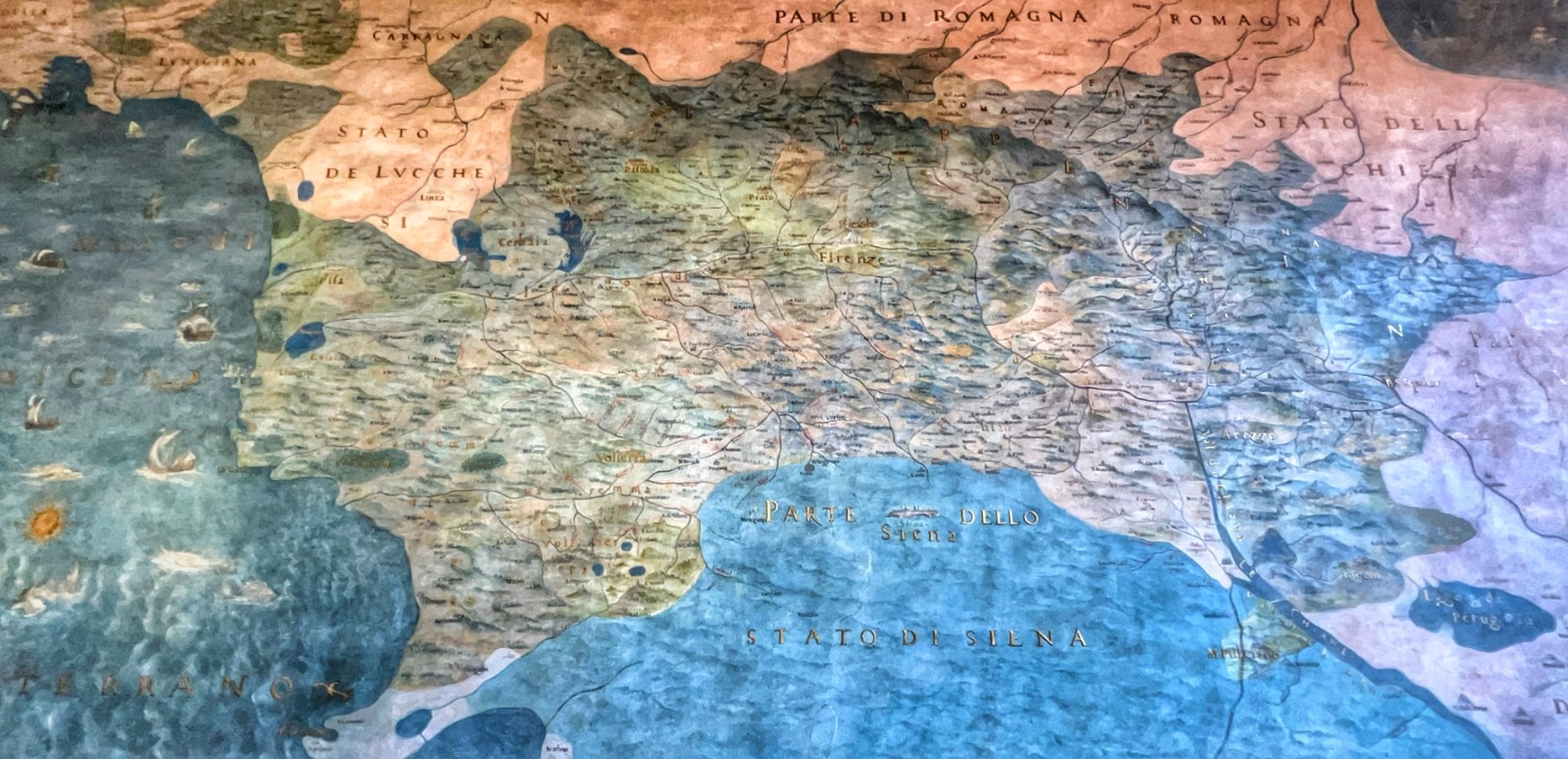
Map of the Medici World

The Medici World – Uffici Gallery – Image ©2022 Tom Haymes

When we are lost, we need a map. The purpose of that map is not to get you somewhere else, but to orient you to where you are. We need that map more than ever today.

Right now, I need a map to figure out how to put together a mapmaking company. Ironically, I need the tool that I hope to design to design the tool that I need.

My students need maps to figure out what the point is to the work that they’re putting into my classes. They do not know where they are, much less where they’re going.

Businesses need maps to navigate their way through a shifting world of uncertain politics, shifting technologies, and uncertain customers.

These are all map problems. Sure, you can write articles and books to explain to people why the world is the way that it is, and with willing and patient audiences, those narratives can have an effect. However, there are many limitations and opportunity costs, plus a lot of noise, that compromise the effectiveness of traditional written narratives.

Since most people don’t read or don’t have time to read, the reach of these narratives is limited to a small elite. However, even here it’s a constant struggle to maintain perspective over the story. It’s hard to step back from a book and see it in context.

More paper is not the answer here. Better maps are. We’ve lost touch with our map use in part because of Google. The point behind Google is to get you to your destination, but it’s useless if you do not know what that destination is. Back in the old days, when we used to unfold paper in the car, we not only saw potential destinations, but we saw where we were in the world.

Life isn’t about getting somewhere. Life is about figuring out how to best thrive where you are. If you want to change where you are, that’s fine, but that’s subsidiary to understanding why you’re going where you’re going.

The same is true with business planning. It’s not about figuring out how far you can get, but how to change your environment to create a sustainable business down the road. You can’t do this unless you know where you are. Books and papers are limited in their ability to contextualize information, especially to do so quickly.

As a student, you are a business of yourself. You are making investments of time and money into a future self that you hope will have a sustainable existence. Most students are poor strategic planners because school usually robs them of agency.

Even when they are allowed to decide their future path, they have very little context, much less experience, upon which to base those decisions. What happens next is often accidental. If you’re lucky, the outcomes are successful, but they are rarely predictable.

Businesses know they can’t operate that way. Therefore, they invest huge amounts of time and effort in strategic planning processes, business intelligence, and other efforts to put themselves into a competitive understanding of their environment. But even there, they often struggle to see the forest for the trees.

Government policy makers try to do the same thing, but they’re even more amateur about it than my students are sometimes. Furthermore, they’re dealing with extremely complex environments, both foreign and domestic, with lots of moving pieces. It’s hard to get a perspective on what to do.

These are all storytelling problems. We don’t think of maps as storytelling devices, but they are. We use them to tell the story of our planet and our societies. However, they are all hampered by the difficulty in producing and reproducing them.

We are now at a technological moment, however, where this could become a lot easier and accessible by everyone, from my students to business planners to political leaders. We have been so fascinated by the ability of generative large language models to generate text and simple images that we’ve missed the larger implications of this technology for our ability to orient ourselves in the world.

Generative AI is a potential mapmaking tool. Even when it creates texts and images, it is sucking context from the world and reassembling it into something new. Most of the popular uses, however, of this amazing process have been the production of rather mundane artifacts.

Endless AI-generated images of humans looking confused makes generative AI easy to ridicule and dismiss on the one hand and to minimize on the other. We’re missing its potential to be a mapmaker for a complex world, to let us see the invisible, and to put ourselves squarely in the center of those maps.

Connection is where AI will produce its biggest impact. However, before we can connect, we must orient ourselves. We cannot do that without using it to create maps of ourselves in the world of information.

Seeing Knowledge Differently

Originally Published May 30, 2024

My decisions on what to attempt and what not to attempt were determined to an embarrassingly great extent by considerations of clerical feasibility, not intellectual capability. – JCR Licklider, 1957

The adage “publish or perish” has been a fixture in academia for decades, often seen as a crude metric of achievement in an industrial system. As competition for limited full-time positions among PhD holders has intensified, institutions have increasingly relied on this metric to filter candidates, sometimes adhering to hidden and arbitrary standards.

This is an inefficient process that often stifles worthwhile ideas, discourages nontraditional exploration of ideas, devalues teaching, and ruins lives. We are on the cusp of new technologies that could change this, such as a fusing of AI with dynamic visualization. However, fixing the problem requires a clear-eyed assessment of where we stand.

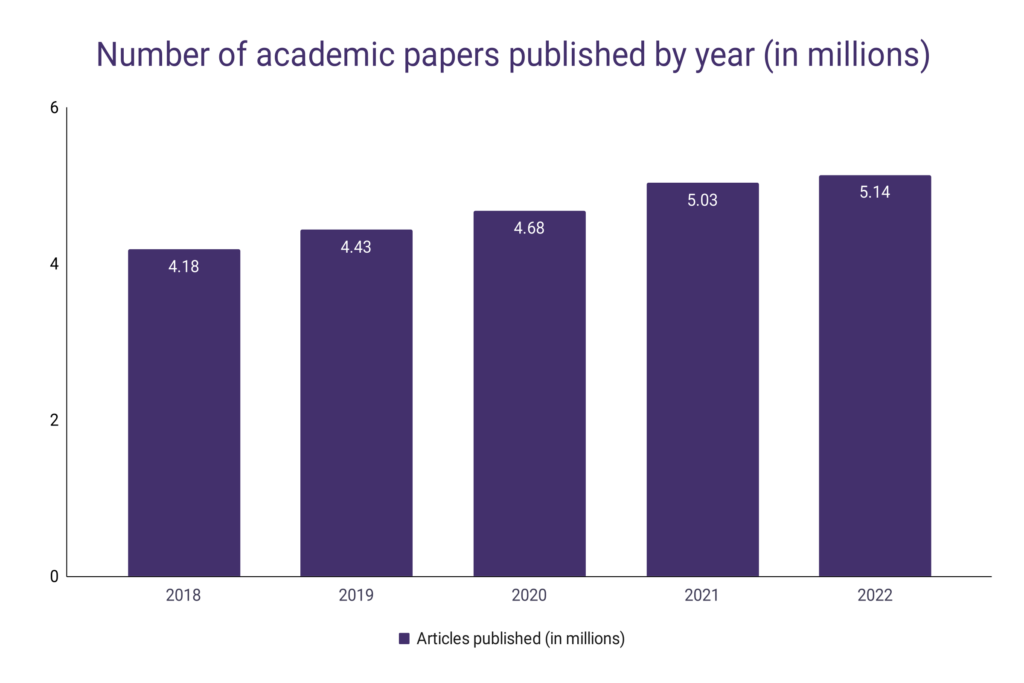
In economics, inflation leads to devaluation, and the academic publishing game is no exception. The system, driven by a need to publish for extrinsic reasons, favors quantity over quality.

I frequently receive requests to write for free from journals that sometimes even expect me to pay for the privilege of being published, primarily in digital formats. They know that if I were a professor vying for a tenured l position, this would be a significant concern, and I might do almost anything to add another line to my CV.

We must ask serious questions about how this system truly advances the purpose of scholarship. The quality of reviews depends on the peers willing to take part. When the academic community was smaller, and the number of papers more limited, the quality of articles was consistently higher. Now, publications scramble to find reviewers as articles flood in from scholars trying to meet their publication quotas.

Academic Papers Published by Year

SOURCE: https://wordsrated.com/number-of-academic-papers-published-per-year/

High-quality scholarship doesn’t scale easily. We’ve added economic-based layers that have little to do with maintaining rigorous academic standards. It’s challenging to envision a system that can separate these two conflicting goals.

This situation contributes to the delegitimization of education. Public figures and the media often mock poorly researched or thought-out papers that enter the public discourse. During the pandemic, poor scholarship contributed to the sea of conflicting information and misinformation.

There are still brilliant publications, but finding valuable ones amidst the vast quantity has become increasingly difficult. I often rely on word-of-mouth to determine whether to invest time in a particular paper. Paywalls and poor discoverability through search engines exacerbate this problem.

The fundamental issue is that people have limited time to read and research, especially with the careful attention a scholar should give. They have other responsibilities, such as teaching and governance. Peer reviewers face the same constraints.

The challenge is sifting through the overwhelming amount of information to find what’s worth pursuing and to be inspired by new ideas. Text alone is often insufficient for this. I have stacks of unread articles and books that seemed like a good idea at the time but remain untouched because of time pressures.

Generative AI offers intriguing capabilities to summarize large volumes of text. It can help manage information overload by summarizing the gist of an article or book, but not its legitimacy or method. It’s a start but doesn’t address the qualitative problem.

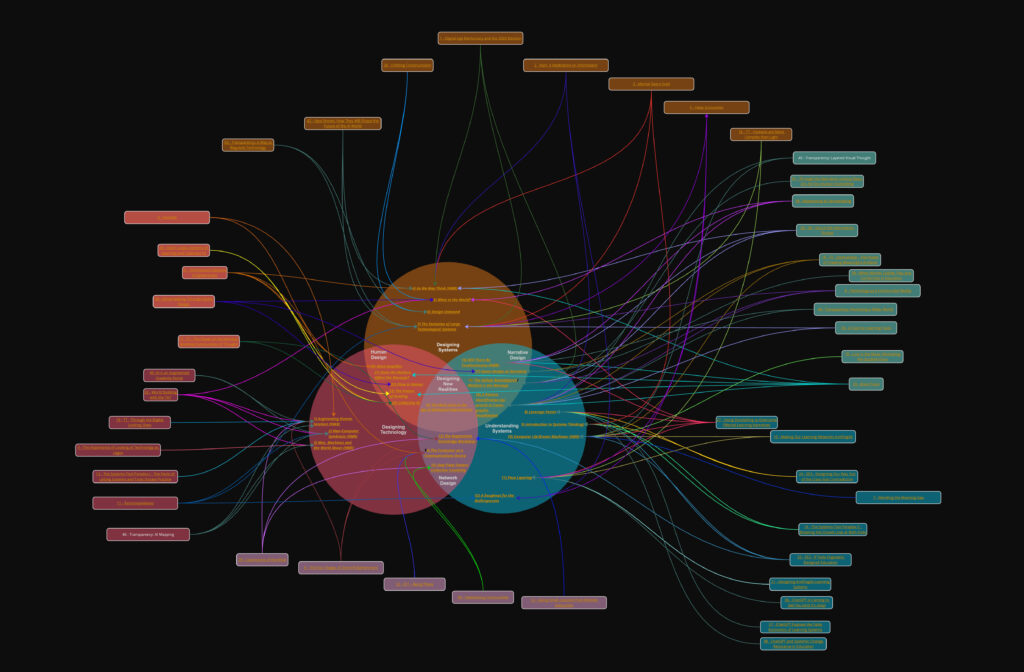
We need better tools to understand text, and this is where the augmented perspective tool I’m developing comes in. Imagine an AI tool that can analyze text for similarities and track great ideas across multiple books and articles. This would allow academics to see how ideas evolve and interconnect.

Blogs and Inspiration 2023A Connective Map of My Work and Sources from early 2023

Academic publishers could use this tool to analyze submitted articles graphically, understanding where they fit within the body of knowledge and their depth. This could help strategically select reviewers and enhance the review process, making it more efficient and effective.

Institutions could use this tool to showcase the interconnectedness of their faculty’s work, attracting donors and students. Researchers could map out new avenues for their work and publications, making research more meaningful and efficient.

Instead of relying on a simple count of publications, scholars could show the impact of their work by showing how it has inspired others. Imagine a spiderweb branching off from Einstein’s theory of relativity, illustrating its influence.

This kind of tool also opens doors for interdisciplinary expirations that could reshape our understanding of the world. For instance, connecting disparate fields, such as medieval poetry and digital transformation, could reveal new insights into how we communicate and its impact on our society..

Scholarship is about building knowledge. The purpose of researching and sharing information is to leverage the network effect to drive this collective effort forward. Gutenberg’s press transformed the world because it made the communication of information that much easier. This in itself shifted how we looked at knowledge.

We are in the middle of a similar technological transformation. While we have become very effective at looking at discrete chunks of knowledge, this has come at the expense of our understanding of the whole.

By shackling the production of knowledge to an inefficient process of publishing, we have limited our ability to benefit from it. Sacrificing quality for quantity is never a good idea and we need to rethink the systems that force this to happen.

We are entering a period of cheap production of quantity. In this world, quality will become the distinguishing factor. The proliferation of low-quality papers, sometimes even generated by AI, highlights flaws in the current system.

Scholarship has always aimed to advance knowledge within a field, but more and more discoveries are being made in the intersection of fields. It’s time to judge research on how it advances knowledge more broadly.

This means we need a better way to measure quality at scale. A dynamic knowledge mapping machine could provide us with just the tool to do that. If we are committed to the central purpose of universities, this is a pursuit worth our energy.

Assessing Students, Not The System

Originally Published May 15, 2024

As I was walking the halls the other day, I overheard a student interviewing another student and asking a question that broke my heart. She asked, “How do you deal with the stress of education, especially the stress of finals?” Learning should be joyous, not stressful. It’s no wonder that most people run away from school as fast as they can. We naturally flee stressful situations.

It should come as no surprise that our students are stressed. We have normalized stress as part of the educational process. Students expect to be boxed on the assembly line of their future. Assessments are there to make sure they are conforming to the process.

Education is a linear process. A myriad of steps that trace from kindergarten to a PhD measure progression. It’s an assembly line for minds. The problem emerges when the factory becomes more important than the product.

This is not how learning works and not how the real world looks. We persist in this fiction because it is easy to wrap our heads around it in the abstract. Completion and grades become the focus. In my book, Learn at Your Own Risk, I explore how the currency of grades undermines learning. Without assessments, you don’t have grades.

Generative Large Language Models inject yet another element of chaos into this system. Last year, students seized these tools as a way of attacking the arbitrary linearity of their academic confinement. Some call this cheating, but what are they cheating, their learning or the factory line?

The primary purpose of assessments these days seems to be as a quality control measure for advancement up the assembly line that results in graduation. We use them as gatekeepers to the future because we view graduation and the legitimacy that it confers as the stepping stone to employment.

This is a perversion of their intent. It obscures the different purposes which assessments can serve. In a system where we measure forward motion with a linear advancement tool, assessments provide an extrinsic motivator for students to focus on whatever material we expect them to remember and then immediately forget half of it or more.

Often these are completely arbitrary in the eyes of the students, and therefore an unfair judgment of their abilities. If this is how students perceive assessments, it’s no wonder “cheating” is endemic.

Most assessments emphasize conformity over creativity. They try to push everyone to a normative ideal. Life is full of arbitrary cruelty, but in few places have we institutionalized this more so than in the world of academic assessment.

We can discard summative assessment in favor of formative assessment. However, it’s much harder to compare students against an arbitrary pecking order if you do. If you are interested in figuring out what students can do, judging them relative to other students is probably the worst way to do that.

If we based our method of assessment on giving the student insight into what they can and cannot do, it completely changes the dynamic of the learning process. Pride of accomplishment replaces fear of failure.

Learning is impossible without failure and yet linear summative assessment routines teach students to fear failure. In this kind of world, students have grasped generative AI to cheat failure in a system that doesn’t really benefit them anymore.

It’s a natural reaction. Integrity and faith in the system only matters if the system is worth defending.

Education has to mean something if it hopes to overcome the technological debasement of its arbitrary processes. The only way to overcome this is if we give the students a mechanism for creating meaning instead of jumping through hoops.

AI is an augmented creativity tool. We need to use it as such to create and execute meaningful assessments.

Traditionally, education is at its best when it gives people meaning and context to explain and organize the randomness of the world. We’ve lost that when our processes are as arbitrary as the world we are trying to explain.

It is hard for anyone to overcome this. The entire system works against learning and whatever assessment practices don’t conform to the norm. Sometimes this is explicit in institutional assessment mandates. Sometimes it’s very passive because students rebel against assessment techniques that turn their lives into jumping through hoops that they find hard to understand.

As I have written about before, I practice unorthodox assessment mechanisms in my class. I spend most of the class teaching the students how to learn. I do this by gradually asking them to do more and more complex tasks. Students are assessed through completing the assignments.

The process of students struggling with the tasks is where the learning takes place. Those who struggle and overcome get the better grades. Those who give up or don’t engage in the struggle fail.

None of these tasks operate in isolation, and like in a real-world project, they build upon each other. The grading system is cumulative, not deficit-based. I use points instead of averages to calculate how my students are progressing through the class.

This semester, for the first time, I’ve integrated generative AI into the process. Students start out by using a chatbot to understand the problems they are investigating in the class. We then workshop that exercise as part of the process.

The one thing I’m not able to avoid, however, is the overriding concern the students have about failure. I don’t have any high-stakes assessments in my class. As a matter of fact, there are no tests at all. Failure on any assignment doesn’t doom them to failure at the end of the class. Unfortunately, the system has trained them to view assessments in this manner.

And this is where the system comes back in. I am lucky in that I do not have arbitrary assessment requirements from my institution. I have taught elsewhere where random multiple-choice tests are required to assess the students’ mastery of content. This would break the spirit of my class entirely.

But there is a larger constraint that I cannot avoid, and that is the insularity of the common academic schedule. During an academic term, you were taking government or English or history or math and that’s what we’re going to talk about, which ends at a fixed time.

In order to fix assessments, we’re going to have to do a much better job with interdisciplinarity and to view the overall learning process much more fluidly. Knowledge is not confined to one class. One conceit that AI exposes is the cross-disciplinary reality of knowledge.

As long as we separate college (and secondary school) into little boxes that bound learning, we will have small demeaning assessments because those boxes’ primary connection with one another lies in the arbitrariness of grades.

Grades matter to the system. They only matter to the students because they matter to the system. Technology breaks that.

College used to produce well-rounded individuals who could handle a variety of nonlinear challenges. Our current systems of assessment work against that outcome.

Assessment should encourage exploration, not constrain it. We can, and must, develop tools and systems to fix this if we want to graduate students capable of handling the wicked problems of today and tomorrow.

Building Tools for Seeing, Not Knowing

Originally Posted May 13, 2024

“It’s the questions we can’t answer that teach us the most. They teach us how to think. If you give a man an answer, all he gains is a little fact. But give him a question and he’ll look for his own answers.” – Patrick Rothfuss

Most of us suffer from a crisis of seeing. What we can’t see, we believe we know, and that’s a problem. We need better tools for seeing, not knowing, and yet that’s what we insist on trying to turn our latest AI tools into. They don’t do that very well unless accompanied by a lot of critical seeing.

We often forget that scientific progress is based on seeing, not knowing. The scientific method always questions what we know and seeks to reconcile that with what we see. Yet we expect science to knowbecause it brought us so much knowledge.

Humans want certainty, an end to the pathway. However, any scientist worth his or her salt will quickly disabuse us of the notion that we know everything. That is because knowledge is a process of constant discovery.

However, we look to our tools for knowledge, not seeing. When we pick up a book (a tool), it’s ostensibly to gain knowledge. When we read a blog or a website (also tools), we’re doing the same. They may be connected to other containers, but those connections are often hard to perceive (a complaint about the internet shared by Tim Berners-Lee and Ted Nelson). The same is true of AI Chatbots. They’re making lots of connections behind the scenes, but we can’t see them. Seeing requires connection.

Seeing beyond the boxes of knowledge that books and website represent requires a great deal of education and practice. Most learners never get to this level and, until they do, they don’t accept that all knowledge is contextual and connected.

I tell my students that there are no right answers in my class, but there are wrong ones. This is to encourage them to explore and create, but to base that on solid foundations. I want them to explore connections, not given “facts.”

They resist this because they want to know the “right” way to do it. This is a direct product of a “learning” system has trained them to fear failure above all. You can’t see without failing.

As an author, I recognize that there are a multitude of compromises necessary to smash any set of ideas into a book, or any other textual format. When we teach the book, we rarely acknowledge what’s going on beyond the covers.

That’s because it’s hard to see those connections. You can follow citations, but that takes a lot of extra work and even they don’t fully capture the imagination of the author.

As a teacher, I recognize how hard it is to get the students to read the book in front of them, much less to acknowledge the vast number of books that exist around that book. Books risk tunnelling our vision because of how they work as narrative containers.

The tension between creativity and conformity is something that our systems of learning struggle with. I remember a conversation with my daughter’s 5th grade math teacher about a particular practice question that my daughter got “wrong.” I pointed out that the assignment worded the question badly and that there were multiple answers to it.

The teacher agreed with me that the question was problematic, but argued that there were problematic test questions on the standardized test that had to be accepted as correct because that was all that the assessment permitted. What you saw (or deduced) didn’t matter. The test itself was the knowledge that mattered and you didn’t want to “fail” that.

Part of being a good thinker is accepting uncertainty. Part of growing up is recognizing that there are many things left to be discovered. Certainty closes that door.

We equate knowledge with certainty because that’s how we learned. This is a fallacy and a corruption of what it means to be “knowledgeable.”

This corruption lies at the center of many of our struggles today. We go around expecting certainty. People wanted certainty during the pandemic, but all legitimate science could give us was a set of probabilities. The same conundrum exists as we struggle to confront the complexity of climate change. There is no certainty there, only probabilities.

However, humans crave clear narratives. Even if they are false, they provide patterns in a complex and uncertain world.

Science has moved past that. Since the discovery of first relativity and then quantum physics over a century ago, science and math realized the world does not work like Newtonian clockwork.

Observations can fool us, and we are continuously searching for better explanations. However, our quest for certainty compels us to insert mysticism where science is still searching for answers. That doesn’t mean the answers are not out there. It just means we haven’t understood them yet.

We couldn’t explain eclipses for much of human history and assigned to them a mystical value because we sought to clear up the uncertainty they aroused. Quantum physics is no different. We are equally wrong to associate it with the certainty of a belief structure to explain it.

With the flood of information we’ve unleashed through the digital revolution, our cloistered informational existences are constantly challenged. As we quest for certainty, these disconnects become ever more apparent and uncomfortable to us.

We lack the tools to see information clearly when one “definitive“ narrative conflicts with another. The current crop of generative AI tools doesn’t get there.

Asking a chatbot for difficult perspectives often triggers a host of “guardrails” to keep us from exploring uncomfortable subjects. AI companies think these guardrails are necessary because we accept their products’ answers as being “given knowledge,” not a synthesis of human conversations online.

AI Chatbots blind us to context. This is not seeing.

Generative AI reflects on us as much as anything the models are doing. Their outputs are the product of trying to create linear narratives out of a profoundly nonlinear observation. We struggle with the chaos of human existence, perceptions of systems of thought, and governance. If we build a tool that merely reflects our “knowledge” we should not be surprised if it reflects that blindness back onto us, garbage-in, garbage-out.

Our quest to know has blinded us to the possibilities of seeing. We need better tools to contextualize our ideas. As teachers, we need to teach the skills of navigating complexity rather than the skill of producing certainty. We must highlight what we don’t know as much as what we do.

New tools for thinking are necessary to facilitate this process. Books are wonderful tools for knowledge and are essential for seeing, but they have limitations as tools for perceiving the world. They can be hard tools to master. Chatbot tools merely reflect this struggle.

Like every tool, we should use them for what they are best at. However, we must look for augmented tools to help us see the world differently (and this includes the analysis of our narratives themselves). AI could provide those tools for us, but only if we design tools to take advantage of its ability to see differently rather than “know” more than us.

Communicating Thinking in a Digital World

Originally Posted April 19, 2024

For this invention will produce forgetfulness in the minds of those who learn to use it, because they will not practice their memory. Their trust in writing, produced by external characters which are no part of themselves, will discourage the use of their own memory within them. You have invented an elixir not of memory, but of reminding; and you offer your pupils the appearance of wisdom, not true wisdom, for they will read many things without instruction and will therefore seem [275b] to know many things, when they are for the most part ignorant and hard to get along with, since they are not wise, but only appear wise. – Plato, Phaedrus (275)

This week, a topic that seems to be a repeating theme in my practice of teaching and consulting is the question of thinking. I keep hearing from faculty members that writing is thinking. As a result, their students’ ability to use generative large language models to create writing that mimics thinking threatens them.

The written word dominates our world, but it is not synonymous with thinking. Much of great thinking is not written, and too much writing contains very little thought. AI may be a threat to thoughtless writing, but it’s not a threat to thinking.

Plato argued that writing was going to destroy thinking. He wasn’t wrong. Even in ancient Greece, it democratized our ability to express ourselves, but, as King Thamus points out, that came as the cost of memory and rigor. Our ability to memorize epic poems has declined since then. Arguably, his prognostications of people using writing “to appear wise” have also borne out.

The invention of writing was not the last time technology democratized our ability to share our thinking. Gutenberg’s press prompted similar outcries as the invention of writing itself. We have heard criticisms like this again over the last few decades as writing became a digitized medium.

The digital revolution has given us all printing presses and has created a proliferation of all forms of reading and writing. This abundance has created a side effect of mediocrity. Any wag can be a pamphleteer if they have a printing press. Everyone has a printing press these days.

The reaction of the establishment was the creation of education and sets of standards that separated writing from the unwashed masses. The written word became the coin of the realm in higher education through the process of publish or perish.

This has had the unfortunate side effect of making even scholarly writing a commodity. As the educational culture forced more and more people to publish for extrinsic reasons, such as to keep their jobs, the quality of the thinking declined. Add to that financial pressure to bias research and the result is a lot of bad “scholarly thinking” that just happens to be written and passes through the peer review process.

The latest iteration of this is the discovery that people are writing scholarly works, and even books, by generating them with chat bots. Writing is no more immune to a race to the bottom than any other creative pursuit. Generative large language models do an admirable job of mimicking thoughtless writing, even in academia. They’re only going to get better at it.

As writing has become more and more ubiquitous, the limitations of thinking skills become more and more obvious. Quantity does not equal quality.

So why are we so obsessed with teaching our students to write rather than focusing on their ability to think? Writing is a quantifiable measure. One reason is extrinsic: Requiring students to write X number of words or pages for a class is something that is easy to measure. Measuring thinking is much harder.

After 20 years of teaching, I can say that quantity does not equal quality. When writing was the only way in which my students could express their thinking, this was a trade-off I had to live with. Of course, even 20 years ago, I couldn’t tell whether a student, or a sibling or parent had written the work they were turning in. Therefore, I could never be sure who was doing the thinking.

The “solution” that some have fallen back on is making more manual, in-class, writing assignments. But what is that teaching? I think with many aids these days, including using AI at various stages. When teachers limit students to pencil and paper, this creates a false environment that in no way reflects the kinds of thinking skills they will need in the real world of today.

Yes, we need to train our students to communicate their thinking effectively. However, we also must accept that no one communicates without technology.

Good thinkers use a variety of tools to create. I didn’t go to the library to write this blog. I used Google. I used AI-powered grammar checkers that help me avoid bad writing habits (which don’t like the fact that I used “I” to start five sentences in a row). I even used ChatGPT to see if my prose was telling the story that I wanted to tell. I shared my thoughts on LinkedIn, not a scholarly journal. Are those uses of technology cheating?

The days of oral poetry are thousands of years in the past. Technology will enter the picture somewhere. As Plato implies, writing itself is a technology. However, teachers and academics overlook that digital technology has opened the doors to a range of complementary technologies ranging from webpages to concept maps to comics to photography, and many more.

When we focus on writing as the only technology, we miss the potential for understanding different ways of thinking. Text drives narrative in certain directions. It leads to over-specialization and the fetishization of narrow slivers of knowledge. It is also something that machines like generative AI find easy to mimic even in the iterations we are using today.

Over the last 40 years, we have opened doors to new ways of expressing our thinking that the educational community has largely ignored. Artificial intelligence, which I prefer to call “augmented” intelligence, augments our ability to think as well as communicate in unprecedented ways. When we don’t teach learners to think in an AI world, we are doing them an immense disservice.

Instead, we should structure our educational experiences to incorporate every tool we can lay our hands on instead of insulating our students from change. If our educational systems don’t do this, society will find replacements for them. The graduates that we produce will be the actual victims here. We need thinkers more than ever today.

Generative AI can be a partner in understanding what our students are thinking. It reduces the friction between thought and narrative. I have found it an invaluable tool for gaining insight into what my students are thinking in real time. This alone makes it far more powerful than any paper or essay they could write.

Technology provides us with tools we can use to figure out what others are thinking. When we fetishize writing, we confuse means with ends. Writing is a means. Thinking is the end. We should teach thinking and use every technological tool we can find to achieve that end. To achieve this, it’s time to stop worrying about protecting the means of getting there because that’s what we’re used to and lean forward in our teaching strategies.

Artificial Stories

Originally Published April 4, 2024

“We shrank our ideas to fit on pages sewn in a sequence that was then glued between cardboard stops. Books are good at telling stories and bad at guiding us through knowledge that bursts out in every conceivable direction, as all knowledge does when we let it. But now the medium of our daily experiences—the internet—has the capacity, the connections, and the engine needed to express the richly chaotic nature of the world.”

David Weinberger quoted in Jarvis, Jeff. The Gutenberg Parenthesis (p. 231). Bloomsbury Publishing. Kindle Edition.

A couple of weeks ago, I wrote about how technology has transformed my writing. When I refer to “my writing,” I’m talking about constructing linear narratives like this one that are the product of print age thinking. Today I want to consider the possibility that this method of expression does not capture the world of ideas and knowledge exposed by the internet.

I just finished reading Jeff Jarvis‘s excellent Gutenberg Parenthesis. In it, he relates the story of how print shapes societies, and how this is ending. One of the key points at the end that he makes going off of Psychologist Alex Rosenberg’s research is that we have a natural disposition toward linear storytelling. “Humans became proficient at predicting the immediate behavior of other animals and humans, which led their literate descendants to believe they could not only predict behavior in the present and future but also explain it in the past, in history. (p. 229). Print reinforces the narrative of the hero’s journey.

We are all on our own hero’s journey in our own minds. Humans are biologically predisposed to believe in pathways. School reinforces this tendency. We talk about learning pathways, career pathways, and life journeys, as if they have a beginning, middle, and end. The teleology of our lives does invariably end in death, but that doesn’t mean there is any logic to what happens before then.

Print segments those journeys into chapters, and, like military promotion, there is an expectation of an upward trend. Marketing reinforces this through endless advertising promising a route to the good life. We condemn political leaders for a lack of progress (although we often struggle to define the term). The stock market punishes CEOs when companies do not grow at a predicted rate.

Attempts to marry this with educational progress have often been disastrous. Education is particularly guilty of chaptering itself. The whole point of K-12 education is to advance to the next chapter, which is higher education. The whole point of higher education is to get a degree to advance to the next chapter of employment. Skipping chapters results in punishment. You are not qualified for a job, because you do not have the appropriate piece of paper that shows you completed the requisite chapter. Life is far from a Choose Your Own Adventure Book.

Once you have a job or, better yet, a career, your goal is to advance within that career along a predictable path. Employers and HR departments trying to understand your story view interruptions or side journeys with suspicion. Everyone needs to advance from employee to manager to senior manager to director to executive director, etc. if they hope to get to the presidency.

Learning has a beginning, middle, and end. Money drives this, and so do accountability paradigms. When we write history, as Jarvis points out, we want to turn it into a coherent narrative instead of a chaotic series of events. When we write our own history, we feel compelled to do the same.

I am well-versed in storytelling. As a writer, you’re forced into linear models of storytelling. The expectations are the same if you are teaching. Photography is different. It’s storytelling all about taking the complexity of the world and simplifying it.

Right now, we’re looking for AI to tell stories as well. When the chaos of reality creates “hallucinations,” we look at that as a storytelling failure, but humans also routinely hallucinate stories that only make sense to them. The only actual difference is that AI is still struggling to make sense of the world we’ve long since “rationalized.” We’ve created the illusion of sense in our efforts to create stories that the current crop of generative large language models cannot match. I’m not sure they’ll ever get there.

Therefore, we should not push them in that direction. That is not a good use of their capabilities. Instead of trying to force them to teach us new, coherent stories, we should use them to better understand the chaotic nature of our own stories.

Large language models have exposed the inadequacy of our storytelling capabilities by shining a mirror on ourselves. We just haven’t realized that yet.

My story is a good example of a nonlinear pathway. Over the last few years, I have struggled to define myself. I don’t fit neatly into any pathway. My story encompasses technology, teaching, creating learning spaces, designing educational pathways, mapping knowledge, and creative expression.

Deep crosscurrents of visualization, communication, project management, and creative problem-solving cut across all these pathways. One of these pathways by itself would make sense to a person focused on a linear career path. (As an experiment, I asked ChatGPT to write bios of me using just the information on the About Me page on ideaspaces.net.)

My career forms a scatter diagram of data points and many linear pathways. I’ve tried to get around this by creating a conceptual map of my career and work, but that doesn’t seem to register with people used to looking for a linear pathway, represented by a standard CV or resumé.

I know many people who climbed a more traditional career ladder but found themselves stuck in a pathway that may not make sense to them anymore. That’s because life is a scatter diagram of experiences, not a set of rails. It is only our narratives that make it seem linear.

As Jarvis points out in his book, this tension between the end of the book and the start of distributed knowledge threatens a whole range of institutions. Education is close to the top of that list, but the world of work will also become far more unpredictable as time goes on. The tyranny of the linear story will hurt more and more people as their pathways become disrupted by the realities of the world.

As humans, we crave certainty. In a world of uncertainty, characterized by a massive flow of information, we are led astray by those promising a level of certainty that they are incapable of delivering. This tendency is dangerous to a democracy because it leads to demagoguery based on faith. Democracy depends on recognizing complexity and coming to terms with competing narratives.

We need to embrace chaos instead of ignoring it or trying to shove it into linear stories. Linear stories will always have their place because they conform to deep-rooted human psychological traits. Our rational minds, however, must recognize the irrationality of this approach to organizing knowledge.

A good first step to this would be through the creation of knowledge maps. AI has been pretty good at illuminating the shortcomings of our mental approaches to the complexity of the world. Instead of expecting to turn that teleological construct into something linear, we should instead lean into its capabilities to strip away preconceptions and false pathways.

We can build augmented intelligence tools to help us map connections between human narratives instead of trying to force it to create even more artificial narratives. In this role, it becomes a partner in our storytelling and not a potential replacement. It augments our intelligence instead of artificializing it. It makes us stronger, not weaker.

« Older posts Newer posts »

© 2026 IdeaSpaces

Theme by Anders Noren — Up ↑