Originally Published June 12, 2024
“The greatest value of a picture is when it forces us to notice what we never expected to see.” – John W. Tukey
We usually think of maps as a way of finding our way to somewhere else. We miss the importance of maps in explaining to ourselves where we are rather than where we’re going.
It’s amazing how often we do not know where we are. That sounds silly, but it’s true, especially if we’re trying to figure out where our heads are. We need maps to orient ourselves before we can figure where we’re going.
It’s easy to accept reality in what we see. The complexity of challenges these days often makes that difficult, if not impossible.
We are very unnerved when our reality shifts because of something we can’t see. It is deeply threatening to us because we struggle to orient ourselves in the face of the incomprehensible or invisible.
This was the case during the pandemic. Even today, people are still arguing over viruses that can’t be seen. Many humans reacted violently to this dislocation by the invisible.
There are many invisible forces in our lives. At a fundamental level, humans find this disquieting. Whether we are talking about the invisible forces of the economy or the mysteries of education, in the absence of context, people fill in the blanks.
Covid can morph into a government conspiracy designed to control people. Government is a distant concept that enforces our poverty and powerlessness. Climate change is a hoax designed to take away what little prosperity you have. These are all narratives that politicians are telling us in the current election cycles in the US and throughout the world.
The media are full of stories of lost and disconnected people directing their anger at everything from social media to our educational systems. Most of us struggle to understand our own stories, much less those of anybody else.
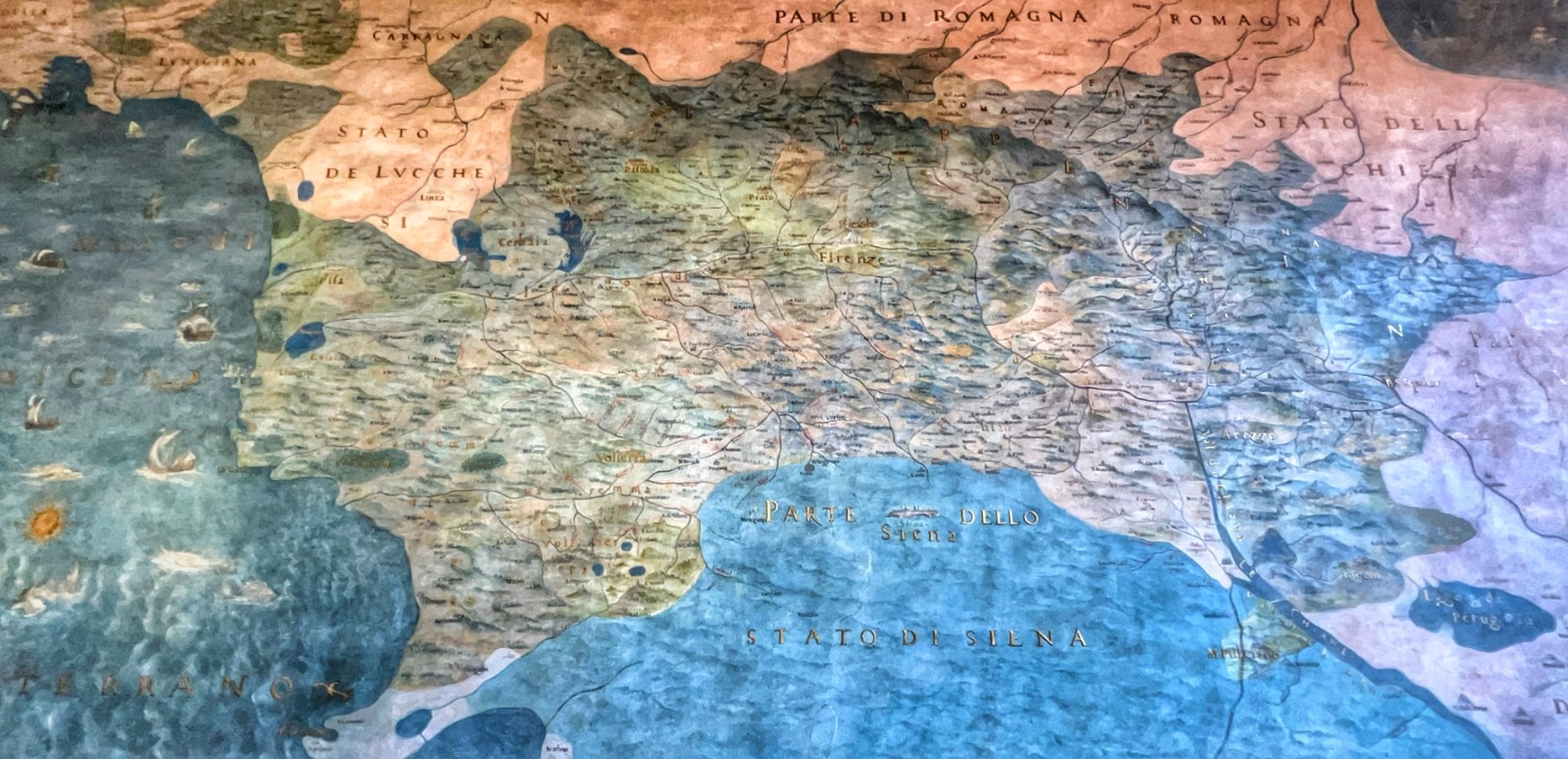
The Medici World – Uffici Gallery – Image ©2022 Tom Haymes
When we are lost, we need a map. The purpose of that map is not to get you somewhere else, but to orient you to where you are. We need that map more than ever today.
Right now, I need a map to figure out how to put together a mapmaking company. Ironically, I need the tool that I hope to design to design the tool that I need.
My students need maps to figure out what the point is to the work that they’re putting into my classes. They do not know where they are, much less where they’re going.
Businesses need maps to navigate their way through a shifting world of uncertain politics, shifting technologies, and uncertain customers.
These are all map problems. Sure, you can write articles and books to explain to people why the world is the way that it is, and with willing and patient audiences, those narratives can have an effect. However, there are many limitations and opportunity costs, plus a lot of noise, that compromise the effectiveness of traditional written narratives.
Since most people don’t read or don’t have time to read, the reach of these narratives is limited to a small elite. However, even here it’s a constant struggle to maintain perspective over the story. It’s hard to step back from a book and see it in context.
More paper is not the answer here. Better maps are. We’ve lost touch with our map use in part because of Google. The point behind Google is to get you to your destination, but it’s useless if you do not know what that destination is. Back in the old days, when we used to unfold paper in the car, we not only saw potential destinations, but we saw where we were in the world.
Life isn’t about getting somewhere. Life is about figuring out how to best thrive where you are. If you want to change where you are, that’s fine, but that’s subsidiary to understanding why you’re going where you’re going.
The same is true with business planning. It’s not about figuring out how far you can get, but how to change your environment to create a sustainable business down the road. You can’t do this unless you know where you are. Books and papers are limited in their ability to contextualize information, especially to do so quickly.
As a student, you are a business of yourself. You are making investments of time and money into a future self that you hope will have a sustainable existence. Most students are poor strategic planners because school usually robs them of agency.
Even when they are allowed to decide their future path, they have very little context, much less experience, upon which to base those decisions. What happens next is often accidental. If you’re lucky, the outcomes are successful, but they are rarely predictable.
Businesses know they can’t operate that way. Therefore, they invest huge amounts of time and effort in strategic planning processes, business intelligence, and other efforts to put themselves into a competitive understanding of their environment. But even there, they often struggle to see the forest for the trees.
Government policy makers try to do the same thing, but they’re even more amateur about it than my students are sometimes. Furthermore, they’re dealing with extremely complex environments, both foreign and domestic, with lots of moving pieces. It’s hard to get a perspective on what to do.
These are all storytelling problems. We don’t think of maps as storytelling devices, but they are. We use them to tell the story of our planet and our societies. However, they are all hampered by the difficulty in producing and reproducing them.
We are now at a technological moment, however, where this could become a lot easier and accessible by everyone, from my students to business planners to political leaders. We have been so fascinated by the ability of generative large language models to generate text and simple images that we’ve missed the larger implications of this technology for our ability to orient ourselves in the world.
Generative AI is a potential mapmaking tool. Even when it creates texts and images, it is sucking context from the world and reassembling it into something new. Most of the popular uses, however, of this amazing process have been the production of rather mundane artifacts.
Endless AI-generated images of humans looking confused makes generative AI easy to ridicule and dismiss on the one hand and to minimize on the other. We’re missing its potential to be a mapmaker for a complex world, to let us see the invisible, and to put ourselves squarely in the center of those maps.
Connection is where AI will produce its biggest impact. However, before we can connect, we must orient ourselves. We cannot do that without using it to create maps of ourselves in the world of information.