Originally Published May 30, 2024
My decisions on what to attempt and what not to attempt were determined to an embarrassingly great extent by considerations of clerical feasibility, not intellectual capability. – JCR Licklider, 1957
The adage “publish or perish” has been a fixture in academia for decades, often seen as a crude metric of achievement in an industrial system. As competition for limited full-time positions among PhD holders has intensified, institutions have increasingly relied on this metric to filter candidates, sometimes adhering to hidden and arbitrary standards.
This is an inefficient process that often stifles worthwhile ideas, discourages nontraditional exploration of ideas, devalues teaching, and ruins lives. We are on the cusp of new technologies that could change this, such as a fusing of AI with dynamic visualization. However, fixing the problem requires a clear-eyed assessment of where we stand.
In economics, inflation leads to devaluation, and the academic publishing game is no exception. The system, driven by a need to publish for extrinsic reasons, favors quantity over quality.
I frequently receive requests to write for free from journals that sometimes even expect me to pay for the privilege of being published, primarily in digital formats. They know that if I were a professor vying for a tenured l position, this would be a significant concern, and I might do almost anything to add another line to my CV.
We must ask serious questions about how this system truly advances the purpose of scholarship. The quality of reviews depends on the peers willing to take part. When the academic community was smaller, and the number of papers more limited, the quality of articles was consistently higher. Now, publications scramble to find reviewers as articles flood in from scholars trying to meet their publication quotas.
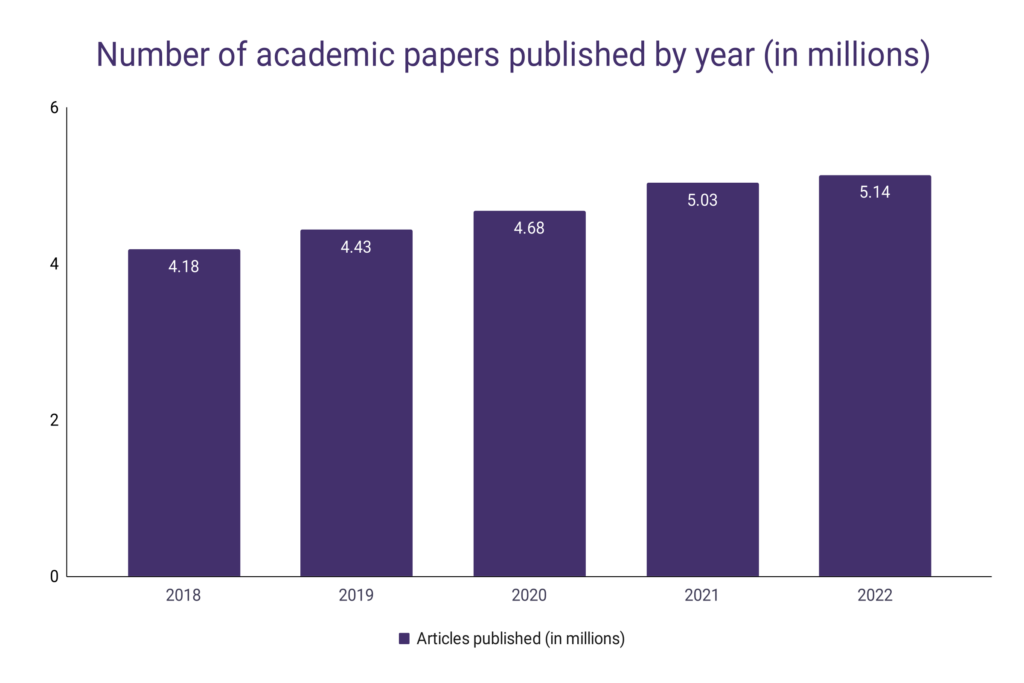
SOURCE: https://wordsrated.com/number-of-academic-papers-published-per-year/
High-quality scholarship doesn’t scale easily. We’ve added economic-based layers that have little to do with maintaining rigorous academic standards. It’s challenging to envision a system that can separate these two conflicting goals.
This situation contributes to the delegitimization of education. Public figures and the media often mock poorly researched or thought-out papers that enter the public discourse. During the pandemic, poor scholarship contributed to the sea of conflicting information and misinformation.
There are still brilliant publications, but finding valuable ones amidst the vast quantity has become increasingly difficult. I often rely on word-of-mouth to determine whether to invest time in a particular paper. Paywalls and poor discoverability through search engines exacerbate this problem.
The fundamental issue is that people have limited time to read and research, especially with the careful attention a scholar should give. They have other responsibilities, such as teaching and governance. Peer reviewers face the same constraints.
The challenge is sifting through the overwhelming amount of information to find what’s worth pursuing and to be inspired by new ideas. Text alone is often insufficient for this. I have stacks of unread articles and books that seemed like a good idea at the time but remain untouched because of time pressures.
Generative AI offers intriguing capabilities to summarize large volumes of text. It can help manage information overload by summarizing the gist of an article or book, but not its legitimacy or method. It’s a start but doesn’t address the qualitative problem.
We need better tools to understand text, and this is where the augmented perspective tool I’m developing comes in. Imagine an AI tool that can analyze text for similarities and track great ideas across multiple books and articles. This would allow academics to see how ideas evolve and interconnect.
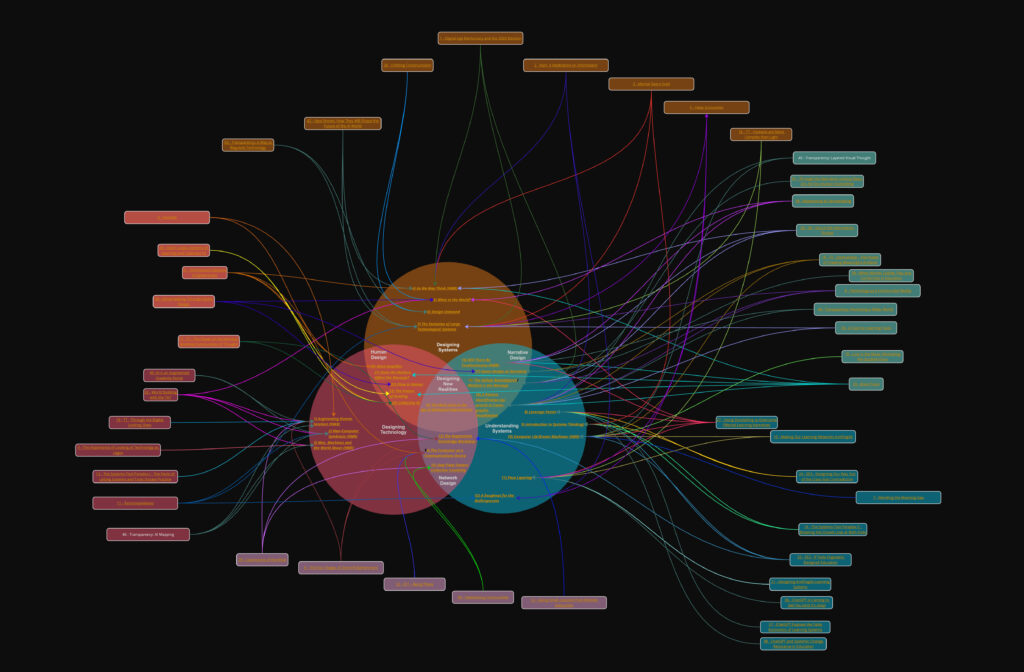 A Connective Map of My Work and Sources from early 2023
Academic publishers could use this tool to analyze submitted articles graphically, understanding where they fit within the body of knowledge and their depth. This could help strategically select reviewers and enhance the review process, making it more efficient and effective.
Institutions could use this tool to showcase the interconnectedness of their faculty’s work, attracting donors and students. Researchers could map out new avenues for their work and publications, making research more meaningful and efficient.
Instead of relying on a simple count of publications, scholars could show the impact of their work by showing how it has inspired others. Imagine a spiderweb branching off from Einstein’s theory of relativity, illustrating its influence.
This kind of tool also opens doors for interdisciplinary expirations that could reshape our understanding of the world. For instance, connecting disparate fields, such as medieval poetry and digital transformation, could reveal new insights into how we communicate and its impact on our society..
Scholarship is about building knowledge. The purpose of researching and sharing information is to leverage the network effect to drive this collective effort forward. Gutenberg’s press transformed the world because it made the communication of information that much easier. This in itself shifted how we looked at knowledge.
We are in the middle of a similar technological transformation. While we have become very effective at looking at discrete chunks of knowledge, this has come at the expense of our understanding of the whole.
By shackling the production of knowledge to an inefficient process of publishing, we have limited our ability to benefit from it. Sacrificing quality for quantity is never a good idea and we need to rethink the systems that force this to happen.
We are entering a period of cheap production of quantity. In this world, quality will become the distinguishing factor. The proliferation of low-quality papers, sometimes even generated by AI, highlights flaws in the current system.
Scholarship has always aimed to advance knowledge within a field, but more and more discoveries are being made in the intersection of fields. It’s time to judge research on how it advances knowledge more broadly.
This means we need a better way to measure quality at scale. A dynamic knowledge mapping machine could provide us with just the tool to do that. If we are committed to the central purpose of universities, this is a pursuit worth our energy.