
Category: Uncategorized (Page 3 of 11)

Unshackling Innovation: AI, Copyright and Our Right to Share Ideas

“To promote the Progress of Science and useful Arts, by securing for limited Times to Authors and Inventors the exclusive Right to their respective Writings and Discoveries.” – Article 1, Section 8 of the US Constitution

“Knowledge, truths ascertained, conceptions, and ideas become, after voluntary communication to others, free as the air to common use.” – Louis Brandeis

As a photographer, I assemble parts of the world into creative compositions that reflect both my vision and excitement of a scene. As a writer, I assemble ideas into coherent narratives.

Lately, I’ve found AI to be a powerful partner in my writing process. However, I am often stymied as I seek to leverage this powerful tool to research and write.

The reason is not technological. It’s social. Specifically, there are many barriers to using books I own to their maximum advantage because of outdated notions of copyright and perceived rights to ownership of ideas.

I can load books and articles into a RAG like Notebook LM and use it to deconstruct and reconstruct ideas contained within those pieces. Prior to AI, this task was a laborious process.

JCR Licklider wrote over 60 years ago, “my choices of what to attempt and what not to attempt were determined to an embarrassingly great extent by considerations of clerical feasibility, not intellectual capability.“ I have spent most of my career trying to reduce my “considerations of clerical feasibility” applying technology to maximize my ability to maximize my (and others’) “intellectual capabilities.”

AI has given me tremendous tools. However, considerations of copyright and intellectual “property” often hobble those tools. I am not talking here about large corporations like Meta and OpenAI vacuuming up vast quantities of content for profit.

My individual ability to analyze ideas in copyrighted works which I’ve legally purchased has no impact on the income of authors and other creators. I should also have this kind of access to material I’ve borrowed from libraries.

US Copyright law  has struggled for decades to manage the realities of the digital world, which simplified creative innovation. Digital tools allow for the quick copying and remixing of text, visual media, and music. The logic of current copyright restrictions collapses entirely when confronted with the emerging logic of Generative AI.

I can now share, repurpose, and modify ideas on a scale impossible when tied to paper. We should not hobble this power because custom shackles us to anachronistic technologies for sharing them, much less legal prohibitions that artificially protect them in the name of profit.

To me, the killer app that AI is likely to provide to us involves synthesizing ideas in new and unexpected ways. This is already happening in the scientific world. The more brains we can put on a problem, the better.

Digital rights management interferes with my ability to use books I already own in the way that I need to use them in an AI world. I cannot simply slice and dice a Kindle book.

I must do this to put it into Notebook LM for analysis. If I had a physical copy of the book, I could do this by scanning the pages into a PDF format, but this is highly inefficient and I’m back to the Licklider problem.

The inability to see inside books also leads to missed connections. I am the author of several books myself, and while I do cite many sources within those books, they contain many ideas that I have forgotten the provenance of. Having a tool to explore those connections would open up new vistas of creativity and intellectual growth for me and my readers.

I spent far too much time in writing my last book going back and forth to sources. Sometimes this was just physically finding an article that I had highlighted months before. I have other books in me, but I don’t have the time to write them. “Clerical considerations” make this too big of an opportunity cost for me right now.

I should be able to search across multiple documents for passages that I need to complete my thinking. However, the process of extracting ideas remains a significant barrier to productivity.

The power of innovation comes from a community of ideas, not individual geniuses. Your priority, if you want to “promote the Progress of Science and useful Arts” should therefore be to promote sharing ideas, not locking them up.

We need more ideas in the public discourse today, not fewer. Just because I have a book does not mean I can access its content efficiently or effectively. I love spending an afternoon reading, but the amount of ground I can cover there is limited by my time and attention span. Going back to highlighted passages is a laborious process.

Digital transformation changed our relationship to the production of ideas (and many are still struggling with this phase), but it will pale compared to how AI will reshape those relationships. Relying on idea sharing mechanisms that were corrupted in the 19th Century is no longer tenable.

I may represent the bleeding edge of this process, but eventually, the world will catch up with me. The more we democratize access to ideas, the richer our societies will become.

The easiest remedy is to clarify the definition of Fair Use to include the individual ability to ingest and analyze ideas using AI tools. One idea might be to replace current lockdown versions of Digital Rights Management with a watermarking system that would allow individuals to download legitimate digital copies of books but give content owners the ability to track wholesale scraping of them by large corporations.

This would build on existing copyright law in the United States. Sony Corporation vs. Universal Studios already recognized our fair use right to make copies of purchased or broadcast content for personal use.

AI, however, is likely to force that expansion into a more generalized “right to read.” As Jeff Jarvis describes it, we (and this includes our AI tools) have the right to consume legitimate media: “If AI creators would be required by law to license *everything* they use, that grants them lesser rights than media — including journalists, who, let’s be clear, read, learn from, and repurpose information from each other and from sources every day.”

A ‘right to read’ would ensure that individuals can legally analyze and process content they own using AI, much like personal research or study under traditional Fair Use. Legal precedent and the original language in the US Constitution implies this right, but legislation to clarify it might be necessary.

My ability to systemize textual (and visual) analysis using AI does not differ from me doing it manually. It’s just faster. I am not violating copyright if I use someone else’s ideas to build my own.

In a world characterized by challenges of technological transition, climate change, and political dislocations, access to ideas and discourse is a matter of human survival. AI shows us what is possible. We must adapt our systems to the new realities of automated knowledge creation.

Escaping the Silo: How AI Can Help Us See

“The Net interprets censorship as damage and routes around it.” – John Gilmore

We are prisoners of narrative. This is because we struggle to make sense of a world that seems too complex for our imaginations.

I have always been at war with complexity. Sometimes it is necessary, but that only occurs at the fringes of science. For most of us, the most important thing we can achieve is a clarity of vision. It is possible to oversimplify stories, but overly complex ones are vulnerable to manipulation by those who claim to understand them.

We need technology tools to carry us out of this trap. The Knowledge Navigator project is based on the naïve thought that we might learn to see better and what that would mean to human societies.

We yearn for an escape from this hall of mirrors. Popular entertainment has really explored this in recent years, most notably on two shows from Apple TV+: Severance and Silo.

A society of 10,000 people in Silo lives physically confined within an underground silo for an unknown reason. It is a fascinating exploration of what it takes to keep this kind of constrained reality under control.

The leadership of the Silo does this by controlling what the population sees. If you can’t see, you can’t construct narratives that make sense of what’s going on.

The brilliance of Hugh Howey’s story (he’s both author of the books and a producer on the show), comes from his exploration of this layered seeing. The reason it is so chilling is that it reflects how our own society controls what we see and tries to dictate narrative.

We don’t live in physical holes in the ground (at least not yet), but we do live in informational silos. Elites shape them by manipulating what we can and cannot see.

There are no monolithic Illuminati here, but there don’t have to be. There just has to be blindness and more sight. In the kingdom of the blind, the one eyed man is king. The leader of the Silo in Howey’s book can control the Silo, not because he is omniscient, but because he knows more than everyone else.

Elites have controlled how we see the world since we organized into complex societies. I wrote about this almost 30 years ago when I was writing about nationalism and ethnonationalism. In my very first scholarly article, “What is Nationalism Really?” I discussed how elites shaped the character and direction of any national or belief-structured discourse.

Some ethnic communities are benign and some are aggressive and hostile. The stories we tell ourselves shape these realities. Our elites shape those stories by making sense of complexity through their manipulation of narrative.

Recently, political discourse in many countries has taken a dark turn. This reality is only possible because of the fictions that we allow ourselves to believe.

The Enlightenment and Scientific Method taught us to always question assumptions about the way the world worked. This questioning has always been difficult for humans.

It comes naturally to us to follow the dominant narratives we’ve encountered. When someone undermines those narratives, it can be profoundly disquieting.

Whoever has the power to define or manipulate those narratives has immense power over our societies. This makes them dangerous if left unchecked.

We can overcome irrational excesses if those narratives are characterized by questioning and rational inquiry. However, as a teacher, social scientist, and observer of politics, I know how poorly people understand the processes of rational inquiry introduced by Enlightenment thinking.

The power of the story concentrates power among those with the power to tell it. Money often accompanies the power to tell stories these days, but not invariably (it does offer an advantage, however).

Making sense of the information noise that confronts us every day has become an immense chore that sucks up far too much of our time. As a result, we are stuck in our individual silos, trying to make sense of it all.

I conceived of the Knowledge Navigator as a tool to put that power back into the hands of individuals. Perhaps I have too much faith in the power of individuals to discern rational patterns in information if they could but see them.

As a teacher, I’ve always seen that as our only hope. As an educator, I’ve long seen how the system itself is a narrative that works against this.

The technologist in me, however, is forever looking to technology as a way out of human limitations. We travel the world in our machines. We see it through our machines most of the time. I think we can apply the same to our thinking and our siloed narratives to feel our way out of our current dark narratives.

Severance takes siloed narratives to a whole new level. It posits a world where mind control allows us to be isolated from our consciousness. The company completely controls the narratives of severed workers while they are at work.

The show is an exploration of the power that emerges from this simple thought experiment. If you don’t know what’s going on for half your time, how do you know what’s going on for the rest of it?

This is Silo taken from a societal level to a personal one (although Silo does explore the personal level more thoroughly in books and perhaps in future seasons).

Severance takes Silo to its horrifying logical conclusion. It is a society of the blind. Unlike Silo, its Innies have no perception of the alternative world other than an awareness that it exists. Both shows are an active exploration of the power of controlling what people see and don’t see.

Technology provides us with an escape from our blindness. In the past, we had little choice but to believe what our elites told us. They controlled all but the most personal levers of information.

The internet changed this. In a 1993 article, John Gilmore, one of the founders of the Electronic Frontier Foundation, recognized this power over narrative when he said, “the Net interprets censorship as damage and routes around it.”

There are other early internet documents such as the ClueTrain Manifesto that proclaim a vision of seeing incorporated into a decentralized thought network. This vision is still there, even if it is clouded by corporate social media and other narrative platforms.

The internet brought with it the potential of transparency. However, it did not solve the problem of elite manipulation of information. Information is not the problem now. Connected knowledge is the deficit we’re struggling with now. As long as we allow elites to make those connections for us, they will still control the narrative.

AI will provide us with a new way to map these connections and make connections as transparent as the internet made information. This is the vision behind the Knowledge Navigator.

The Knowledge Navigator would be a tool to harness the connective power of generative AI to see. I know we can build it. The question is whether people are willing to climb out of their silos and face a world where reality is not dictated to them. The question is not whether an AI connection tool can be built, but whether we are ready to see.

Empowering human agency is key to our future in a confusing and complex world. Without sight, agency is impossible. And in that world, we’re always going to be prisoners to circumstances dictated by those with power over our narratives.

The Unfinished Evolution: We’re Still Waiting for AI’s Durable Mutation

We shape our tools and thereafter our tools shape us. – Marshall McLuhan

The spreadsheet is a tool, and it is also a world view — reality by the numbers. If the perceptions of those who play a large part in shaping our world are shaped by spreadsheets, it is important that all of us understand what this tool can and cannot do. – Steven Levy

Picture the office environment of 1980. Telephones, stacks of paper, the occasional calculator, and reams of data stored in impenetrable filing cabinets dominate it.

The logic of this office environment was essentially unchanged for the better part of a century. Calculators and typewriters transitioned from mechanical to electronic, but their basic functionality remained the same. Neither transition altered the daily functions of most businesses or their employees.

We are still struggling with this transition today. The typical office of 2025 still operates in a paper metaphor, and most operate according to industrial scheduling.

While communication and sharing have changed considerably, it has done nothing more than speed up the speed at which we receive, store, and process data. The world has shifted slightly, but we are still in the midst of an unfinished evolution.

For most people, this transitory period started around 1980. Computers existed at a distance in the early 80s for most companies. Perhaps you sent out data requests to one of the big computing firms, but the idea of doing this yourself at speed was something completely alien to your thought process or workflow.

In the consumer space, some people started playing with personal computers, like the Apple ][, or one of the Radio Shack computers. People viewed these as toys.

However, one of those computers, the Apple ][, had a new application on it. This application allowed you to do advanced calculations on grids of numbers. It grew out of a Harvard business school practice of creating these grids manually and the insight of Dan Bricklin and Bob Frankston that this was an ideal task for personalized computing.

Today, we take spreadsheets for granted, but in 1980 they were an alien and revolutionary idea. Business was operating at full speed just to keep up with the day-to-day requirements of running itself.

Technology limited their ability to predict the future. Paper is an artifact of the past. Once you put it on paper, it has already happened.

If you can’t predict the future, you can’t plan. You can’t lay in for unexpected crises and emergencies. You are hostage to the whims of fate.

Most importantly, you couldn’t model alternative futures and build scenarios to prepare your company for the likelihood that the unexpected will happen. This all changed with VisiCalc and its instantaneous calculation of rows of figures.

This idea was so powerful and revolutionary that people started buying Apple ][‘s with their own money and bringing them into the office. Businesses that looked to the future installed these strange devices and explored ways to use them more efficiently.

AI’s integration into business routines mirrored VisiCalc’s. Within weeks of ChatGPT’s release in late 2022, people were already using it to increase their personal efficiency.

They did this with little understanding of its strengths and limitations. This led to some hilarious missteps and professional embarrassment when people assumed the computing infallibility they expected from existing systems only to discover ChatGPT didn’t work like that.

For two years, considerable debate surrounded AI’s influence on our lives, both personal and professional. I am still awaiting the VisiCalc moment when our ability to perceive the world shifts.

I have written many times before about our struggles to put tasks in front of tools. Generative AI is no exception. It’s the latest and greatest thing. Everyone wants to use it. No one knows what to do with it.

VisiCalc reshaped the paradigm of the possible. It changed our sense of time in very subtle but profound ways. Suddenly, an application linked the past, present, and future.

Most applications of AI we see today are merely substitutions for existing tasks. All too often, it doesn’t do these tasks well. Early computers seemed obtuse and without a clear, practical function until spreadsheets and word processors came around.

I still use AI in “legacy” ways. For instance, this blog will get run through ChatGPT, which will offer suggestions for structure and content. I used to have human partners read through drafts, but they are usually much too busy to read my drafts.

This is not transformative. I am substituting ChatGPT for my busy friends. This has changed the speed and efficiency of my writing, but it has not significantly altered my workflow (yet).

Everyone seems to think that AI has changed everything, but no one seems to be able to identify what has changed. It probably took several years in the early 80s for the impact of spreadsheets to sink in. We had to play with them for a while to figure out how they changed our thinking.

I heard a speaker refer recently to AI as either a “toy, tool, or teammate.“ I don’t like the implication of separation between the three. We should play with our tools and our teammates in order to create innovative ideas. Therefore, everything should be a toy.

VisiCalc let us play with numbers in ways that were impossible before. AI lets us play with ideas in ways that were impossible before.

The dominant Generative AI tools today don’t make that very obvious. They reflect existing metaphors. It’s not obvious to most people how they synthesize information and so they look like more sophisticated versions of legacy information retrieval systems, like Google search.

We are still operating like we’ve been operating for the last quarter century. Sure, ChatGPT and other large language models give us more useful results than a Google search has done, but that’s not because they represent a new modality for thinking.

VisiCalc changed how we think. It grew out of the computational capabilities provided by access to PC computing power.

AI is not VisiCalc in this metaphor. AI is the PC. Generative Large Language Models are engines. We are still building cars around them to attach them to transformative action in our business and personal lives, much like VisiCalc transformed the utility of the Personal Computer.

Scott McCloud refers to these kinds of transformative changes as “durable mutations.” He describes durable mutations as lasting shifts in how we think and create, not just passing trends. Spreadsheets did that for the PC. We are still looking for AI’s durable mutations of how we work and live.

The thing that makes Generative AI unique is its ability to synthesize information at scale. This enables play on a vastly larger scale than the labor-intensive tools of the last 40 years have let us do.

The revolution that VisiCalc ushered in was systems that automated calculation. AI automates creativity.

Durable mutation will come from our willingness to play with boundaries in what we think is possible in the ideas space, just as VisiCalc encouraged us to play with boundaries in the business space. AI allows for unstructured combinations of ideas. That is where its power lies.

Instead of employing technical people to create macros for data, we can skip that step and let AI augment our vision in ways that show us the possibilities rather than constraints. We must allow ourselves to play in order to complete our unfinished digital evolution.

The AI Revolution Will Be Small

There is a world market for maybe five computers. – Thomas Watson, CEO of IBM in 1943

Knowledge is power and so it tends to be hoarded. Experts in any field rarely want people to understand what they do, and generally enjoy putting people down. – Ted Nelson

Do you remember when we would say “power to the people?” Thatʼs what I’m doing, I’m giving power to the people. Iʼm building a computer that every person can put on their desktop, and Iʼm going to get rid of the high price of the mainframes. – Steve Jobs

Bigger is not better in computing technology. Small tech is where the actual power has been over the last 50 years.

When we democratize computing power (or power in general), we create the seeds for actual change. In doing so, we have harnessed the power of millions of imaginations. That is where the actual power lies.

Every technology goes through a phase where people can’t wrap their heads around what the new technology is for, how it works, or how it changes our social and economic paradigms. This is where we are now with Generative AI.

In the 90s, the problem was getting people to think of the Internet as anything beyond an “online billboard.” This line of thinking only extended the existing models of the roadside billboard or the display ad in a newspaper or magazine.

In another example, the 1950s saw a palpable excitement over the possibilities of computing technology. You saw this in science fiction story after science fiction story as they expanded on the power of postwar computing. However, it also reflected in the dominance of IBM’s thinking through its CEO Thomas Watson, who famously predicted in 1943 that there wouldn’t ever be a market for over five computers in the world..

This reflected industrial thinking. In that paradigm, the bigger you made it and the more it was consolidated, the more powerful it would be.

The Industrial Age dehumanized people by making them part of vast machines and systems of production. Computing reversed this logic as Douglas Engelbart, Ted Nelson, and other visionaries in the 1960s foresaw. Their revolutionary insight was to humanize computing by making it smaller, more accessible, and more intuitive.

However, if you had asked a journalist, businessperson, or ordinary consumer in 1970 how they envisioned the future of computing, it wouldn’t have been that different from Thomas Watson’s 1943 prediction. They did not see what people like Wozniak and Jobs were building in their garages.

Our vision of AI seems based on the big models of social media and search engines of yesterday instead of imagining how the technological world might become more humanized. National competition and a focus on “big” AI further divorces ordinary people from technology. Lack of access to this infrastructure will exclude those who can’t afford it.

This isn’t necessarily how it will play out. AI will get smaller and more efficient.

Right now it doesn’t seem like this kind of world, but that is a vision of technology that we are being sold like IBM sold mainframes in the 1970s. Companies want to consolidate power because it gives them control over market share and profit.

We’ve seen massive consolidation occur through the tech giants that emerged from Silicon Valley over the last two decades. Open AI is mimicking the business model established by Facebook and Google.

This phenomenon could be transitory. However, it is a narrative that the media, itself until recently monolithic, can wrap its head around and sell.

The story of big is easier to tell than the quiet revolutions that are taking place on desktops and phones across the country. Our storytellers don’t understand the technology, much less the story. The panic of Monday, January 27th, was driven by ill-informed media reporting.

We feel compelled to follow narratives when we do not understand what’s going on. This is particularly true with a fast-moving technology like AI. We almost need AI to understand AI.

I talk with a broad range of people, some of whom are very technical. Even those technical people who understand large language models developed in an environment dominated by giants like Google, Apple, Amazon, and Microsoft. Similarly, IBM, Honeywell, and UNIVAC dominated these narratives in the 1960s.

AI is software. It doesn’t suffer from the same sort of physical limitations that developing microchips, hard drives, and displays involves. Therefore, it has even fewer physical constraints about how it might evolve.

We look at most AI models today and associate them with the brute force models developed by companies like OpenAI, Google, and Perplexity. We think they have all the answers because they are dominating the narrative like IBM did in the 60s.

This is only one version of reality, however. For instance, if you combine the computing power of all of our PCs with our mobile devices in the US, it comes out to around 130 Exaflops. Aggregating all the commercial data centers in the country only gets you around 20 Exaflops or 1/6 as much computing as is in the hands of individuals. (I had ChatGPT crunch these numbers for me.)

More importantly, you vastly increase the number of minds at play with a disaggregated model. PCs produced most of the billionaires of today. AI will produce the billionaires of tomorrow. We don’t want those to be the same people. The ideas and products they produce will be far less transformative than otherwise.

Small footprint information models are already beginning to prove their utility. I’ve already begun experimenting with a Retrieval-Augmented Generation (RAG) system, Google’s Notebook LM. Other lightweight models are proliferating, particularly in the Open Source world, like Mistral and Llama 3, that don’t require massive computing power to operate.

We are reaching the limits of data collection for AI models as well. We have scraped the internet for our existing AI models. Doing it repeatedly is only going to yield marginal results.

Eventually, someone is going to develop a comprehensive open data set any AI model can access. If you don’t have to reinvent the wheel with your model every time, this also reduces size and power requirements.

Just like with the PC, as the overhead gets smaller, it becomes more accessible to everyone. Sure there will still be some need for large complex server farms to crack the most complicated problems we’re looking at, so Nvidia-style chips will still have a home at the bleeding edge.

However, most of us won’t need that kind of horsepower. We already have so much power in our hands (120 Exaflops, to be exact) that this power will migrate from the large corporations and their black boxes.

AI disrupts information silos. If the source of any company’s power is its database, AI will erode that power. AI will either find the information elsewhere or triangulate on what’s missing and develop information that way. That is a losing corporate strategy.

The Information Age is over. We are now entering the Connection Age. To see that, it pays to look at what humans are doing, not corporations. Humanized technology will always win out in the end.

Liberating Ideas

Our “Age of Anxiety” is, in great part, the result of trying to do today’s job with yesterday’s tools – with yesterday’s concepts.
– Marshall McLuhan –

I love books and have since I was a child. Lately, however, I’ve become frustrated by their limitations as I run into roadblocks trying to extract ideas from them. They also limit my ability to make connections between those ideas and those of other writers (including myself). This has led me to scrutinize the utility of the book as a tool and how commerce and emotional attachments impede the free flow of ideas.

While I certainly appreciate the emotional value some of us hold for books, they are at root containers for ideas. Books are subject to deconstruction, and it may be time to liberate those ideas differently than we are used to.

Books are the foundation of any institution of learning. The modern university emerged from physical books. The reason that the British still refer to their education as having “read” at Oxford is because before the printing press, that was the only location those books existed.

Until recently, books were relatively scarce and valuable. My parent’s generation viewed them through a lens of scarcity. This is not the case anymore as I seem to be in a constant battle to economize the number of paper books I store in my house.

Don’t get me wrong. I attach great personal value to my library of books. Perhaps this was something I inherited from my book-loving parents, who probably had 20-30,000 volumes in their house when we cleaned it out.

Books still form valuable connections to my past, both personal and generational. However, that is not an ideational function, it is a talismanic function.

I thought digital books would change my relationship with reading and books, but the design of platforms like Kindle very much mirrors a traditional reading experience (only worse). There is the advantage of portability and no need for physical storage space, but the ideas in them are even more locked than a print book.

Books are containers of ideas. Ideas strategically connect pieces of information. With our traditional conception of the book, the only way these ideas interact is through human brains.

Humans train for years to remember and analyze connections between ideas within books. However, even those of us who have spent a lifetime analyzing writing and ideas are in a constant struggle with what we don’t know. I cannot synthesize ideas I’ve never read.

In college, I developed a system of small Post-it notes to mark interesting passages in books that I was reading or consuming. The system worked reasonably well. I could write limited notes on those posts and could even color code them.

If I knew the book well, the system worked. However, there are always passages that I glossed over when I first read the volume, but suddenly became important in retrospect. I hadn’t marked these. When I tried to retrieve key information, I couldn’t find it, even assuming I knew which book a particular idea was in.

I have wasted countless hours chasing down information and ideas in this way. Initially, I found the highlighting and search functions in a Kindle book were superior to my post-it note method. However, I had to exchange that functionality for the commercial limitations Amazon put on the content. (You don’t own Kindle books, you just rent them.)

As an author, I am far more excited about the prospect of sharing my ideas than I am about making a quick buck. Unfortunately, the iron grip of the publishing industry interferes with the exchange of ideas.

Ideas in books connect to ideas in other books, but this happens through an inefficient process of various citation methods (hence education’s obsession with Strunk & White). Rich citations are very much the exception to the rule. They also interfere with the flow of the narrative when used to excess.

As an author myself, I am honest about the fact that there are many ideas in my books whose provenance I have long forgotten. My books are collections of ideas, reading, and conversations that stretch back for decades.

Most books also suffer from the limitation of text. Text is a powerful tool, but it provides us with a linear narrative that is hard to break out of. Ideas are rarely linear and as an author, I’ve always struggled to organize my thoughts linearly. This is good discipline, but it also limits what I can express.

I have the same problem organizing my book collection. When you have hundreds or thousands of books, logically placing them on the shelves is a constant challenge.

I prefer to organize my books by subject, but I see connections between “unrelated” books. For instance, I put my design books with my constructivism books. Constructivism is a design process and vice versa. But there are many more intertwingled ideas that I cannot accommodate on a one-dimensional set of shelves.

A lot of our struggles to comprehend the world comes from an imposed need for informational silos created by the physical existence of books. Capitalism interferes with this as well. In the current publication/copyright model, a book can only be in one place at one time.

This is not an accurate reflection of the ideas in books, however. This visualization by the Open Syllabus Project shows how the intertwingled nature of books connect different academic disciplines by showing us where they’re being used in college syllabi.

Open Syllabus Project

Ideas do not respect disciplinary (or bibliographic) boundaries. When you traverse paradigms, traditional systems of organization no longer make sense.

In the old paradigm, we used books and cataloging systems to provide crude maps to the ideas in them, but in the process of organizing information, these systems siloed the ideas. Generative AI doesn’t need to do that and that has the potential to transform our relationship with the ideas contained in them.

As an experiment, I’ve been scanning and otherwise digitizing key books in my library. I then analyze them by feeding them into a Retrieval-Augmented Generation (RAG) model called Notebook LM.

My goal is to build an idea extraction machine. I want the tools to help me find connections I may miss. This experiment is ongoing.

I want to build a tool to do this visually because this will give me the ability to analyze ideas in completely different ways. That is one of the many ways in which the Knowledge Navigator will change how we see information.

These systems are not replacements for my bookshelf. I will still read for pleasure. I also hope that once we stop flogging learners with books they don’t want to read, perhaps they will read for pleasure as well. We’ve already ruined learning with grades. We’ve done the same thing to casual reading.

The skills learners will need are not dissimilar from the skills we developed as readers, but AI can make those much more approachable. If we digitally adapt our information systems so that generative AI can analyze them, this will make both learning and research easier and more approachable for both formal and informal learners.

To achieve that, we need to free the ideas contained in them. That is a systemic problem, not a technological one. However, the payoffs in both equity and the progress of human ideas will be immense.

Boxes

“Finite players play within boundaries; infinite players play with boundaries.” – James Carse

 We like our boxes. They are how we make sense of an overwhelming world with too much information and demands for rapid decisions. Yet, they also form prisons for our imaginations. The digital world has always threatened these boxes. AI has the potential to liberate us from them altogether.

The industrial world was a world of boxes. Most of us worked in boxes, and if we were lucky, those boxes intersected with others to provide a richer experience. If we weren’t, we never left our boxes.

The boxes in question here could be physical, like the infamous cubicle. However, these boxes were usually also manifestations of conceptual boxes.

Those boxes are layered: this is my job, this is my company, this is my career, and these are the bounds of my universe.

If you didn’t clearly fit into a box, you were suddenly unhoused from a career perspective. For some of us, that has been our fate. It has also made me exceptional at any job that I applied my creative energies to because I never let myself be fooled or constrained by any boxes I find myself in.

I’m also very aware of the artificiality of edges that others may seek to impose on me. We construct our existences. We can also reimagine them.

I’m constantly running up against people who are stuck in their boxes and find sanctuary and solicitude in them. The rules provide comfort and companionship comes from those who are stuck in the same boxes. If you give them opportunities to transcend those boxes, they ignore or violently reject them.

Generative AI doesn’t respect boxes. That is why so many people feel threatened by it. AI breaks their rules. It brings rapid fire outside influences into their work. It shatters paradigms.

Franz Johansson argued almost 20 years ago now that it is in these intersections between boxes that true innovation emerges. You do nothing new if all you do is the same thing repeatedly.

The digital world has been threatening boxes for decades. Once information became digitized and was no longer confined to paper, books, filing cabinets, etc., it started leaking across boxes. Insularity became a liability, but many institutions resisted pressures to unbox themselves.

Leaders may expound the virtues of interdisciplinarity, but in the real world, most of the people who would benefit from it resist change. Innovation suffers. Networks atrophy.

The other insight that has driven much of my innovation work was Steven Johnson’s liquid networks. Liquid networks allow ideas to flow but give them channels for application.

For liquid networks to work, people must flow between boxes. Channels must be flexible and adapt to the needs of the project.

I have been trying to break down boxes within the networks of education for over two decades. However, until recently, I have been reluctant to step outside the larger box of education itself. I have a deep and abiding love for the work of education, and I come from a family of educators.

One frustration that drove me to pursue my passion outside of formal educational structures is that education boxes are extremely inflexible. One of the more liberating aspects of my startup journey has been to step outside the education world. This move has allowed me to create completely different networks that serve my passion for teaching and learning.

Not that the startup world doesn’t have its own boxes. Many people in it come from heavily boxed environments. They bring that with them because they are seeking to understand and impose a structure of thinking on what they see is a chaotic system.

For a while, I took these boxes at face value because I was used to an environment of navigating a honeycomb of boxes. But over time, I perceived a collection of boxes rather than a rigid system.

We design boxes to mitigate risk. Risk takes many forms. There’s personal and career risk, which is something I have unfortunately never paid much attention to. There’s corporate risk. And then there’s the risk associated with money.

Money drives the creation of boxes. That is what I found in the more structured elements of the startup world. Those who have the money want quick returns. They want to reduce the risk associated with making those returns. This creates boxes because “no one will give you money unless you [insert truism here].”

I am designing the Knowledge Navigator to break down boxes. It does so by showing connections around any chunks of information or between them. It doesn’t actually break down boxes, but at least it shows you what you’re missing if you never look over the edge of where you are.

As part of my marketing efforts, I designed a map of some products that the Knowledge Navigator could provide in various fields. The map is necessarily incomplete because, like every tool I’ve ever built, people will find uses for it I have not imagined.

However, in building this diagram, I immediately saw connections between the boxes that the use case scenarios represent. The Knowledge Navigator would do this work automatically. It took me quite some time to do it manually.

When I make these intersections, it breaks boxes. The true power of the tool lies in connecting the unconnected. For instance, a company needs someone to do a particular set of tasks. That person is out there.

However, the systems for connecting that person to company needs are horribly inefficient and time-consuming. They stretch through personal, informal creation to the education system to various layers of human resources before they get anywhere near the person who actually needs the skills. Those boxes are all disconnected.

The Knowledge Navigator could break through all of those boxes by connecting information siloed within them. The potential employer gains immediate perspective that allows the company to navigate to the needed talent.

So many of the problems of the world are at root problems of a lack of perspective. We can educate and feed everyone, but our boxes tell us that’s impossible. As the boxes collapse, we feel an increasing sense of desperation and retreat further into what’s left of those boxes.

We are not rabbits. I hope we’ve evolved past that. However, those instinctual flight instincts run deep and are associated with fear. It’s way past time that we put our heads above the horizon and see out of our perceptual boxes. That’s what I hope to change with the Knowledge Navigator project.

PlAi

“I’ve been more interested in whether a problem is exciting than what it will do.” – Claude Shannon

Play is essential for growth. We grow ideas through play. Iteration is not possible without play and failure.

AI provides new avenues for play, and yet it is its playfulness that is most often criticized. We call them hallucinations and most platforms work to minimize or remove them. I see them as an asset.

We don’t accept when AI is absurd because we want it to be serious. There is a general expectation that it should provide us with “answers.” The more interesting product of AI platforms, however, are the questions that it generates.

Our culture finds AI’s ambiguity hard to accept because we have separated “play” from “work.” In the process, we’ve lost sight of or demonized its two essential characteristics: fun and failure. Both “waste” time and generate sunk “costs” on our short-term operations.

Product takes precedence over process. Everything is about commodifying ideas as fast as possible.

Commodified creativity is at the root of many of the criticisms of AI. Extrinsic motivators such as money corrupt so many of our creative systems. Extrinsic motivators such as money corrupt so many of our creative systems. It’s easy to steal a product. It’s hard to steal passion.

This is one of the crucial elements that is broken in our educational systems. School no longer teaches people to play. Cost and a focus on grades turns everything into a high stakes game.

This “game” is not fun and distracts from the play that is central to all authentic learning activities. I was reading recentlyabout concerns that the number of young people reading outside of school has declined since the 1980s.

Our kids no longer consider reading to be playing. Reading is associated with the boring extrinsic motivators in school. Education focuses students on grades over the creative pursuit of learning.

It’s unsurprising that younger people don’t read when they have free time. Social media is not to blame for this. It is the fault of a culture that doesn’t understand play.

This deficit of playfulness extends into their professional lives. A lack of playfulness has profound implications for “innovation” in business.

A love of play unites true innovators. To innovate, you must learn to play with ideas.

In 1948, Claude Shannon authored a groundbreaking treatise showing that all information is reducible to mathematical theory. This was the genesis of the information revolution. All computing as we know it today is based on this idea.

He was also known for his playfulness. Shannon would ride his unicycle down the hallway of Bell Labs, made a device to cheat at roulette, and wrote an unpublished treatise on the physics of juggling.

He never would have broken the information theory paradigm without this playful spirit. Play is essential for looking at boundaries and then pretending they’re not there.

Another playful character who I’ve mentioned repeatedly is Ted Nelson. If you just flip through Computer Lib/Dream Machines, you will catch its playful spirit.

Nelson was poking fun at computing, education, and other structures that personalized computing threatened. This book was central to the personal computing revolution over the next couple of decades.

But why would anybody want such a computer? It’s just for serious business. Jobs and Wozniak, both notoriously playful, thought otherwise. Wozniak wrote in the foreword of a recent book of his experience phone phreaking in the early 70s:

Today a lot of people are computer hackers and a lot of them just want to cause problems for others—they’re like vandals. I was not a vandal, I was just curious. But, boy, I wanted to find out what the limits of the telephone system were. What are the limits of any system? I’ve found that for almost anybody who thinks well in digital electronics or computer programming, if you go back and look at their lives they’ll have these areas of misbehavior. And I think some of the most creative people have all, at some point, focused their creativity on doing things that they aren’t supposed to do. But their goal is usually, oh my gosh, can I discover something? Is there some way to do something that is not exactly in books and not known? (Lapsley, Phil. Exploding the Phone: The Untold Story of the Teenagers and Outlaws who Hacked Ma Bell. Grove Atlantic. Kindle Edition.)

Hacking is play. Curiosity is only possible when we play. Wozniak understood this and used it to propel him into a new paradigm of thinking about computers and systems.

We are at a similar moment now and are struggling to understand the implications of AI. It is playful and refuses to conform to what’s in the books.

Some people think they can make money off of it, but they’re doing so in a very un-playful manner. Woz was never about the money. He was interested in playing with boundaries (but that didn’t stop him from becoming wealthy when he was the first one to explore new games outside the safe boundaries of computing).

We are not looking at AI responses through the lens of playfulness. Most of the products I’ve seen seem to be content playing within the current economic boundaries and so are uninteresting.

The second wave of AI “innovation” seems stalled because it’s not creative. Our extrinsically motivated impulses drive so many uncreative products. There’s deep psychological evidence that those who go into projects focused on the payoff produce less creative, and less innovative products.

Too many of us are more concerned with becoming rock stars than making music. Our systems demand that we monetize every moment of our time. We leave little room for failure and creative play.

A recent article by Stephen Johnson on his use of notebook LM to create a game out of its most recent book shows the potential for playing to understand a topic. My own experiments with Notebook LM were also attempting to create a playful serendipity of ideas.

Creative innovation is possible because we’re both leveraging generative AI to generate playful outcomes. Johnson suggests that “artfulness” might be a defining characteristic of an organization operating in a contextual AI world:

All of which suggests an interesting twist for the near future of AI. In a long-context world, maybe the organizations that benefit from AI will not be the ones with the most powerful models, but rather the ones with the most artfully curated contexts.

Johnson is arguing that organizations need to create contexts for people to play. He is arguing that organizations that use AI creatively to create these contexts will have an advantage of over those that cannot employ the technology in that way.

Generative AI lets us play with ideas. We just have to learn to play ourselves. We’ve lost that.

The Knowledge Navigator project has playful innovation at its core. It’s a tool for playing with ideas.

We don’t play enough because it’s too much work to go sifting for ideas we can play with using current tools. Even when we find them, we accept them at face value because of the sunk cost involved in building them.

Conventional wisdom, based on the blind acceptance of ideas, fills LinkedIn. No innovation ever comes of that. You just see the same thing repeated over and over again.

Humans do not have to be parrots. We are dreamers. Innovation comes from dreaming, not parroting.

The idea behind the Knowledge Navigator is that it scales our ability to play with ideas. If we are going to leverage this ability, we have to let it do the unexpected. Play generates unexpected outcomes. Safe play reduces our fear of failure.

Educators interested in deep learning must build contexts that foster creative play. Business leaders interested in sustaining paradigm-busting innovation must do the same.

True creation and innovation require play. AI reduces the opportunity costs of play, but only if we design systems that embrace notions of fun, ambiguity, and failure.

The problem isn’t in the AIs themselves. Evolution depends on random selection and mutation. Play mutates ideas and challenges boundaries. Those who figure out how to bend AI to play will create the biggest innovations of the new paradigm. They will shift the rules of the game.

Synthesizing Serendipity

Originally Posted on November 13, 2024

Learn from everyone; follow no one; look for patterns; and work like hell. – Scott McCloud

A couple of years ago, I compiled a list of 25 Books Every Technologist Should Read. It was an effort to synthesize some of the most important influences on my thinking. It received a good reception (including from some of the authors). A couple of months later, I started working on a similar list of shorter pieces, but never published it because I got pulled into other projects.

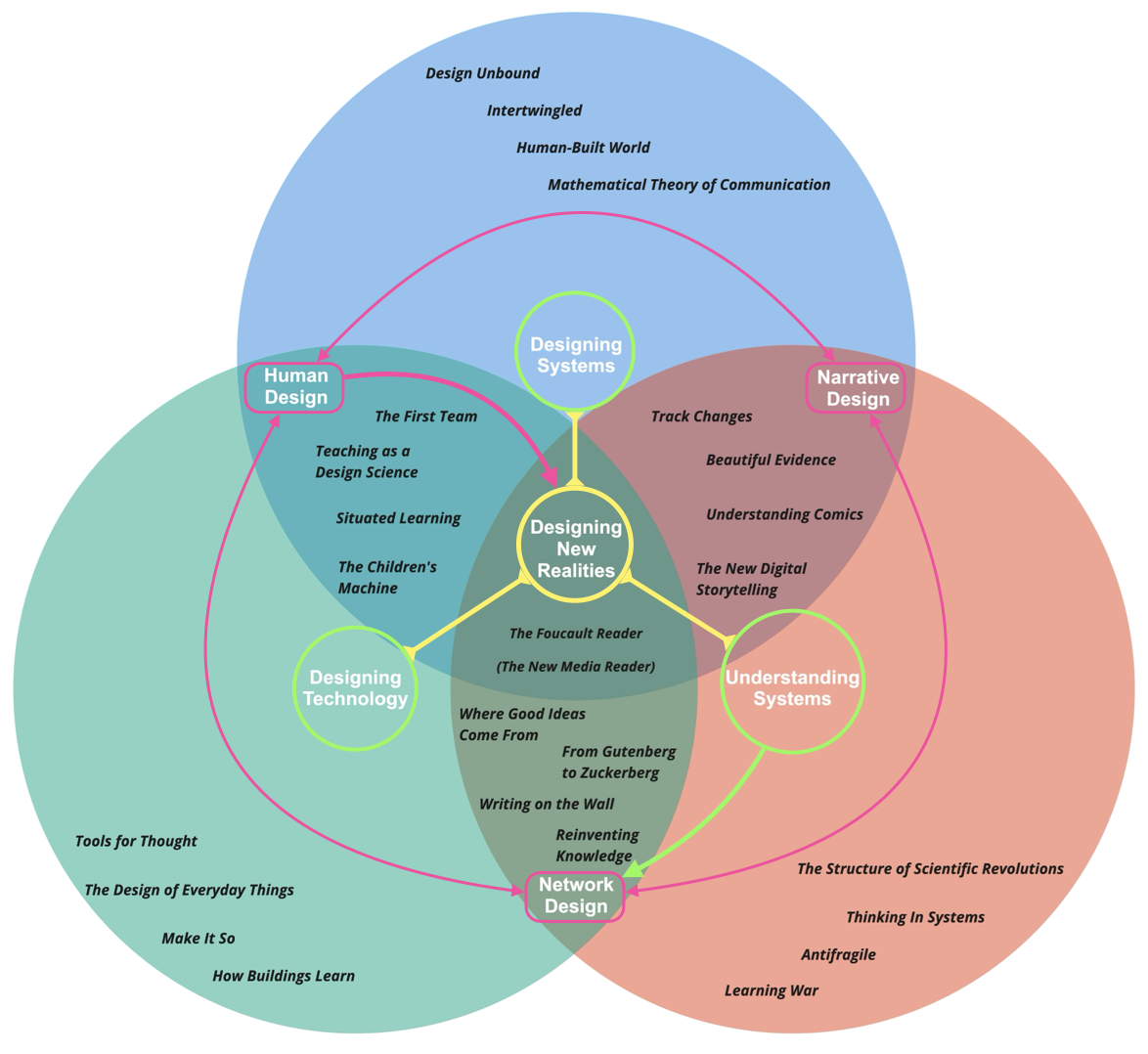
Like all curated bibliographies, both lists were exercises in synthesis. I charted how these books and articles related to each other and to the project of augmenting our intelligence through the careful construction of technologies and human systems. I created this Venn diagram of the book list.

Orbiting ConstructivismThe Original Book List Venn Diagram from 2023

I started playing with Google’s NotebookLM (co-developed by Steven Johnson, who is on the book list with Where Good Ideas Come From). NotebookLM is the closest thing to my Knowledge Navigator concept currently in the LLM space.

As I have written in the past, the real breakthrough with Large Language Models is their ability to synthesize disparate chunks of ideas without human ontologies. I was interested in exploring how well NotebookLM synthesized abstract ideas and what kinds of serendipity it might produce. I wanted to see how well it broke categories.

We learn to categorize things from a very young age. Remember the “One of these things is not like the other” segment on Sesame Street? It taught us that everything belonged in a category. As an adult, I’ve learned to reject that lesson and recognize the interconnectedness of things.

For me, when I am told that something “doesn’t fit,” I take it as a challenge to figure out how it does. I want a tool that makes it even easier for me to do this.

When I created the list, I could see the connection between Vannevar Bush’s seminal article “As We May Think” from 1945 and Kate Raworth’s “Doughnut Economics” concept from 70 years later. They are both connected by systems theory, but it’s a long and complicated road to get there.

I’ve been writing for quite some time about the idea of a Knowledge Navigator, which would take any data and synthesize it into a visual map of information, allowing the user to find hidden patterns and surfacing buried information.

©2024 Tom HaymesThe Knowledge Navigator Concept

One of the key aspects of the Knowledge Navigator idea is the ability to explore serendipity to form new connections and ideas. I was curious how close NotebookLM could come to replicating this idea.

We rely on other humans to give us opportunities for serendipitous synthesis. I do this professionally in a variety of ways as a trainer, teacher, writer, and consultant. However, the effort requires ongoing and active conversations.

I’ve found some of the most rewarding times in my life come when brainstorming ideas with people whose ideas challenge and expand my paradigms. Processing these inputs and turning them into useful new ideas requires synthesis.

However, getting people and their attention spans into that kind of alignment is hard work. Conferences are rare and expensive (and don’t always create space for this to happen). I have developed techniques to achieve these kinds of interactions, but in-person has a decided edge when it comes to the all-important side conversations that drive thinking.

As someone who spends most of his hours working on ideas alone (as many of us do), I’ve often found my creative synthesis stunted by a lack of conversation. This creates an echo chamber, where I find myself struggling with the same ideas.

I was interested in exploring NotebookLM’s potential as a conversation “partner.” Being a true partner requires that it does far more than respond to queries. It must be capable of having a conversation with my mind.

I found this serendipity in an unexpected place. One of NotebookLM’s features is an ability to generate a podcast from the information in your collection.

In order to explore synthesis, I asked it to generate a podcast based on my 25 articles. I could tell it was struggling to synthesize the diverse strands of my warped mind, but it eventually produced a 25 minute conversation. As usual, I’ve explored the edges of what the intended capabilities of the tool are.

The interesting thing about this conversation was how much it gave me an alternate synthesis to the one I already had constructed in my mind. This was synthesis and serendipity. Then I had it build two more “podcasts” (Version 2 and Version 3) for even more serendipitous fusions.

There are many problems with these podcasts. They are bland and rather white (and more than a little sexist in how they use the male and female voice). However, if you get past that and analyze how it is synthesizing the information with a critical eye, every version holds some aspect of fascination (and differs from my synthesis).

To think critically and look for opportunities, you must look at an idea from a wide variety of angles. Perspective is the difference between good and boring photography. It’s also the difference between good thinking and lazy thinking.

The podcasting function on NotebookLM synthesizes information from a different perspective than mine. The model has unusual rules about what makes “sense” so it challenges my sense making.

Sometimes this verges on parody, but even that has its uses. A few weeks ago, I mentioned the power of “parody” to shift “paradigms” (a juxtaposition that occurred to me as the result of a voice transcription AI getting my dictation serendipitously wrong).

Paradigm shifting is key to critical synthesizing, but it is hard to do systematically. You must read widely, understand what you’re reading in context, and be prepared to shuffle that context at will.

Without this skill, our civilization will not survive. Complex problems ranging from climate change to democracy in a world of information overload require a paradigm-shifting approach. We need better synthesizing tools to meet these kinds of challenges.

NotebookLM points the way, but it’s only the first step. The analyses in the NotebookLM podcasts suffer from a somewhat myopic view of the information.

NotebookLM podcast’s perspectives are incomplete. They are also, by necessity, linear, because it is trying, even struggling, to make a linear conversation out of a scatter plot of readings.

Iteration mitigates these problems, but you still must devote the time to listening to 20-25 minute “conversations.” As thought-provoking as they are, they’re still a time sink. (An integrated transcription function would be nice.) We need to synthesize much more quickly and comprehensively than the NotebookLM platform does.

The Knowledge Navigator would address this challenge by providing a two-dimensional map of the information instead of a linear narrative structure. Creating a map allows us to create a constellation of ideas, not just to ram them into a linear storyline. (See below for a comparison.)

We need better thinking tools to engage the problems of the world today. Better thinking tools are better synthesizing and serendipity tools. It’s time to get busy building them.

A Practical Example:

This exercise demonstrates the limits of textual thinking in organizing the ideas expressed in the 25 Articles list:

First of all, here is a graphic grouping of them manually created using Miro:

Image ©2024 Tom Haymes

Article List Venn diagram from 2024

When I tried to get NotebookLM to organize these ideas (even with my categories), it didn’t go so well (the podcasts it generated did a better job of synthesizing).

My query: Group these articles into one of these seven categories: 1) designing technology, 2) designing systems, 3) understanding systems, 4) information network design, 5) narrative design, 6) human design, and 7) designing new realities

NoteBookLM response:

Here is a grouping of the articles based on your provided categories:

Here is a list of titles of the categories you provided, populated with titles of the sources you provided in our previous turn:

  • Designing Technology:
    • “Man-Computer Symbiosis”
    • Excerpts from “Design Principles Behind Smalltalk”
    • “The Augmented Knowledge Workshop”
  • Designing Systems:
    •  “Augmenting Human Intellect: A Conceptual Framework”
    •  “Leverage Points: Places to Intervene in a System”
    •  “Computer Lib/Dream Machines”
  • Understanding Systems:
    • “Pace Layering: How Complex Systems Learn and Keep Learning”
    • “The Evolution of Large Technological Systems”
  • Information Network Design:
    •  “As We May Think”
  • Narrative Design:
    • Excerpts from “Science Fiction Prototyping: Designing the Future with Science Fiction”
  • Human Design:
    • There are no sources in this category.
  • Designing New Realities:
    • Excerpts from “1982violacondominiumsindataspace.pdf”
    • Excerpts from “Design Unbound: Designing for Emergence in a White Water World”
    • Excerpts from “Dynamic Difficulty Adjustment in Games”
    • Excerpts from “thinkingbackward.pdf”

And its underlying logic:

  • Designing technology:
    • This source consists of a list of references from “Man-Computer Symbiosis,” focusing on technological advancements in areas like speech synthesis, chess-playing programs, and pattern recognition.
    •  This excerpt focuses on the user interface (UI) design of Smalltalk, an object-oriented programming language. It discusses design principles and the process of creating a user-friendly environment for exploration and learning.
    • These excerpts are from a paper titled “The Augmented Knowledge Workshop.” It describes the features of the NLS system, which was designed to augment human intellect. The features include structured text, hyperlinking, multiple windows for viewing, and support for collaboration and teleconferencing.
  • Designing Systems:
    • These excerpts come from Doug Engelbart’s “Augmenting Human Intellect: A Conceptual Framework.” They propose an augmentation system to enhance human problem-solving. It emphasizes structuring information with techniques like list structuring and linking, enabling efficient browsing, manipulation, and comprehension of complex concepts.
    • These excerpts from Donella Meadows’ “Leverage Points” offer a framework for intervening in complex systems. It presents a hierarchy of leverage points, ranging from parameters and numbers to the system’s goals and the paradigm it operates within.
    •  These excerpts come from “Computer Lib/Dream Machines,” a book exploring the potential of computers in various domains. It covers hypermedia, hypertexts, computer graphics, and interactive systems, emphasizing the need for user-friendly designs that represent the true content and structure of human thought.
  • Understanding Systems:
    • This excerpt from “Pace Layering: How Complex Systems Learn and Keep Learning” introduces the concept of pace layering as a mechanism for adaptability and resilience in complex systems. It proposes six levels of pace and size for a healthy civilization.
    •  These excerpts are from “The Evolution of Large Technological Systems,” discussing the characteristics and evolution of these systems. They highlight momentum, hierarchical structures, and the interplay of various components, including physical artifacts, organizations, and scientific knowledge.
  • Information Network Design:
    • This excerpt from Vannevar Bush’s “As We May Think” proposes the “memex,” a hypothetical device that allows users to create associative trails between pieces of information. It envisions new forms of encyclopedias and information retrieval systems based on the concept of interconnected knowledge.
  • Narrative Design:
    • These excerpts explore the use of science fiction narratives in urban futures and design. It highlights the role of storytelling in shaping the imagination, facilitating discourse, and engaging communities in the design process, particularly in urban planning.
  • Human Design: This category doesn’t have any corresponding sources.
  • Designing New Realities:
    •  This excerpt suggests new ways to visualize and interact with information. It proposes moving away from linear, hierarchical structures to a more spatial, explorable “data space” that mirrors the conceptual structures of the brain.
    • These excerpts from the book “Design Unbound” present a framework for “designing for emergence,” emphasizing the design of contexts rather than things and the need for a transdisciplinary approach to address complex problems.
    • These excerpts highlight the concept of “Flow” in video game design and discuss its relationship to dynamic difficulty adjustment (DDA). It explores the application of Flow principles in enhancing player engagement and creating an optimal gaming experience.
    • These excerpts emphasize the limitations of traditional text and paper metaphors for knowledge organization and propose moving towards a more interconnected and dynamic knowledge network. They advocate for systems that enable flexible manipulation and recombination of ideas, drawing inspiration from thinkers like Ted Nelson.

The More Perspective You Have, the Less the Message Matters

Originally Published November 7, 2024

A popular Government, without popular information, or the means of acquiring it, is but a prologue to a farce or a tragedy; or, perhaps, both. Knowledge will forever govern ignorance; and a people who mean to be their own governors must arm themselves with the power which knowledge gives. – James Madison, 1820

There is a deep division in the United States and indeed throughout the world. This division is not delineated by ideology, but through our ability to make sense of information.

In a textual world, critically processing information requires complex and hard-won skills. You must be willing to pore over stacks of paper, both digital and physical. This takes time and constant attention, no matter how skilled you are at absorbing the information on the page.

Incoming streams of textual information still inundate those that don’t take the time to analyze information critically. Even if most of your consumption is through video or various forms of television, your information is a narrative constructed through or by text. Someone wrote the script. They control the narrative you are being fed.

More than anything else in the world, our ability to manufacture information products has exploded since the emergence of the digital world. Like every product, all this production has to go somewhere. We are suffering from an obesity epidemic of information.

It is just too much to process. Our bodies are shutting down. We shovel constantly just to get through the day, but it keeps coming. It’s mentally and socially exhausting.

That world has always been out there. The difference now is that we can see it and feel it to an extent impossible before.

The last time we experienced a narrative explosion of this type, we fell prey to demagogues. In the 1920s, radio exploded onto the scene. Like the newspaper, it was a storytelling device. Unlike the newspaper, it was far more accessible because you didn’t need it physically delivered to you and you didn’t have to be able to read.

Radio was also controllable because the technology necessary for broadcasting was big, expensive, and technologically complex. Narcissistic demagogues seized on this capability to seize the minds of vast numbers of people in a way impossible even a few decades before. If we were lucky, they were benign, like Franklin Roosevelt. If we weren’t, they were Hitler and Mussolini.

It’s no accident that during the Cold War, every time there was a coup, the first thing the insurgents seized was the radio or TV station. With that, they could try to control the narrative of what was happening.

With the digital revolution, suddenly everyone had a printing press, followed by everyone having a radio station, and then a TV station. But even here, there was a measure of control.

Those that had control over the means of distribution, social media companies from Google to Facebook to Twitter, could still influence the narrative behind the scenes through algorithms that controlled the flow of this vast trove of content, but the nature of this control was both more subtle and difficult.

As I discuss in Discovering Digital Humanity, a lot of good came from this explosion of content. Voices that were previously muted or unheard through the chokepoints of broadcast media, suddenly made themselves felt. We discovered our communities were far more diverse than we had previously imagined them to be.

However, even the good increased the cacophony of information coming at us. Most of this information was linear. Even a YouTube video has a linearity to it.

One innovation of TikTok is that it offers us a potential kaleidoscope of ideas in a nonlinear fashion. From a creator’s standpoint, at least, storytelling is short and unstructured. This comes through even though it they are manipulating it through an algorithm behind the scenes.

I am not a TikTok user (although many have urged me to become a creator) in part because I prefer to structure my narratives through the more traditional process of writing.

I am putting myself at a disadvantage because of this decision. My blogs fall into the maelstrom of information that is LinkedIn or the web (depending on where I post them). Few see them.

TikTok to the user, however, appears to offer an unstructured narrative environment unlike any other. It leans into the unexpected. This is also the way Twitter used to be.

We enjoy serendipity. Unfortunately, in an environment characterized by radical abundance, too much “serendipity” can easily become overwhelming too.

It’s easy to get tunnel vision as we struggle to make sense of the overwhelming flood of inputs. It is precisely this yearning that makes us so manipulable.

There is something profoundly unsettling about ambiguity. If someone comes along and convinces us they can make sense of it all, they have tremendous power over us.

But we don’t live in a mono-narrative world and that’s what makes it so threatening. Humans require information to survive. It is our evolutionary edge. We remember things and can make sense of things like no other species on the planet, but the other side of this is our struggle to define patterns.

It is because of our urge make sense of it all, that today’s most valuable commodity is structured narratives. The problem is that if we can’t make sense of the overwhelming flood information coming into our headspace, someone else will do it for us.

All around the world, we are seeing expressions of fear. It is not about competing narratives as much as it is about our inability to construct safe narratives.

The more information we get, the more we must filter out. We create systems to help regulate this, but even they are incapable of shifting fast enough to deal with the constant streams of conflicting information.

Our best defense against tyranny is a better set of information tools. When you are lost, the tool you need is a map. This is true whether you are a business trying to understand a complex world for competitive advantage, or an individual scared of the present and future.

We all survive on a little knowledge. There are a few who, through either training or skill, can step beyond that in to realize that our paradigms of knowledge are not absolute. Donella Meadows called this skill surfing paradigms.

The fundamental problem of our age is not the erosion of our societies. It is our societies’ inability to cope with a kaleidoscopic information environment using linear tools. If the world doesn’t make sense to you, someone else will step in and try to make sense of it for you. Now you have really lost control.

Most people are decent, and if we give them the right tools to feel safe, they will make the right decisions. If you think I am talking about the people that voted for Donald Trump this week, this is only partially true. The other side of the argument has yet to find a singular demagogue, but that doesn’t mean that it also doesn’t have its own holy narratives. This is an equal opportunity challenge.

If you threaten my dog, he will react in one of two ways. He might fight back, bark, or try to scare away a threat. However, my dog is equally likely, if not more so, to retreat and find a safe place to hide.

Humans hide in their narratives. If we are going to solve the problems of the world, we need to come out of our holes and look around.

Achieving narrative perspective will require a new way of looking at the world and new technological tools, which are just now beginning to emerge. At its core, this is the project I’m working on. If the events this week emphasized anything, it is the urgency of this task.

Spatial Narratives

Originally Posted October 31, 2024

“While image is, text is always about.” – Nick Sousanis

We are used to linear stories and construct them out of habit. However, the world is not linear. We just like to think it is.

We also like to think that the overarching narrative of society has a trajectory. In modern times, at least in the west, that trajectory is perceived as trending toward “progress.” In other words, tomorrow is “better” than today, and we can “build toward a better tomorrow.”

This trajectory is not consistent, however. At other periods of history, and in other cultures, the trajectory of the overarching narrative varies.

For instance, European Christians during the Middle Ages viewed the world as being in decline.  Therefore, all their efforts in this world were oriented toward their standing in the next.

The trajectory of narrative that we impose on our world creates all sorts of, sometimes contradictory, pressures from history to philosophy to literature. It shapes our appreciation of the possible.

If we feel like we’re moving upward toward a better world, then we will build toward the future. If we feel like the world is coming apart, we tend to retreat to preserve what we can. If we feel the world is in decline, then we defer living and await the next chapter. These interpretations of time are artificial constructions, but our reactions are not.

Text is a natural outgrowth of our search for linear meaning. Even before literacy, we told stories with beginnings, middles, and ends. Writing only reinforces this.

Narratives became more formalized over time. However, they also became more fictionalized as we struggle to cram increasingly diverse experience into linear narratives.

Editing is a natural part of this process as we must decide what to include and what to discard. As a result, we frequently alter stories to cover up unpleasantness both in our own lives and in our collective experience.

But every historian will tell you that the stories are just that: stories. The whole practice of historiography is based on the fact that there is no one true narrative about the way things happened in the past.

Our pasts, presents, and futures are miasmas of conversation and negotiation, not legacy or destiny. Alternative narratives proliferated in recent decades because they are easier to tell, not because there are suddenly more of them.

Again, it is a natural human inclination to tell stories. They help us make sense out of the world.

Concept mapping helps us explore alternative narrative possibilities because they are nonlinear. They often lead to new insights because we get stuck in narratives that don’t make sense. Dead end narratives impact our ability to move forward as individuals or as organizations.

But entrenched narratives are difficult to dislodge. Even when someone comes along and points out that your narrative doesn’t make sense anymore, you cling to it because it makes sense to you and provides structure and order to your existence.

The narrative in this blog is a lie. The narrative in this blog tells the truth. It has a beginning, a middle, and an end. We’re in the middle right now. You will judge my skill as a writer by how skillfully I move the reader down this pathway.

However, text is not the only way to tell stories. Visual media allows us to step back from the linearity of our stories.

If you look at a photograph or painting there’s a narrative embedded in it, but it doesn’t follow a linear path, at least not one that’s wholly dictated by the artist. We are allowed to create our own narratives and lay them over the narrative that was communicated in the artwork.

Maps are more like photographs than stories. They represent complex layers of narrative. No map is an absolute reflection of what the world actually is but we like to think they can be.

The idea of the Knowledge Navigator is to create visual representations of information that instantly change based on the same information using generative large language models as an engine for doing this. The idea is to disrupt our teleological sense of narrative by exposing false narratives about where we are now and how we got here.

To understand possibility, we need to be able to run time backwards, forwards, and sideways to liberate ourselves from destiny. Images give us that power.

Instead of being confined by the destiny of text, we are empowered to explore alternative interpretations of reality. It is possible to do this through extensive reading. This is a labor intensive way to gain critical perspective, whether you are trying to understand a historical event or poring through your company archives in search of a forgotten brilliant idea.

By taking information and turning it instantaneously into maps that show us different versions of the world, the Knowledge Navigator would empower us to change how we see it. It would allow us to construct alternative narratives for both the past and how that might impact the future.

Being able to process complexity is essential for learning. It is also central to the process of innovation, which is just a form of learning at scale. We cannot do either unless we are willing to move out of our narrative safe zones and see the complexity of the world for what it is.

Perspective gets harder the more information that we must process. We have gotten a lot more information in the digital age. We need better tools to help us construct better, more inclusive narratives to become better humans and generate the essential insights necessary to confront the challenges of today.

« Older posts Newer posts »

© 2026 IdeaSpaces

Theme by Anders Noren — Up ↑