
Month: November 2024 (Page 2 of 2)

Building Tools for Seeing, Not Knowing

Originally Posted May 13, 2024

“It’s the questions we can’t answer that teach us the most. They teach us how to think. If you give a man an answer, all he gains is a little fact. But give him a question and he’ll look for his own answers.” – Patrick Rothfuss

Most of us suffer from a crisis of seeing. What we can’t see, we believe we know, and that’s a problem. We need better tools for seeing, not knowing, and yet that’s what we insist on trying to turn our latest AI tools into. They don’t do that very well unless accompanied by a lot of critical seeing.

We often forget that scientific progress is based on seeing, not knowing. The scientific method always questions what we know and seeks to reconcile that with what we see. Yet we expect science to knowbecause it brought us so much knowledge.

Humans want certainty, an end to the pathway. However, any scientist worth his or her salt will quickly disabuse us of the notion that we know everything. That is because knowledge is a process of constant discovery.

However, we look to our tools for knowledge, not seeing. When we pick up a book (a tool), it’s ostensibly to gain knowledge. When we read a blog or a website (also tools), we’re doing the same. They may be connected to other containers, but those connections are often hard to perceive (a complaint about the internet shared by Tim Berners-Lee and Ted Nelson). The same is true of AI Chatbots. They’re making lots of connections behind the scenes, but we can’t see them. Seeing requires connection.

Seeing beyond the boxes of knowledge that books and website represent requires a great deal of education and practice. Most learners never get to this level and, until they do, they don’t accept that all knowledge is contextual and connected.

I tell my students that there are no right answers in my class, but there are wrong ones. This is to encourage them to explore and create, but to base that on solid foundations. I want them to explore connections, not given “facts.”

They resist this because they want to know the “right” way to do it. This is a direct product of a “learning” system has trained them to fear failure above all. You can’t see without failing.

As an author, I recognize that there are a multitude of compromises necessary to smash any set of ideas into a book, or any other textual format. When we teach the book, we rarely acknowledge what’s going on beyond the covers.

That’s because it’s hard to see those connections. You can follow citations, but that takes a lot of extra work and even they don’t fully capture the imagination of the author.

As a teacher, I recognize how hard it is to get the students to read the book in front of them, much less to acknowledge the vast number of books that exist around that book. Books risk tunnelling our vision because of how they work as narrative containers.

The tension between creativity and conformity is something that our systems of learning struggle with. I remember a conversation with my daughter’s 5th grade math teacher about a particular practice question that my daughter got “wrong.” I pointed out that the assignment worded the question badly and that there were multiple answers to it.

The teacher agreed with me that the question was problematic, but argued that there were problematic test questions on the standardized test that had to be accepted as correct because that was all that the assessment permitted. What you saw (or deduced) didn’t matter. The test itself was the knowledge that mattered and you didn’t want to “fail” that.

Part of being a good thinker is accepting uncertainty. Part of growing up is recognizing that there are many things left to be discovered. Certainty closes that door.

We equate knowledge with certainty because that’s how we learned. This is a fallacy and a corruption of what it means to be “knowledgeable.”

This corruption lies at the center of many of our struggles today. We go around expecting certainty. People wanted certainty during the pandemic, but all legitimate science could give us was a set of probabilities. The same conundrum exists as we struggle to confront the complexity of climate change. There is no certainty there, only probabilities.

However, humans crave clear narratives. Even if they are false, they provide patterns in a complex and uncertain world.

Science has moved past that. Since the discovery of first relativity and then quantum physics over a century ago, science and math realized the world does not work like Newtonian clockwork.

Observations can fool us, and we are continuously searching for better explanations. However, our quest for certainty compels us to insert mysticism where science is still searching for answers. That doesn’t mean the answers are not out there. It just means we haven’t understood them yet.

We couldn’t explain eclipses for much of human history and assigned to them a mystical value because we sought to clear up the uncertainty they aroused. Quantum physics is no different. We are equally wrong to associate it with the certainty of a belief structure to explain it.

With the flood of information we’ve unleashed through the digital revolution, our cloistered informational existences are constantly challenged. As we quest for certainty, these disconnects become ever more apparent and uncomfortable to us.

We lack the tools to see information clearly when one “definitive“ narrative conflicts with another. The current crop of generative AI tools doesn’t get there.

Asking a chatbot for difficult perspectives often triggers a host of “guardrails” to keep us from exploring uncomfortable subjects. AI companies think these guardrails are necessary because we accept their products’ answers as being “given knowledge,” not a synthesis of human conversations online.

AI Chatbots blind us to context. This is not seeing.

Generative AI reflects on us as much as anything the models are doing. Their outputs are the product of trying to create linear narratives out of a profoundly nonlinear observation. We struggle with the chaos of human existence, perceptions of systems of thought, and governance. If we build a tool that merely reflects our “knowledge” we should not be surprised if it reflects that blindness back onto us, garbage-in, garbage-out.

Our quest to know has blinded us to the possibilities of seeing. We need better tools to contextualize our ideas. As teachers, we need to teach the skills of navigating complexity rather than the skill of producing certainty. We must highlight what we don’t know as much as what we do.

New tools for thinking are necessary to facilitate this process. Books are wonderful tools for knowledge and are essential for seeing, but they have limitations as tools for perceiving the world. They can be hard tools to master. Chatbot tools merely reflect this struggle.

Like every tool, we should use them for what they are best at. However, we must look for augmented tools to help us see the world differently (and this includes the analysis of our narratives themselves). AI could provide those tools for us, but only if we design tools to take advantage of its ability to see differently rather than “know” more than us.


Communicating Thinking in a Digital World

Originally Posted April 19, 2024

For this invention will produce forgetfulness in the minds of those who learn to use it, because they will not practice their memory. Their trust in writing, produced by external characters which are no part of themselves, will discourage the use of their own memory within them. You have invented an elixir not of memory, but of reminding; and you offer your pupils the appearance of wisdom, not true wisdom, for they will read many things without instruction and will therefore seem [275b] to know many things, when they are for the most part ignorant and hard to get along with, since they are not wise, but only appear wise. – Plato, Phaedrus (275)

This week, a topic that seems to be a repeating theme in my practice of teaching and consulting is the question of thinking. I keep hearing from faculty members that writing is thinking. As a result, their students’ ability to use generative large language models to create writing that mimics thinking threatens them.

The written word dominates our world, but it is not synonymous with thinking. Much of great thinking is not written, and too much writing contains very little thought. AI may be a threat to thoughtless writing, but it’s not a threat to thinking.

Plato argued that writing was going to destroy thinking. He wasn’t wrong. Even in ancient Greece, it democratized our ability to express ourselves, but, as King Thamus points out, that came as the cost of memory and rigor. Our ability to memorize epic poems has declined since then. Arguably, his prognostications of people using writing “to appear wise” have also borne out.

The invention of writing was not the last time technology democratized our ability to share our thinking. Gutenberg’s press prompted similar outcries as the invention of writing itself. We have heard criticisms like this again over the last few decades as writing became a digitized medium.

The digital revolution has given us all printing presses and has created a proliferation of all forms of reading and writing. This abundance has created a side effect of mediocrity. Any wag can be a pamphleteer if they have a printing press. Everyone has a printing press these days.

The reaction of the establishment was the creation of education and sets of standards that separated writing from the unwashed masses. The written word became the coin of the realm in higher education through the process of publish or perish.

This has had the unfortunate side effect of making even scholarly writing a commodity. As the educational culture forced more and more people to publish for extrinsic reasons, such as to keep their jobs, the quality of the thinking declined. Add to that financial pressure to bias research and the result is a lot of bad “scholarly thinking” that just happens to be written and passes through the peer review process.

The latest iteration of this is the discovery that people are writing scholarly works, and even books, by generating them with chat bots. Writing is no more immune to a race to the bottom than any other creative pursuit. Generative large language models do an admirable job of mimicking thoughtless writing, even in academia. They’re only going to get better at it.

As writing has become more and more ubiquitous, the limitations of thinking skills become more and more obvious. Quantity does not equal quality.

So why are we so obsessed with teaching our students to write rather than focusing on their ability to think? Writing is a quantifiable measure. One reason is extrinsic: Requiring students to write X number of words or pages for a class is something that is easy to measure. Measuring thinking is much harder.

After 20 years of teaching, I can say that quantity does not equal quality. When writing was the only way in which my students could express their thinking, this was a trade-off I had to live with. Of course, even 20 years ago, I couldn’t tell whether a student, or a sibling or parent had written the work they were turning in. Therefore, I could never be sure who was doing the thinking.

The “solution” that some have fallen back on is making more manual, in-class, writing assignments. But what is that teaching? I think with many aids these days, including using AI at various stages. When teachers limit students to pencil and paper, this creates a false environment that in no way reflects the kinds of thinking skills they will need in the real world of today.

Yes, we need to train our students to communicate their thinking effectively. However, we also must accept that no one communicates without technology.

Good thinkers use a variety of tools to create. I didn’t go to the library to write this blog. I used Google. I used AI-powered grammar checkers that help me avoid bad writing habits (which don’t like the fact that I used “I” to start five sentences in a row). I even used ChatGPT to see if my prose was telling the story that I wanted to tell. I shared my thoughts on LinkedIn, not a scholarly journal. Are those uses of technology cheating?

The days of oral poetry are thousands of years in the past. Technology will enter the picture somewhere. As Plato implies, writing itself is a technology. However, teachers and academics overlook that digital technology has opened the doors to a range of complementary technologies ranging from webpages to concept maps to comics to photography, and many more.

When we focus on writing as the only technology, we miss the potential for understanding different ways of thinking. Text drives narrative in certain directions. It leads to over-specialization and the fetishization of narrow slivers of knowledge. It is also something that machines like generative AI find easy to mimic even in the iterations we are using today.

Over the last 40 years, we have opened doors to new ways of expressing our thinking that the educational community has largely ignored. Artificial intelligence, which I prefer to call “augmented” intelligence, augments our ability to think as well as communicate in unprecedented ways. When we don’t teach learners to think in an AI world, we are doing them an immense disservice.

Instead, we should structure our educational experiences to incorporate every tool we can lay our hands on instead of insulating our students from change. If our educational systems don’t do this, society will find replacements for them. The graduates that we produce will be the actual victims here. We need thinkers more than ever today.

Generative AI can be a partner in understanding what our students are thinking. It reduces the friction between thought and narrative. I have found it an invaluable tool for gaining insight into what my students are thinking in real time. This alone makes it far more powerful than any paper or essay they could write.

Technology provides us with tools we can use to figure out what others are thinking. When we fetishize writing, we confuse means with ends. Writing is a means. Thinking is the end. We should teach thinking and use every technological tool we can find to achieve that end. To achieve this, it’s time to stop worrying about protecting the means of getting there because that’s what we’re used to and lean forward in our teaching strategies.

Artificial Stories

Originally Published April 4, 2024

“We shrank our ideas to fit on pages sewn in a sequence that was then glued between cardboard stops. Books are good at telling stories and bad at guiding us through knowledge that bursts out in every conceivable direction, as all knowledge does when we let it. But now the medium of our daily experiences—the internet—has the capacity, the connections, and the engine needed to express the richly chaotic nature of the world.”

David Weinberger quoted in Jarvis, Jeff. The Gutenberg Parenthesis (p. 231). Bloomsbury Publishing. Kindle Edition.

A couple of weeks ago, I wrote about how technology has transformed my writing. When I refer to “my writing,” I’m talking about constructing linear narratives like this one that are the product of print age thinking. Today I want to consider the possibility that this method of expression does not capture the world of ideas and knowledge exposed by the internet.

I just finished reading Jeff Jarvis‘s excellent Gutenberg Parenthesis. In it, he relates the story of how print shapes societies, and how this is ending. One of the key points at the end that he makes going off of Psychologist Alex Rosenberg’s research is that we have a natural disposition toward linear storytelling. “Humans became proficient at predicting the immediate behavior of other animals and humans, which led their literate descendants to believe they could not only predict behavior in the present and future but also explain it in the past, in history. (p. 229). Print reinforces the narrative of the hero’s journey.

We are all on our own hero’s journey in our own minds. Humans are biologically predisposed to believe in pathways. School reinforces this tendency. We talk about learning pathways, career pathways, and life journeys, as if they have a beginning, middle, and end. The teleology of our lives does invariably end in death, but that doesn’t mean there is any logic to what happens before then.

Print segments those journeys into chapters, and, like military promotion, there is an expectation of an upward trend. Marketing reinforces this through endless advertising promising a route to the good life. We condemn political leaders for a lack of progress (although we often struggle to define the term). The stock market punishes CEOs when companies do not grow at a predicted rate.

Attempts to marry this with educational progress have often been disastrous. Education is particularly guilty of chaptering itself. The whole point of K-12 education is to advance to the next chapter, which is higher education. The whole point of higher education is to get a degree to advance to the next chapter of employment. Skipping chapters results in punishment. You are not qualified for a job, because you do not have the appropriate piece of paper that shows you completed the requisite chapter. Life is far from a Choose Your Own Adventure Book.

Once you have a job or, better yet, a career, your goal is to advance within that career along a predictable path. Employers and HR departments trying to understand your story view interruptions or side journeys with suspicion. Everyone needs to advance from employee to manager to senior manager to director to executive director, etc. if they hope to get to the presidency.

Learning has a beginning, middle, and end. Money drives this, and so do accountability paradigms. When we write history, as Jarvis points out, we want to turn it into a coherent narrative instead of a chaotic series of events. When we write our own history, we feel compelled to do the same.

I am well-versed in storytelling. As a writer, you’re forced into linear models of storytelling. The expectations are the same if you are teaching. Photography is different. It’s storytelling all about taking the complexity of the world and simplifying it.

Right now, we’re looking for AI to tell stories as well. When the chaos of reality creates “hallucinations,” we look at that as a storytelling failure, but humans also routinely hallucinate stories that only make sense to them. The only actual difference is that AI is still struggling to make sense of the world we’ve long since “rationalized.” We’ve created the illusion of sense in our efforts to create stories that the current crop of generative large language models cannot match. I’m not sure they’ll ever get there.

Therefore, we should not push them in that direction. That is not a good use of their capabilities. Instead of trying to force them to teach us new, coherent stories, we should use them to better understand the chaotic nature of our own stories.

Large language models have exposed the inadequacy of our storytelling capabilities by shining a mirror on ourselves. We just haven’t realized that yet.

My story is a good example of a nonlinear pathway. Over the last few years, I have struggled to define myself. I don’t fit neatly into any pathway. My story encompasses technology, teaching, creating learning spaces, designing educational pathways, mapping knowledge, and creative expression.

Deep crosscurrents of visualization, communication, project management, and creative problem-solving cut across all these pathways. One of these pathways by itself would make sense to a person focused on a linear career path. (As an experiment, I asked ChatGPT to write bios of me using just the information on the About Me page on ideaspaces.net.)

My career forms a scatter diagram of data points and many linear pathways. I’ve tried to get around this by creating a conceptual map of my career and work, but that doesn’t seem to register with people used to looking for a linear pathway, represented by a standard CV or resumé.

I know many people who climbed a more traditional career ladder but found themselves stuck in a pathway that may not make sense to them anymore. That’s because life is a scatter diagram of experiences, not a set of rails. It is only our narratives that make it seem linear.

As Jarvis points out in his book, this tension between the end of the book and the start of distributed knowledge threatens a whole range of institutions. Education is close to the top of that list, but the world of work will also become far more unpredictable as time goes on. The tyranny of the linear story will hurt more and more people as their pathways become disrupted by the realities of the world.

As humans, we crave certainty. In a world of uncertainty, characterized by a massive flow of information, we are led astray by those promising a level of certainty that they are incapable of delivering. This tendency is dangerous to a democracy because it leads to demagoguery based on faith. Democracy depends on recognizing complexity and coming to terms with competing narratives.

We need to embrace chaos instead of ignoring it or trying to shove it into linear stories. Linear stories will always have their place because they conform to deep-rooted human psychological traits. Our rational minds, however, must recognize the irrationality of this approach to organizing knowledge.

A good first step to this would be through the creation of knowledge maps. AI has been pretty good at illuminating the shortcomings of our mental approaches to the complexity of the world. Instead of expecting to turn that teleological construct into something linear, we should instead lean into its capabilities to strip away preconceptions and false pathways.

We can build augmented intelligence tools to help us map connections between human narratives instead of trying to force it to create even more artificial narratives. In this role, it becomes a partner in our storytelling and not a potential replacement. It augments our intelligence instead of artificializing it. It makes us stronger, not weaker.

Writing With AI: Transcendence or Replacement?

Originally Posted March 21, 2024 

Give a man a book, you entertain him for a night. Teach a man to write, you give him crippling self-doubt for life. – Andy Weir

I’ve been thinking a lot lately about my qualities as a writer. Andy Weir’s statement has a deep resonance with me. It is difficult to step outside yourself enough to appreciate the quality of your writing. Getting other people to read my work in a busy world is half the battle. I’ve had my writing described as “deep,“ “thoughtful,“ “too negative,“ and many other things. However, my greatest critic is myself as I struggle to get my points across as a writer, photographer, and visual communicator.

I consider writing an artistic process, not a technical exercise. In some ways, it both competes with, and complements, my work as a photographer. I must be in the mood to write. There are certain times of the day where I write well and other times of the day where I’m better off doing other things. I only seem to have enough in the creative tank to focus on one at a time. That’s not entirely true, but my writing output negatively correlates with my photographic output.

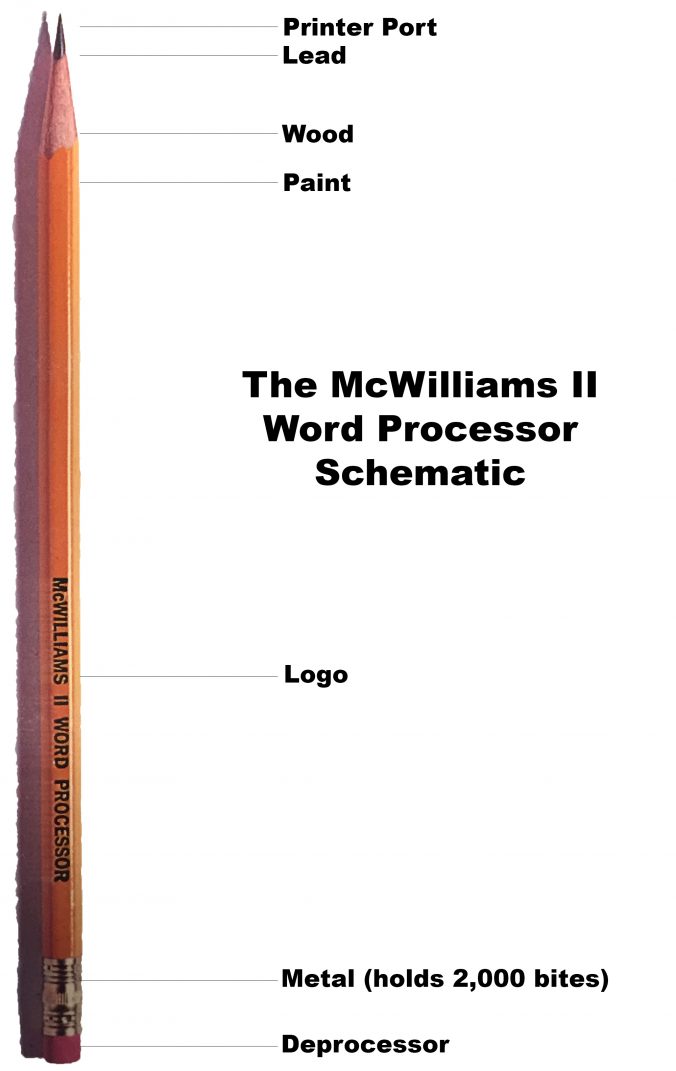
 Over the last year, I’ve been playing with AI to realize both my visual and textual ideas. The impact of technology on my writing has increased over the years. I’ve written extensively about how word processing shaped my writing in the early years.

 Since then, however, I’ve gone from using a spellchecker to grammar checkers to style checkers. My book, Discovering Digital Humanity, was copy edited using ProWritingAid as I did not have the funds to hire a human editor. That program also subtly changed the way I write by making me more self-aware as a writer.

 Generative AI has taken the automation involved in my writing to a whole new level. I started out using it to create drafts for blogs to break bouts of writer’s block. Over the last year, however, I’ve experimented with several techniques that shape the writing itself. The results have been a mixed bag.

 I started out trying to improve the criticism that my ideas were too hard to follow in text. I asked ChatGPT to rewrite blogs and other materials to appeal to a higher Flesch reading ease score. The raw result was often misleading.

 However, by putting it side to side with my original text, I could edit the original to make it more approachable. At least that’s what I think I was doing. As with every writer, I think I’m making perfect sense and struggle to understand why others struggle with my text. That’s where that crippling self-doubt comes into play for me.

 After these experiments, I asked ChatGPT to alter the tone of my arguments and make them more positive. The result was a bit more useful and figured heavily into the writing of a blog I published about a month ago, called “In the Beginning.”

 I’ve also learned that I can feed my blogs and other writing into ChatGPT and have it summarize my arguments. If the summary aligns with my intent, I at least know that another filter understands what I’m trying to say (helping with my “crippling self-doubt”). This was a useful check, but it didn’t really change my writing style very much.

 Writing itself is a technology for communicating thoughts and ideas. The technical means by which we produce it have always acted as an intermediary between the communicator and the receiver.

Text requires literacy to appreciate. Literacy is a variable, not a constant. This factor is crucial to whether the reader understands what I’m trying to say.

If I use Generative AI to make my writing more understandable, is it still my writing? If I ask a Generative AI to write a letter or blog for me, I think it’s clear that unedited those are not my words. But are they my ideas?

This blog started using an AI because I dictated it into my phone as I walked. The words are all mine, but they’re often garbled and require editing after the fact. But the ideas were in my head at that moment.

But what if I run it through ChatGPT to make it more understandable or organized? Is that still mine? Is this only controversial because we haven’t worked our way through it yet? Even grammar and spelling checkers are making judgment calls. With language, humans are also always making judgment calls. For instance, there is the endless debate over the Oxford comma (pro tip: you can’t write the word “comma” while dictating). So, is it illegal to use a grammar checker?

 Plagiarism inevitably comes up in this context. We don’t know where many of the generative AI tools get their raw materials from. They mash it up just like humans do.

The ideas in this blog also come from dozens of teachers, books and articles I’ve read over the years, many of which I have forgotten, but whose ideas I’ve internalized while forgetting their original source.

This blog would not be possible without the thinking of McLuhan, Foucault, Engelbart, Nelson, and many, many others. One reason that I’m wanting an AI tool like a Generative Augmented Perspective is to make a map of where my ideas come from.

I started this blog out musing whether my writing was truly mine. I must balance that out against the reality that no one’s writing is truly theirs because many teachers, both alive and dead, have influenced it over the years. Am I teaching the AI to replace me as a writer? Is my thinking replacing any of the thinkers I referenced above? It is not.

I can’t see AI replacing our thinking. I am a different writer because of technology, but so was Shakespeare. The idea of writing downplays for publication was as revolutionary as his prose. This hasn’t changed.

Writing is always going to be hard, but that’s because thinking is always going to be hard. Writing that doesn’t require thinking is a technical exercise. AI can replace that. But if AI helps me think and communicate what I’m thinking and gives others fuel for their own thinking and creativity, that’s useful.

Generative AI’s impact on human writing might represent a shift of the magnitude of Gutenberg’s press. Everybody seems to be worried about AI replacing human thought. I’m excited to see where it takes human thought.

  • The first draft of this blog was 1580 words.
  • The final draft of this is 1085 words
  • I’ve used the following filters: Siri dictation, Google Grammar, MS Word Grammar, and ProWritingAid

Creativity vs. Conformity and Our AI-Augmented Future

Originally Posted February 29, 2024

This semester, I am once again struggling with the demons of conformity in our educational systems. We like to tout how education encourages creativity and critical thinking. Those students who rise above its deadening mechanics of grades and bounded knowledge are often lauded as its stars. Yet most of them have learned the lessons of conformity that the system teaches. This puts them at a severe disadvantage in a world where AI is increasingly good at meeting conformist expectations.

In my design-based government classes, I have always worked to give my students the tools to design processes to understand, explain, and creatively approach the government process. This bewilders many of them.

I had one student complain about me last year because I didn’t give her precise rails to follow for every assignment. She wanted me to give her a problem with a single solution, explain the solution, and grade how well she conformed to my expectations.

She didn’t like it when I asked her to investigate and create her own problem, find approaches to it, and design creative approaches to implement those approaches. In short, she wanted me to treat her like a Generative AI.

Many of my students struggle with the idea that they must understand a societal problem before they can dictate “solutions” to that problem (as do many of our politicians). Students are used to being given a problem and graded on how well they conform to the proscribed solution. The real world doesn’t work that way.

Grades are also a mechanism for conformity. For them to work, you must define “A” work and they have to conform to those expectations. This often leads to “minimum necessary” approaches to the work and what I refer to as “transactional teaching.” You do a trick and I pay you for it with a grade.

This year, for the first time, I’m teaching a creative topic, photography. I am teaching it at a “college prep” school with a huge emphasis on “making the grade” so that you can get into competitive colleges.

There is a chunk of my students who yearn to break from these shackles, but many of them are marking time for their other classes. I must grade in this class as well, but I’ve very much approached it as completion grades, like I do in my government classes: You do the task and meet the minimum requirements and you get the points.

The problem is that in a creative endeavor, minimum necessary almost always leads to mediocre results. Every student in my class can make extraordinary images. They all have at least one quality image in their portfolios, but they don’t stretch their vision consistently.

Good photography requires that you slow down and contemplate what you are doing. I have tried many tricks this year to get them to do just that, like breaking assignments into two parts with a requirement that they go back and reshoot the subject after a critiquing session.

However, they often lump both halves together, defeating the purpose. My only recourse is to be punitive with grades to force them to follow the system.

Relying on grades for compliance undermines my goal of getting them to slow down and think about what they are doing as they contemplate a scene. Like the government student, they’re just “fetching” images like Dall-e and Mid-journey most of the time.

The emergence of generative AI elicited a negative reaction from the artistic community. There were fears it would create and pass off its creations as “human” and that it was getting its creative inputs from human creations without respecting copyright or creative licensing.

This misses the point. All artists steal other artists’ work. AI replicates this part of the process pretty well. What it doesn’t replicate well is the value added by adding human creativity to that theft. Sure, it can replace artists, but those who have the most to fear are those that create art that is easily replicated.

The dirty little secret of the art world is that the industrial processes that have taken it over demand a level of conformity to maximize art’s profit potential. There are also a lot of low-level artists that survive on churning out content based on artistic techniques that have lost their creative roots, but they must do this to make money in the system.

Current Generative AIs can replicate many of those derivative techniques because they require little creative thought, just rote repetition. The sudden proliferation of AI-generated images on YouTube and elsewhere is one demonstration of that.

Generative AI, however, is not creative. Sure, it can “create” a level of novelty. Sometimes that novelty can be truly Daliesque. However, the root of AI images is always the of the prompt created by a human. Bad prompts accepted without a critical eye make for bad images, even in generative AI.

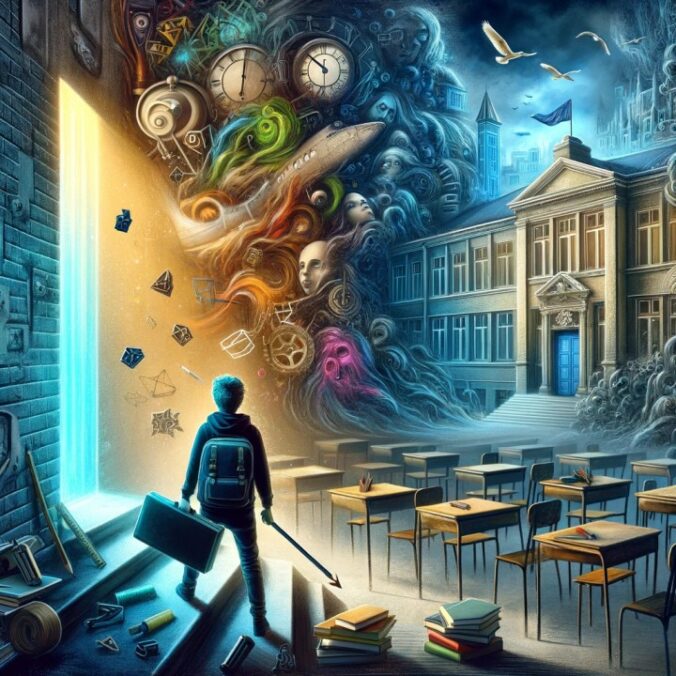
For the header image of this blog, I asked it to create me an image of a “student torn between creativity and conformity in their learning.” Then, I asked it to change the image to “add to it the element of a school pushing him toward conformity.”

My prompts required a level of creative thinking. They also required me to define a problem set I wanted illustrated and to look critically at the image that it generated.

As I have played with Dall-e over the last few months, one thing I’ve discovered is that it illustrates abstract concepts remarkably well. As in my photography, I have many ideas in my head struggling to get out, but I struggle to execute them so that they resonate with others.

Text is a complicated business (I’ve found ChatGPT helpful there as well) and images require a high degree of technical proficiency (and time) to create. For over a decade, I’ve used concept mapping software as simple (and collaborative) illustration tools. However, even with these powerful tools, it’s still a lot of work to express complex sets of ideas.

AI can be a tremendous partner to help humans create and analyze complex ideas. The jobs it replaces are those that emphasize conformity.

All my students will need to think creatively as they interact with AI going into the future. I can manufacture conformity using AI tools with ease, but for AI to augment what I’m doing, I need to approach it with refined creativity and critical thinking skills.

Conformity was a trait valued in the Industrial Age, so we designed our systems of education to meet that need. There are many studies that show how educational processes drum creativity out of our students. By the time they get to me in college and high school, they are very resistant to exploring ideas creatively. My students seek answers, not questions.

It is imperative that we identify why this happens and transform the philosophical underpinning of what we’re doing in education. AI will punish conformity and reward creativity. If we don’t stop churning out conformists, we are doing our students a tremendous disservice.

Art, Technology, and Simplicity

Originally Posted February 12, 2024

Life is an ongoing journey to unravel the complexities of the world. Despite the increasing intricacies, we persistently seek anchors and waypoints to navigate through it all. In today’s technologically driven era, we find ourselves inundated with vast amounts of information and choices, which can sometimes overwhelm us.

It takes a certain humility to admit that the more you know, the less you know, you know. Toddlers have an enviable certainty about the way the world works. Most of us recognize over time that our imaginations inherently limit our ability to understand and process. Our imaginations are simultaneously the outlet that gives us art, which is an imagining of a more ordered state of the world.

Having dedicated over four decades pursuing the photographic art, I’m intimately familiar with this struggle. While most art requires addition, photography requires subtraction. It is about ordering the world in a frame. It is about taking a three-dimensional world and transforming it into a two-dimensional one. The art of photography is a process of simplification.

Good photographers recognize how to make sense out of a complex world. Photography is the constant battle to refine images that resonate with us and our audiences emotionally and intellectually.

I employ similar techniques when delving into the realms of politics, technology, or history. As an educator, I struggle to teach the need to confront the complex and make sense of it to my students, who exude a youthful confidence in their understanding of the world. They know little. Therefore, they think they know a lot.

In the realm of technology, we see a perpetual tug-of-war between complexity and understanding. There is a difference between perceiving simplicity and inventing it, however.

Some pundits maintain AI is merely an enhancement of what currently we use. Others see it as an existential threat to humanity. Both viewpoints stem from a desire to grapple with complexity. Yet, nestled between these two extremes lies a middle ground, where simplicity can offer us a guide to exploration rather than dismissal or fear.

Large language models, such as AI, neither operate through sheer simplicity nor magic. Instead, they offer a means of simplifying the intricate fabric of our technological landscape.

Simplification, like composing a captivating photograph, involves removing noise, drawing connections, and discerning patterns. AI can provide us with a critical tool in creating understandable patterns from the noise. It is not the technology itself; it is what the technology does that should fascinate and inspire us.

I get impatient with those who would wield complexity as a tool for dominance. For instance, I find little attraction in the obsession over equipment in the photography space. Gear is a distraction from the truly difficult task of artistic vision. Similarly, in the realm of technology, our aim should be to demystify rather than obfuscate.

Complex technology is a necessary evil, not an end. We must always strive to simplify our tools as much as possible. Our tasks are inherently complex and addressing those should be the focus of our efforts, not the tools necessary to get there.

My focus as a technologist lies not on the technology itself but in its potential applications. How can it enrich creativity? How can it facilitate learning and knowledge-sharing? Those are hard enough without adding overly complex technology on top of them.

Approaching AI with a similar mindset, I view it as a catalyst for simplification—a mechanism to illuminate the intricacies of our world. However, context is paramount.

Every piece of knowledge requires a framework, just as every photograph requires a frame. AI could construct those frameworks for us, allowing us to perceive patterns of knowledge more quickly.

The economist E.F. Schumacher once wrote, “Any intelligent fool can make things bigger, more complex, and more violent. It takes a touch of genius — and a lot of courage — to move in the opposite direction.” I would add to this insight and say genius is about exploring the edges of complexity and creating simple, yet dynamic, and evolving visions of reality.

AI, while promising in its ability to simplify, is not immune to pitfalls. Hidden complexities breed biases and manipulation, often with an underlying profit motive. Ignorance has always been a component of capitalist growth. Transparency is therefore imperative, enabling users to comprehend the processes underlying all technological systems, particularly AI algorithms.

I need AI to simplify the world for me. I need pictures I can explore with my mind and my eyes. I want to know where those pictures came from and how they what went into constructing them. That is itself a picture of connections and causalities.

In my quest for understanding, I hold books and AI to similar standards for providing pathways for further exploration, such as connections to sources and related maps of information. This requires clear evidence and transparency.

No one book or AI query can provide a complete map, even if they are transparent. Transparency itself is necessary to simplify our pathways through information.

I always strive to be a simplifier—a superpower laboriously honed through years of distilling complexity. Instead of viewing AI as a threat, I see it as a complementary tool—an enhancer of our innate ability to simplify and understand.

AI could provide a powerful new tool in our quest for simplification. However, that will require careful design and a focus on that goal, not the complexity of the tool. I haven’t been this excited about the potential for this tool to expand our horizons and wisdom in a long time.

This is the time to advocate for open systems of understanding, both of and by the tools we create. AI could do both and provide us with a simple view of the complex world we all confront so that we can get on with the process of being human, not just statistics on an industrial scale.

I leave you with this quote from a BBC report on Word Processors from the dawn of the personal computing revolution (1979) which I think also speaks to our current moment in AI:

“If we do it all wrong, then it could be an absolute disaster. It’s the biggest aid to totalitarianism you could ever come across if you think about it and that must be avoided at all costs. On the other hand, it’s the greatest boon to decentralization and people fulfilling themselves and that’s sort of the way we’ve got to go, but it’s up to us. Being an optimist, I’m quite excited.”

— SOURCE: BBC, 1979 report on “Word Processors” at https://youtu.be/b6URa-PTqfA

Rethinking Carbonized Systems of Education

Originally Posted August 31, 2023

Last week, I took part in Bryan Alexander’s Future Trends Forum thought exercise about Solarpunk campuses. There was a lot of discussion about how to redesign campuses to be more efficient and to limit carbon emissions. The discussion centered on how to make those campuses antifragile[1] [2] , and more resistant to the severe weather events that will be more common under climate change.

However, campuses don’t live in a vacuum and, while they need to be concerned about their carbon emissions, the impact that institutional policies and practices have on the carbon emissions of their students, employees[3] [4] , and the larger community are perhaps even more significant than internal efforts to “go green.”

I have been arguing for years that we need to look more critically at our systems of learning for pedagogical and technological reasons. However, there is a strong carbon emissions benefit to doing this as well.

NetZero building construction is a laudable goal. However, this approach won’t radically alter the carbon footprint of a campus because so much of the built infrastructure is decades old. Almost 70% of buildings on a typical campus are over 10 years old.

Institutions could retrofit some buildings to make them more efficient, but the idea of wholesale campus rebuilds is outside the conception of most cash-strapped institutions. Instead, budgetary pressures often motivate colleges to focus on challenges presented by congestion and parking. These are cost drivers because they eat up valuable land and reduce enrollment as potential students reason that it’s hard to get to campus.

Some colleges have attempted to restrict cars on campus or access to campus parking resources for this reason alone. However, by doing this, they are shifting the burden of carbon mitigation onto the individual student or employee who face economic barriers over which they have little control.

These kinds of policies shift responsibility away from institutional drivers of carbon emissions. Institutional inflexibility forces too many students and employees to travel to and from campuses far too often.

Around 85% of all college students are commuter students. Their collective impact on carbon emissions is significant. We can eliminate a lot of those planetary costs if we rethink how our industrial-based systems of education work to drive transportation costs.

Educational systems are not immutable. The pandemic proved just how much flexibility was possible during an extreme event.

Climate change is a slow rolling version of Covid. Like the pandemic, it is up to institutions, from government to business to education, to create the conditions necessary for individuals to adapt to flexible, remote modalities of work and learning.

Cal Polytechnic did an experiment [5] [6] [7] on the eve of the pandemic to reduce the number of students driving to the campus every day. They found that by banning freshman parking they reduced the number of students driving to campus by a considerable margin, at least at first. Unfortunately, they also discovered a backlash effect as sophomores and up drove even more.

When they reduced restrictions, freshmen drove more than well, resulting in a net increase in miles driven by students to reach the institution. Coupled with the expensive California housing market, students had to drive more and drive further to reach affordable housing.

Neither students nor institutions can control the macroeconomic factors that drive off-campus housing costs. Institutions can impact the burdens those realities impose on their students (and employees).

College’s attempted to restrict parking is an example of putting the burden of change on the individual. The system rewrote the rules that were easiest to rewrite. A captive student population has little choice but to go along with that decision.

The average car in the United States emits 4.6 metric tons of CO2 in the atmosphere every year, according to the United States Environmental Protection Agency. This translates into around 400 g of CO2 per mile driven.

In 2020, the Cal Poly students in their study drove almost 7 miles per student or 14 miles per trip. That’s 5.6 kg per student per day going to campus.

Sixty percent of Cal Poly students commute to campus, according to US News and World Report. That means 13,200 students drive 14 miles every day on average. Every day the college forces those 13,200 students to commute to campus puts 74,000 kg of CO2 into the air.

If institutions converted classes to hybrid or blended learning, they could cut these emissions in half or more. Again, a little math.

If we assume a typical class meets twice a week during a regular academic 16-week term, and four times a week for 10 weeks in the summer, this saves 42 student trips to campus. 42 trips X 5.6 kg X 13,200 students means that doing this conversion results in over 3000 metric tons of CO2 saved from Cal Poly’s carbon ledger.

Imagine the carbon savings when you extend this line of thinking to the millions of commuter students in the US alone. Cal Poly is just one institution and far from the worst. The community college where I teach has almost five times the number of commuter students and probably similar average commute distances.

There are other direct benefits from this one policy shift. Institutions could reduce building utilization. The resultant savings in heating and electricity would save millions and cut carbon emissions.

Campuses could be strategic and shut down the least efficient buildings first, achieving an even greater net gain to their carbon balance sheets. This would also reduce pressures on room assignments and overcrowding in classrooms for those institutions that have that problem.

I outlined how we could reconstruct and reconfigure campuses to support hybrid learning last year in my blog “Classrooms of the Mind.” This is education without compromise. It leverages technology, where appropriate, to augment more targeted and substantial face-to-face interactions than is the current practice.

Sometimes, 100% online classes are appropriate, especially for more advanced learners. However, the over 50% of American students that attend community colleges and a significant chunk of students who attend four-year institutions require a lot of instruction on how to learn to be effective students. This requires a high degree of personalized attention, much of which benefits from face-to-face interactions.

Physical campuses still have a role. There is something to be said for the spontaneity of putting groups of people in a room together to explore ideas and information, but this does not happen in the same manner for every class session in most classes.

Educating our students in this manner also prepares them for hybrid or remote work environments, which are increasingly common and have similar carbon benefits. Schools must prepare students to succeed in all technological modalities. Forcing them to learn based on industrial modalities does not do this.

We can create systemic environments that limit carbon outcomes. Coupled with efforts to make existing infrastructure more carbon neutral, these can have a multiplier effect on how we address carbon change.

We should not ignore the elephant in the room because human systems “have always worked that way.“ This is a fallacy. Most of the systems we work under are only 100 to 150 years old, if that. We developed them to satisfy industrial norms.

It is these norms that gave us climate change. It’s high time we shifted our paradigms to meet new technological realities of working and learning. Doing so will also contribute to mitigating the effects of the Anthropocene and result in a more diverse, accessible, and quality educational experience for our students.

Thank you to Bryan Alexander for contributing his reactions to this blog

In The Beginning

Originally Published January 29, 2024

ChatGPT 4.0 was used to alter the tone of this blog from the original draft. I edited the text significantly for the final draft you see here. The content of the text is 100% mine.


I’ve come up with a set of rules that describe our reactions to technologies:

Anything that is in the world when you’re born is normal and ordinary and is just a natural part of the way that the world works.

Anything that is invented between when you’re fifteen and thirty-five is new and exciting and revolutionary and you can probably get a career in it.

Anything invented after you’re thirty-five is against the natural order of things. – Douglas Adams

In the exciting dawn of any technology, there is a natural sense of wonder about the direction it will take and how it will impact our day-to-day lives. Initially, people may feel cautious, but this is a common response to the unknown. As we delve deeper, the second reaction is to explore how this new technology can integrate into our existing technological landscape. The third reaction is to align it with our systems of control.

While these reactions are understandable, they don’t always lead to the most constructive outcomes. At best, they offer incremental progress. At worst, they can reinforce existing systems, such as emphasizing their flaws and dehumanizing aspects.

Over the past year, I have been sharing a vision of harnessing the power of AI to create entirely new perspectives on the world. This vision, which I call Generative Augmented Perspective, involves the fusion of Generative Language Models (LLMs) with visualization to automate the generation of information and conceptual maps of ideas.

However, I seem to be well outside the dominant conversations in articulating this potential aspect of AI. Depending on the audience, my vision can sometimes get overshadowed by discussions about adapting existing systems to the new reality or concerns about corporate dominance. Most of the people having these reactions fall into the third category Douglas Adams mentions in his discerning observation in the quote above.

No one says that the pathway I’m suggesting is technically impossible. However, I am greeted with a lot of skepticism. The assumption that AI will follow pathways that so many technologies have followed drives this line of thinking.

Web 2.0 and social media are the most recent examples of this. However, neither of these have transformed education, business, or government systems in any meaningful way, even as they consolidated into a few large corporate entities.

I see an alternative future. I think AI is more disruptive than Web 2.0 ever was. The better analogy is the PC Revolution of the 1980s. Looking back at this example, my work emphasizes AI’s potential as a disruptive tool that tackles information overload. It could help us navigate the complexities of our interconnected world. This vision has profound implications for both education and practical problem-solving across all fields.

I understand that I’m not in the majority when championing this vision. Instead of envisioning how AI could revolutionize the way we teach and learn, much of the educational discourse revolves around using AI to enhance students’ adaptation to the current, somewhat flawed, industrial education system. Similarly, discussions about AI’s impact on businesses often focus on short-term profit gains, rather than addressing the deeper challenges it presents, such as our current vision of copyright and the impact of the automation of routine tasks on employment and required employee skills.

 It’s not surprising that these conversations lean towards short-term goals. It’s human nature to be slow in adapting to paradigm-shifting realities.

When personal computers emerged in the 1980s, there was a mix of overly optimistic ideas (e.g., the belief that schools would become obsolete) and apocalyptic predictions (as seen in the movie “WarGames”). Similarly, the popularization of the internet in the 1990s brought about additional concerns over media and music business models.

The response to these darker views of the implications of new technology led to legislation like the Computer Fraud and Abuse Act of 1984 and the Digital Millennium Copyright Act in 1996, both of which sought to enshrine elements of the older paradigm even as the technological world shifted out from under them. We are still living with the implications of these choices today as they reinforce monopolies at the expense of individual creative rights.

These discussions inevitably focus on immediate concerns, rather than considering the deeper implications of the technology and leveraging opportunities that emerge through a new paradigm. These reactions are reactive, not proactive.

AI challenges our systems because it highlights the need for higher cognitive standards among students and employees. One of these cognitive standards is learning how to think proactively, systemically, and strategically about problems. Even current AI systems are pretty good at reactive thinking.

These capabilities highlight the risk of training students and employees for roles that increasingly sophisticated generative systems will replace. This challenge is not new; it is the consequence of ignoring industrialized learning processes that emphasize conformity over creativity. Conformist thinkers are inevitably reactive. It takes creativity to think proactively.

Ironically, it’s the creative thinkers that can benefit from generative AI the most. It can create scenarios and games to predict outcomes or allow humans to simulate them. I’ve used it myself to create graphics to illustrate complex ideas that are beyond my artistic skills and to brainstorm ideas that are not gelling in my imagination (aka overcoming writer’s block).

These applications show how AI can help humans frame questions. They allow us to express ideas in ways that were much more difficult without large language models. I plan to use it in my classes this semester as a teaching tool to help students develop the right questions for their assignments (my assignments emphasize questioning over responding).

The early days of the computer revolution in the 1980s have many interesting parallels to what’s happening with AI today. However, AI’s rapid progress gives us less time to adapt. In just one year, the AI landscape has transformed as much as it did in the first decade of the computing revolution.

Graham Allison’s classic line about bureaucracy “you stand where you sit” applies here. We are all attached to our usual paradigms. There is a lot of fear attached to thinking through the implications of as disruptive a technology as Generative AI on the systems in which we operate. Many of the changes that need to be made, both in education and business, are long overdue. The difference now is that Generative AI has made them much harder to ignore.

I’m about as excited about the possibilities for where this might take us as when I got my first personal computer and started using it as a creation engine. Millions of words and hundreds of thousands of images later, I’m still creating. AI has taken this exploration to a whole new level in the last year (and every day I’m finding new uses for it).

The computer opened doors of creative exploration to more and more diverse groups of people, Web 2.0 opened those doors even more, and AI will once again expand that exponentially. We just need to perceive its possibilities instead of mourning its destruction of outdated systems of thought.

Newer posts »

© 2026 IdeaSpaces

Theme by Anders Noren — Up ↑