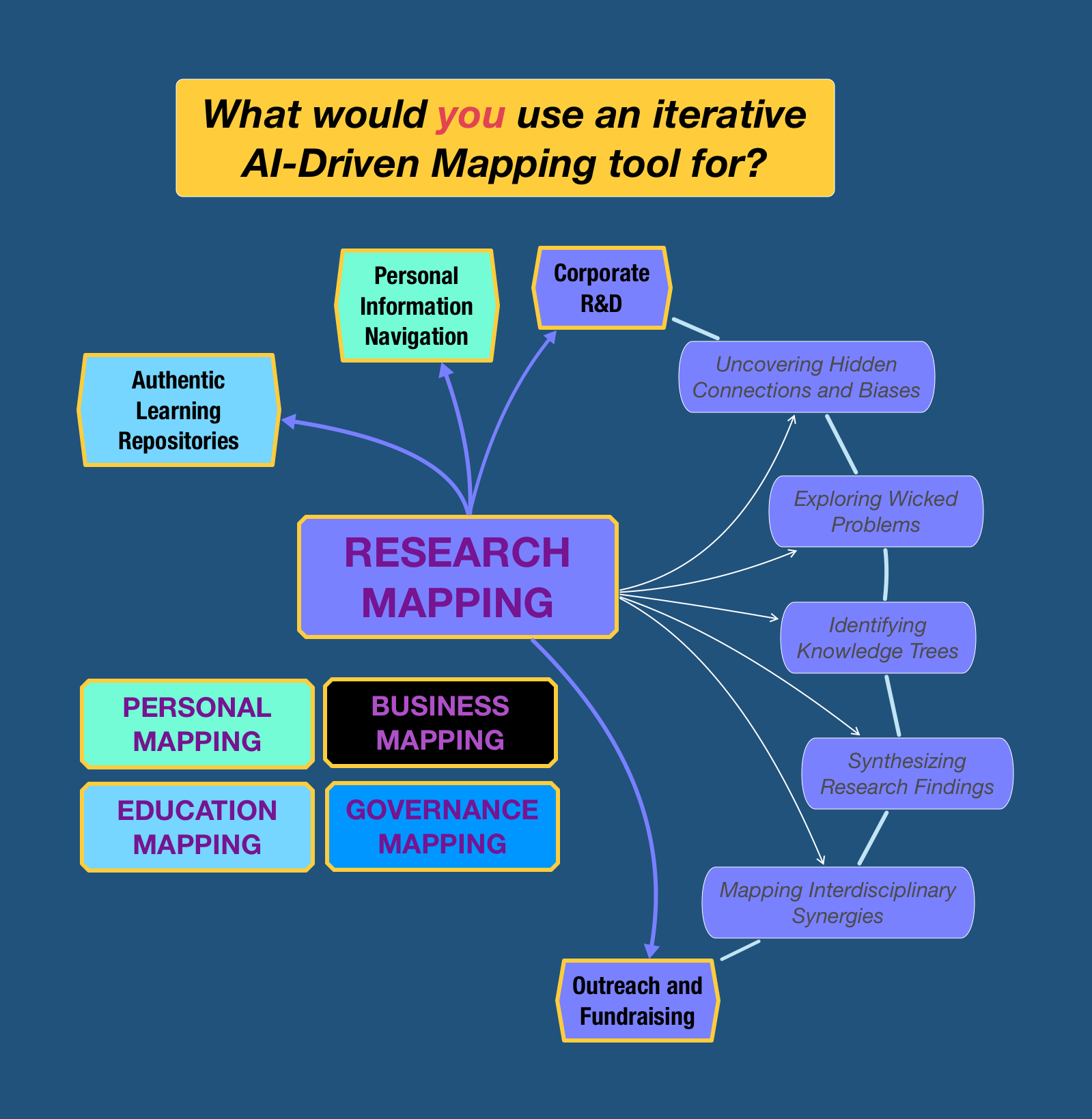
Research occurs across a wide array of disciplines and different types of environments. The complexity of this information environment is unprecedented in human history and there is vast benefit to connecting disciplines and environments, whether they be government, educational or corporate with a universal mapping tool. Innovation and discovery in this area would benefit all of humanity and form the basis for healthy economic growth of any given society that leverages it.
- Uncovering Hidden Connections and Biases: The Knowledge Navigator can help researchers uncover hidden connections and biases in their research by visually mapping out the relationships between different pieces of information. This allows researchers to see patterns and connections that might not be apparent from reading text alone. The tool can also help identify potential sources of bias by highlighting areas where the research is skewed or where there are gaps in the data. For example, a researcher studying the history of a particular event could use the Knowledge Navigator to map out the different sources of information on that event, including primary sources, secondary sources, and different interpretations of the event. This would help the researcher see how the narrative of the event has been shaped by different perspectives and identify potential areas of bias. The Knowledge Navigator can also be used to map out the connections between different researchers working on a particular topic to see how their work is influencing each other and identify potential areas of collaboration or conflict
A materials scientist working on developing a new type of battery is struggling to find a breakthrough. They have hit a wall in their research, and traditional methods of reviewing scientific literature are proving inefficient. Using the Knowledge Navigator, they hope to spark new insights and uncover hidden connections that could lead to innovation.
The scientist inputs all their research data into the Knowledge Navigator:
- Existing battery technologies
- Material properties
- Manufacturing processes
- Scientific papers
- Patent applications
The Knowledge Navigator generates a dynamic, multi-layered map that goes beyond simple keyword searches:
- Obvious connections appear between existing research on battery components, performance metrics, and known limitations.
- Zooming out, the map reveals unexpected relationships:
- A cluster of research on nanomaterials used in a completely different field (like solar energy) highlights potential applications in battery design.
- Another cluster focuses on biological processes that efficiently store energy, inspiring the scientist to investigate bio-inspired battery designs.
- The map even highlights seemingly unrelated patents on manufacturing techniques that, when applied to battery production, could lead to significant cost reductions and scalability.
The visual representation allows the scientist to:
- See patterns and connections that were not apparent from reading text-based research alone.
- Identify promising research avenues that they would have otherwise overlooked.
- Connect with researchers in other fields who are working on technologies with potential crossover applications.
This cross-disciplinary approach fuels innovation:
- The scientist combines insights from nanomaterials, bio-inspired design, and advanced manufacturing to develop a revolutionary new battery with higher energy density, faster charging times, and lower environmental impact.
The Knowledge Navigator can help us see better, faster and make sense of a complex world of interconnections. The tool empowers scientists to break free from traditional research silos, discover unexpected connections, and generate groundbreaking new technologies that benefit society. Just as Claude Shannon’s playful exploration of juggling informed his groundbreaking work on information theory, the Knowledge Navigator encourages a similar spirit of creative exploration and discovery in the hard sciences, ultimately leading to “real results” and “unexpected innovations”.
- Exploring Wicked Problems: The Knowledge Navigator can help researchers explore wicked problems by providing a visual representation of the complex relationships between different factors. This allows researchers to see the problem from multiple perspectives and identify potential leverage points for intervention. For example, a researcher studying climate change could use the Knowledge Navigator to map out the different factors that contribute to climate change, as well as the potential impacts of climate change on different parts of the world. The Knowledge Navigator can also help researchers identify potential solutions to wicked problems by mapping out the connections between different ideas and approaches. This tool can help researchers break down complex problems into smaller, more manageable chunks and make progress toward finding solutions.
A team of climate scientists are struggling to develop effective strategies to mitigate the effects of rising sea levels. The problem is multifaceted, with interconnected factors spanning social, economic, and environmental domains. Using the Knowledge Navigator, they can:
- Input a vast dataset: climate models, geographic data, infrastructure reports, social and economic data, and even historical records of past sea level changes.
- The Knowledge Navigator generates a dynamic, multi-layered map that visualizes the complex interplay of factors contributing to rising sea levels:
- Greenhouse gas emissions, ocean currents, and melting glaciers appear as interconnected nodes, highlighting their impact on sea level rise.
- Zooming in on specific coastal regions, the map reveals the vulnerability of different populations, critical infrastructure at risk, and potential economic consequences of inaction.
The visualization reveals potential leverage points for intervention:
- The scientists notice a cluster highlighting the role of coastal ecosystems (mangrove forests, salt marshes) in naturally mitigating sea level rise. This prompts them to investigate nature-based solutions, like restoring these ecosystems to protect coastal communities.
- Another cluster focuses on urban planning strategies, like building seawalls and elevating structures. The map helps them identify best practices from cities around the world and adapt them to local contexts.
This systems-level thinking, enabled by the Knowledge Navigator, allows the scientists to:
- Move beyond simplistic, linear solutions and develop comprehensive strategies that address the problem from multiple angles.
- Identify unexpected synergies between different approaches, leading to more effective and sustainable solutionsfor mitigating the impacts of rising sea levels.
The Knowledge Navigator can help us see the big picture, break down complex problems into smaller, more manageable chunks, and make progress toward finding solutions. Just as the Knowledge Navigator can help a working mother manage her busy schedule or a recent graduate navigate their career path, it can also empower researchers to tackle wicked problems like climate change by visualizing complex relationships and identifying potential solutions.
- Synthesizing Research Findings: The Knowledge Navigator can help researchers synthesize research findings by creating visual representations of the connections between different studies. This can help researchers see the big picture of what is known about a particular topic and identify areas where further research is needed. For example, a researcher conducting a literature review could use the Knowledge Navigator to map out the different studies that have been conducted on a particular topic, highlighting the key findings of each study and the connections between them. Researchers can use the tool to identify gaps in the research, as well as areas where different studies agree or disagree. They can also use the Knowledge Navigator to generate new research questions by exploring the connections between different findings.
An epidemiologist researching a new infectious disease wants to synthesize existing research to understand its origins, transmission patterns, and potential treatments. They are overwhelmed by the volume of data and the difficulty of connecting findings from different studies across various disciplines. The Knowledge Navigator offers a solution:
- They input a vast dataset of research:
- Epidemiological studies
- Genetic analyses of the pathogen
- Clinical trials data
- Social and behavioral studies related to disease spread
- The Knowledge Navigator generates a dynamic map that goes beyond a traditional literature review:
- Clusters of studies emerge, highlighting key findings about the disease’s incubation period, modes of transmission, and risk factors.
- Connections between seemingly disparate studies appear, revealing a possible link between environmental factors (like deforestation) and increased disease incidence.
This visualization of the research landscape allows the epidemiologist to:
- Quickly identify knowledge gaps. For example, the map reveals limited research on the disease’s long-term effects, prompting further investigation.
- Spot areas of contradiction between studies, highlighting the need for additional research to resolve discrepancies.
- Generate new research questions. The map’s visualization of connections inspires the epidemiologist to explore the potential for existing antiviral drugs to treat the new disease.
The Knowledge Navigator, in this case, acts as a powerful synthesis engine, allowing researchers to see the “big picture” of a research area, identify promising research avenues, and accelerate the pace of scientific discovery. The Knowledge Navigator will help us see better, faster, make sense of complex information, and surface buried information.
- Identifying Knowledge Trees: The Knowledge Navigator can help researchers identify knowledge trees by mapping out the relationships between different concepts and ideas. This allows researchers to see how knowledge is structured and organized within a particular field. For example, a researcher studying the history of philosophy could use the Knowledge Navigator to map out the different schools of thought, as well as the key thinkers and ideas associated with each school. The Knowledge Navigator can also help researchers identify the key sources of information on a particular topic and see how those sources have influenced each other over time. Researchers can then use this information to trace the evolution of ideas and see how knowledge has been built and disseminated within a particular field. By mapping out knowledge trees, researchers can gain a deeper understanding of the structure of knowledge and identify areas where their research can contribute to the advancement of knowledge.
A software engineer developing the Knowledge Navigator faces a challenge: designing an algorithm that effectively maps and visualizes “knowledge trees” for diverse fields of study. The engineer needs to understand how knowledge is structured, connected, and evolves over time. They turn to the Knowledge Navigator itself for assistance:
- The engineer inputs a test dataset:
- A collection of articles and books on the history of artificial intelligence.
- Source code from early AI programs.
- Biographical information on key figures in AI research.
- The Knowledge Navigator, using its existing algorithms, generates a preliminary map:
- Key concepts in AI, like machine learning, natural language processing, and computer vision, appear as central nodes.
- Branches extend from these nodes, representing different schools of thought, methodologies, and historical developments.
- The map highlights influential researchers, their contributions, and how their work builds upon previous ideas.
The engineer analyzes this visualization, looking for patterns and gaps:
- They notice that certain branches of the knowledge tree are sparsely populated, suggesting areas where research is lacking. This informs the development of algorithms that prioritize unexplored connections and emerging fieldswithin a knowledge domain.
- The engineer observes how connections between concepts change over time. This insight leads to algorithms that can dynamically visualize the evolution of knowledge, highlighting how ideas have been adopted, modified, or challenged over the course of history.
This recursive use of the Knowledge Navigator, demonstrates how the tool could be used to help develop itself. By visualizing knowledge trees, researchers and developers can gain a deeper understanding of how knowledge is structured, identify areas ripe for innovation, and ultimately create the biggest innovations of the new paradigm by shifting the rules of the game.
Intersectional
|
|