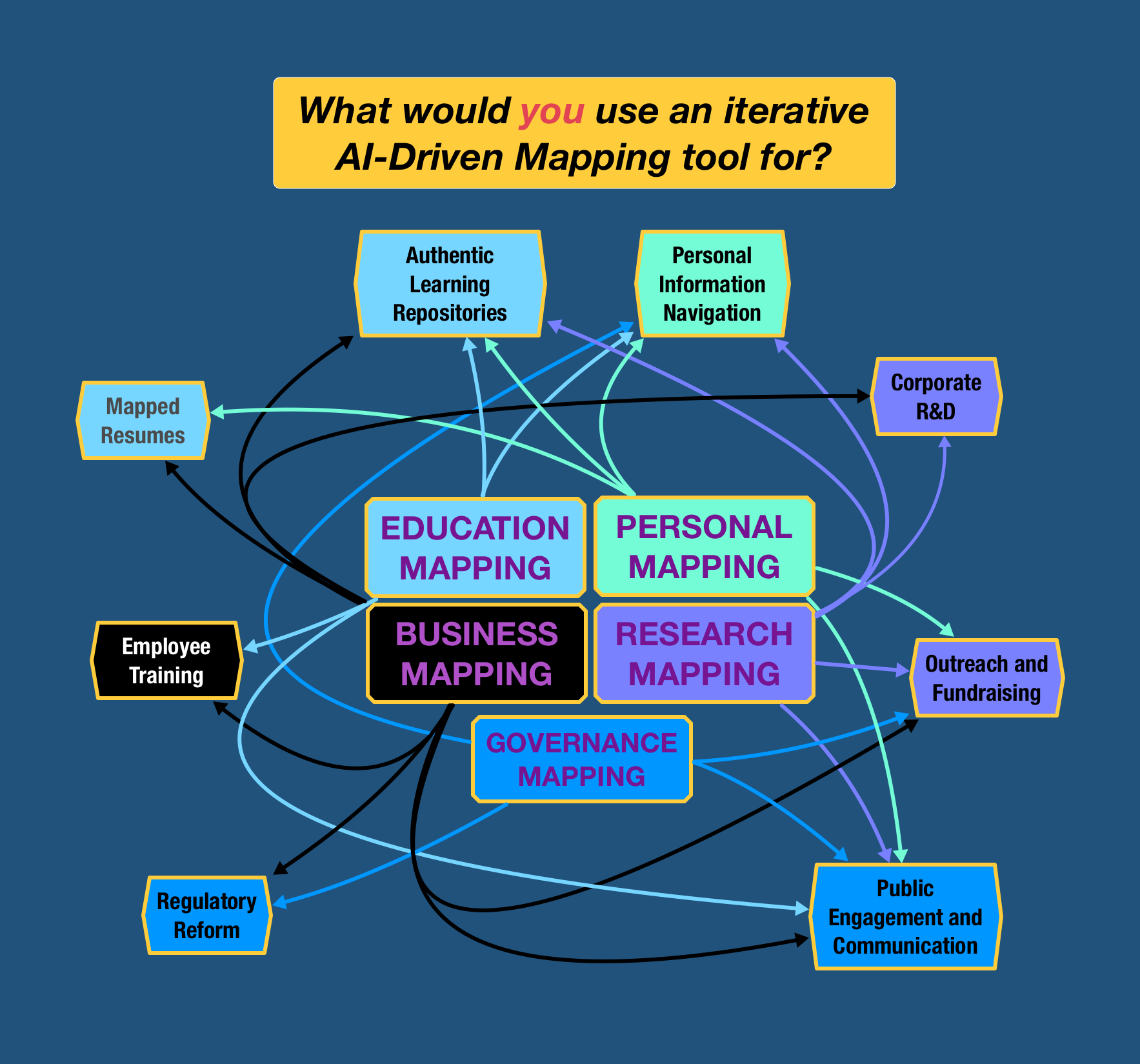
In addition to use case scenarios centered on business, education, government, personal, and research mapping, the Knowledge Navigator also creates a series of opportunities for tools that connect these areas with one another. These tools are the ones most ripe for additional exploration as they would inform interlocking systems and generate new systems for information exchange and connection.
- Authentic Learning Repositories (Business, Education, Research, and Personal) – One of the chief challenges we have as a society is the authentic communication of learning, both formal and informal. We use credentialling shorthand, which is opaque and imprecise (and increasingly expensive). The challenge with authentic work is discoverability. A mapping program would help businesses and researchers identify candidates through their work. Education would have a more authentic indicator of its worth. Even individuals could contribute their work for recruitment to both education and the worlds of work. The map would act as a filter for the quality and authenticity of the work product.
SCENARIO: A student uses the Knowledge Navigator to map their learning journey, showcasing projects, research, and collaborations across disciplines. This dynamic, visual representation replaces the traditional resume and transcript, offering a deeper understanding of their skills and competencies.
A business looking for innovative problem-solvers discovers this student’s map through the Knowledge Navigator’s network. The map highlights the student’s experience with collaborative research on sustainable energy solutions, a perfect fit for the company’s R&D focus.
An educational institution uses the map to evaluate the student’s non-traditional learning pathway, recognizing the value of their hands-on experience and interdisciplinary thinking. This allows them to offer the student a tailored program that builds upon their existing knowledge.
A research lab working on a related project identifies the student as a potential collaborator. They are impressed by the student’s demonstrated ability to connect seemingly disparate ideas, recognizing the potential for cross-disciplinary breakthroughs.
The student, now empowered to chart their own learning path, continues to use the Knowledge Navigator to discover new connections, contributing to the collective knowledge base while advancing their personal and professional goals.
The Knowledge Navigator democratizes access to learning opportunities, connects individuals with opportunities that align with their interests and skills, and fosters a more collaborative and innovative approach to problem-solving.
- Personal Information Navigation (Personal, Governance, Research, and Education) – Personal mapping of information would bypass methods of misinformation on both a practical (such as purchasing decisions) and political level. Maps would allow individuals to navigate all manner of decisions in their personal level, would act as a gateway to education and an understanding advanced research and governmental decisions.
A recent high school graduate, undecided about their future, uses the Knowledge Navigator to map their interests, skills, and potential career paths. They input information about their favorite subjects, hobbies, volunteer work, and even their social media activity. The tool, drawing on a vast database of educational programs, job market trends, and research on career satisfaction, generates a personalized map:
- Clusters emerge, highlighting strong connections between their passion for environmental science, their volunteer work at a local conservation organization, and the growing field of renewable energy.
- The map also reveals potential educational pathways, connecting them to relevant college programs and online learning resources.
This personalized map empowers the student to:
- Make more informed decisions about their education and career.
- Identify unexpected career paths they might not have considered otherwise.
- Connect with mentors and professionals working in fields that align with their interests.
This scenario intersects with multiple aspects of the Knowledge Navigator:
- Personal: The tool facilitates self-discovery and informed decision-making at a personal level.
- Governance: By understanding job market trends and the skills needed for the future, the student becomes a more informed citizen, capable of participating in policy discussions related to education and workforce development.
- Research: The tool leverages research findings on career satisfaction, learning pathways, and the skills gap to provide personalized guidance.
- Education: The map acts as a gateway to further education, connecting the student to relevant learning opportunities and fostering lifelong learning.
This Knowledge Navigator empowers individuals, improves educational outcomes, and promotes a more informed and engaged citizenry.
- Mapped Resumes (Personal, Business) – Resumes are an impenetrable code that acts as a barrier between hiring and qualified employees. Coupled with Authentic Learning Repositories, mapping skills, tangible work, and experience is a much more effective way of connecting employers and potential employees than current opaque, linear methods.
A talented artist is struggling to find work. Their traditional resume, filled with freelance gigs and unconventional projects, fails to showcase their true skills to potential employers in the creative industry. They turn to the Knowledge Navigator, inputting their portfolio, project descriptions, and even social media presence. The tool generates a dynamic map:
- Nodes representing the artist’s diverse skills emerge: graphic design, illustration, animation, video editing, and social media marketing.
- Connections between projects appear, highlighting their ability to manage complex projects, collaborate effectively, and adapt their skills to different creative challenges.
- The map also reveals connections to potential employers, showcasing companies looking for individuals with their specific skill set.
This visual representation of the artist’s abilities allows them to:
- Communicate their skills more effectively to potential employers. The map’s clarity helps employers quickly understand the artist’s unique value proposition, going beyond the limitations of a traditional resume.
- Discover new job opportunities by identifying companies whose needs align with their skills.
- Connect with other creative professionals for potential collaborations and networking.
This scenario bridges the gap between the personal and business realms, demonstrating how the Knowledge Navigator can:
- Empower individuals to showcase their skills and talents in a more compelling way, breaking down traditional barriers in the job market.
- Benefit businesses by connecting them with the right talent more efficiently, leading to better hiring decisionsand a more productive workforce.
The Knowledge Navigator helps us see better, faster, connects nodes of narrative, and maps connections between human narratives. By transforming the way skills and experience are represented and communicated, the Knowledge Navigator can revolutionize the hiring process for both individuals and businesses.
- Corporate R&D (Research, Business) – A mapping tool that offered a connection between advanced research and potential product development would accelerate innovation and the adoption of new technologies.
A pharmaceutical company is investing heavily in research and development for a new class of cancer drugs, but progress is slow. Researchers struggle to keep up with the vast volume of scientific literature and connect findings from different areas of study. The Knowledge Navigator offers a solution:
- The company inputs a massive dataset:
- Internal research data on drug compounds and clinical trials
- Published scientific literature on cancer biology, genetics, and immunology.
- Patent data on existing cancer treatments.
- The Knowledge Navigator generates a dynamic map that visualizes the research landscape:
- Clusters emerge, highlighting promising avenues of research, such as the development of drugs that target specific genetic mutations or enhance the body’s immune response.
- Unexpected connections appear between seemingly disparate areas of research, revealing a potential synergy between a new drug compound and an existing immunotherapy treatment.
This visualization of knowledge allows the company to:
- Accelerate the pace of drug discovery. The Knowledge Navigator helps researchers identify and prioritize the most promising research directions, leading to a faster and more efficient R&D process.
- Reduce research costs. By avoiding dead ends and focusing on areas with the highest potential, the company can save significant resources.
- Foster innovation by encouraging cross-disciplinary collaboration and the exploration of unconventional approaches.
This scenario showcases how the Knowledge Navigator can bridge the gap between research and business, driving innovation and creating a competitive advantage for companies. The Knowledge Navigator is designed to surface buried information, create opportunities to diversify our conversations, make sense of complex information, and accelerate the pace of scientific discovery. By visualizing the connections between research findings and business opportunities, the Knowledge Navigator can help companies transform scientific breakthroughs into marketable products.
- Employee Training (Education, Business). – Connecting learning with business needs is an ongoing problem. Internal training programs are extensive and often one-off. A mapping tool could create matrixes of learning and bring in options from higher education more effectively – connecting expertise with specific needs, which at the same time giving educational institutions more effective means of partnering directly with businesses.
A Fortune 500 company is facing a skills gap in its workforce as technology rapidly evolves. Traditional employee training programs are costly, time-consuming, and often fail to address the specific needs of individual employees and departments. The company turns to the Knowledge Navigator to create a more effective and targeted training program:
- The company inputs data on:
- Employee skills assessments
- Emerging technologies relevant to their industry
- Available training resources, including online courses, university programs, and internal expertise.
- The Knowledge Navigator generates a dynamic map that visualizes the company’s learning ecosystem:
- Individualized learning pathways emerge for each employee, recommending specific courses, mentors, and projects to address their unique skill gaps and career aspirations.
- Connections appear between internal training programs and external educational resources, allowing the company to leverage a wider range of learning opportunities.
- The map highlights areas where the company can develop internal expertise or partner with universities to create custom training programs.
This visualization allows the company to:
- Create a more agile and responsive training program, adapting quickly to the evolving needs of the workforce.
- Reduce training costs by targeting resources more effectively.
- Empower employees to take ownership of their professional development.
- Foster a culture of continuous learning and innovation.
This scenario connects the education and business sectors, demonstrating how the Knowledge Navigator can transform employee training by:
- Bridging the gap between learning and business needs.
- Facilitating partnerships between corporations and educational institutions.
- Creating a more adaptable and skilled workforce.
The Knowledge Navigator democratizes knowledge, allows users to see knowledge differently, augments our ability to think, and creates a roadmap for success. By visualizing the connections between employee skills, business needs, and educational resources, the Knowledge Navigator can help companies build a more competitive and future-ready workforce.
- Outreach and Fundraising (Personal, Business, Research, Education) – Communicating complex information is essential for a broad range of organizations. Targeted funding is critical to support research and education. Connecting research to the right businesses is fundamentally a communications issue.
A university research lab working on cutting-edge renewable energy technology needs funding to continue its work. Traditional grant applications and fundraising efforts are time-consuming and often unsuccessful, as potential funders struggle to understand the complexities of the research and its potential impact. The Knowledge Navigatoroffers a solution:
- The lab inputs its research data, publications, and potential applications of its technology.
- The Knowledge Navigator generates a dynamic map:
- Visualizing the research in an easy-to-understand format.
- Highlighting connections to potential applications in various industries.
- Identifying potential funders (businesses, government agencies, foundations) whose interests align with the research.
This interactive map becomes a powerful communication tool:
- The research lab can use it to clearly and compellingly convey the importance of its work to potential funders.
- The map can also be used to identify potential industry partners for commercializing the technology.
- Students in the lab can use the map to connect their research to real-world problems and career opportunities, enhancing their educational experience.
This scenario interweaves personal, business, research, and education:
- On a personal level, this kind of map creates an accurate public awareness of the work of the researchers, generating political support for further funding.
- Businesses gain insight into cutting-edge research and potential investment opportunities.
- The research itself is advanced and disseminated more effectively.
- Educational institutions can better connect their research to funding and real-world applications.
The Knowledge Navigator helps users communicate thinking in a digital world, make research more meaningful and efficient, and turn scientific breakthroughs into marketable products. The Knowledge Navigator can transform outreach and fundraising by making complex information accessible by facilitating connections between stakeholders, and driving innovation across sectors.
- Public Engagement and Communication (Personal, Business, Governance, Education, Research) – We live in complex information environments. Giving individuals the power to navigate those environments gives business, government education, and research new sets of tools to garner public support for their activities. Individuals can create their own maps but organizations that generate complex data can also generate maps to share with the public to help it understand what the purpose of their work is, taking away scope for misinformation and conspiracy theories that emerge because the public has a limited ability to navigate complex technological, societal, or scientific projects and programs.
A grassroots environmental organization is struggling to gain public support for its efforts to combat climate change. They find that many people are skeptical of the science, overwhelmed by the complexity of the issue, or simply unaware of the potential solutions. Using the Knowledge Navigator, the organization creates a dynamic, publicly accessible mapthat visualizes the interconnectedness of climate change:
- It incorporates data from scientific research on climate patterns, economic analyses of the costs and benefits of different solutions, and policy proposals from governments around the world.
- The map highlights the personal impact of climate change by connecting global trends to local effects, such as rising sea levels, extreme weather events, and changes in agricultural yields.
- It visualizes different scenarios based on various policy choices, showing the potential consequences of inaction and the benefits of taking swift action.
This interactive map empowers individuals to:
- Explore the issue of climate change at their own pace and depth of understanding.
- Connect the global to the personal, seeing how climate change directly affects their lives and communities.
- Understand the complexities of the issue, breaking down information silos and overcoming skepticism.
- Engage in informed discussions with others and advocate for effective solutions.
This scenario bridges the gap between personal action, business interests, government policy, scientific research, and public education:
- Individuals gain the knowledge and agency to make informed choices in their own lives.
- Businesses can see the economic opportunities associated with sustainable practices.
- Governments can use the map to communicate the urgency of the issue and the rationale behind their policies.
- Researchers can connect their work to a broader audience and see how it fits into the larger picture.
- Educational institutions can use the map as a powerful teaching tool, fostering critical thinking and civic engagement.
By empowering the public with accessible and engaging information, the Knowledge Navigator can drive informed decision-making, foster collaboration, and build consensus around complex issues like climate change.
- Regulatory Reform (Business, Governance) – Regulation often generates perverse outcomes because its effects are only partially understood when it is designed. This hurts both the public and businesses that are looking for a level regulatory playing field. Cooperative mapping using the Knowledge Navigator will help both government and the businesses it regulates map out regulatory regimes that help the economy grow while protecting public goods.
A government agency is tasked with updating regulations for the financial technology sector, a rapidly evolving industry with the potential to both boost economic growth and create new risks for consumers. Traditional regulatory approaches, often based on outdated information and linear thinking, can stifle innovation or fail to adequately address emerging threats. The agency uses the Knowledge Navigator to create a dynamic map of the FinTech ecosystem:
- The agency inputs a diverse dataset of:
- Existing regulations and their intended outcomes
- Data on FinTech companies, their business models, and their impact on consumers and the economy
- Research on financial innovation, cybersecurity, and consumer protection
- Feedback from industry stakeholders and consumer advocacy groups
- The Knowledge Navigator generates a multi-layered, interactive map that visualizes the complex interplay of regulations, business practices, and potential risks and opportunities.
This visualization allows the agency and stakeholders to:
- Identify areas where existing regulations are outdated or create unintended consequences.
- Explore the potential impact of new regulations before they are implemented.
- Collaborate on the design of regulations that foster innovation while mitigating risks.
This cooperative mapping approach, facilitated by the Knowledge Navigator, helps align the goals of government and business by:
- Creating a shared understanding of the complexities of the FinTech ecosystem.
- Facilitating open communication and collaboration between regulators and industry stakeholders.
- Enabling the design of more effective and agile regulations that promote economic growth while protecting the public interest.
Transparency is key to effective governance. By visualizing the connections between regulations, business practices, and public interests, the Knowledge Navigator can help create a more level playing field, minimize regulatory costs and overreach, as well as foster a more innovative and responsible business environment.