We are confronted with a bewildering range of choices on a daily basis. These choices a have deep impact on our happiness, financial security, generational wealth, and career options. The blindness of consumers drives dysfunctional business models. Giving individuals access to a service that would allow them to consolidate and map information allows them to plan strategically and tactically in ways that are currently impossible due to information overload.
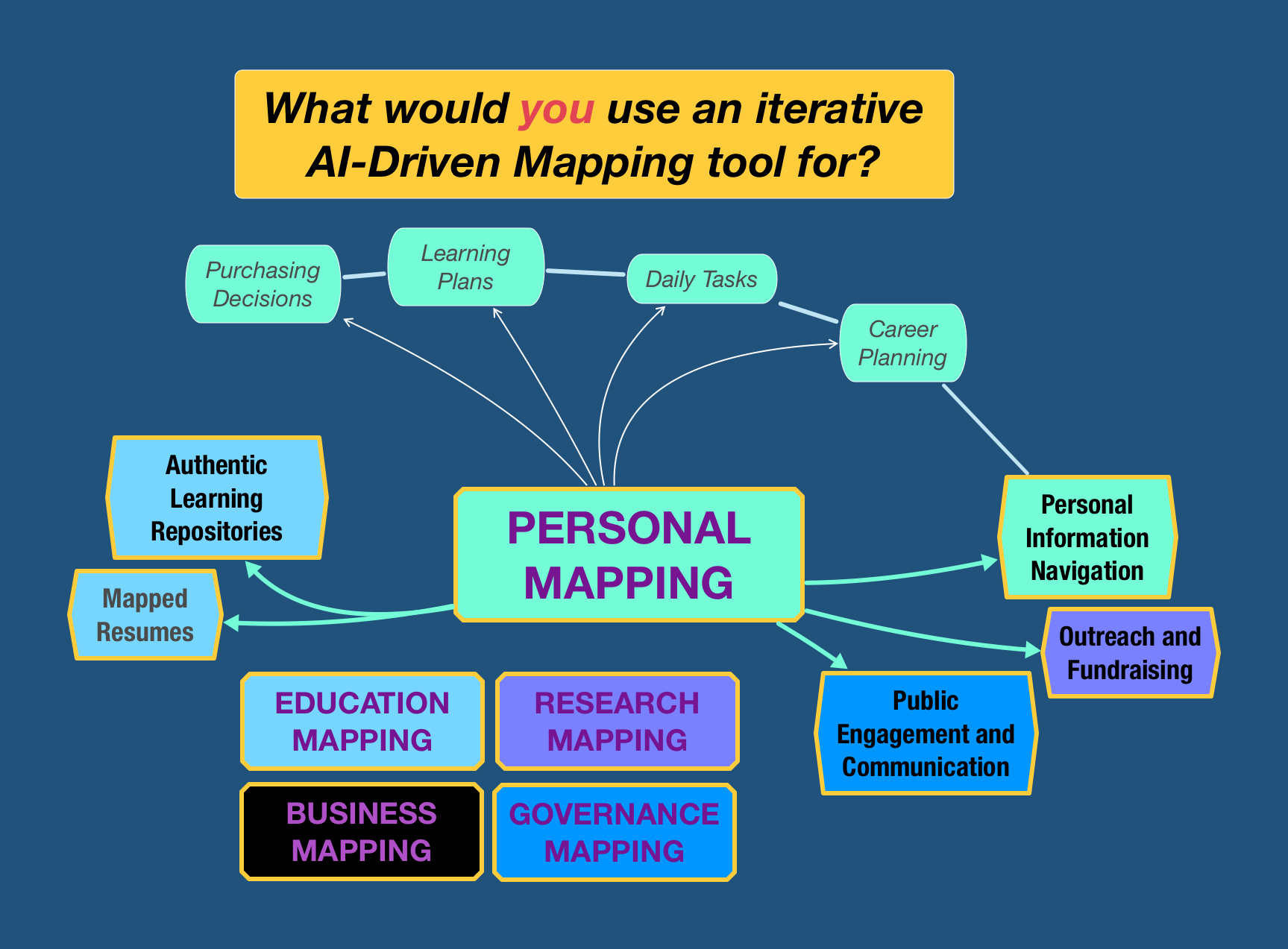
- Learning Plans: A personal Knowledge Navigator can be used to map out learning goals and create personalized learning plans. Instead of following a predetermined curriculum, people can use the Knowledge Navigator to identify their learning interests, explore different learning pathways, and create a customized learning plan based on their individual needs. The tool can then help connect users with relevant learning resources, such as books, articles, videos, and online courses. The Knowledge Navigator can also be used to track learning progress and identify areas where additional support is needed.
A father wants to encourage his daughter’s passion for astronomy. However, traditional educational resources feel too rigid and don’t capture the interconnectedness of the subject. He utilizes the Knowledge Navigator to create a personalized learning plan with his daughter:
- They input her current knowledge, interests (like black holes, constellations), and preferred learning styles(visual learner? hands-on activities?).
- The tool generates a dynamic map visualizing potential learning pathways.
- Connections appear between astronomy concepts, related scientific disciplines (physics, chemistry), and even historical figures (Galileo, Hubble).
- Resources like online courses, documentaries, and local astronomy clubs are automatically linked, offering a multifaceted learning experience.
The Knowledge Navigator allows for continuous adaptation:
- As the daughter’s understanding grows, they can re-generate the map, revealing new connections and resources.
- The father can track her progress, identify areas where she needs more support, and even find opportunities to connect her with mentors or peers who share her interests.
This personalized approach, driven by the Knowledge Navigator’s ability to visualize and connect knowledge in a dynamic way, makes learning engaging and empowering, fostering lifelong curiosity and a deeper understanding of the subject. The Knowledge Navigator enables playful exploration of ideas, empowering individuals to take control of their learning journeys and discover unexpected connections.
- Purchasing Decisions: The personal Knowledge Navigator can help users make more informed purchasing decisions by mapping out the relevant information. Users can input their needs, budget, and other criteria. The tool can then generate a map that shows the different options available, as well as the pros and cons of each option. This can help users compare products, understand the potential risks and benefits, and make a purchase that is aligned with their needs and values. The Knowledge Navigator can also help users understand complex systems, like extended warranties, fees, and other requirements.
A young couple is overwhelmed by the process of buying their first home. The market is complex, and they’re bombarded with information about mortgages, interest rates, neighborhoods, and property values. Using their personal Knowledge Navigator, they can:
- Input their criteria: Budget, desired location, number of bedrooms, and preferred features.
- Generate a dynamic map visualizing:
- Available properties within their price range, plotted on a map to show proximity to work, schools, and amenities.
- Mortgage options from different lenders, with interest rates, terms, and potential monthly payments clearly visualized.
- Neighborhood data layering in school ratings, crime statistics, and even local amenities like parks and restaurants.
The Knowledge Navigator helps the couple see beyond the surface:
- Connections appear between seemingly disparate data points. For example, they might discover that homes near a new transit line are projected to increase in value, while also having access to convenient public transportation.
- Potential risks are highlighted, like properties in flood zones or areas with high property taxes.
This visual representation empowers them to:
- Weigh trade-offs, make informed decisions, and negotiate confidently with real estate agents and lenders.
- Avoid common pitfalls, like hidden fees or unfavorable mortgage terms.
The Knowledge Navigator helps the couple navigate the complexities of the housing market, ensuring they find a home that meets their needs and aligns with their values. The Knowledge Navigator empowers individuals by making complex systems transparent and revealing potential risks and manipulations.
- Daily Tasks: The personal Knowledge Navigator can be used to manage daily tasks by creating a visual representation of to-do lists and schedules. The tool can help users prioritize tasks, see deadlines, and identify potential conflicts. The Knowledge Navigator can also be used to track progress on tasks and identify areas where adjustments need to be made. By using the Knowledge Navigator to manage daily tasks, users can reduce stress and increase productivity. The tool can also help users see how their daily tasks connect to their larger goals and help them stay motivated.
A working mother is feeling overwhelmed by the constant juggle of work deadlines, household chores, and her children’s schedules. Using the personal Knowledge Navigator, she can:
- Input her to-do list, appointments, and family commitments.
- Generate a dynamic visual map that displays her week:
- Work tasks are color-coded by priority level and deadlines.
- Household chores are allocated to specific days or family members.
- Children’s activities (soccer practice, music lessons) appear with clear time slots and locations.
The Knowledge Navigator helps her see the big picture:
- Potential scheduling conflicts are immediately apparent. For example, she might notice that her son’s soccer game overlaps with an important work meeting, prompting her to proactively adjust her schedule or delegate tasks.
- The tool can even suggest time-saving strategies: grouping errands together based on location or identifying tasks that can be done simultaneously (folding laundry while supervising homework).
By visualizing her daily tasks and their interconnections, the Knowledge Navigator helps the mother:
- Prioritize effectively, reducing stress and avoiding feeling constantly behind.
- Identify opportunities for optimization, freeing up time for family activities or personal pursuits.
This scenario connects with the idea in the sources that the Knowledge Navigator can empower individuals to “slow down” and “see patterns” in their lives, allowing them to make more mindful decisions and regain control over their time and energy. Just as the tool can be used to analyze complex policy decisions, it can also bring that clarity and perspective to the management of everyday life.
- Career Planning: The personal Knowledge Navigator can help users explore career options and create a personalized career plan. Users can input their skills, interests, and values. The tool can then generate a map that shows different career paths, as well as the education and experience required for each path. Users can explore different career options, identify potential mentors, and develop a plan to achieve their career goals. The Knowledge Navigator can also help users understand the job market, identify emerging trends, and make informed decisions about their career path.
A recent college graduate is feeling uncertain about their career path. They have a degree in environmental science, but the job market feels vast and overwhelming. Using the Knowledge Navigator, they can:
- Input their skills (data analysis, fieldwork), interests (conservation, renewable energy), and values (sustainability, social impact).
- The tool generates a dynamic map visualizing potential career pathways:
- Connections appear between different environmental science roles (researcher, policy analyst, consultant), highlighting related fields (urban planning, public health).
- Educational programs and relevant certifications are linked, showing clear steps to acquire necessary qualifications.
- The map even identifies potential mentors and organizations working in their areas of interest, allowing the graduate to reach out and network strategically.
The Knowledge Navigator helps them see beyond traditional job boards:
- Emerging trends in the environmental sector are highlighted, like the growing demand for green building experts or climate change mitigation specialists.
- The tool can analyze the job market, visualizing areas with high demand and strong salary potential.
This empowers the graduate to:
- Make informed decisions about their career path, tailoring their skills and education to align with market needs and their personal values.
- Approach their job search with confidence and direction, crafting compelling applications and standing out from the competition.
This scenario reflects the idea in the sources that the Knowledge Navigator can empower individuals to “explore unknown territory” and discover unexpected pathways, helping them “find their way” in a complex and ever-changing world. Just as the tool can help a father guide his daughter’s learning journey, it can also help an individual take control of their career trajectory and achieve their full potential.
Intersectional
|
|