
Author: haymest (Page 8 of 12)

Designing Antifragile Learning Systems

As technologists, we often have our minds set firmly on the future. We have made it a hallmark of our profession to find the latest and greatest to share with our communities. Sometimes this results in innovative outcomes but all too often these efforts result in intriguing “projects” that never seem to take root in the fabric of our institutions.

We are so trained in this approach to reshaping pedagogy that, when we are asked to develop innovative approaches to teaching and learning, we instinctively grasp for our toolboxes instead of considering the pedagogical approach or other purposes of the technology first. All too often, technology guides the purpose and not the other way around.

The weaknesses of this tendency became apparent last year as most institutions were suddenly forced to lean heavily on their technology infrastructures to maintain continuity of instruction during the pandemic. Those institutions with a diverse set of tools that complemented each other and provided faculty and students with low barriers to entry had relatively smooth transitions to remote teaching.

However, those institutions that had not devoted much attention to their technology infrastructures ran into repeated problems as faculty and students bent technology to meet their learning needs. More often, however, we were driven to compromise instruction in order to do anything at all with the tools at hand. Even institutions that had relatively sophisticated technology infrastructures struggled if those tools were hard to use or did not incorporate antifragile design principles.

Challenges always look for weak points in any system. This is true of COVID, which looks for weak points in our biological systems. It is also true of Black Swan events, which will seek out weak points in our social systems. Education is a social system with many weak points. It is based on rigid systems of time (contact hours) and space (“online courses are to be kept separate from ‘real’ courses”). The pandemic disrupted both time and space. As a consequence, it compromised many different systems in unexpected ways. The design of our technological toolsets reflected many of these systemic weaknesses.

This did not have to be the case. Digital technology has the capacity to make our systems less rigid. Online courses can be decoupled from time and space with little regard for logistics like room scheduling. As long as you have power and the internet, you are good to go.

One mistake that many institutions made last year was to move courses online without considering those two essential preconditions. For instance, instead of trying to reduce class sizes, the focus should have been to reduce the need to physically be in class. Instead of expending scarce resources trying to get students into classrooms, technological resources should have been distributed throughout our campuses to allow those students with connection or device issues to come in and use institutional resources such as computers and wi-fi.

Ultimately, the purpose of a classroom is community. We seem to have lost sight of that. Instead, we sought to replace the tool without considering how we could build communities in the absence of physical proximity. The system drove this train of thinking, not the tools. It’s no surprise we saw so many failures under those circumstances.

Our systems measure instruction through imperfect metrics such as “contact hours” that are based on old technological systems such as classrooms. The technology of the classroom drove the system in this direction but then the system assumed its own logic based on that technology. This rigidity created a structural weak point that was attacked by the pandemic. Trying to mimic a singular set of tools centered on the concept of the classroom online resulted in a great deal of dissatisfaction, as well as declines in outcomes, when it came to the quality of our educational product.

For my own classes, I made a conscious decision to ignore these systemic constraints and focus entirely on what my students needed to learn. I carefully analyzed all of the different tasks required to successfully complete my course, designed a set of tools matched to specific tasks, and went on teaching as normal with few compromises in my instructional approach. As a matter of fact, as I wrote in my book, Learn At Your Own Risk, there were many aspects of my instruction that were better than before remote instruction took hold.

My approach isn’t a perfect system (no system of individualized learning can be “perfect”). However, it does illustrate an antifragile approach to integrating the appropriate technological tools available to me. I let the needs of the learner drive my decisions, not the available technology. There were some things that were suboptimal. For instance, in-person contact, particularly for those still struggling to learn how to learn, is almost impossible to replace. Videoconferencing is not a panacea.

So how are we going to be ready for the next set of challenges that come down the road? Everything from climate change to demography are going to buffet our institutions. Climate change makes a repeat of COVID more likely as humans and viruses interact in new and unexpected ways as both struggle to adapt to changes in their ecosystems.

We are going to have to change how we think about technology to make education a much more antifragile system. That means we need to understand how our technologies work holistically with one another to shape our learning environments. But we must also consider, as happened last year, what happens when a particular set of tools is taken away from us by unexpected events. How quickly will our learning ecosystems adapt and heal under similar circumstances?

This is not just about preparing for disaster. We must also grasp the opportunities afforded to us by creating more flexible systems. Climate change is one example of a challenge that cannot be solved by any one discipline or specialty. Like Covid, science must be complemented with social science. If the last year has taught us anything, it’s that sociology and politics have often created illogical outcomes that have killed more people than would have been the case had we simply followed the science. It has taken both science and our social systems to develop and, more importantly, distribute vaccines to slow or stop the disease.

Our systems of learning need to facilitate the construction of bridges between disciplines. The challenges that we will likely face will require a range of interlocking skills and technologies to overcome. Creating an information ecosystem is critical to any large scale effort. Digital technology excels at information exchange. As a social scientist, there is little stopping me from bringing a physicist or biologist into my class. This is true even if the scientist in question happens to be thousands of miles away. The act of sharing research is simple as well.

However, none of this will have an impact if our systems don’t adapt as well. Silos are human constructions. Sometimes we build them into our digital solutions as well where they undermine the potential of the tools. We have to decide to use our tools in such a way as to make our systems antifragile. Our technology will not do this for us.

Blogs on the Hackathons can be found here:

Out of the Information Thicket – XR Reflections

We find ourselves in a thicket, trying to make sense of the vast amounts of information that the Digital Age has unlocked. Our tools seem somehow inadequate to the task as all they seem to do is speed up the flows while doing little to cut through the tangles. Extended Reality (XR) is about to unlock a new suite of tools with the potential to help us link humans and their ideas in entirely new ways.

In 1945, Vannevar Bush, who headed science programs for the United States during World War II, wrote an article for the Atlantic Monthly called “As We May Think.” His concern in the article was our ability to process and meaningfully link information in an age of large, distributed research efforts, such as the one he had just led to develop the atomic bomb. To address this, he imagined a device to connect, recall, and remix pieces of information, which he called the Memex. The key aspect of Bush’s design of the Memex was that it focused on the linkages between chunks of information, which he called “breadcrumbs,” instead of the information itself.

Bush realized that the flood of information was useless unless you could connect it in meaningful and replicable ways. Knowing it is raining is only useful if you connect it to the need to take an umbrella with you on your walk. Bush, and the pioneers that followed him, recognized the power of computing technology lay in its ability to connect humans and their ideas. The thinking behind the Memex influenced the evolution of computing technology from Doug Englebart’s Human-Computer Interaction to Tim Berners-Lee’s World Wide Web and beyond.

What separated Bush’s piece from most other early computing documents was that he only spoke of technology toward the end. He started with a problem. The challenge that he perceived was not a technology problem. It was challenging of linking and understanding human knowledge. Meaning lives in the linkages, not the information. Technology could facilitate human these linkages. It could not replace them.

Almost 80 years on, we have not emerged from Bush’s thicket of information overload. Instead, the problem he identified is magnified to the Nth degree by our computing and communication technologies. Navigating today’s information environments as a teacher is every bit as complex as the problems that Bush faced. We often struggle to see the connections ourselves, much less make them clear to our students. Our problem is that we’ve been thinking with blinders that focus our attention on the nodes and not the linkages.

Almost all computing technology since the 1970s has been constructed on the metaphor of paper. We think of web “pages” and “documents.” It logically follows that we build tools around the creation, storage, and presentation of artifacts based on those metaphors. We “see” information in this context and miss precisely the kinds of insights that Bush was struggling toward with his conception of the Memex.

Networks are patterns. They are patterns of linkages between people, but they also represent patterns of ideas. Bush recognized that our fundamental problem was one of effectively seeing these patterns of ideas. As teachers, we should recognize that problem. We seek to have our students see the world in a different light by showing them new paradigms. As researchers and learners, we struggle to imagine new patterns of knowledge.

The paper metaphor limits our ability to see patterns differently. We become creatures of habit and context. We see challenges as linear, with a clear beginning and end. Because prose appears fixed, we miss opportunities to bend time and space. Networks are also creatures of time. They bend and morph dynamically. We may miss something critical by assuming it is frozen. (As I’m implicitly doing with this very blog/column.)

Not long after Bush wrote his article, Claude Shannon provided the other key piece to breaking the Gordian Knot of information tied to the medium of paper. His “Mathematical Theory of Communication” shattered the idea of communication being tied to analog streams of information. After Shannon, information did not exist in the tunnel of text but in a fractal universe of bits. This insight flipped the switch on the Digital Age. It was now possible to see information not simply as a network of interconnected narratives but as a network of interconnected ideas on the cellular level.

While Shannon’s reality forms the bedrock of general-purpose computing, it has yet to penetrate the human imagination fully. Even under the best of circumstances we build our tools to facilitate the limits of our imaginations. If we continue to imagine based on the limits of paper, our toolmaking ecosystems will continue to build tools to support that vision of the world. We are still networking with the creative metaphor of the postbox.

XR breaks the paper metaphor because it finally treats information as distinct bits, allowing us to remix it. We can bring digital spaces into the real world by augmenting our vision. We can fully enter digital spaces and share networks of ideas in constructed spaces we can manipulate and turn in any way that we want. Virtual spaces open up 3D concept mapping and allow us to practice scenarios in ways that were impossible in a two-dimensional world defined by flat digital spaces. We will be able to walk through ideas. By going into these imaginary spaces, we may finally emerge out of our informational thickets.

Through the Digital Looking Glass: Reflections on Toolset Hackathon So Far

Our tools not only shape what we do, they also shape what we think we can do. They bind our realities and our perceptions of what is possible. Everything from product marketing to comparisons with older tools to habits formed through their initial use shape our perceptions of the tools we use. The goal of Summer 2021 Teaching Toolset Hackathons was to push past these kinds of preconceptions and use the collective experience of the ShapingEDU group to introduce the world to creative ways to use digital tools.

This project demanded its own set of tools to be successful. At the urging of Laura Gehringer and Karina Branson, I implemented Miro as a concept mapping tool and brainstorming area for the live sessions. I selected this tool in order to creatively and actively engage the hackathon participants, both during and between live sessions. I used this tool to implement what I like to call “digital constructivism.” In this role, the tool has served well.

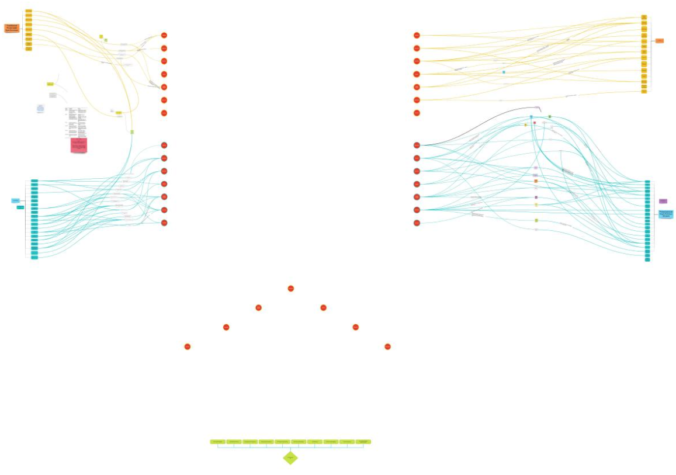
As I explored and tried to make sense of the data collected in the concept map, however, it became increasingly clear to me that we were looking at the problem backwards. The tools we were analyzing were driving the conversation at the expense of the tasks we intended them to perform. The concept map, however, reframed how I looked at the challenges we were working through. I perceived a way to flip the conversation so that the teaching goals would frame how we perceived the tools. In this way my concept mapping tool actually served a meta purpose: the tool itself reshaped how we should analyze tools. Ironically, using the concept map tool itself led me to see how we should ultimately frame the project.

When we embarked on the latest iteration of the Teaching Toolset Project, I intended for the group to create a catalog of tools that could achieve specific teaching and learning goals as defined by Diana Laurillard in her book Teaching as a Design Science. These were Practice, Acquisition, Discussion, Inquiry, Collaboration, and Production. To her list I added the challenge of engagement, which I defined as Curiosity. The problem that the Toolset Project sought to tackle, as originally conceived, was that we were uncritically using far too many digital tools. All too often, these tools failed to connect to the tasks that they were intended to perform.

The two hackathons that we have done so far have given the participants a list of tools grouped by proximity and time, allowed them to add to the list, and then asked them to connect these tools to the aforementioned teaching goals. It was my thinking that the critical gap in knowledge was a deep understanding of the tools themselves. Because we so often uncritically adopt tools, we miss opportunities to apply them to the creative practice of teaching and learning. As a result, we miss opportunities or become frustrated with the tools when they undermine our pedagogical goals.

I slowly realized that in the project’s design that I was making exactly the same mistake that I wanted the project itself to overcome: I was missing an opportunity to use the concept tool creatively to better understand how it was itself reshaping the project. The concept map that emerged from the first two excellent sessions on Synchronous and Asynchronous tools was a complex snarl of connections. After the last session, I set to untangling this flying spaghetti monster of linkages. I eventually discovered that the only way I could make sense out of it was to put it up to a mirror.

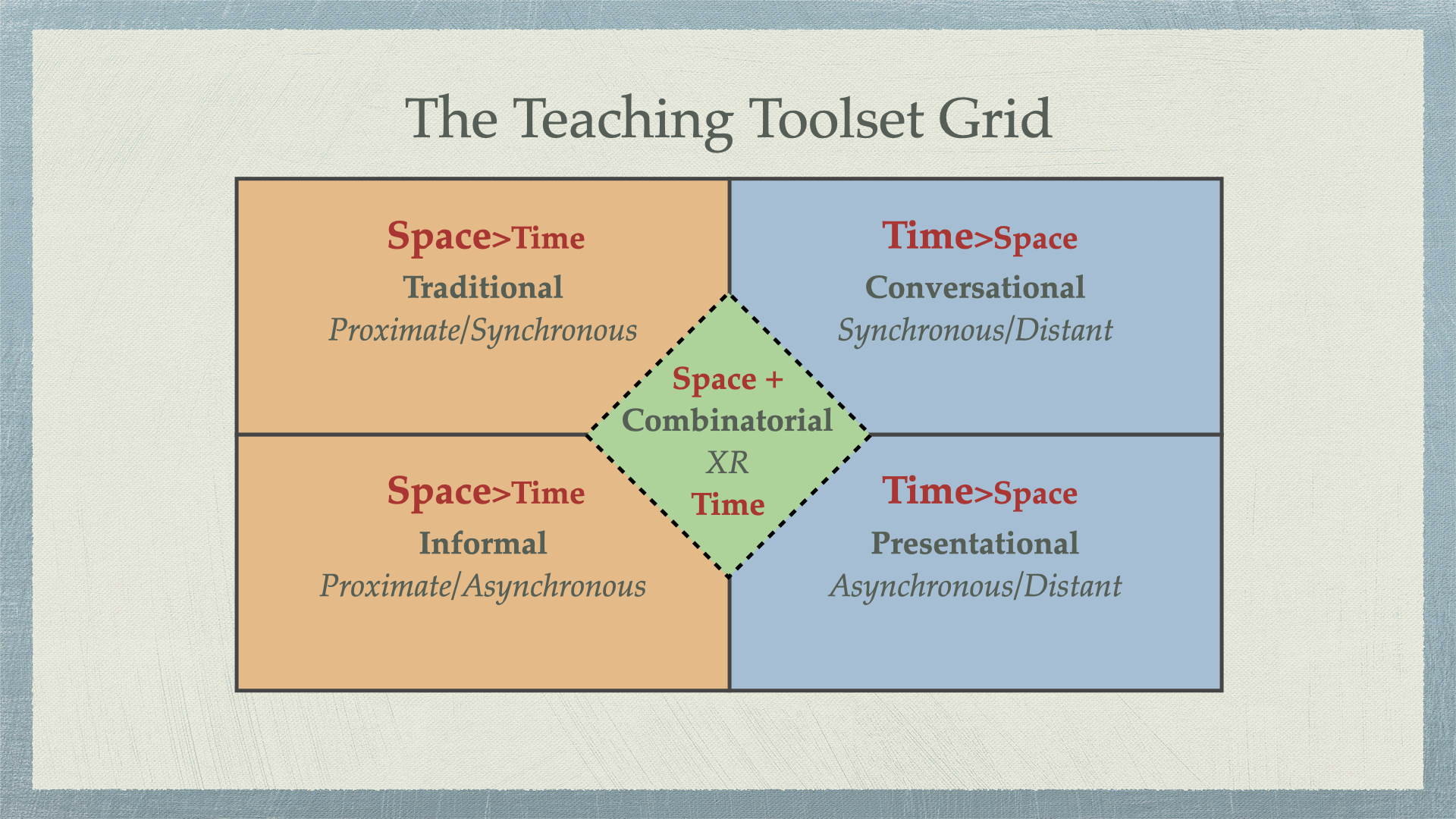
My initial thinking on the project was to create a guide grouped into the five tool modes Traditional (synchronous/proximate), Informal (asynchronous/proximate), Conversational (synchronous/distant), Presentational (asynchronous/distant), and Combinatorial (XR) but I have since realized that this was a trap. This approach led us down a path where we’re letting the tools drive the instructional pathway rather than collecting and developing tools to support specific teaching goals as laid out by Laurillard. This is exactly the opposite of what I intended this project to do but it’s not surprising that it took this turn given how most of us are used to thinking about the role of tools in our teaching strategies.

It seems to be a fundamental human trait to become fascinated with the tools instead of the tasks which we have designed them to perform. Or, as Diana Laurillard says, “tools and technologies, in their broadest sense, are important drivers of education, though their development is rarely driven by education.” (Laurillard, Diana. Teaching as a Design Science, p. 2, Taylor and Francis. Kindle Edition). I would actually take this a step further and say that tools often eclipse our ability to imagine the tasks they were meant to perform. We think of the car, not the drive. This reality has become a central conceptual challenge in the Teaching Toolset Project.

As technologists we have a particular bias in this direction because mastery of our tools has been what has always set us apart from our colleagues. Therefore, to channel Foucault, we control the language around technology and use it as an instrument of power. Many of us are individually aware of this reality, but the systems we exist in have reinforced this part of our identity. Most institutions only recognize our value because of our technological distinction.

The alternative view of our role, reshaping systems of learning, disrupts established structures too much for many institutions’ comfort. This conceptual constraint has always been a matter of intense frustration to me. I always look at tools as a means to an end and never an end unto themselves. I judge tools based on how far and how fast they allow me to create my ends, whether we are talking about creating a photograph or a lifelong learner.

In an era of digital tool glut, keeping our ends firmly in sight becomes even more important. When everyone seems to advertise the latest and greatest at the expense of intuitiveness and capturing human creativity, we end up with a smorgasbord of increasingly complex tools that obscure our goals instead of augmenting us to greater possibilities.

As I attempted to clean up the sandbox that was created during the first two hackathons, the tool reshaped how I envisioned the final product of our efforts. Instead of creating a manual divided into the five tool modes, it compelled me to see a new structure based on the 6+1 instructional tasks laid out by Laurillard. Like an origami, the tool showed me I could take the work of the participants and reverse it to create the opposite: seven sets of tasks with tools to support them. In this way, the tool itself fulfilled the purpose of the project and created a meta understanding of how we think about tools.

Like art, our use of tools is a mirror for human ideas and identity. Digital Age tools amplify this effect through their innate bias towards transparency, they lay bare implicit human assumptions. As masters of our tools, we can grasp these opportunities to see new patterns that emerge from examining our challenges in a different light. Tools should always augment us as human beings by allowing us to create, see, and experience in ways that are unexpected. They are the gateway through the digital looking glass. The world will never look the same again.

Ozymandias – The Power of Creating Meaningful Artifacts

We tend to undervalue the value of our students’ creations and, as a result, so do they. Digital tech gives us unprecedented power to create. It also gives us power to preserve, duplicate and share artifacts of our learning journeys in ways that paper cannot. But with that bounty also comes challenges. We are flooded by the products of creation. When creation was scarce, it was valuable. When thousands of TikTok videos compete for the world’s attention, the danger lies in undervaluing the gems among them.

We are also flooded by a plethora of options when it comes to tools for creation. Which media and media creation tools make the most sense to preserve the work of learning. Conservatives among us will argue that the discipline of writing is essential for developing the necessary mental skills to be considered learned. I won’t argue with the importance of writing but it can now be shared easily. It doesn’t have to go from the student’s printer to the teacher’s filing cabinet. It can be scrutinized much more broadly through the mechanism of blogging with comments, to cite just one possibility.

The importance of taking that writing and those ideas and using them as a foundation for other kinds of media should not be underestimated in a world dominated by videos, web pages and slide decks. The friction associated with creating visual artifacts has declined markedly in recent years. This kind of creation also constitutes a vital skill.

Applying rigorous methods to more creative production is a key to separating student work from the masses of ephemera that have emerged in today’s media environment, but rigor must be coupled with meaning to achieve true value. Are we asking our students to produce throwaway objects or are we asking them to invest in creating something that is meaningful to them and not just as a box checked off of our syllabi? How we ask them to employ digital tools is at least as important as selecting the tools themselves. All of our tools tell stories. We need to make them meaningful ones.

Our lives consist of a series of artifacts. Some are committed to memory. Some are tangible objects. The most powerful involve the mating of the two. That special book or picture touches off memories of what is fleeting. This is the core of what it means to be human. We all have history and are part of our families, communities, and cultures. All of these produce artifacts. Some are more persistent than others but any one of them can acquire deep, personal meaning to us. This is what we remember and becomes part of us. Time is fleeting. Our artifacts are what root us to experience. Shelley’s sonnet “Ozymandias” can serve as a powerful metaphor for the tenuous connection between the permanent and fleeting.

I met a traveller from an antique land

Who said: “Two vast and trunkless legs of stone

Stand in the desert. Near them, on the sand,

Half sunk, a shattered visage lies, whose frown,

And wrinkled lip, and sneer of cold command,

Tell that its sculptor well those passions read

Which yet survive, stamped on these lifeless things,

The hand that mocked them and the heart that fed:

And on the pedestal these words appear:

“My name is Ozymandias, king of kings:

Look on my works, ye Mighty, and despair!’

Nothing beside remains. Round the decay

Of that colossal wreck, boundless and bare

The lone and level sands stretch far away.”

— Percy Shelley’s “Ozymandias”


Like all other memories, our learning experiences can be simultaneously fleeting and permanent. The most powerful experiences combine the two and our tools must be used to connect them in a meaningful way to have a lasting effect on the minds of our students. However, all too often we handicap our imaginations as we consider how to structure learning experiences and the tools needed to facilitate them.

We have at our fingertips today an unprecedented set of tools for creation. Our challenge is unlike that of Shelley and his contemporaries. Pen and paper pretty much represented his range of options. Within decades, we added photography and then film to create, capture, and share our memories. In the last 40 years we have taken all of these media and given them to the masses. In the last 20 we have made it possible to share them widely.

We are faced with the challenges of opportunity. Even while it has opened the doors of creation to many, the democratization of creation has cheapened its value as a container of memory. What used to be a precious scrapbook of family memories is now a vast database of photos and videos of precious moments. The challenges now are ones of sorting and tool selection. For a precious few of those artifacts, the connection to memory remains as powerful. We assign meaning. It is not a given.

Our students must create objects to which they are prepared to assign meaning. It is this power of meaningful memory that we need to tap into as teachers. The problem is that all too often we cheapen the memories of learning by letting our tools limit the universe of possibilities open to us to create those memories. Our students learn that school is about the creation of nothing more than cheap, ephemeral artifacts and treat the experience accordingly.

Our challenge is to use our tools for creation and sharing to build powerful networks of meaning and memory from their learning journeys. We cannot do that if we treat their artifacts as disposable meaning, relevant only within the context of an assignment or assessment. To do this we must turn artifacts into experience.

This is not in any way to denigrate the experience of writing as Shelley experienced it. Creation is as much a product of constraint as it is of opportunity. Using our tools to reimagine those constraints is part of adding importance to our memories. Instead of the traditional paper, have your students create a photo essay. Teach them how to adapt their ideas from one medium to another. Have them work publicly and share with their peers and the world beyond the classroom. These are all ways that we can turn the confusing array of digital tools to create more precious artifacts of their work. It is networks of ideas mated with powerful tools that allow us to create scarcity and meaning out of excess and meaninglessness.

Meaning comes from scarcity. We must actively create scarcity as part of our quest for deep learning. “More of the same” will generate nothing more than the same from our students.

The purpose of asynchronous tools is to create statues that stand the test of time, maybe not as long as Ozymandias, but at least past the course or college experience. How can we use these tools to string together the times we are together with our students and complement their power to achieve meaning and not just the routine of assembly line learning? How can we use them to awaken the creative spirit within them and motivate them to do more than the minimum necessary to “get through” the class? These are all questions that we will explore.

The Power of the Moment: Building Communities of Thought

Time is our only truly non-fungible asset. Deficits of money can be made up but deficits of time are impossible to recover. As teachers, we struggle with this every class. We understand that time spent with students is absolutely precious. It can never be made up once the clock at the end of a term runs out. It is difficult recoup even within the context of a single class session. Time is a truly scarce resource.

Scarcity doesn’t always breed perceived value, however. Students often struggle to find motivation. They sit through classes out of a sense of obligation or a belief that showing their faces will increase their grade. Their perception of time in an instructional session can often stretch toward the infinite (“When is this going to be over?”).

The reality is that we waste a lot of time in any class. The density of knowledge that we can ask our students to absorb within a given live session is even more constrained than that marked out by the clock hands. Lessons in a single class session can usually be counted on one hand, if that. One of my grad school professors (the only one who bothered to teach me anything about teaching) told me that you can’t expect students to absorb more than 3 points in a given lecture. Your challenge as a teacher is making sure that they absorb the right three points. I have found this to be a good yardstick of what I can realistically accomplish within a single session but even that is often an optimistic measure.

The pandemic and remote teaching showed many of us the limits of synchronous teaching. Students weren’t even engaging to the same level as they had during in-person sessions (and that was a low bar). The fact is that much of a given hour of synchronous instruction is repetitious. If it’s repetitious it doesn’t need to be synchronous. The first 5-10 minutes of my classes are usually spent checking roll, making announcements, and recapping highlights from the last session.

None of those things need to take up precious synchronous time and can be shifted into asynchronous tools. Taking roll can be automated by having students put their names in a saved chat or with numerous other tools. It is better to send announcements through an online course shell. Recapping lectures is unnecessary if you record a Zoom session and post it for later review.

Expository talking, aka lecturing, also took a hit during remote teaching. Many of us practice some form of the Socratic method. We quickly discovered that question-and-response really doesn’t work well with a bunch of anonymous black boxes in a Zoom session. Like announcements and recaps, moreover, the same level of interaction can be achieved through pre-recording lecture highlights and pushing that off into asynchronous time.

Using various methods, therefore, I liberated close to 80% of my synchronous time from the time vault during remote instruction. This drove me to think hard about what to do with the remaining time. Attention spans online are even shorter than they are in person. There was also an expectation that, since the session was being recorded, the student could go back and review the tape if there was something he or she missed.

The key to making synchronous time as productive as possible was doing something instead of just talking about it. I had always nibbled around the edges of this in my in-person classes but I never really trusted student-driven work to actually drive the class. I wanted to control the narrative in the classroom to make sure we “covered the material.” Giving control of the pace of the class to the students was a scary prospect and, after all, wasn’t I, as the “expert in the room,” abdicating my responsibility?

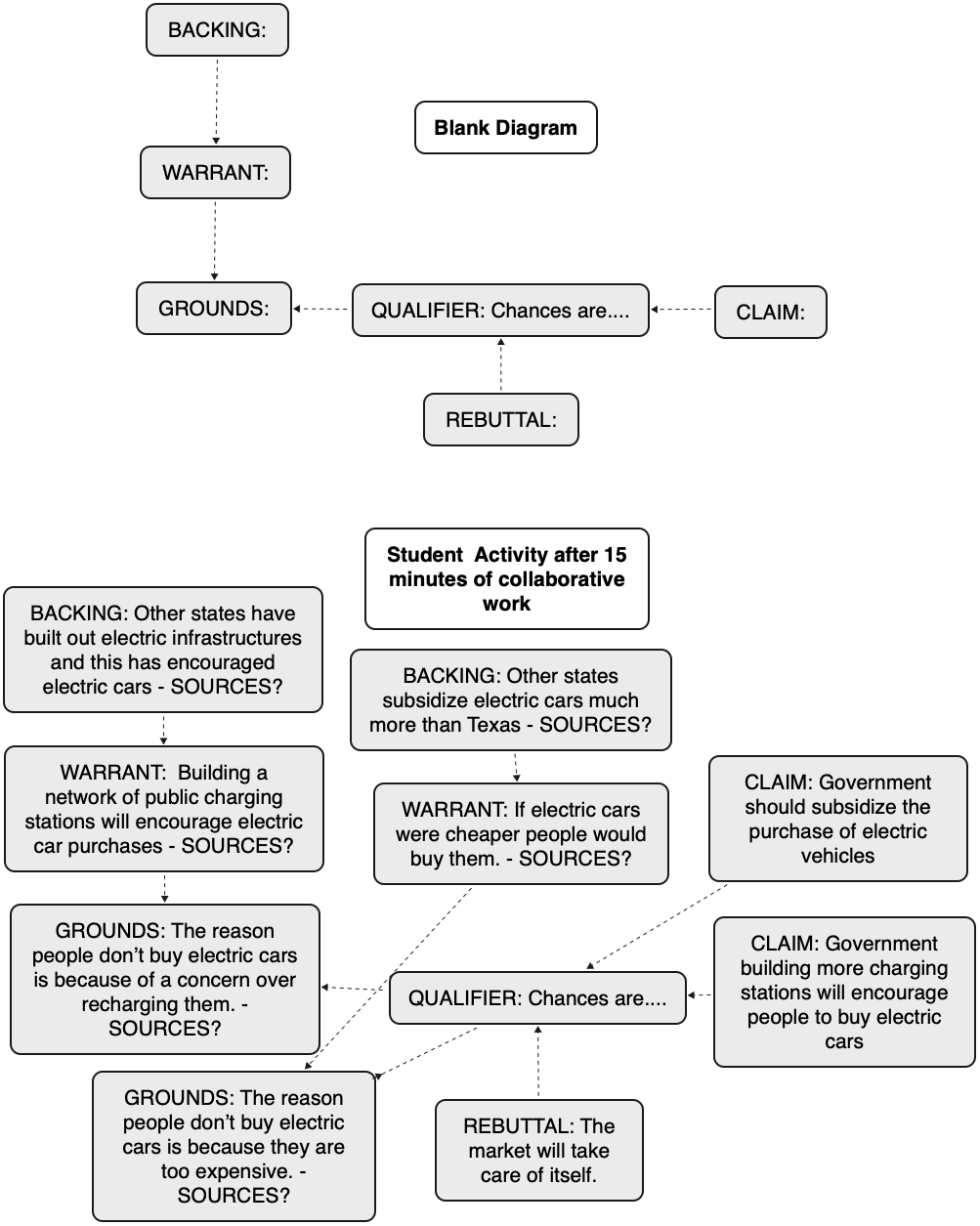
Faced with obvious indifference using online tools, it was clear that I needed to pivot decisively toward creating moments centered on the students, not the material. I would have to trust that the material would take care of itself. In in-person settings simulations often were a good way of creating immediacy and active learning. However, this was challenging in an online setting where interpersonal interactions are often more stilted. Instead, I asked myself where my students needed the most help. I started working back from my assessments and determined that analysis and argument were conspicuously absent from most of their work. The solution (HT Ruben Puentedura) was to introduce the Toulmin Argumentative Method directly into my live sessions.


Toulmin Method Example


This work consumed many class sessions as we dissected each students’ argument. My knowledge of the subject plus techniques of argumentation and research were brought to bear as I walked them through the steps of constructing an argument. The students were then tasked with finding sources that supported their arguments. In this way I sought to develop a community centered around intellectual inquiry. The tools used were very simple. I used Zoom and shared my screen with a concept-mapping tool. After the sessions I cleaned up the diagrams a bit and shared them on Canvas. This would have been more difficult to do using traditional, in-class tools. But it drew power from the collaborative synchronicity of the work online.

The central goal of this activity was to stimulate conversations and group practice to collectively unlock the riddle of their research projects. As Diana Laurillard points out, conversations are central to any learning experience. We can have most kinds of conversations asynchronously but they are reshaped, some might say limited, by their lack of immediacy. The key to generating effective conversations is creating opportunities for the unexpected and these are far easier to achieve synchronously. This is a more important distinction than whether that interaction happens in close proximity or at a distance.

We should not assume that returning to “traditional” classrooms will automatically return us to where we want to be, forgetting the lessons learned from remote instruction. As we discussed in a previous blog, most “traditional” classrooms did not take full advantage of the potential for the student-teacher relationship. Conversation was often one way. Over the last decades, learning space design has worked hard to overcome these initial biases. However, even the most innovative classroom will lose much of the benefit of immediacy if the teacher uses it to teach in a “traditional” way.

Digital Age tools can speed the flow of ideas but they have to be applied strategically in order to achieve the “decisive moment” where deep learning occurs. Information alone is not sufficient to stimulate ideas. Those ideas must resonate within the community of learning. Ideas are central to our humanity. Therefore, if we want to share our humanity, we must also share our ideas. If we want to teach in a learner-centric world, we must find ways to connect our humanity. This is where digital tools can help us. They give us tremendous power to amplify how we connect humans to each other. This reality forms the core of all synchronous learning experiences.

Good teachers shape realities and do so with intentionality. Synchronous experiences are the most visceral realities that students can experience in their learning process. These are the spaces where we can “perform” as teachers. However, they only work if they are also spaces where our students can perform as well. Teaching is all about achieving that “a-ha” moment in our students.

Humans are More Complex Than Light: Iterating a Tool for Understanding Tools

Originally Published on May 11, 2021 at: https://shapingedu.asu.edu/blog/humans-are-more-complex-light-iterating-tool-understanding-tools

The Teaching Toolset Project will reframe how we view the tools we use as teachers. As I argue in my forthcoming book, Discovering Digital Humanity, all too often we become prisoners of our tools instead of their masters. We create technological monstrosities with the idea that somehow this will make our students learn better. There is no question that digital tools open up vast new possibilities for learning but they also hold within them traps for the unwary. These traps can be avoided if we know where we are going and use the ends of teaching to drive the means of our tools.

The Teaching Toolset has always been about chasing the elusive will-o-wisp that forms the connection between what we are trying to do and the tools we use to do it. As I argued a few weeks ago, most of us have gradually lost connection with our tools over the last two centuries. Pre-industrial teaching consisted largely of small groups of students working directly with the teacher. The industrial age gradually disconnected students from teachers, particularly at the higher levels of education and the tools it made available gradually weakened that student-teacher connection.

Digital tools have theoretically made it possible to reverse the trend toward the isolated student. Tools that used to be extremely complex for both teacher and student to operate are becoming much simpler to access. This opens up many new possibilities to reconnect with students in ways that were impossible even a couple of decades ago. Diversity carries with it its own complexity, however, and now our challenge is understanding and applying the opportunities our new tools give us.

Simplifying this relationship has been an overriding goal of my career as a technologist, going back at least to my days trying to explain photography as a camera salesman in the 80s. The technology of photography is easy. It is a simple set of mental calculations combining shutter speed, aperture, and film/sensor sensitivity. Everything else flows from an understanding of these three elements. The art of seeing is where the challenge lies. I always perceived my job to be pushing technology to the side as much as possible to allow my customers to “see” and create art. This is what I’m trying to achieve with the Teaching Toolset: pushing technology to the background so that teachers and students can see knowledge and create the basis for deep learning.

Unfortunately, teaching is not as easily distilled down a small set of variables as photography. Humans are more complex than light. The kinds of tools necessary for understanding our relationships with teaching and learning are commensurately more complex. It is the construction of these tools that have obsessed me at least since I wrote the “Three-E Strategy for Technology Adoption” well over a decade ago. As my understanding of teaching has deepened since then, I have come to realize that individual tools, while helpful, need to be integrated into wider systems of tools to become “essential.” However, tools and the goals of these systems need to be carefully aligned or they will have unintended consequences.

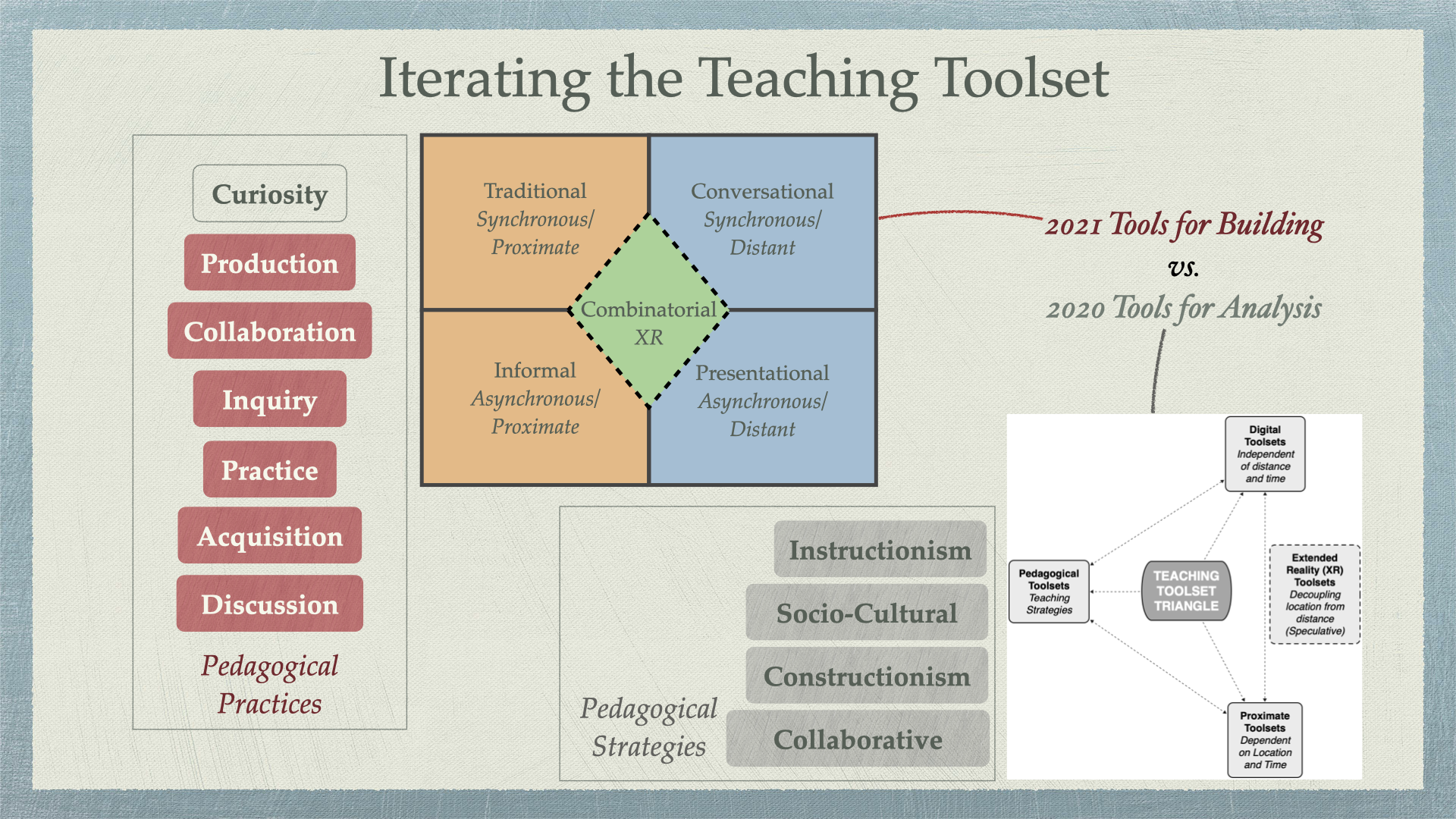
My initial take on the Teaching Toolset was an attempt to understand how certain tools drove us toward certain pedagogical paradigms. For instance, having tools in a room concentrated in the hands of the teacher tends to lead to instructor-dominated pedagogy. The trick was figuring out which tools led in this direction and to be conscious of how they were impacting our teaching. The opportunity was also there to select tools mindfully that would lead to richer styles of teaching. The Teaching Toolset Triangle from 2020 attempted to connect sets of tools to particular strategies in teaching as defined by Diana Laurillard in her 2009 article on the subject. It was designed as  a tool for analysis and self-analysis. This project was an important exercise in self-reflection and there is still work to be done there.


Teaching Toolset 2021 Transformation


However, the pandemic taught me that we still have a long way to go in understanding the complexities of these relationships . It became apparent to me that we need a more immediately practical tool for understanding the relationship between technology and teaching. During the pandemic many of us were forced to strip away all of our preconceptions about how tools were used in instruction. These efforts often led to a much more nuanced perception of how and why we use tools to communicate with our students.

One thing that was already causing me to question the original structure even before remote teaching was where XR fit into the picture. It didn’t really fit in either the physical or virtual categories as it had characteristics of both. Add to that we now have a whole new appreciation of a wide range of video conferencing platforms and the profound implications they can have for the kinds of conversations that can take place within them. The older model also wasn’t designed to account for how tools could be combined to complement themselves into a greater whole.

The model’s triangular structure masked an inherent tension between two concepts I had carefully separated in my foundational framework, Ideaspaces, because it papered over the tension between Space and Time. Proximate and Virtual contained both synchronous and asynchronous sets of tools. In my system tools create Spaces where humans can interact. However, tools are also a fundamental component in how Time works. Badly designed spaces can distract from tasks and eat productive time.

A more complex structure is needed to underpin the model in order to better capture the richness of the opportunities our tools create for teaching and learning. The trick is balancing this out so that the tool for understanding doesn’t itself become difficult to understand. This structure must provide different boxes that capture the nature of tools as Spaces but also provide the context of their relationship to Time. Finally, this structure should also help us understand how the emerging technologies of XR creates opportunities in all four quadrants of categorization.

The solution I am in the process of developing, and which guides the creation of a new ShapingEDU product, is to create a 4+1 visualization that I have tentatively dubbed the Teaching Toolset Quintangle. Since Quintangle is a mouthful, I’ve decided to shorten this to the Teaching Toolset.


Teaching Toolset 2021 Grid


The goal of this new model is to create a better bridge between the tools we select as teachers and understanding the opportunities that they open up to better reach our students. Instead of the more abstract teaching styles of the earlier system, we will look at 6 specific teaching goals that Laurillard identifies in her 2012 book, Teaching as a Design Science: Production, Collaboration, Inquiry, Discussion, Acquisition, and Practice. I will add one more to this mix, the question of motivation, which is centered on whether or not a particular tool fosters a sense of Curiosity in students.

This summer we will engage in a series of interconnected hackathons starting with tools for Building Communities of Thought (Synchronous Tools) on May 18th, followed by Building Communities of Practice (Asynchronous Tools) and Building Communities of Learning (XR Tools) in June. These connected hackathons will assemble information and strategies for understanding tools that we can share with the larger world in a publication later this year tentatively titled Building Communities of Practice: A Practical Guide to Shaping Meaning with Tools. This practical guide will connect tools’ strengths and weaknesses with one of the 6+1 teaching goals. This is intended to be an iterative publication that will be updated yearly as technology and teaching co-evolve.

Teaching in a process of iteration. Iteration was difficult during the Industrial Age because tools were complex and hard to use. The Digital Age is an age of iteration because now our tools can be iterated as fast as we iterate ourselves. Now we need a different kind of tool. We need tools to help us construct environments that can be fine-tuned around the needs of each learner and iterated itself. The central challenge here is to make the systems for understanding our tools as iterative as the tools themselves. The opportunities that we will unlock will shape the possible in teaching and learning. I hope you will join us to contribute your voice to the project.

Lost in the Maze: Motivating the Student Voice

Originally Published on April 23, 2021 at: https://shapingedu.asu.edu/blog/lost-maze-motivating-student-voice

I have always dreamed of having critical, curious, motivated students trying to understand the world around them. I was that kind of student, but I have come to realize that I am all too often the exception to the rule, as are most faculty.

How often have we stopped to take an honest look at what exactly it is that connects college to success? Is it grades? Grades are at best a proxy for learning. At worst they turn into an achievement game for students and their parents. Some students have the motivation or resources to play this game. Many do not. Since I began teaching I have tried in vain to convince my students, most of whom fall into the latter group, that if they focused on the learning process, the grades would follow. I furiously opened doors for them and, more recently, did a massive redesign of my class whose number one goal was to connect the often esoteric study of government with something meaningful to them.

I recently had a student in my community college class who hadn’t turned in any work by the 10th week of classes. After several emails I finally got him alone in a Zoom session and asked him why. It turns out that not only wasn’t he doing any work in my class, he wasn’t working in any of his classes. I dug deeper. Was this his first semester? No. He had failed all of his classes in his first semester because he failed to turn anything in.

I asked him why he was bothering with college in the first place when he clearly didn’t see the point in making an effort. He is a first-generation immigrant and he explained that his mother desperately wanted him to go to college. This is heartbreaking because she almost certainly undertook the trauma of immigration in order to give her son the chance of a better life and saw college as a critical part of that pathway. However, she didn’t understand the college game because she, herself, had never gone to college. No one had ever bothered to explain this to him either.

I get all too many students like this young man. Most are not quite as unmotivated as him but the vast majority of them still equate putting effort into their learning as the equivalent of drinking castor oil. This is because too often our courses become fetch quests for quests for grades. Grades are currency whose only value lies in playing a game I call “Transactional Teaching.”  As Alfie Kohn writes, “Grades tend to diminish students’ interest in whatever they’re learning…. If nourishing their desire to learn is a primary goal for us, then grading is problematic by its very nature.” Only a small minority in my classes have any interest in the learning. Most have been trained to focus on the grade, robbing them of the education or of any rationale for pursuing it.

I care about what I teach. But I care even more about whether or not I’m doing any good in the world. My students’ lack of motivation can be tremendously demoralizing. Do I think my course redesign reaches my students better than what I was doing before? I think it does. However, it does not come without sacrifice. I have had to sacrifice a lot of time unpacking content in favor of a skills-based student-centric approach to using content.

Then there is the fact that most of my colleagues accept this lack of motivation as an immutable fact and resort to a combination of extrinsic sticks (using grades) to give the appearance of efficacy and tertiary support systems to get as many through the game as possible. Graduation is defined as success. Achievement is lauded over any skills a student might bring with him or her with that piece of paper. The churn continues.

As I dug deeper into this particular student’s lack of motivation, I managed to get out of him that his interests were centered on playing video games with his friends. This closely mirrors the preferences of one of my own children, who is a graduating senior this year.

There are stark differences between the two teenagers, however. My son has had opportunities to do robotics and theater tech, both of which I have actively encouraged, not because of how they would look on a college application, but because I wanted him to explore what motivated him. We’ve also had long conversations about what drove him to play video games and what kinds of games he favored.

From these activities and conversations I was able to discern that a primary motivator for him was building things, and that a path toward engineering would give him fulfillment in that area. Moreover, we both recognized that any engineering program he attended should have a strong practical component. His problem is the opposite: he understands the game so he doesn’t take it very seriously.

I decided to pursue the similarity between my son and my wayward student so I attempted to tease out elements of his high school experience. Was there a robotics team at his school? Yes. Had he been interested in joining it? Yes. Why didn’t he? Too complicated. My wife and I had to jump through a bunch of hoops to get my son into robotics. It’s a “club” and not a “sport” so it is not integrated into the curriculum in the same way. We had to work hard to introduce richness into his high school experience (and he also went to a school where that was possible. No one did that for my student. He was just sent through the maze.

These students aren’t broken and if they are it’s because the system broke them. Only an exceptional few rise above the maze the educational system made for them. I don’t blame my student’s mother for not navigating the game as effectively and creatively as I have (and I’m not without fault in that area either). She shouldn’t be expected to know how to play a game that is completely alien to her. It should come as no surprise that first generation college students have much lower success rates and that a significant predictor of educational attainment is the educational level of the parents. If we look at educational achievement as key to social mobility these statistics should be a matter for grave concern.

It is easy to lay this on the shoulders of our students. We’re just giving them what they want, after all. They want grades because the system has conditioned their expectations. Grades are key to escaping the maze. Too many of our students have never been asked to truly explore what they want from life, much less how that relates to their education. Education loses its joy. All that’s left is a frustrating maze.

I’ve done the best I can to motivate my students within the constraints of my class. Sometimes I see a glimmer, but more often than not I see the students look at my class structure, see it as a different kind of game, recognize the endpoint as the same kind of grade they get in any other class, and proceed in a business as usual fashion. They accept what I’m doing as an eccentricity.

Studying your students’ needs should not be an eccentricity. I have come to accept (reluctantly) that many of the issues that my students face when I try to empower them are structural in nature and my ability to change their motivations is limited. I am swimming against strong institutional and cultural currents. It will take a lot of faculty who are willing to try to dig deeply into the motivations of their students to change this paradigm.

A final scary consequence of this game is that our current systems are very good at producing uncritical followers whose primary skill is navigating mazes instead of questioning leaders who are good at learning. Even those who beat the education game risk graduating with the same intellectual skills with which they entered college. This is borne out by studies of the Collegiate Learning Assessment such as the one in Academically Adrift.

Facing challenges like how to make our democracy work, automation and climate change will require a generation of leaders skilled at critically examining information and learning from it. There won’t be a grade assigned here. It will be pass/fail. Daniel Patrick Moynihan said, “You are entitled to your opinion. But you are not entitled to your own facts.” Humanity’s future depends on our ability to create systems to motivate students to distinguish between the two instead of worrying about the difference between an “A” and a “B.”

The Systems-Tool Paradox – Part II – Breaking the Closed Loop at Both Ends

Originally published on April 6, 2021 at: https://shapingedu.asu.edu/blog/systems-tool-paradox-part-ii-breaking-closed-loop-both-ends

Part I – The Perils of Letting Systems and Tools Dictate Practice

Yesterday, we discussed how tools and systems become entangled in closed loops that tend to preserve systemic preferences about teaching and learning, even when they no longer meet the needs of the vast majority of learners. The problem with both systems and tools is that we usually accept them uncritically and attempt to adapt practice to be more learner-centric. However, as I discuss in my recent book, Learn at Your Own Risk (ATBOSH, 2020), there are hard limits to how much you can adjust practice and how effective those adjustments will be on learners accustomed to the existing paradigms. To address this challenge we need to attack the problem from both ends and analyze both systems and tools to look for opportunities to create new and more productive learning paradigms.

It is hard to untangle the impact of tools and systems on each other. At the systemic level we need to envision what a post-pandemic, antifragile system of instruction should look like. My own interests on this level center around rethinking how tools have the potential to reshape what we consider to be a “class,” how it’s delivered, and how the current structure has impeded holistic, interdisciplinary approaches to learning that will be critical in preparing our students to address the global challenges of climate change and automation.

Parallel to our exploration of systemic-level change, we must also understand how our tools drive the systems that they are a part of, and vice versa. We’ll explore how tools drive instruction in more depth in a series of upcoming hackathons to expand the Teaching Toolset Triangle Project. The goal of this project is to provide a mechanism for both faculty and administrators to explore creative uses of the tools we use to facilitate learning. The Toolset Triangle is designed to allow us to hack paradigms and use our collective knowledge and experience to demand tools that fulfill the ends of individualized, empowered learning.

Tool vendors, from learning space design to learning management systems to textbooks, are all driven by catering to the preferences of the markets they support. If those markets demand tools based on archaic paradigms, that is what those providers will provide. A few years ago I worked at an architectural firm trying to help them design learning spaces for the future. However, what quickly became apparent was that the kinds of questions I insisted on asking made their clients uncomfortable. Instead of educating their clients, the firm decided the better strategy, from a business perspective, was to give the clients what they wanted. What the clients wanted was largely driven by industrial models and so even the most “innovative” learning spaces never really questioned those paradigms.

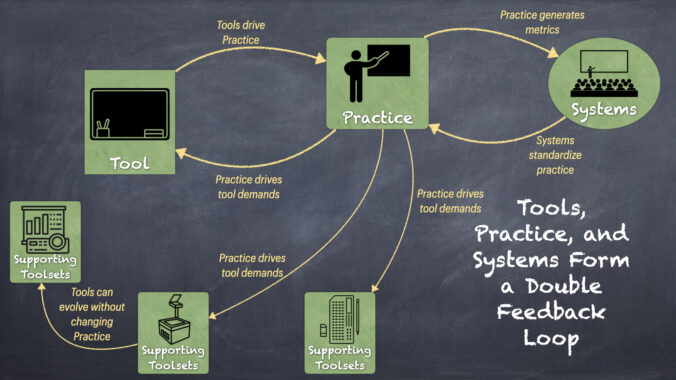
This is a serious problem. As was pointed out in yesterday’s blog, the tools drive the systems but, more importantly, are themselves driven by the logic of systems and the practices that they seek to rationalize. The logic of education is not driven by the needs of the learner. The logic of education is driven by the educational systems that have evolved since the 19th Century.

If you challenge higher education to explain the ends we are seeking for our students, it is virtually impossible to come up with a consensus. That is because reality often has little to do with aspiration and that is in large part because that aspiration is so ill-defined. What does it mean to learn? How do we measure that? We almost never confront that question honestly. As Diana Laurillard says in Teaching as a Design Science: “We cannot challenge the technology to serve the needs of education until we know what we want from it. We have to articulate what it means to teach well, what the principles of designing good teaching are, and how these will enable learners to learn. Until then, we risk continuing to be technology-led.” (p. 4) At the tool level, therefore, we need to re-establish the primacy of the task – learning – when it comes to designing ecosystems of tools that are meant to support learning. This is what the Teaching Toolset Triangle Project seeks to do.

When the blackboard entered the scene in the mid-1800s, there really weren’t many other learning tools outside of pen and paper. The Digital Age has seen a vast proliferation of tools and we’re about to be hit with a second wave of opportunities through the gradual adoption of XR technologies. Having gone through the first wave as an administrator, I saw that time and time again tools were adopted in a completely haphazard manner and that the vast majority had little or no impact on pedagogical outcomes as a result. That was largely because tools were adopted without understanding their pedagogical impact. Often, technology was purchased by technology groups or the IT department without any clear purpose in mind, much less working from any kind of deep understanding of how learning works.

One of the lessons of Remote Teaching is that this needs to change. All too often I saw faculty struggling with technology that was designed for corporate meetings, not effective classroom instruction. As we return to physical environments, we need to mindfully reintegrate in-person instruction with some of the affordances of digital instruction we discovered when we were physically separated from our students. This summer the Toolset Triangle will host a series of hackathons centered on three tool groups (physical, virtual, and XR) where participants will hack them to explore how they could reshape our pedagogy and how our pedagogy can shape the tools we demand to facilitate learning. The goal is to produce a handbook describing uses for tools as well as tools we should be demanding based on the hackathons.

Systems are reshaped slowly even in times of crisis. Remote teaching has provided us with an opportunity to engage in new conversations. ShapingEDU facilitates conversations. Conversations form the basis for learning. Systemic change is a product of scaled learning. Join us in the conversation and move the world.

The System-Tool Paradox – Part I – The Perils of Letting Systems and Tools Dictate Practice

Originally Published on April 5, 2021 at: https://shapingedu.asu.edu/blog/system-tool-paradox-part-i-perils-letting-systems-and-tools-dictate-practice

All too often we let our systems dictate the tools that we have to facilitate learning in our students. If our goal is individualized, learner-centric instruction, then tools driven by systemic logic will often fail to meet the needs of the learners we are trying to serve. Those tools all too often tend to be driven by the logic of the systems that created them. Tools and systems become self-reinforcing loops and the result is practice that is driven by tools and systems instead of its effectiveness in reaching the learner. Our systems and tools came under immense strain last year under the pressures of Remote Teaching. It provided a unique opportunity to assess how these two factors impact how we teach and perhaps to imagine how flawed systems and tools can be reimagined to design better learning futures for our students.

The blackboard, which emerged in the 19th Century, both drove and evolved in parallel with modern forms of classroom lecture. Industrial Age pedagogy was characterized by the scaling of the distribution of knowledge, with efficiency of exchange being its primary systemic goal. Before the blackboard the teacher usually interacted on a much more individualized level with the student. The blackboard enabled the scaling of classrooms to a size that increasingly depersonalized instruction and made possible the growth of higher education itself into what we would recognize as its modern form.

Eventually, the blackboard facilitated the creation of an economic logic biased toward ever larger classes and a pedagogical bias toward expository content delivery, aka, the lecture. Norms begat culture and we now have several generations of professors (and their students) who have been inculcated in this cultural practice. Supporting tools have sprung up around this paradigm such as mass, high stakes testing and a textbook industry based on access to a captive audience, creating an ecosystem of tools that serve the system more than they serve the learner.

The impact of the blackboard, however, was far from bad. It represented a technological leap over speech alone. Initially, it was a technology developed by faculty that allowed teachers of the new sciences established by The Enlightenment to more effectively work and communicate with their students. As such, it was a powerful tool that also enabled high-level communication and problem-solving by the instructor and any students the professor chose to allow access to the board. It made the best use of the technology available to teaching in the 19th and for much of the 20th century.

In short, the blackboard was perfectly sufficient for teaching those whose destiny was to reach the higher levels of society through their university education. This, of course, included all of the professors who subsequently used the tool to continue the chain by passing down knowledge and pedagogical strategies to the next generations of teachers in their classrooms. Norms emerged in this system to create powerful self-reinforcing loops that this is what education looked like and what it should always look like. You either had to adapt to the norms or be left behind. If you wanted to be part of the club, you adapted to the norms.

Following World War II, however, the demands on higher education started to shift as the economy demanded that more and more of the workforce receive a college education. Teaching learners to be the equivalent of a college professor in this environment no longer made sense to the vast majority of the new students. As Diana Laurillard pointed out in her 2012 book, Teaching as a Design Science:

Until quite recently,it was the prevailing view, especially in universities, that teaching is about imparting knowledge. Sadly, “imparting knowledge” has usually been only a partially successful teaching activity, as every essay and examination paper testifies. While higher education was an elitist enterprise, and exams were designed to select the best minds, it was possible to make this failure the responsibility of the student. This has changed. Higher education has become less elitist, and has taken on the task of educating a much larger proportion of the population to degree level…. – Laurillard, Diana. Teaching as a Design Science (p. 11). Taylor and Francis. Kindle Edition.

However, despite this paradigmatic shift in the ends of education and those who should receive its benefits, the tools that facilitated it only evolved incrementally. Blackboard and lecture instruction were augmented by overhead transparencies and automated assessment methods such as multiple choice testing. Students still had to master the intricacies of decoding a professor’s scribbled notes on an evermore distant board as the classroom grew larger and larger. Furthermore, they became widgets in a system driven by limitations of 19th-Century technological paradigms (the punch card – which eventually begat the Scantron – was invented for the 1890 census and the first commercial overhead projectors were demonstrated in 1866).

With the introduction of digital projectors around the turn of the 21st-century, the possibility of more interactive instruction became possible. However, the vast majority of professors merely used this new technology to amalgamate the overhead projector and the blackboard into one tool. The practical advantages of a slide deck projected to the class lay in overcoming the handwriting of a professor and providing a media container for their transparencies. It made existing practice easier. However, this shift in tools was easily accommodated into the existing paradigm. There was no real pressure at most institutions to change that.

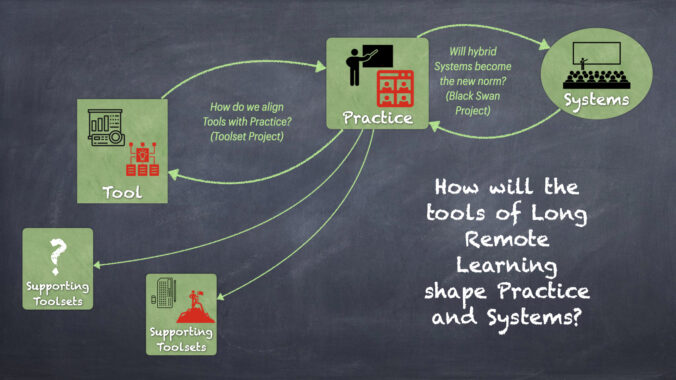
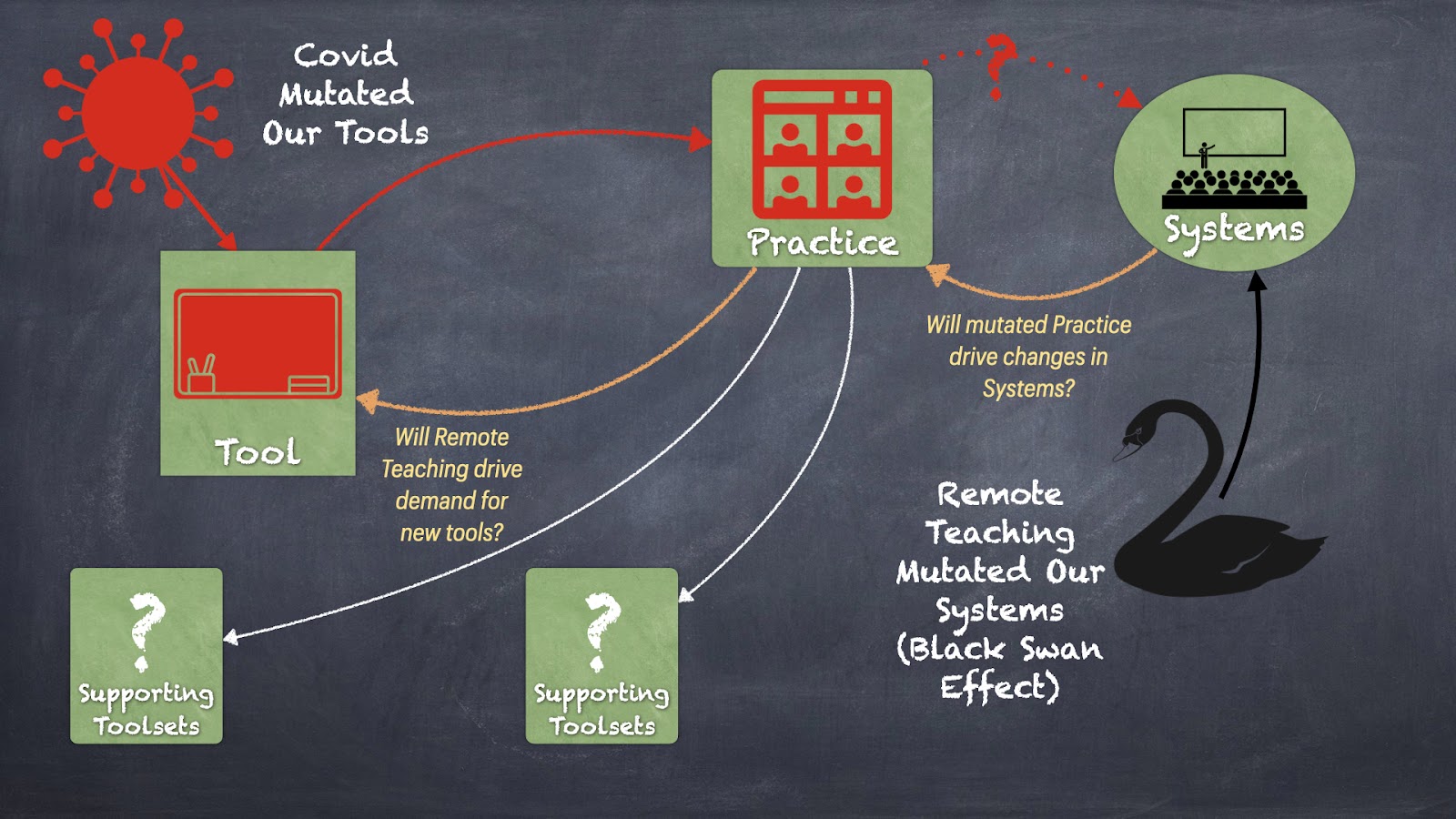
Covid broke many Tools. New Practice had to be developed. Systems had to adapt.
How deep is the viral disruption going to be long term on shaping Practice and the Tools it demands?

The pandemic broke those tools and forced professors to try to replicate what they had been doing in a physical classroom using some sort of video conferencing solution and whatever other tools they could quickly master. Suddenly, the logic of the space changed. Both individuals and institutions struggled with the implications of what this new space taught us.

While the pandemic itself was not a Black Swan event, Remote Teaching was. Those that recognized the systemic nature of what was happening to their instruction used this as an opportunity to take a sober look at what was working in their pedagogy and what wasn’t. Those that didn’t and tried to stick to the lecture-driven approach that was familiar to them quickly discovered that students checked out far more obviously online and that many of the strategies that professors had developed to break down the dehumanizing effects of a lecture-based classroom didn’t work in these unfamiliar learning environments.

Under the pressures of Remote Teaching we quickly discovered that the systemic environments created through our relationships with the blackboard and its derivatives blinded us to a huge range of tools as well as pedagogical strategies. A comprehensive rethinking of how we adapt the systems of education designed to educate the elite to the needs of much broader audiences with vastly different priorities was long overdue. We have also rarely considered how tools and systems drive each other. I know from my own experience that purchasing decisions were rarely driven by any comprehensive analysis of the pedagogical implications of a given tool, and that’s if the instructional side was even consulted at all.

The foolishness of this approach was exposed when infected by the implications of an invisible virus. Badly designed tools cracked under the strain. Systems were forced to expedient adaptations. Poor decisions, past and present, were amplified. Students and faculty were often left adrift with little idea of how to respond to these events. Many students took one look at this reality and checked out of school entirely. We learn from failure. It’s time to begin that journey back. Tomorrow, I will describe how ShapingEDU is responding to this challenge through a pair of innovation projects that will take place over the coming months.

Part II – Breaking the Closed Loop at Both Ends

Going Small: Lessons from Remote Instruction

Originally Published on March 9, 2021 at: https://shapingedu.asu.edu/blog/going-small-lessons-remote-instruction

One of the underappreciated side effects of the Covid pandemic has been to make everything small. Over the last year I have become much more focused on the individual stories of my students as I try to shepherd them through classes, often under very difficult circumstances. My students have lost relatives, become sick themselves, and had to deal with a host of technical issues related to remote instruction. Digital tools have provided me with an unexpected boon as they allowed me to become much more aware of their struggles and given me new opportunities to reach out to them. This ease of connection is not something I want to lose when things go back to “normal.”

Under the old paradigm students often disappeared from my class, never to be seen again. I teach at an urban community college and many of my students are clinging to the edges of higher education as best they can. Even under the best of circumstances, they are buffeted by individual crises that have nothing to do with a global pandemic. They may have shaky job situations, visa issues, or responsibilities to extended families that can suddenly rise up and overwhelm their learning journeys.The difference now is that I have a much better awareness of what’s going on in their lives and can creatively bend the course to adjust to their circumstances without compromising outcomes.

We should look to the positives and consider what lessons we can take forward into post-pandemic instruction. For instance, it is easier to interact with students one-on-one than in environments where they shuffle in and out of your classroom according to the clock, not their learning needs. During the pandemic it has been far easier to adjust class meeting times to allow for groups with similar interests to learn together and for me to tailor my facilitation around their interests. I can meet with students with almost zero friction simply by firing up a Zoom meeting. I am not subject to the vagaries of room scheduling. I detail many of these digital affordances in my book Learn at Your Own Risk.

All too often we are forced by the needs of mass education to process learners through the system like we would a car through an assembly plant. The pandemic shut down our assembly plants but it did not shut down our garages. Instead of viewing the student as a widget on an assembly line, digital time and space gives us new tools to view each student as a custom project we’re working on in our garages. Zoom can be used to broadcast to dozens of students or it can be used as a platform for small groups and individualized interactions.

By fully leveraging the communication tools I have at my disposal, something I’m not forced to do under normal circumstances, I can fine tune the funnel of information and feedback much more effectively around the needs of the individual learner. Remote learning showed us that four principles are key to individualized learning in the “new normal.”

  1. Digital tools, applied strategically, will not lose their potency when we go back to in-person instruction. We should continue to leverage tools such as videoconferencing to connect with our students. They give us connections to our students that were underused prior to the pandemic. It’s one thing if you are working on a residential campus where most of your students are within walking distance of your office. It’s a totally different scenario connecting to our students on commuter campuses where no one lives and any trip to campus is just that: a trip. The pandemic has shown us that digital tools can help bridge that connection gap. Furthermore, asynchronous resources like recorded videos and repositories of written materials allow us to move a lot of instruction away from scarce times when student and teacher are in the same place at the same time, making for a far more efficient instructional structure.

  1. Class size really matters and systems need to be adapted to create more antifragile learning environments. Due to the pandemic I was fortunate to have had class sizes capped at 18. This circumstance was created by CDC guidelines, not pedagogical decisions, but it allowed me to more effectively connect with small groups of students. Institutions looking to develop Communities of Practice need to consider these limits very seriously even after safety no longer requires them. While there are issues of economic viability that must of course be considered, the advantages, particularly when dealing with more challenged students, cannot be overstated. When I was responsible for 32 students per section last summer, my ability to keep up with struggling students was significantly compromised. There needs to be more study of the connection between student success and class sizes, but limited data suggests that remote classes taught constructively should be limited to no more than 23 students. Other systemic changes that should be considered are more fluid, blended learning modalities where instruction can seamlessly shift between in-person and online according to the needs of the learner.

  1. Schools must prioritize ensuring students have access to the digital tools and environments they need to succeed. I am convinced that much of the drop in enrollment in community colleges was because of technical barriers faced by students. Digital communication tools require connections at both ends. That means students must have access to computing resources as well as broadband internet access. We have discovered that these are not a given. The big mistake that many colleges made was not adapting their campuses around digital access and informal interaction under safe circumstances. For instance, computer labs could have had their computers distributed throughout multiple rooms to allow for safe usage by students who needed either wi-fi access or computers themselves to do their work. Most classroom functionality can be replicated online. Infrastructure, however, represents a hard stop for far too many of our students. I am convinced that many students assessed their resources and refused to sign up for classes..

  1. Physical environments need to prioritize informal learning. Students need to know that services are available for them when they come to campus. Instruction can be moved into digital realms but connection often can’t. Sometimes that means meeting rooms for small groups or faculty with small groups. Sometimes that means support personnel such as librarians, counselors, designers, or tutors. Sometimes that means technical resources as mentioned in the previous point. Either way, what we have learned from the pandemic is that individuals, particularly in a commuter college setting, really need the college to provide these resources and, as these resources became scarce during the pandemic, students will struggle if forced to compensate for the lack of them on their own.

Remote learning demonstrated the power of going small with our students. Our industrial educational systems have long emphasized the opposite as we sought to increase the reach of our institutions while holding the line on costs. Even institutions based on large, lecture-hall instruction can develop strategies for “going small.” Creating hybrid modalities that synthesize large group content delivery with individualized instruction along the lines of what Britain’s Open University pioneered, while leveraging digital affordances to overcome time and space limitations, could become a powerful combination of tools in the digital age.

It is my hope that one key element that we will take away from remote teaching a sense of possibility contained in going small. We have had a glimpse of what can be accomplished with our existing tools to bring instruction home to the individual. Our ShapingEDU projects are designed to bring the power of our own community of practice to bear on overcoming the barriers to individualized learning. The Student Voices Project is focused on assessing the needs of individuals in the educational process. The Universal Broadband initiative seeks to ensure all students have equal access to a distributed educational network. Our Black Swan Project is working toward creating antifragile systems of learning so that the burden of crises such as the pandemic does not fall upon the shoulders of struggling learners. Finally, our Teaching Toolset Triangle Project is actively exploring the suite of tools, both digital and analog, that we must fully leverage in order to execute effective learner-centric, distributed instruction to our diverse communities of learners.

All of these projects have one common element: bringing all of our tools and creative energies to bear on preparing all of our students for a lifetime almost certainly shaped by crisis. The pandemic has shown us what is possible. It’s time to get creative in how we integrate what we have learned with the best of the old to create new and better cultures of learning. It’s a cultural shift that was long overdue even before circumstances forced us to confront it.

« Older posts Newer posts »

© 2026 IdeaSpaces

Theme by Anders Noren — Up ↑