
Year: 2025 (Page 2 of 2)

Augment, Don’t Automate: Using AI to Speed Work and Learning

“My choices of what to attempt and what not to attempt were determined to an embarrassingly great extent by considerations of clerical feasibility, not intellectual capability.” – JCR Licklider, 1960

“We refer to a way of life in an integrated domain where hunches, cut-and-try, intangibles, and the human ‘feel for a situation’ usefully coexist with powerful concepts, streamlined technology and notation, sophisticated methods, and high-powered electronic aids.” – Douglas Engelbart, 1962

Technology should augment us, not handicap us. All too often, I see people, from students to fellow faculty, approach technology with fear. Generative AI tools are generating a lot of fear. We need to make the choice to use them to augment what we’re doing. It’s the human choice about how we use it that matters. We need to teach ourselves as well as our students the right way to steer this technology, not ignore it or ban it.

Faced with the challenge of reinventing my class, I chose the augmentation path for both my work and teaching my students how to augment their own work. It’s amazing how quickly things get better when you use AI to augment what you are doing.

In redesigning my course over the past few weeks, I didn’t just focus on teaching AI as augmentation, I used it to augment my ability to overcome constraints of time and inspiration.

I quite often get responses from colleagues who look at the challenges of AI and throw up their hands and say I don’t have time to deal with this. This has been a recurring topic of discussion on Bryan Alexander‘s Future Trends Forum as well as the Talking with machines podcast that I do with Bryan and Mark Corbett Wilson.

As I confronted getting ready for my summer courses, the idea of a complete reinvention seemed far beyond my means. Whenever you upset the applecart of a carefully designed course, you have to recognize all of the different parts of the system that are likely to become undone. As Douglas Adams said, “A common mistake that people make when trying to design something completely foolproof is to underestimate the ingenuity of complete fools.”

Classes are complicated systems. If you’re trying to get students to do something unfamiliar to them like I do, it’s really easy to see things go haywire. I am usually very conservative when it comes to tinkering with the class structure.

At the same time, I was acutely aware that I was not living up to my own ideals when it came to teaching my students the skills they needed to be successful. I put a light coating of AI onto the class over the last couple of years, but it was always sort of an add-on.

Also, students were abusing it in the way that people often accuse them of. Instead of writing papers they were letting ChatGPT do it for them. They failed because ChatGPT doesn’t really know how to write papers for my class. But failing them is not my goal.

Most of my students are technology illiterate. Sure, they use technology, but they don’t really understand what they’re doing.

Education does a lousy job of teaching students how to use technology to maximize their potential. Usually, when confronted with a new technology, the collective response is to do the equivalent of handing the car keys to a 16-year old and telling them, “You go figure it out for yourself.”

My class is already fairly technology-training intensive. Bear in mind that the subject that I teach is government, not computer science. I already teach them blogging, digital and visual communication, and the final project is a website on a public web service like Google Sites or WordPress.

AI, however, demands something more than that. Properly employed, it is a tool for augmenting yourself, not just augmenting your output. This has the potential for changing our relationship with our tools at a fundamental level.

On the first day of class, I asked them what part of school was most difficult for them. Almost universally, it was writing. As a writer myself, I know the pain of putting things into words so I could relate to that. I’ve used AI to ease that pain, so I decided that a key goal of my AI use in class would be to help them engage with writing more effectively.

But first, I had to solve my own problems, which, ironically, were like those of my students. I needed to rewrite/redesign parts of my course in a short amount of time.

I knew what I wanted to do, but I didn’t really know how to do it. I got some good input from a friend who is a course designer. She gave me some excellent ideas. However, her suggestions were too extensive for me to comfortably implement given the time constraints.

Instead, I grasped for the very tool I was trying to teach my students. I gave Notebook LM and my AI pedagogy library a set of queries based on existing assignments and the goals of the class. Starting with my own text and instructions, it modified assignments so that they folded AI into the process. Using this iterative process with AI simplified the process of modifying my class system without eliminating it entirely.

In short, I developed a sequence of “Blog Prep” assignments. In the first assignment, I have the students query an AI chatbot about how they thought the question should be asked. We then reviewed these live in class. It is very important that they understand what I’m asking them to do as my class is based on learning by doing and if they do it wrong, they miss a lot of the learning.

In the second step, the students found sources to develop their arguments to the question. They could use AI to help them with this or more traditional search tools.

Finally, I had them bring in a rough draft of their first blog post and post it in the discussion. I then ran those through either ChatGPT or Gemini using the same strategies I use for my own writing. Again, this was done in class and was a centerpiece of the discussion that day.

We asked the chatbot what the draft was about to verify that it was clear in what it was trying to say. Then, we asked it to compare with the assignment question and verify whether it had answered that.

Finally, we asked the chatbot for ways we could improve the post. The results generated a surprised reaction from the class. They had never thought of using an AI chatbot in this way before.

JR Licklider in the quote above talks about how he often rejected work because of the clerical infeasibility of it. I realized that that’s exactly what prevented me from changing my course. It is also what my students needed to help them change how they approached the work of learning. In both cases AI removed barriers.

For those of us trying to facilitate change, whether with our students or the process of teaching and learning, time barriers are a major roadblock. In the same way that I use AI to facilitate my writing processes, I was able to use it to facilitate rewriting my course, and as a mechanism to teach my students to do the same.

I know I can solve a lot of problems given enough time, but therein lies the rub: I never seem to have the time. If I can use AI to overcome barriers and save time, I can make a lot more problems solvable. The same logic applies to my colleagues and my students.


We Will All Construct AI: Five Principles For Getting It Right

“Technological systems contain messy, complex, problem-solving components. They are both socially constructed and society shaping.”  – Thomas P. Hughes

“It’s the questions we can’t answer that teach us the most. They teach us how to think. If you give a man an answer, all he gains is a little fact. But give him a question and he’ll look for his own answers.” – Patrick Rothfuss

Every day there seems to be a new story about how AI is destroying education, work, or civilization itself. When I dig into them, they almost always describe a situation where AI is being misused or abused by human fallacies or systems.

It’s like damning hammers by highlighting every instance where someone uses one to beat someone to death instead of using them to build a home. The hammer is an apt metaphor because I often feel like I’m playing whack-a-mole when people bring these stories up to me to justify ignoring, banning, or fearing AI tools.

People are afraid and they have a right to be afraid. However, we must realize that those fears are of change and our own infirmities (we all have them).

This fear blinds many to the possibilities of any new technology, but the cascade of skeptical articles of AI is unprecedented in my experience of new technologies emerging on the scene. I am speculating, but I do think writers and journalists are particularly threatened by this technology because, for the first time, there is a tool that threatens the routine aspects of their jobs rather than someone else’s.

It is time to embark on a clear-headed exploration of how humans should approach this technology. AI can’t be banned. At this point, that would be like banning wind from an outdoor wedding.

Nor should we ignore AI. There is no disputing its likely impact and the potential for humans to abuse it. We also shouldn’t dismiss its potential to change the world for the good.

We need a human-centered framework for moving forward into a changed world. For this, I would suggest a set of mirrored principles to guide us forward.

1.

AI should facilitate transparency. AI provides us with a tremendous tool for seeing information. This vision should be what we use it for, even to shine a spotlight on the various AI models themselves.

AI fails when we use it to mimic transparency. It is not all-seeing and therefore we should never trust it to give us the full picture. Those who sell it to us in that way are selling answers that are often false and misleading, leading to much of the criticism of the tool as a whole.

It is a lack of transparency that fuels criticisms of AI that center on it generating a torrent of misinformation. I constantly must remind people that humans already do this. The problem is not the information, it is finding a way back to its source. AI built on transparency will always connect information (see next point) and help us navigate toward finding our own answers, not give them (see #5 below).

2.

AI should facilitate connection of all kinds. It should show us how information might be connected to other information. It should help us connect better with other humans in a chaotic, busy, and complex world.

AI fails when we use it to substitute for human contact or trust it to connect information uncritically. If we use it this way, we risk isolation and blindness. Again, these are human choices that we make. Failure is a sign that we are failing to address deeper societal problems about education and emotional well-being.

Technological isolation is not a new thing. AI may make it more appealing, but it is no different from those who use it to hide for whatever reason.

3.

AI should generate surprise. I like “hallucinations.” When someone from another culture says or does something that surprises me, my first impulse is to try to understand why that is. AI should elicit the same response from us. This is how we learn.

AI fails when we use it to dampen human differences and regulate normative behavior. AI is a natural pattern recognition tool. If we use it to turn the rich tapestry of human experience, knowledge, and emotion into an industrial gray carpet, we’ve turned it into a robot overseer. This robs us of humanity and our powers of inspiration and innovation.

Critics of AI’s impact on labor often ignore the reality that the industrialized economy has dehumanized us for decades, if not centuries. This is not a new thing. Neither is automation replacing menial labor.

If we only teach humans to do mindless, repetitive tasks, they will be ripe for replacement by any technology. This is a societal choice and one that needs to be fixed in the social sphere.

4.

AI should facilitate creativity. Humans are naturally creative and are capable of building amazing things but often lack the technical skill to be able realize them. AI often provides a ladder that allows us to tell our unique stories in ways that were impossible before.

AI fails when we use it to replace creativity. Creativity requires an expression of the soul. AI is soulless, so if you want soulless art, it’s a good tool. I, however, would not call that art (and don’t even when humans create it).

AI can mimic human creative expression but cannot replace it. Creative people such as myself embrace AI because it gives us another tool with which we can express ourselves. Most of the criticism I see in this area comes from creatives who aren’t doing very creative work in the first place and those who think they own our creativity. AI can never threaten authentic creativity.

5.

AI must promote questioning. It has the potential to show us the world in ways that allow us to overcome our human blinders.

AI fails when we rely on it for answers. Generative AI relies on associations at the root of its logic structure. Sometimes these associations can be definitive but quite often they are spurious.

Learning requires questioning. AI’s power to shift perspectives gives us a powerful ladder to see through our conceptual blinders.

When you rely on anyone for answers instead of exploring for them yourself, you make yourself vulnerable to bias. I have seen many criticisms of AI dwell on this question of bias. This is only a problem if we accept its responses unquestioningly as answers.

No matter where we get information from, we must develop good skills to question information that is given to us even when dealing with pure human-engineered content.

AI is actually a powerful tool for examining bias at scale but only if we use it to question information rather than assuming what it is giving us is somehow magically unbiased.

As humans, we do the same thing but (hopefully) have the critical thinking skills to dismiss those associations that don’t make sense. AI lacks critical thinking skills. We should never forget that.

How we adapt and learn as humans and societies is far more likely to determine whether we thrive or wither under the pressure of technological change. These are the kinds of questions we should be asking ourselves, not tilting at the windmills of a technology that can’t be stuffed back in the bottle.

These five principles and their antitheses should guide us as we use these tools and, more importantly, adapt our human systems to their capabilities and challenges. At the end of the day, these are a product of human choices, not technological ones.

Nothing In, Nothing Out: Creativity, Art, and AI

“The work of art is valuable only in so far as it is vibrated by the reflexes of the future.” – André Breton

As I’ve been exploring the AI world and using it for my own creative facilitation, I have occasionally written about its ability to help me get past the blank page phenomenon. Every creative writer, painter, and photographer struggles with this phenomenon. In my case, this can last for days or even weeks. I never know when my creative energy will emerge.

One of the frequent criticisms I hear about AI from creatives is that if you use AI to mitigate this pain, you will lessen the product of that inspiration. Has this happened to me? I don’t know. As someone who is usually insecure about his work, I’m never sure whether my output has gotten better, gotten worse, or become in some way not me.

I washed the last blog I published through ChatGPT much earlier than I otherwise would have because I had two related half-blogs, neither of which worked alone. After two or three cycles in the chatbot, I went back to editing with a much clearer vision of what I was trying to say.

At the end of that process, however, it was very difficult for me to figure out how much of that work was mine and how much of that was a product of ChatGPT. It conveyed the message I wanted to transmit.

Often when I see people (especially my students) use AI chatbots, they are using it to replace their lack of inspiration. This creates inauthentic outputs that are easily discernible from quality human work. Human inspiration is central to the human voice. AI can tune that voice, not replicate it.

I like to tell people that if they are seeking answers from AI, it will disappoint them. Instead, we should seek questions. Completing your work is to offer an answer. Suggesting courses of action should stimulate questions.

The Knowledge Navigator I am working on is at its root a platform to help surface questions. I see it as an intuition accelerator. In this way, it can inspire our writing and creating. It does so by generating the seeds of inspiration by pulling together disparate ideas and assembling them into maps that the writer or creative can then navigate to figure out what to say.

Creating has always been a product of synthesis aided and abetted by technology. We went from copying phrases of music to sampling them in the 1980s. However, you can tell which songs are the product of creative genius by what the synthesizer does with the phrases and ideas in their new creation.

Instead of Beethoven, listening to Mozart and then putting phrases of his into his own work, the artists of the 20th century could literally take the performed music itself and assemble it into whole new works of art.

This extended beyond music. Visual artists like Andy Warhol took photography and embellished it into novel art forms. Collage art is another example of synthesis in the visual sphere.

However, I’m not trying to appropriate anybody else’s work more than any other kind of creative writer or photographer. I am trying to use AI to make my own writing better and more accessible.

It’s always been a struggle for me to reduce the complexity of my thoughts to two-dimensional sentences. Even worse is trying to make those sentences convey the richness of my thought without losing the reader.

I am dictating this blog into my phone right now as I walk down the street, so in its initial draft, it’s a very unfiltered version of my thoughts. It takes a lot of hammering to get those thoughts into a format that I find understandable to others.

Is it cheating to let AI help me with that? The thoughts that are coming out of my head are genuine and a product of my creative brain at work. I use the technology of my phone to take dictation as I walk. Is that an inappropriate use of technology? How far does this go?

The more I use various AI tools, the more I realize just how much AI will change how we think and communicate our thinking. It will change how we research and assemble ideas. It will also change how we polish our ideas for others.

AI allows us to tone them for various audiences. For instance, it should allow us to translate scholarly writing into something understandable for a general audience. Applied creatively, these tools magnify our ability to exchange ideas.

But what is most important to this process, the ideas or the struggle to communicate them? Is suffering required to produce art?

Would you be able to tell the difference between something that’s never been touched by AI and something that has? Which one is better?

One thing, however, that we should hold onto as our own as a species if not individual is that genesis moment of creation. Whatever methods we use to create the spark that ignites the art, whether written or visual; it must be a human spark. That is where authenticity lies.

AI will redefine art, just like reproduction and broadcast did. It will broaden the reaches of art to most forms of human generated content.

Humans generate a lot of low-level content, such as graphics for advertising or filler writing for marketing brochures. Sometimes this reaches the level of art, but, most of the time, people paid to mass produce content generate it.

Like many creatives, I’ve done both artistic and commercial work as a photographer and as a writer. Most creators recognize the difference between the work that they do for themselves and the work that they did for a paycheck.

AI will take over a lot of that commercial space. It’s already happening.

This should prompt a deeper conversation about how we support creative work and value it in our society. Capitalism and art have always had an uneasy relationship. AI will throw that into even starker relief.

We need to build systems to incentivize humans to push themselves into new areas of thinking and creation. Right now, our educational systems dis-incentivize that kind of activity. So do most of our work environments.

The more we teach people that creativity is not worth the creative pain, the more vulnerable we make ourselves to being replaced by AI. Creativity requires a frame of mind motivated by intrinsic forces, not the promise of extrinsic rewards.

AI may simplify the process of creation, but the act of creation will always be artisanal. I’m able to do photography these days, because I have access to digital tools. I am a better writer because of word processing. AI tools are another evolution of my toolbox, not a replacement for me, any more than PhotoShop or a grammar checker are.

If we can use AI to build bridges and help us communicate our passions better, it will lead to greater innovation and understanding among all of us. That can’t be a bad thing.

Unflattening Ideas

“And today, the book is already, as the present mode of scholarly production demonstrates, an outdated mediation between two different filing systems. For everything that matters is to be found in the card box of the researcher who wrote it, and the scholar studying it assimilates it into his own card index.” — Walter Benjamin, ca. 1923-26

“Give a man a book, and you entertain him for a night. Teach a man to write, and you give him crippling self-doubt for life.” — Andy Weir, 2015


The most intimidating thing about storytelling is seeing a complex world in front of you and trying to distill it into a linear narrative. Grammar, spelling, and style are tools to make narratives more understandable—but the real challenge is the linear form itself.

Written narratives are a byproduct of a technological paradigm—paper—that forced ideas into constrained, two-dimensional forms. Though we’ve started to move beyond paper as our primary medium, we still shoehorn our thoughts into formats designed for it.

Anyone who has ever tried to write knows the world isn’t linear. Capturing the diversity of what we see, hear, and feel in a straight line of text is a hard task. Transforming our internal idea spaces into something comprehensible is even harder.

As someone who’s struggled with writing, I know how hard it is to make ideas understandable. We lose so much insight and perspective because our tools require time and skill most of us don’t have.

Digital storytelling attempts to solve this, but we still dig for meaning in incomplete records. Historiography and pretty much any kind of research requires both expertise and time to piece together coherent narratives out of fragmentary evidence.

While we now capture vastly more information than ever, our storytelling hasn’t caught up. We’re flooded with unfiltered content and disconnected data, yet we still rely on boundaries like “the document” to shape and constrain ideas.

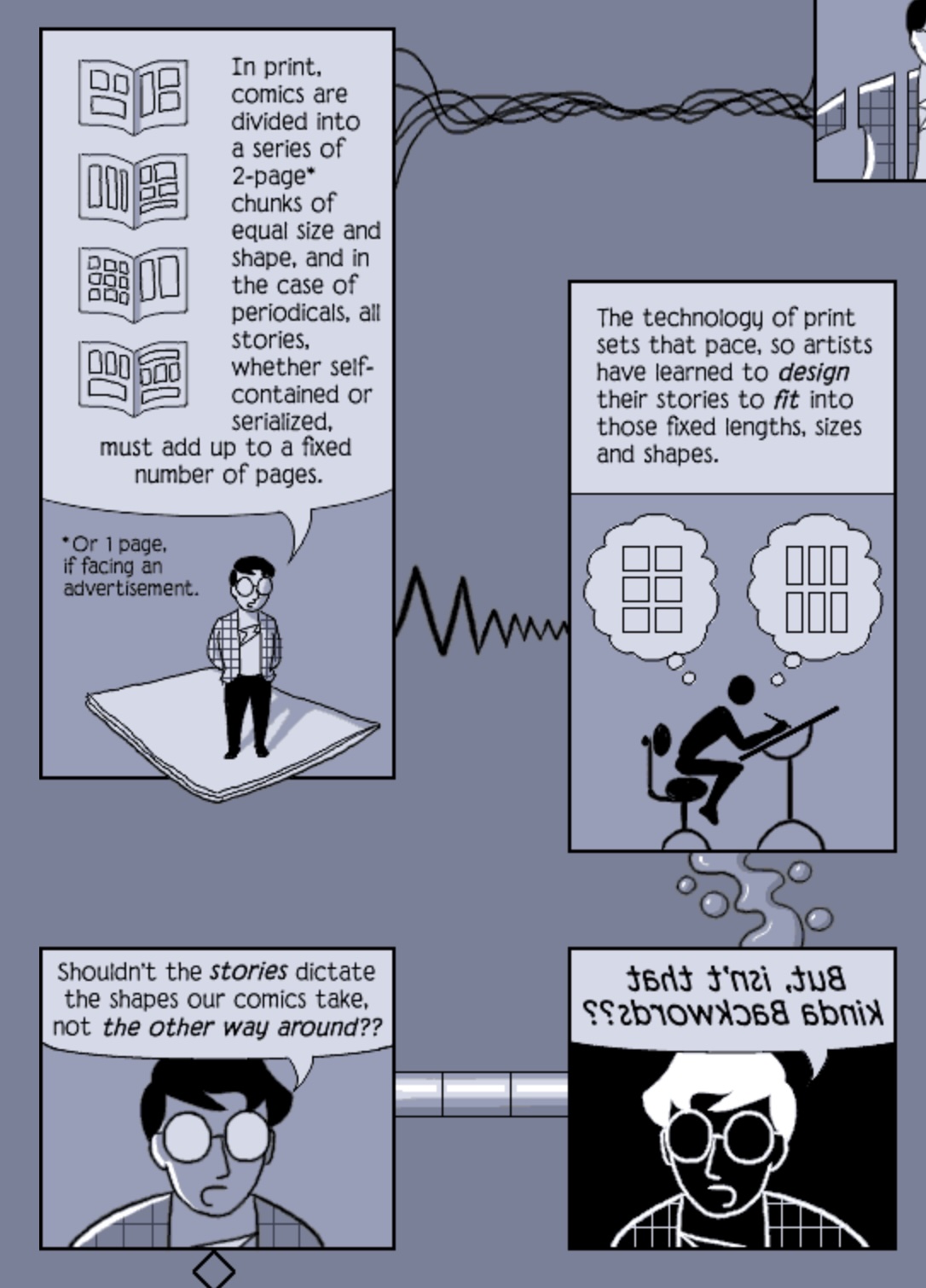
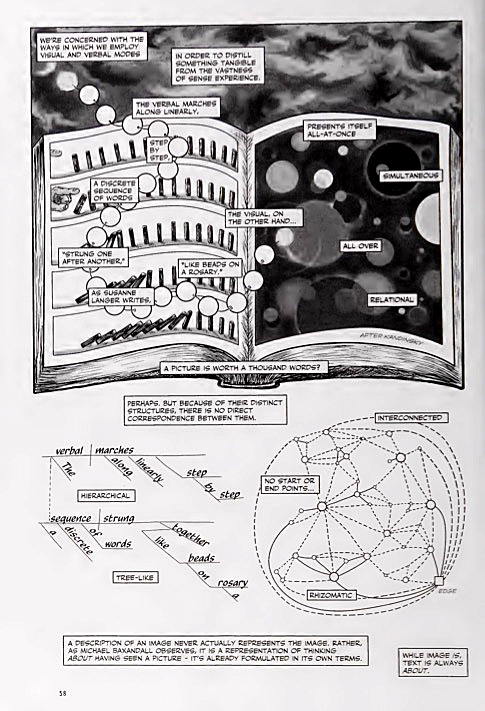
That’s a habit we inherited from paper—and we need to move on. Visual narratives, like the one constructed by Scott McCloud above, have explored what digital visualization truly means. Even visual artists, like Nick Sousanis, constrained by the page, demonstrate the possibilities of visual languages.

Nick Sousanis, the power visualization

Visualization plus digitization shows us that paper is no longer a necessary organizing metaphor. While we remain conceptually constrained, the technical reasons for avoiding this exploration have diminished. AI can illustrate connections for us and break us free from text and paper.

Our education systems still rely on carving off manageable chunks of knowledge—because we’ve given up on perceiving holistic abundance. We try to make it digestible through citations, cataloging and tagging systems. Those forms reflect a slower, flatter information space that is over matched by current information flows.

Scholarly formats—from five-paragraph essays to footnote rituals—exist because of paper’s physical limitations. They have logic and even beauty in their structure—but they’re also exclusionary. Poor writing frequently obscures good ideas. Extracting meaning requires specialized training, especially in the humanities.

Clear communication is a particular challenge in STEM fields. Most scientists lack writing training. Much gets lost in translation. Structured papers help readers extract meaning, but they still confine ideas to rigid formats. It’s no surprise that AI tools are seeing the fastest adoption in scientific domains—because those domains are desperate to move beyond their restrictive storytelling forms.

This points the way forward. Literature, statistics, code—all are more than the lines they appear on. Everything has context. Producing holistic narratives has been difficult; not anymore. The technology simply wasn’t there to break ideas free from paper systematically.

That’s the promise of large language models. They allow us to move in and out of dimensions and design narratives that aren’t stuck to a page. Scholars can now create rich, interactive diagrams of their work—instantly understandable but open to deeper exploration.

Information can now evolve beyond the technology of the book. This shift could usher in a new era of scholarship, creativity, and innovation. That’s what we’re trying to build with the Knowledge Navigator.

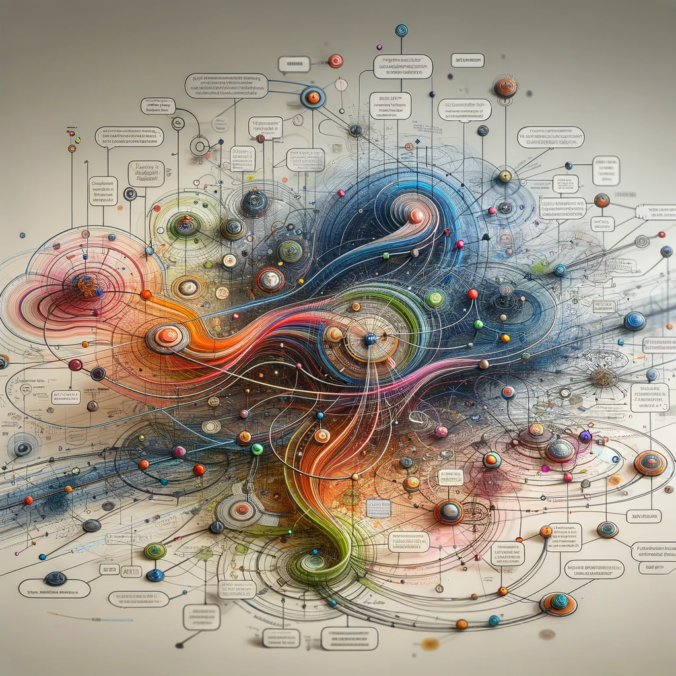
For a content creator—whether you’re a scholar, storyteller, educator, or entrepreneur—this shift means you don’t have to force your ideas into a rigid, linear format. Instead of starting with an essay or blog post, you might begin by building a concept map, a visual story, or an interactive explainer that connects your ideas multidimensionally (Robert Horn has been doing this for years). You might even co-create with an AI that helps you draw connections you hadn’t considered, offering insights or references in real time.

Imagine a researcher publishing a study not just as a dense PDF, but as a navigable, visual web of concepts—where a viewer can zoom in on data, click into contextual backstories, and explore connected fields without ever losing the thread. The traditional paper becomes just one mode of access—one “window” into a multidimensional landscape.

If you’re a teacher, this might require rethinking how tools reshape how students interact with knowledge. Rather than expecting them to summarize a chapter in a five-paragraph essay, you could ask them to create a dynamic timeline, an interactive comic, or a narrated walkthrough of connected events. With the help of tools like AI, students can build artifacts that reflect how they think—visually, spatially, relationally—not just how well they can conform to essay templates.

For businesses, it might mean ditching the standard pitch deck or white paper in favor of a living knowledge hub. AI could help tailor a narrative to a stakeholder’s needs, pulling from different content layers depending on interest—skimming visuals for high-level decision makers or diving into deep technical specs for engineers.

And for writers like me—those who’ve struggled with linear formats—it’s a shift from battling the blank page to collaborating with a canvas. I can explore fragments of ideas visually or conversationally and let AI help weave those fragments into coherent, nonlinear wholes. It turns writing from a rigid process into a fluid, evolving ecosystem of thought.

Too often, I’ve found that complex-sounding ideas are actually simple underneath. It’s the form that drives the complexity. Explaining paradigm shifts is especially messy—not because the ideas are hard, but because they ripple across contexts. Everyone lives in their own paradigm and in the collective one. Challenging that triggers cognitive friction.

If people don’t want to listen, even the best explanations fall flat. But visual explanations? They cut through. That’s why Knowledge Navigator is a visual tool: to finally unflatten the way we think

Unshackling Innovation: AI, Copyright and Our Right to Share Ideas

“To promote the Progress of Science and useful Arts, by securing for limited Times to Authors and Inventors the exclusive Right to their respective Writings and Discoveries.” – Article 1, Section 8 of the US Constitution

“Knowledge, truths ascertained, conceptions, and ideas become, after voluntary communication to others, free as the air to common use.” – Louis Brandeis

As a photographer, I assemble parts of the world into creative compositions that reflect both my vision and excitement of a scene. As a writer, I assemble ideas into coherent narratives.

Lately, I’ve found AI to be a powerful partner in my writing process. However, I am often stymied as I seek to leverage this powerful tool to research and write.

The reason is not technological. It’s social. Specifically, there are many barriers to using books I own to their maximum advantage because of outdated notions of copyright and perceived rights to ownership of ideas.

I can load books and articles into a RAG like Notebook LM and use it to deconstruct and reconstruct ideas contained within those pieces. Prior to AI, this task was a laborious process.

JCR Licklider wrote over 60 years ago, “my choices of what to attempt and what not to attempt were determined to an embarrassingly great extent by considerations of clerical feasibility, not intellectual capability.“ I have spent most of my career trying to reduce my “considerations of clerical feasibility” applying technology to maximize my ability to maximize my (and others’) “intellectual capabilities.”

AI has given me tremendous tools. However, considerations of copyright and intellectual “property” often hobble those tools. I am not talking here about large corporations like Meta and OpenAI vacuuming up vast quantities of content for profit.

My individual ability to analyze ideas in copyrighted works which I’ve legally purchased has no impact on the income of authors and other creators. I should also have this kind of access to material I’ve borrowed from libraries.

US Copyright law  has struggled for decades to manage the realities of the digital world, which simplified creative innovation. Digital tools allow for the quick copying and remixing of text, visual media, and music. The logic of current copyright restrictions collapses entirely when confronted with the emerging logic of Generative AI.

I can now share, repurpose, and modify ideas on a scale impossible when tied to paper. We should not hobble this power because custom shackles us to anachronistic technologies for sharing them, much less legal prohibitions that artificially protect them in the name of profit.

To me, the killer app that AI is likely to provide to us involves synthesizing ideas in new and unexpected ways. This is already happening in the scientific world. The more brains we can put on a problem, the better.

Digital rights management interferes with my ability to use books I already own in the way that I need to use them in an AI world. I cannot simply slice and dice a Kindle book.

I must do this to put it into Notebook LM for analysis. If I had a physical copy of the book, I could do this by scanning the pages into a PDF format, but this is highly inefficient and I’m back to the Licklider problem.

The inability to see inside books also leads to missed connections. I am the author of several books myself, and while I do cite many sources within those books, they contain many ideas that I have forgotten the provenance of. Having a tool to explore those connections would open up new vistas of creativity and intellectual growth for me and my readers.

I spent far too much time in writing my last book going back and forth to sources. Sometimes this was just physically finding an article that I had highlighted months before. I have other books in me, but I don’t have the time to write them. “Clerical considerations” make this too big of an opportunity cost for me right now.

I should be able to search across multiple documents for passages that I need to complete my thinking. However, the process of extracting ideas remains a significant barrier to productivity.

The power of innovation comes from a community of ideas, not individual geniuses. Your priority, if you want to “promote the Progress of Science and useful Arts” should therefore be to promote sharing ideas, not locking them up.

We need more ideas in the public discourse today, not fewer. Just because I have a book does not mean I can access its content efficiently or effectively. I love spending an afternoon reading, but the amount of ground I can cover there is limited by my time and attention span. Going back to highlighted passages is a laborious process.

Digital transformation changed our relationship to the production of ideas (and many are still struggling with this phase), but it will pale compared to how AI will reshape those relationships. Relying on idea sharing mechanisms that were corrupted in the 19th Century is no longer tenable.

I may represent the bleeding edge of this process, but eventually, the world will catch up with me. The more we democratize access to ideas, the richer our societies will become.

The easiest remedy is to clarify the definition of Fair Use to include the individual ability to ingest and analyze ideas using AI tools. One idea might be to replace current lockdown versions of Digital Rights Management with a watermarking system that would allow individuals to download legitimate digital copies of books but give content owners the ability to track wholesale scraping of them by large corporations.

This would build on existing copyright law in the United States. Sony Corporation vs. Universal Studios already recognized our fair use right to make copies of purchased or broadcast content for personal use.

AI, however, is likely to force that expansion into a more generalized “right to read.” As Jeff Jarvis describes it, we (and this includes our AI tools) have the right to consume legitimate media: “If AI creators would be required by law to license *everything* they use, that grants them lesser rights than media — including journalists, who, let’s be clear, read, learn from, and repurpose information from each other and from sources every day.”

A ‘right to read’ would ensure that individuals can legally analyze and process content they own using AI, much like personal research or study under traditional Fair Use. Legal precedent and the original language in the US Constitution implies this right, but legislation to clarify it might be necessary.

My ability to systemize textual (and visual) analysis using AI does not differ from me doing it manually. It’s just faster. I am not violating copyright if I use someone else’s ideas to build my own.

In a world characterized by challenges of technological transition, climate change, and political dislocations, access to ideas and discourse is a matter of human survival. AI shows us what is possible. We must adapt our systems to the new realities of automated knowledge creation.

Escaping the Silo: How AI Can Help Us See

“The Net interprets censorship as damage and routes around it.” – John Gilmore

We are prisoners of narrative. This is because we struggle to make sense of a world that seems too complex for our imaginations.

I have always been at war with complexity. Sometimes it is necessary, but that only occurs at the fringes of science. For most of us, the most important thing we can achieve is a clarity of vision. It is possible to oversimplify stories, but overly complex ones are vulnerable to manipulation by those who claim to understand them.

We need technology tools to carry us out of this trap. The Knowledge Navigator project is based on the naïve thought that we might learn to see better and what that would mean to human societies.

We yearn for an escape from this hall of mirrors. Popular entertainment has really explored this in recent years, most notably on two shows from Apple TV+: Severance and Silo.

A society of 10,000 people in Silo lives physically confined within an underground silo for an unknown reason. It is a fascinating exploration of what it takes to keep this kind of constrained reality under control.

The leadership of the Silo does this by controlling what the population sees. If you can’t see, you can’t construct narratives that make sense of what’s going on.

The brilliance of Hugh Howey’s story (he’s both author of the books and a producer on the show), comes from his exploration of this layered seeing. The reason it is so chilling is that it reflects how our own society controls what we see and tries to dictate narrative.

We don’t live in physical holes in the ground (at least not yet), but we do live in informational silos. Elites shape them by manipulating what we can and cannot see.

There are no monolithic Illuminati here, but there don’t have to be. There just has to be blindness and more sight. In the kingdom of the blind, the one eyed man is king. The leader of the Silo in Howey’s book can control the Silo, not because he is omniscient, but because he knows more than everyone else.

Elites have controlled how we see the world since we organized into complex societies. I wrote about this almost 30 years ago when I was writing about nationalism and ethnonationalism. In my very first scholarly article, “What is Nationalism Really?” I discussed how elites shaped the character and direction of any national or belief-structured discourse.

Some ethnic communities are benign and some are aggressive and hostile. The stories we tell ourselves shape these realities. Our elites shape those stories by making sense of complexity through their manipulation of narrative.

Recently, political discourse in many countries has taken a dark turn. This reality is only possible because of the fictions that we allow ourselves to believe.

The Enlightenment and Scientific Method taught us to always question assumptions about the way the world worked. This questioning has always been difficult for humans.

It comes naturally to us to follow the dominant narratives we’ve encountered. When someone undermines those narratives, it can be profoundly disquieting.

Whoever has the power to define or manipulate those narratives has immense power over our societies. This makes them dangerous if left unchecked.

We can overcome irrational excesses if those narratives are characterized by questioning and rational inquiry. However, as a teacher, social scientist, and observer of politics, I know how poorly people understand the processes of rational inquiry introduced by Enlightenment thinking.

The power of the story concentrates power among those with the power to tell it. Money often accompanies the power to tell stories these days, but not invariably (it does offer an advantage, however).

Making sense of the information noise that confronts us every day has become an immense chore that sucks up far too much of our time. As a result, we are stuck in our individual silos, trying to make sense of it all.

I conceived of the Knowledge Navigator as a tool to put that power back into the hands of individuals. Perhaps I have too much faith in the power of individuals to discern rational patterns in information if they could but see them.

As a teacher, I’ve always seen that as our only hope. As an educator, I’ve long seen how the system itself is a narrative that works against this.

The technologist in me, however, is forever looking to technology as a way out of human limitations. We travel the world in our machines. We see it through our machines most of the time. I think we can apply the same to our thinking and our siloed narratives to feel our way out of our current dark narratives.

Severance takes siloed narratives to a whole new level. It posits a world where mind control allows us to be isolated from our consciousness. The company completely controls the narratives of severed workers while they are at work.

The show is an exploration of the power that emerges from this simple thought experiment. If you don’t know what’s going on for half your time, how do you know what’s going on for the rest of it?

This is Silo taken from a societal level to a personal one (although Silo does explore the personal level more thoroughly in books and perhaps in future seasons).

Severance takes Silo to its horrifying logical conclusion. It is a society of the blind. Unlike Silo, its Innies have no perception of the alternative world other than an awareness that it exists. Both shows are an active exploration of the power of controlling what people see and don’t see.

Technology provides us with an escape from our blindness. In the past, we had little choice but to believe what our elites told us. They controlled all but the most personal levers of information.

The internet changed this. In a 1993 article, John Gilmore, one of the founders of the Electronic Frontier Foundation, recognized this power over narrative when he said, “the Net interprets censorship as damage and routes around it.”

There are other early internet documents such as the ClueTrain Manifesto that proclaim a vision of seeing incorporated into a decentralized thought network. This vision is still there, even if it is clouded by corporate social media and other narrative platforms.

The internet brought with it the potential of transparency. However, it did not solve the problem of elite manipulation of information. Information is not the problem now. Connected knowledge is the deficit we’re struggling with now. As long as we allow elites to make those connections for us, they will still control the narrative.

AI will provide us with a new way to map these connections and make connections as transparent as the internet made information. This is the vision behind the Knowledge Navigator.

The Knowledge Navigator would be a tool to harness the connective power of generative AI to see. I know we can build it. The question is whether people are willing to climb out of their silos and face a world where reality is not dictated to them. The question is not whether an AI connection tool can be built, but whether we are ready to see.

Empowering human agency is key to our future in a confusing and complex world. Without sight, agency is impossible. And in that world, we’re always going to be prisoners to circumstances dictated by those with power over our narratives.

The Unfinished Evolution: We’re Still Waiting for AI’s Durable Mutation

We shape our tools and thereafter our tools shape us. – Marshall McLuhan

The spreadsheet is a tool, and it is also a world view — reality by the numbers. If the perceptions of those who play a large part in shaping our world are shaped by spreadsheets, it is important that all of us understand what this tool can and cannot do. – Steven Levy

Picture the office environment of 1980. Telephones, stacks of paper, the occasional calculator, and reams of data stored in impenetrable filing cabinets dominate it.

The logic of this office environment was essentially unchanged for the better part of a century. Calculators and typewriters transitioned from mechanical to electronic, but their basic functionality remained the same. Neither transition altered the daily functions of most businesses or their employees.

We are still struggling with this transition today. The typical office of 2025 still operates in a paper metaphor, and most operate according to industrial scheduling.

While communication and sharing have changed considerably, it has done nothing more than speed up the speed at which we receive, store, and process data. The world has shifted slightly, but we are still in the midst of an unfinished evolution.

For most people, this transitory period started around 1980. Computers existed at a distance in the early 80s for most companies. Perhaps you sent out data requests to one of the big computing firms, but the idea of doing this yourself at speed was something completely alien to your thought process or workflow.

In the consumer space, some people started playing with personal computers, like the Apple ][, or one of the Radio Shack computers. People viewed these as toys.

However, one of those computers, the Apple ][, had a new application on it. This application allowed you to do advanced calculations on grids of numbers. It grew out of a Harvard business school practice of creating these grids manually and the insight of Dan Bricklin and Bob Frankston that this was an ideal task for personalized computing.

Today, we take spreadsheets for granted, but in 1980 they were an alien and revolutionary idea. Business was operating at full speed just to keep up with the day-to-day requirements of running itself.

Technology limited their ability to predict the future. Paper is an artifact of the past. Once you put it on paper, it has already happened.

If you can’t predict the future, you can’t plan. You can’t lay in for unexpected crises and emergencies. You are hostage to the whims of fate.

Most importantly, you couldn’t model alternative futures and build scenarios to prepare your company for the likelihood that the unexpected will happen. This all changed with VisiCalc and its instantaneous calculation of rows of figures.

This idea was so powerful and revolutionary that people started buying Apple ][‘s with their own money and bringing them into the office. Businesses that looked to the future installed these strange devices and explored ways to use them more efficiently.

AI’s integration into business routines mirrored VisiCalc’s. Within weeks of ChatGPT’s release in late 2022, people were already using it to increase their personal efficiency.

They did this with little understanding of its strengths and limitations. This led to some hilarious missteps and professional embarrassment when people assumed the computing infallibility they expected from existing systems only to discover ChatGPT didn’t work like that.

For two years, considerable debate surrounded AI’s influence on our lives, both personal and professional. I am still awaiting the VisiCalc moment when our ability to perceive the world shifts.

I have written many times before about our struggles to put tasks in front of tools. Generative AI is no exception. It’s the latest and greatest thing. Everyone wants to use it. No one knows what to do with it.

VisiCalc reshaped the paradigm of the possible. It changed our sense of time in very subtle but profound ways. Suddenly, an application linked the past, present, and future.

Most applications of AI we see today are merely substitutions for existing tasks. All too often, it doesn’t do these tasks well. Early computers seemed obtuse and without a clear, practical function until spreadsheets and word processors came around.

I still use AI in “legacy” ways. For instance, this blog will get run through ChatGPT, which will offer suggestions for structure and content. I used to have human partners read through drafts, but they are usually much too busy to read my drafts.

This is not transformative. I am substituting ChatGPT for my busy friends. This has changed the speed and efficiency of my writing, but it has not significantly altered my workflow (yet).

Everyone seems to think that AI has changed everything, but no one seems to be able to identify what has changed. It probably took several years in the early 80s for the impact of spreadsheets to sink in. We had to play with them for a while to figure out how they changed our thinking.

I heard a speaker refer recently to AI as either a “toy, tool, or teammate.“ I don’t like the implication of separation between the three. We should play with our tools and our teammates in order to create innovative ideas. Therefore, everything should be a toy.

VisiCalc let us play with numbers in ways that were impossible before. AI lets us play with ideas in ways that were impossible before.

The dominant Generative AI tools today don’t make that very obvious. They reflect existing metaphors. It’s not obvious to most people how they synthesize information and so they look like more sophisticated versions of legacy information retrieval systems, like Google search.

We are still operating like we’ve been operating for the last quarter century. Sure, ChatGPT and other large language models give us more useful results than a Google search has done, but that’s not because they represent a new modality for thinking.

VisiCalc changed how we think. It grew out of the computational capabilities provided by access to PC computing power.

AI is not VisiCalc in this metaphor. AI is the PC. Generative Large Language Models are engines. We are still building cars around them to attach them to transformative action in our business and personal lives, much like VisiCalc transformed the utility of the Personal Computer.

Scott McCloud refers to these kinds of transformative changes as “durable mutations.” He describes durable mutations as lasting shifts in how we think and create, not just passing trends. Spreadsheets did that for the PC. We are still looking for AI’s durable mutations of how we work and live.

The thing that makes Generative AI unique is its ability to synthesize information at scale. This enables play on a vastly larger scale than the labor-intensive tools of the last 40 years have let us do.

The revolution that VisiCalc ushered in was systems that automated calculation. AI automates creativity.

Durable mutation will come from our willingness to play with boundaries in what we think is possible in the ideas space, just as VisiCalc encouraged us to play with boundaries in the business space. AI allows for unstructured combinations of ideas. That is where its power lies.

Instead of employing technical people to create macros for data, we can skip that step and let AI augment our vision in ways that show us the possibilities rather than constraints. We must allow ourselves to play in order to complete our unfinished digital evolution.

The AI Revolution Will Be Small

There is a world market for maybe five computers. – Thomas Watson, CEO of IBM in 1943

Knowledge is power and so it tends to be hoarded. Experts in any field rarely want people to understand what they do, and generally enjoy putting people down. – Ted Nelson

Do you remember when we would say “power to the people?” Thatʼs what I’m doing, I’m giving power to the people. Iʼm building a computer that every person can put on their desktop, and Iʼm going to get rid of the high price of the mainframes. – Steve Jobs

Bigger is not better in computing technology. Small tech is where the actual power has been over the last 50 years.

When we democratize computing power (or power in general), we create the seeds for actual change. In doing so, we have harnessed the power of millions of imaginations. That is where the actual power lies.

Every technology goes through a phase where people can’t wrap their heads around what the new technology is for, how it works, or how it changes our social and economic paradigms. This is where we are now with Generative AI.

In the 90s, the problem was getting people to think of the Internet as anything beyond an “online billboard.” This line of thinking only extended the existing models of the roadside billboard or the display ad in a newspaper or magazine.

In another example, the 1950s saw a palpable excitement over the possibilities of computing technology. You saw this in science fiction story after science fiction story as they expanded on the power of postwar computing. However, it also reflected in the dominance of IBM’s thinking through its CEO Thomas Watson, who famously predicted in 1943 that there wouldn’t ever be a market for over five computers in the world..

This reflected industrial thinking. In that paradigm, the bigger you made it and the more it was consolidated, the more powerful it would be.

The Industrial Age dehumanized people by making them part of vast machines and systems of production. Computing reversed this logic as Douglas Engelbart, Ted Nelson, and other visionaries in the 1960s foresaw. Their revolutionary insight was to humanize computing by making it smaller, more accessible, and more intuitive.

However, if you had asked a journalist, businessperson, or ordinary consumer in 1970 how they envisioned the future of computing, it wouldn’t have been that different from Thomas Watson’s 1943 prediction. They did not see what people like Wozniak and Jobs were building in their garages.

Our vision of AI seems based on the big models of social media and search engines of yesterday instead of imagining how the technological world might become more humanized. National competition and a focus on “big” AI further divorces ordinary people from technology. Lack of access to this infrastructure will exclude those who can’t afford it.

This isn’t necessarily how it will play out. AI will get smaller and more efficient.

Right now it doesn’t seem like this kind of world, but that is a vision of technology that we are being sold like IBM sold mainframes in the 1970s. Companies want to consolidate power because it gives them control over market share and profit.

We’ve seen massive consolidation occur through the tech giants that emerged from Silicon Valley over the last two decades. Open AI is mimicking the business model established by Facebook and Google.

This phenomenon could be transitory. However, it is a narrative that the media, itself until recently monolithic, can wrap its head around and sell.

The story of big is easier to tell than the quiet revolutions that are taking place on desktops and phones across the country. Our storytellers don’t understand the technology, much less the story. The panic of Monday, January 27th, was driven by ill-informed media reporting.

We feel compelled to follow narratives when we do not understand what’s going on. This is particularly true with a fast-moving technology like AI. We almost need AI to understand AI.

I talk with a broad range of people, some of whom are very technical. Even those technical people who understand large language models developed in an environment dominated by giants like Google, Apple, Amazon, and Microsoft. Similarly, IBM, Honeywell, and UNIVAC dominated these narratives in the 1960s.

AI is software. It doesn’t suffer from the same sort of physical limitations that developing microchips, hard drives, and displays involves. Therefore, it has even fewer physical constraints about how it might evolve.

We look at most AI models today and associate them with the brute force models developed by companies like OpenAI, Google, and Perplexity. We think they have all the answers because they are dominating the narrative like IBM did in the 60s.

This is only one version of reality, however. For instance, if you combine the computing power of all of our PCs with our mobile devices in the US, it comes out to around 130 Exaflops. Aggregating all the commercial data centers in the country only gets you around 20 Exaflops or 1/6 as much computing as is in the hands of individuals. (I had ChatGPT crunch these numbers for me.)

More importantly, you vastly increase the number of minds at play with a disaggregated model. PCs produced most of the billionaires of today. AI will produce the billionaires of tomorrow. We don’t want those to be the same people. The ideas and products they produce will be far less transformative than otherwise.

Small footprint information models are already beginning to prove their utility. I’ve already begun experimenting with a Retrieval-Augmented Generation (RAG) system, Google’s Notebook LM. Other lightweight models are proliferating, particularly in the Open Source world, like Mistral and Llama 3, that don’t require massive computing power to operate.

We are reaching the limits of data collection for AI models as well. We have scraped the internet for our existing AI models. Doing it repeatedly is only going to yield marginal results.

Eventually, someone is going to develop a comprehensive open data set any AI model can access. If you don’t have to reinvent the wheel with your model every time, this also reduces size and power requirements.

Just like with the PC, as the overhead gets smaller, it becomes more accessible to everyone. Sure there will still be some need for large complex server farms to crack the most complicated problems we’re looking at, so Nvidia-style chips will still have a home at the bleeding edge.

However, most of us won’t need that kind of horsepower. We already have so much power in our hands (120 Exaflops, to be exact) that this power will migrate from the large corporations and their black boxes.

AI disrupts information silos. If the source of any company’s power is its database, AI will erode that power. AI will either find the information elsewhere or triangulate on what’s missing and develop information that way. That is a losing corporate strategy.

The Information Age is over. We are now entering the Connection Age. To see that, it pays to look at what humans are doing, not corporations. Humanized technology will always win out in the end.

Liberating Ideas

Our “Age of Anxiety” is, in great part, the result of trying to do today’s job with yesterday’s tools – with yesterday’s concepts.
– Marshall McLuhan –

I love books and have since I was a child. Lately, however, I’ve become frustrated by their limitations as I run into roadblocks trying to extract ideas from them. They also limit my ability to make connections between those ideas and those of other writers (including myself). This has led me to scrutinize the utility of the book as a tool and how commerce and emotional attachments impede the free flow of ideas.

While I certainly appreciate the emotional value some of us hold for books, they are at root containers for ideas. Books are subject to deconstruction, and it may be time to liberate those ideas differently than we are used to.

Books are the foundation of any institution of learning. The modern university emerged from physical books. The reason that the British still refer to their education as having “read” at Oxford is because before the printing press, that was the only location those books existed.

Until recently, books were relatively scarce and valuable. My parent’s generation viewed them through a lens of scarcity. This is not the case anymore as I seem to be in a constant battle to economize the number of paper books I store in my house.

Don’t get me wrong. I attach great personal value to my library of books. Perhaps this was something I inherited from my book-loving parents, who probably had 20-30,000 volumes in their house when we cleaned it out.

Books still form valuable connections to my past, both personal and generational. However, that is not an ideational function, it is a talismanic function.

I thought digital books would change my relationship with reading and books, but the design of platforms like Kindle very much mirrors a traditional reading experience (only worse). There is the advantage of portability and no need for physical storage space, but the ideas in them are even more locked than a print book.

Books are containers of ideas. Ideas strategically connect pieces of information. With our traditional conception of the book, the only way these ideas interact is through human brains.

Humans train for years to remember and analyze connections between ideas within books. However, even those of us who have spent a lifetime analyzing writing and ideas are in a constant struggle with what we don’t know. I cannot synthesize ideas I’ve never read.

In college, I developed a system of small Post-it notes to mark interesting passages in books that I was reading or consuming. The system worked reasonably well. I could write limited notes on those posts and could even color code them.

If I knew the book well, the system worked. However, there are always passages that I glossed over when I first read the volume, but suddenly became important in retrospect. I hadn’t marked these. When I tried to retrieve key information, I couldn’t find it, even assuming I knew which book a particular idea was in.

I have wasted countless hours chasing down information and ideas in this way. Initially, I found the highlighting and search functions in a Kindle book were superior to my post-it note method. However, I had to exchange that functionality for the commercial limitations Amazon put on the content. (You don’t own Kindle books, you just rent them.)

As an author, I am far more excited about the prospect of sharing my ideas than I am about making a quick buck. Unfortunately, the iron grip of the publishing industry interferes with the exchange of ideas.

Ideas in books connect to ideas in other books, but this happens through an inefficient process of various citation methods (hence education’s obsession with Strunk & White). Rich citations are very much the exception to the rule. They also interfere with the flow of the narrative when used to excess.

As an author myself, I am honest about the fact that there are many ideas in my books whose provenance I have long forgotten. My books are collections of ideas, reading, and conversations that stretch back for decades.

Most books also suffer from the limitation of text. Text is a powerful tool, but it provides us with a linear narrative that is hard to break out of. Ideas are rarely linear and as an author, I’ve always struggled to organize my thoughts linearly. This is good discipline, but it also limits what I can express.

I have the same problem organizing my book collection. When you have hundreds or thousands of books, logically placing them on the shelves is a constant challenge.

I prefer to organize my books by subject, but I see connections between “unrelated” books. For instance, I put my design books with my constructivism books. Constructivism is a design process and vice versa. But there are many more intertwingled ideas that I cannot accommodate on a one-dimensional set of shelves.

A lot of our struggles to comprehend the world comes from an imposed need for informational silos created by the physical existence of books. Capitalism interferes with this as well. In the current publication/copyright model, a book can only be in one place at one time.

This is not an accurate reflection of the ideas in books, however. This visualization by the Open Syllabus Project shows how the intertwingled nature of books connect different academic disciplines by showing us where they’re being used in college syllabi.

Open Syllabus Project

Ideas do not respect disciplinary (or bibliographic) boundaries. When you traverse paradigms, traditional systems of organization no longer make sense.

In the old paradigm, we used books and cataloging systems to provide crude maps to the ideas in them, but in the process of organizing information, these systems siloed the ideas. Generative AI doesn’t need to do that and that has the potential to transform our relationship with the ideas contained in them.

As an experiment, I’ve been scanning and otherwise digitizing key books in my library. I then analyze them by feeding them into a Retrieval-Augmented Generation (RAG) model called Notebook LM.

My goal is to build an idea extraction machine. I want the tools to help me find connections I may miss. This experiment is ongoing.

I want to build a tool to do this visually because this will give me the ability to analyze ideas in completely different ways. That is one of the many ways in which the Knowledge Navigator will change how we see information.

These systems are not replacements for my bookshelf. I will still read for pleasure. I also hope that once we stop flogging learners with books they don’t want to read, perhaps they will read for pleasure as well. We’ve already ruined learning with grades. We’ve done the same thing to casual reading.

The skills learners will need are not dissimilar from the skills we developed as readers, but AI can make those much more approachable. If we digitally adapt our information systems so that generative AI can analyze them, this will make both learning and research easier and more approachable for both formal and informal learners.

To achieve that, we need to free the ideas contained in them. That is a systemic problem, not a technological one. However, the payoffs in both equity and the progress of human ideas will be immense.

Boxes

“Finite players play within boundaries; infinite players play with boundaries.” – James Carse

 We like our boxes. They are how we make sense of an overwhelming world with too much information and demands for rapid decisions. Yet, they also form prisons for our imaginations. The digital world has always threatened these boxes. AI has the potential to liberate us from them altogether.

The industrial world was a world of boxes. Most of us worked in boxes, and if we were lucky, those boxes intersected with others to provide a richer experience. If we weren’t, we never left our boxes.

The boxes in question here could be physical, like the infamous cubicle. However, these boxes were usually also manifestations of conceptual boxes.

Those boxes are layered: this is my job, this is my company, this is my career, and these are the bounds of my universe.

If you didn’t clearly fit into a box, you were suddenly unhoused from a career perspective. For some of us, that has been our fate. It has also made me exceptional at any job that I applied my creative energies to because I never let myself be fooled or constrained by any boxes I find myself in.

I’m also very aware of the artificiality of edges that others may seek to impose on me. We construct our existences. We can also reimagine them.

I’m constantly running up against people who are stuck in their boxes and find sanctuary and solicitude in them. The rules provide comfort and companionship comes from those who are stuck in the same boxes. If you give them opportunities to transcend those boxes, they ignore or violently reject them.

Generative AI doesn’t respect boxes. That is why so many people feel threatened by it. AI breaks their rules. It brings rapid fire outside influences into their work. It shatters paradigms.

Franz Johansson argued almost 20 years ago now that it is in these intersections between boxes that true innovation emerges. You do nothing new if all you do is the same thing repeatedly.

The digital world has been threatening boxes for decades. Once information became digitized and was no longer confined to paper, books, filing cabinets, etc., it started leaking across boxes. Insularity became a liability, but many institutions resisted pressures to unbox themselves.

Leaders may expound the virtues of interdisciplinarity, but in the real world, most of the people who would benefit from it resist change. Innovation suffers. Networks atrophy.

The other insight that has driven much of my innovation work was Steven Johnson’s liquid networks. Liquid networks allow ideas to flow but give them channels for application.

For liquid networks to work, people must flow between boxes. Channels must be flexible and adapt to the needs of the project.

I have been trying to break down boxes within the networks of education for over two decades. However, until recently, I have been reluctant to step outside the larger box of education itself. I have a deep and abiding love for the work of education, and I come from a family of educators.

One frustration that drove me to pursue my passion outside of formal educational structures is that education boxes are extremely inflexible. One of the more liberating aspects of my startup journey has been to step outside the education world. This move has allowed me to create completely different networks that serve my passion for teaching and learning.

Not that the startup world doesn’t have its own boxes. Many people in it come from heavily boxed environments. They bring that with them because they are seeking to understand and impose a structure of thinking on what they see is a chaotic system.

For a while, I took these boxes at face value because I was used to an environment of navigating a honeycomb of boxes. But over time, I perceived a collection of boxes rather than a rigid system.

We design boxes to mitigate risk. Risk takes many forms. There’s personal and career risk, which is something I have unfortunately never paid much attention to. There’s corporate risk. And then there’s the risk associated with money.

Money drives the creation of boxes. That is what I found in the more structured elements of the startup world. Those who have the money want quick returns. They want to reduce the risk associated with making those returns. This creates boxes because “no one will give you money unless you [insert truism here].”

I am designing the Knowledge Navigator to break down boxes. It does so by showing connections around any chunks of information or between them. It doesn’t actually break down boxes, but at least it shows you what you’re missing if you never look over the edge of where you are.

As part of my marketing efforts, I designed a map of some products that the Knowledge Navigator could provide in various fields. The map is necessarily incomplete because, like every tool I’ve ever built, people will find uses for it I have not imagined.

However, in building this diagram, I immediately saw connections between the boxes that the use case scenarios represent. The Knowledge Navigator would do this work automatically. It took me quite some time to do it manually.

When I make these intersections, it breaks boxes. The true power of the tool lies in connecting the unconnected. For instance, a company needs someone to do a particular set of tasks. That person is out there.

However, the systems for connecting that person to company needs are horribly inefficient and time-consuming. They stretch through personal, informal creation to the education system to various layers of human resources before they get anywhere near the person who actually needs the skills. Those boxes are all disconnected.

The Knowledge Navigator could break through all of those boxes by connecting information siloed within them. The potential employer gains immediate perspective that allows the company to navigate to the needed talent.

So many of the problems of the world are at root problems of a lack of perspective. We can educate and feed everyone, but our boxes tell us that’s impossible. As the boxes collapse, we feel an increasing sense of desperation and retreat further into what’s left of those boxes.

We are not rabbits. I hope we’ve evolved past that. However, those instinctual flight instincts run deep and are associated with fear. It’s way past time that we put our heads above the horizon and see out of our perceptual boxes. That’s what I hope to change with the Knowledge Navigator project.

Newer posts »

© 2026 IdeaSpaces

Theme by Anders Noren — Up ↑