Year: 2025 (Page 1 of 2)

The Looking Glass Writer: AI and the End of the “Perfect” Idea

“Give a man a book, and you entertain him for a night. Teach a man to write, and you give him crippling self-doubt for life.” — Andy Weir, 2015

I recently completed a research paper for publication. It was the first time I’d written that kind of paper since I started using AI in my writing process. I assembled all of the books and papers I was going to use into a NotebookLM and got to work. It was a surprisingly painful experience but one that may have resulted in a deeper argument overall (only time will tell).

However, is there something deeper going on here with my thinking? I have long treated AI as a wonderful boon in making me time by removing a lot of mundane tasks from my plate. From creating materials for my classes on the fly to dealing with everyday correspondence, I could vastly shorten the amount of time I used to devote to such tasks.

What I didn’t realize was just how much AI would change my perspective on writing and where my ideas fit into the universe of ideas out there. I was writing a paper on the shift between a textual and post-textual society, but it turned out that I was experiencing some aspects of the shift while I was writing the paper itself.

As I describe in Discovering Digital Humanity, I learned to write digitally. What that means is that I never had to use a typewriter for serious writing. I never had to be systemic in my prep work. I got what I wanted to say onto digital paper. Then I worked backwards to edit it and source it. If I found gaps or contradictions, I corrected them as part of the editing process.

I learned to avoid outlining where I’m going (unless I’m writing something bigger, like a book) so that I don’t straightjacket my thought pathways. I just let my ideas flow and take me where they will, knowing I can clean it up in “post.”

For me, research is getting my brain where it needs to be to start and, as I described, filling in the blanks and correcting my thoughts as I go along. The most frustrating part of this process is working backwards through sources and finding new ones as I realize that I need to explore a particular aspect of my paper as I go along.

I thought AI would speed up this part of the task and it did. However, it was very good at opening new doors for me. That was a trap. Like Alice, I kept going through the looking glass because something interesting beckoned from the other side.

Instead of spending hours flipping through papers looking for highlights or flipping through books looking for notes, I would just search for them in my AI brain. Instead of spending agonizing hours struggling with the question of “what’s this paper really about?” I could use my AI brain to help me sort through the possibilities at speed.

That second process worked, at least in part. I gave NotebookLM the general premise about what I was going to write about, including data on the publication I was writing for. I also gave it my own writing over the last few years and then asked it to review my sources to give me a list of suggestions of how to frame the paper.

For instance, in the paper I theorized that ideas were bound into linear text and that visualization coupled with AI tools could provide new ways of looking at them. As part of my research, I came across the idea of “deep mapping” to contextualize information using GIS (Geographic Information System) tools.

How and why deep mapping is so effective would have bolstered my entire argument, but it would have added considerable length to the paper. That didn’t stop me from wasting a lot of time considering how I could add it. Meanwhile, the clock was ticking to finish the project.

I did not realize how much the “discipline” of my writing was being limited by my analog ability to explore sources to find complementary ideas. As we have all done, I always find things after a paper has been published that alters what I “would have” said, had I to do it over. This is a natural part of the learning process.

Using the AI, however, opened those “would have” doors before I finished writing. I found myself repeatedly exploring new ideas and adapting what I was writing on the fly. Then, I had to go back and fix the overall narrative to make it make sense. This had the paradoxical effect of lengthening the writing process.

AI has massively sped up this task but, at the same time, has opened new avenues of exploration. Authors know that what you leave out of your work is at least as important as what you put into it. I set out to write a 2000-word piece for publication. The last version topped out at almost two times as many.

As a writer, I frequently like to quote the Andy Weir quote with which I started this blog (note that I didn’t think of doing that until I wrote those words). We are constantly asking ourselves the question of whether anything we write is any good. The purpose of writing is to put yourself out there to everyone else to be judged. Otherwise, you might as well just journal your thoughts to yourself.

But most of us have a lousy sense of whether anything we write is good or not. Even successful authors like Weir constantly question whether they are creating things up to their own quality standards.

What I am trying to say here, is that I don’t know whether this process has yielded work that is better than what I wrote pre-AI. It has shifted the pain, not eliminated it. I like to argue that AI frees us from the mundane so that we can focus on higher level tasks that we never had time for before.

One thing this process has done is to give me a lot more to think about, both from the perspective of the writing process itself as well as the process I was writing about. Ironically, this topic morphed into a discussion of systems theory and the human process of adapting to new forms of sharing our ideas. I was therefore writing about what I was doing and doing what I was writing about. Talk about a rabbit hole…

Writing this paper has taught me that, even as a partner, AI reshapes how we think. Digital writing shaped how I thought about structuring my ideas. AI will do the same thing if I let it (and I need to). Ironically, it’s my experience as a writer that will make this transition harder.

AI opens doors for us to explore topics in a deeper human way. However, it also preys on our natural curiosity to explore. As writers and thinkers, we must adapt to this new reality. We can’t hide from it.

We all must learn to accept the incompleteness of our ideas. We can no longer entertain ourselves with the notion that our thinking will change the world and settle for just making it better before handing it off to the next thinkers in the chain. In this way, we can take pride in our role in building the human knowledge project without succumbing to the hubris of the “perfect” idea.

We Need the Enlightenment Now, More Than Ever

A popular Government, without popular information, or the means of acquiring it, is but a prologue to a farce or a tragedy; or, perhaps, both. Knowledge will forever govern ignorance; and a people who mean to be their own governors must arm themselves with the power which knowledge gives..- James Madison, 1820

There are certain points in human history where we have discovered a lot only to discover there’s a lot more to discover. Thinkers sensed that massive change was coming but did not understand the shape it would take.

One of these periods was the late 18th century. Science was on a much firmer foundation after Newtonian physics had taken over. Hints of the Industrial Revolution were out there but no one knew how it would reshape their worlds over the next century.

It was into this interregnum that philosophers like Immanuel Kant and the Marquis de Condorcet stepped in. They sought to establish principles for both society and science going forward.

We are at one of those moments again. We have unlocked the power of computing and are poised on the edge of the age of AI. But our cultures and systems are still stuck in an industrial mindset.

Humanity has had far less time to adapt to this shift than the thinkers of the late 18th Century. Their shift took over a century and even then things were spinning out of control for them. Condorcet did some of his most important work while on the run from the French Revolution.

Their insights still ring today even though many were lost in the Industrial Revolution and its counter revolutions throughout the last century. Since World War II we have increasingly questioned these constructed realities. This has only accelerated over the last 30 years. Kant and Condorcet also existed in a world where humanity increasingly questioned familiar forms of legitimacy and truth.

The painful process of establishing and holding the legitimacy of the people over their governments would convulse human history for two centuries. Reason never fully triumphed over superstition. The organization of capitalist economies established new hierarchies of power under the guise of democratic access to wealth.

The information revolution gradually undermined the weak foundations established in the latter half of the 20th Century by making Reason hard to discern through informational noise, leading to a resurgence of superstitious thought.

Now, we are confronted with a new set of challenges, driven by that very democratization of information coupled with new tools, like AI Large Language Models, to sift through and distort them.

Kant and Condorcet summarized the development of Enlightenment thinking and these can be boiled down into three distinct principles, all of which should resonate with us today.

In the current atmosphere of political, economic, and intellectual turmoil, these principles provide a map toward positive outcomes. AI gives all of us far more influence over our systems than ever before. However, this is only possible if we are prepared to seize it before it is imposed on us by the existing hierarchical orders. In other words, just as technology arguably undermined the original Enlightenment, now it can be used to liberate us from the shackles of industrial thinking.

  1. Reason As the Foundation of Legitimacy

Enlightenment is man’s leaving his self-caused immaturity. Immaturity is the incapacity to use one’s intelligence without the guidance of another. Such immaturity is self-caused if it is not caused by lack of intelligence, but by lack of determination and courage to use one’s intelligence without being guided by another. Sapere Aude! Have the courage to use your own intelligence! is therefore the motto of the enlightenment. – Immanuel Kant, On History, trans. Lewis White Beck (Indianapolis: Bobbs-Merrill, 1963), p. 3

AI only presents a threat to those who can’t (or won’t) reason. For those of us that do, it is a tremendous tool for amplifying our reasoning powers. AI does this by cutting through the vast seas of information that blind us to what’s actually happening. If you can’t see, you can’t reason.

Most of the critiques of AI seem to center on our propensity to give up our reason to it. My students, who have poor reasoning skills, lean on it heavily to reason for them. A frequent “critique” of AI centers on a series of cautionary tales (e.g., legal briefs citing nonexistent cases, consulting reports written by AI tools). These kinds of examples are not a sign of AI’s “intelligence” or “danger,” but instead signal our abdication of reason.

Our ability to reason is dulled by centuries of industrial thinking. The vast majority of workers were not expected to reason. Indeed, they were discouraged from it because it had the potential to interfere with the operation of the machines.

The real tragedy came when we started basing our educational processes on production rather than Reason. We have produced generations of dependent thinkers who can, at best, reason their way through the task in front of them but fail to see the larger process it’s a part of. That part has been “educated” out of them, because it was seen as unnecessary (and potentially disruptive).

In my classes I use AI as a reasoning tool. I teach my students how to use AI to generate questions rather than simply providing them with answers. We use the SIFT Method from Mike Caulfield and Sam Wineburg to analyze not only sources from the internet, but also the responses of the AI itself.

This supports their reasoning abilities because it introduces them to a powerful tool to compare and explore open-ended questions. This is something that traditional schooling often deprecates because it’s too hard to assess.

As a teacher, I can focus on teaching them how to navigate the processes of reasoning and navigating the complex information environment they face. I don’t have to spend nearly as much time doing the nuts and bolts. Instead, I can use AI to create reasoning exercises on the fly. I am not dependent on a test bank of questions that demand answers.

In my research I use it to explore knowledge more efficiently. One method is to use Notebook LM as what I call an “idea extraction machine.” I’ve been building customized libraries for everything from coding to assessment to technology.

Using these libraries, I no longer have to depend on fragmentary notes. I can scan, and more importantly, compare entire books at a keystroke. This also lets me evaluate what sources I want to spend extra time with to really get their complex points.

Augmenting our exploration of Reason is a primary facet of Douglas Engelbart’s plea for “augmenting human intellect” or, as Howard Rheingold puts it, they are “tools for thought.” We just need to use them that way. It’s fun to imagine what Kant might have done with a reasoning tool like Notebook LM.

A central challenge of our age is the sheer amount of information we have to confront. If we are constantly just “keeping up” that leaves little time for reasoning.

Tools that help me and my students efficiently find the needles that we need in the haystacks of information we are confronted with are invaluable. They are necessary to open the space for reasoning and to find the legitimate knowledge that is out there instead of depending on interpreters and charlatans to do it for us.

Establishing the legitimacy of our reasoning, as Enlightenment principles demand, never vanished. Instead, it was overwhelmed by our growing ability to produce narrative noise, from the steam press to radio, television, and modern databases. As Marshall McLuhan observed, 20th century technologies dulled rather than amplified our capacity to think – until the computer.

We didn’t lose Reason; we lacked the tools to make it heard above the din. AI has given us those tools. We just need to demand that they be designed to augment Reason, not further blind us to it.

  1. Progress and Perfectibility (Intellectual + Moral Improvement)

Such is the object of the work I have undertaken; the result of which will be to show, from reasoning and from facts, that no bounds have been fixed to the improvement of the human faculties; that the perfectibility of man is absolutely indefinite; that the progress of this perfectibility, henceforth above the control of every power that would impede it, has no other limit than the duration of the globe upon which nature has placed us. The course of this progress may doubtless be more or less rapid, but it can never be retrograde; at least while the earth retains its situation in the system of the universe, and the laws of this system shall neither effect upon the globe a general overthrow, nor introduce such changes as would no longer permit the human race to preserve and exercise therein the same faculties, and find the same resources. – Condorcet, Marie-Jean-Antoine-Nicolas. Outlines of an historical view of the progress of the human mind. Trans. M. Carey, 1795, p. 12.

If Reason grants legitimacy to our thoughts and actions, progress gives them direction. As economic progress stalled for most of us, we lost faith in ourselves because progress was tied to wealth.

However, Condorcet was not talking about economic progress. That was a capitalist invention. The Marquis was talking about our ability to learn and grow as humans, not as consumers.

The Industrial Age conflated progress with economics. However, unlimited economic growth is no longer possible due to climate change. As we stagnate, machines take over many industrial tasks (including office-bound assembly lines). Extremist movements (like those that Condorcet was hiding from in 1794) thrive in this kind of uncertainty. We’ve lost track of what progress means.

Our uncertainty is a product of shifting paradigms. We have spent the last 30 years trying to figure out how the world was going to relate to itself politically and economically and longer than that figuring out how humans should relate to their machines.

The thinkers of the Enlightenment may not have always lived up to their ideals (see Madison and Jefferson, the slave owners), but they did break the mold when it came to clarity of thought. They marked a unique moment in human history where we broke away from superstition.

With misinformation and fake news providing today’s superstition and AI demanding a level of rationality that most find difficult, we are once again at a crossroads.

If we look to AI as some sort of God, then we have succumbed to superstition. If, on the other hand, we look to AI as a partner to our rationality we can reach heights of human progress only dreamt of in science fiction stories.

The power we are “giving” to AI is the central question that drives much of the current debate over its threat. Those that seek to elevate it to godhood are both the naysayers and hucksters of the debate. Those of us that see it as a reasoning tool are a small minority caught in the middle.

A lot of this uncertainty is driven by our inability to gain perspective on the daily deluge of information which pretty much everyone has to confront.

18th century Europe was also confronting a confusing and bewildering change. They were loosening their bonds with religion. Technical revolutions were starting to shift relationships between people and work.

Societies were struggling with how to organize themselves internally and at the end of the century revolutionary France and secession of the American colonies put the alien concept of government’s responsibility to the people firmly on the table leading to decades of warfare.

Enlightenment thinkers, however, realized that the quest for human perfection required collective action. They got this from a century of experience in a society of letters, which focused discussion between thinkers seeking to perfect their own thinking.

We have lost hope that this is possible. Faith in our educational systems is at an all-time low. Part of the problem is that so many of our educational processes have conflated progressive human improvement with economic improvement. AI presents a fundamental threat to that logic.

The imperative here is human improvement, not technical improvement. This is another tenet that the Industrial Revolution reversed. As we became fascinated with our machines, we became part of them.

In the process, we lost sight of what Doug Engelbart wrote should be the primary task of those machines: augmenting human intellect. Instead, we augmented our machines with humans.

We can design AI to follow this trend or undermine it. Digital technologies have lowered the barrier to human improvement, even as we failed to grasp them. This is a central theme of my book, Discovering Digital Humanity.

We must make a conscious choice to break with that trend. This means fundamentally reimagining our systems of learning and work in the face of the new realities that AI confronts us with.

News reports indicate that the loss of entry-level jobs across many industries is real. That is because the purpose of these jobs was to indoctrinate those college graduates into the systems of an organization and its technology. In other words, they were being trained to become part of the machine.

Machines are by definition better at being machines. Humans need to lean into being human.

I have spent my technological career fighting against this trend. Specifically, I have no patience for technologies in education that interfere with the learning process. I’ve created everything from physical spaces to online spaces designed to flex for the needs of the humans using them.

AI increases that flexibility considerably. As a teacher, I can pivot on the fly to meet the needs of any given class whereas before that was very difficult to do logistically.

I never seemed to have enough time to create and test classroom activities to meet the specific needs of a particular group of students. With AI assistance, I am now able to do this much faster and that brings with it a humanizing benefit because I can be that much more responsive to the human needs and variability of my classes.

My focus in teaching has always been to make my students better humans, not better machines. I stress using AI tools to overcome many of the barriers to their success. Research and writing that are often intimidating barriers to my students. Struggling with the mechanics of writing keeps them from engaging in deeper reasoning. Rote repetition is for machines, not humans.

My goal has always been to make the next generation capable thinkers because the world is increasingly unkind to those who can’t reason. AI doesn’t reason, but it can help us to reason.

This is the moral imperative that Condorcet lays before us with this principle. I may not transform them with my classes alone but I can light a fire of questioning that will take them down their own paths to reasoning. Not all of them will make it but more of them will than would be the case without my intervention. Reasoning tools like AI make this imperative task easier.

  1. Universal Moral/Legal Norms (Equality Before Reason / Rule of Law)

For if the law is such that a whole people could not possibly agree to it (for examples, if it stated that a certain class of subjects must be privileged as a hereditary ruling class), it is unjust. – Immanuel Kant, Zum ewigen Frieden (Perpetual Peace: A Philosophical Sketch, 1795), in Kant: Political Writings, ed. Hans Reiss (Cambridge: Cambridge University Press, 1970), p. 79.

In the Enlightenment mind, progress was impossible without a level of equality before the law. At first, this centered on political equality, as professed in the US Declaration of Independence or the bloody leveling of the early years of the French Revolution. The real threat to this principle, however, was economic inequality brought on by capitalism and the Industrial Revolution.

The seismic shifts of the 18th century led to two disconnected responses. At the popular and political level societies (eventually) demanded order from chaos. But at the scientific and technical level change was driven by rational inquiry, which tolerated uncertainty.

Sometimes these two intersected such as in the United States Constitution but more often they were at odds such as during the French Revolution. The Industrial Revolution cemented this tension between capitalism and democracy by elevating “inequality” as the “price of progress.” “Progress” is therefore driven by the extrinsic motivator of wealth, not the intrinsic motivator of personal and societal growth.

What both the Americans and the French realized fairly quickly was that actually making democratic institutions work was far different from envisioning their rational functionality. America descended into partisan bickering within a decade of the ratification of the Constitution. Within 75 years this partisan bickering would descend into civil war. In France, the chaos opened the door for a strong man who plunged Europe into war for the next 20 years.

Reading the United States Constitution and Madison, Hamilton, and Jay’s defense of it demonstrates what Enlightenment thinkers thought was possible in the political sphere. Their dissection of human foibles and systems was unprecedented. They built on a century of philosophical thought that gave them the ability to envision a world originally conceived of by philosophers like John Locke, Rousseau, and the Baron de Montesquieu.

Thinkers like Madison, however, had to apply them to an unequal society. They did this through deep inquiry and critical thinking. Some things appear deceptively simple like factions. The implications are this, however, are complex, as Madison explores in Federalist 10.

These leaders were facing uncharted territory. No one had ever done this before but they felt an urgency to make it work. If George Washington had been more like Napoleon, we could have very easily degenerated into a French outcome.

The mechanics of economics were largely a mystery and technologies were already starting to reshape the world in Britain. That is why the Constitution is such a flexible document that is still with us today even with all of its flaws.

We face a similar pivot today. The turn of the 21st century saw a brief flourishing of widespread democracy underpinned by capitalist economics. Both were rooted in Enlightenment concepts but mutated by the intervening Industrial Age into pale shadows of their ideals.

The ideals expressed in the US Declaration of Independence, and the Declaration of the Rights of Man and the Citizenare difficult, if not impossible, ideals in a society that is economically unequal. We can profess that no man is above the law but time and again men have put themselves over it because they had access to resources that others did not.

This is not a plea for communism. Its historical tenet was to bring everybody down to an average. This is no longer necessary. We have the technological capacity to bring everyone up without significantly pulling our societies down.

I have always looked at digital technology as a democratizing force. As it has grown more powerful people have access to information and resources previously unimaginable. There is a supercomputer on my belt, and I am talking into it right now.

Before AI this technology was relatively inaccessible. You had to have certain skills (like coding or the mastery of complex programs) in order to create even with digital technology.

As I described in a series of blogs earlier this year, we are entering into a world where the limits on your creativity are just that, your creativity. Technology is increasingly not the bottleneck. Patterns of thought are.

This is why patterns of thought are what I teach students of all ages. Teachers are limited by this as much as their students, if not more. Private industry is struggling to manage this transition not because it threatens their profits, but because it upsets the systems they’re used to in achieving their profits.

The key to equality before the law is human improvement. Madison put it succinctly when he wrote in 1820 that, “Knowledge will forever govern ignorance: And a people who mean to be their own Governors, must arm themselves with the power which knowledge gives.”

You cannot be equal before the law in a hierarchical society. We have transformed from a hierarchy based on kinship to one based on wealth. Knowledge hierarchies have existed uneasily beside these, but now technology gives my students, most of whom have never had the benefit of a first class education, a fighting chance to climb that hierarchy in order to achieve the level of Reason and equality demanded of us by Kant.

Conclusions

These principles are intertwined with one another. You cannot have equality before the law if you do not prioritize the improvement of the human condition. You cannot improve the human condition without fostering Reason. In an age where many people were still struggling to meet the basic needs of human survival, these goals seemed distant.

However, creativity and knowledge exist in tension with capitalist hierarchy. Capitalism is dependent on inequality. Profit motive demands that some achieve success while others pay for that success. The argument, of course, is that the rising tide will lift all boats. This has been largely true but stagnated over the last 50 years.

Today, there are real questions about whether capitalism can survive the end of scarcity and the emergence of tools like AI that will replace traditional workers. Democracy is under threat across the globe as chaos replaces uncertainty.

But we can learn from the ideals of the Enlightenment thinkers. The execution of democracy is what is flawed. Its underlying Enlightenment principles remain, and even the most authoritarian dictators are forced to give it lip service.

The thing we have lost and need to rediscover is a process of deep, rational inquiry. This permeates through all of the Federalist Papers and from the discussions of the convention itself. This was their truly radical idea. The areas where the Constitution failed (like in dealing with slavery) was when the delegates gave up on rationality in favor of pragmatism.

AI can be a powerful tool for fostering rationality but we have to know when to discard pragmatism to achieve our potential with it. If we use it to replicate the broken processes of the near past, we are asking for failure (or worse).

We should be looking to AI to give us better questions to ask of ourselves, not rely on it for answers. We can use these questions to achieve human progress and redesign our systems to adapt them to the realities of our chaotic world.

By widening the circle of Reason, AI can augment human progress and help us survive our present chaos or it can stifle human progress by bolstering repressive institutions that serve themselves, not the humans they were designed for. This is our choice. The Enlightenment was never a moment; it was a pattern of thought. We need to follow it now more than ever.

Democratizing Critical Thinking with AI Tools

“It is an epistemological mystery why traditional education has so often emphasized extensiveness and coverage over intensiveness and depth.” – Jerome S. Bruner

As I continue to integrate AI into my teaching practice, I’m discovering that it can help me create experiences for students that go far beyond the usual ask and tell. We do those things because they are easy. However, they don’t really “educate” students in the skills they will need to have to thrive in a world dominated by AI-driven tools.

It’s one thing to talk about critical thinking, but it’s another to create activities to force students into critical thinking modes. These activities cannot be divorced from the flow of the class. Up until now, I’ve struggled to find or build activities that are in the right place and at the right moment for my students to engage with them critically.

AI helps me with this in two transformative ways. First, I can pick up on what things my students are struggling to figure out and immediately create an exercise with AI tools. Secondly, I can use these tools to create activities that are far more interactive than your usual pen and paper or whiteboard exercise.

As I argue in Learn at Your Own Risk, we don’t learn on a schedule. Systemically, classes are bounded by time and space availability. Within those constraints, good teachers know that they must flex to maximize learning.

However, the logistics of running a classroom make it very difficult to flex the class on the fly. But that’s exactly what we need in order to create the conversational spaces needed for deep learning. That’s where having access to a tool like AI not only helps me adapt but invites me to experiment, often in unexpected ways.

I’ve just started to scratch the surface of the possibility here. I describe some of these in my series of blogs on the maker world this summer, but AI is like an onion. I keep finding new ways to apply it to my practice.

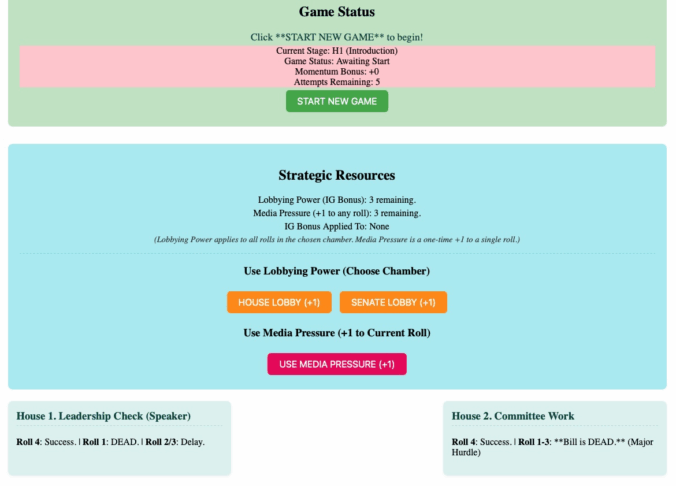
This week, I was afflicted by the Amazon Web Service (AWS) outage in interesting ways. Several years ago, I created a board game to teach my students the complex process of getting bills through a legislature. However, this exercise was very time-consuming, and I wasn’t happy with the probabilities of success.

I therefore asked ChatGPT and Gemini to analyze the probabilities on the board and make them better align with the actual chances a bill had to get through the US Congress and the Texas legislature. It gave me updated values and I went to alter the board.

However, I created the board in Miro, and it was down due to the AWS outage. I tried to get both ChatGPT and Gemini to replicate the board with the new values on it, but they were illegible.

Crisis inspires. It occurred to me that I didn’t really need a board. I could create a web application to simulate the process. Within about an hour, I had a working website that simulated both the US Congress and Texas legislature. Gemini generated HTML, CSS, and Java code to build the site. I was then able to post it onto CodePen to get it working.

The next day in class, I broke the students up into groups and had them attempt to get bills through. The Texas simulation worked beautifully. Some groups spent the equivalent of 50 years in game time struggling to get their bill through the process.

The US simulation was a little too easy and two of the four groups succeeded in getting their bills passed. One of my tasks for today is to adjust the difficulty level by ramping up partisanship. That will be relatively easy.

This is where we need to go in education. Memorizing content has its place, but it should not be the central focus of our activities in the classroom. Computers will always beat us when it comes to information retrieval. Where they can’t match us is in interpreting and applying that information.

Teaching must reflect that reality. Focusing on information retrieval does a disservice to our students who are going to be forced to compete with AIs optimized for information retrieval.

At the same time, I’ve always argued that technology is fundamentally democratizing. Its diffusion through the personal computer and, more recently, large language model chat bots has opened new opportunities for humans to think. When you put powerful tools into the hands of creative people, you create opportunities for them to grow.

However, I run up against a philosophical challenge. Historically, intellectual elites, whose status often came from their ability to access high-quality education, have dominated creation and discovery. In a world where creation and discovery are minimum qualifications for success, this slice cannot remain at 10%.

We like to think in the United States that we have achieved mass education. We haven’t. We have scaled at the expense of quality and this is the crisis afflicting our institutions today.

I am part of a community of creative and brilliant educators who are constantly pushing the boundaries of what’s possible in the classroom. I also recognize that we are a pretty small group at any institution (maybe 10%). This creates tremendous headwinds for change.

The real question is whether we can lower barriers with technology to overcome those headwinds. Will giving more powerful creation tools release everyone’s natural creativity or will our systems crush it before it has a chance to emerge? Are our students capable of engaging in that advanced thinking after being subject to a system of education that has never valued it?

I continue to be an optimist that AI will open these doors and by making difficult tasks easier, creating opportunities for us to do ever more fulfilling tasks. I saw a brief spark in my class yesterday as they struggled with an activity that forced them to think critically about a problem they needed to solve.

Without AI, the experience would not have been as rich for them. Let’s just hope it’s enough to set them down a path toward thinking for themselves.

The End of Academic Dishonesty

“The pupil is thereby “schooled” to confuse teaching with learning, grade advancement with education, a diploma with competence, and fluency with the ability to say something new. His imagination is “schooled” to accept service in place of value.” – Ivan Illich

When I first started teaching, I thought that the students were cheating me when they cheated on a test or paper. This evolved into thinking the students were cheating themselves out of their own learning when they did that. Since at least the beginning of ChatGPT, I have realized what the students are actually cheating is a meaningless system of education.

This is a battle the system cannot win. It should be forcing teachers and administrators to ask some very deep questions about what the purpose of this educational exercise actually is. Is it to prepare our students for some sort of job or is it to prepare our students to face a world outside of school? While there is a lot of overlap, those are not the same thing.

If our primary purpose is credentialing, then we are marking them as being capable for a job. This shorthand for competence evolved over the last 75 years, where people are ruled out of jobs because they do not have a college education. However, if you ask the employer why they put this requirement in place, they often can’t really give you a good answer.

The system doesn’t communicate clearly to the students what the purpose of their learning is. Therefore, they buy into this mythology as well: that somehow having a piece of paper that says they graduated from an accredited institution prepares them to succeed in the world. If you ask them why this is, they also can’t give you a good answer.

The third group is the educators themselves. They are vested in a system whose purpose is to spit out degrees. Too often “learning” is measured by that benchmark. We are the drunk driver looking for his keys under the streetlight because that’s where the light is.

None of these benchmarks have anything to do with learning. This is the sad truth that sudden access to generative AI has stripped bare, but it has been recognizable for those who were paying attention since at least Web 2.0 came on the scene in the mid-2000s.

Culture is a hard thing to change. We have created a culture that supports the automated production of graduates in higher education. The students know they are widgets and behave accordingly. It’s just an exercise to get a degree. School becomes nothing more than a hazing exercise.

Why should we be surprised if, under these circumstances, the students rebel? A whole industry of products, from anti-plagiarism software to tools that limit internet access, has sprung up to aid the system in its vain attempts to stem that rebellion. However, to paraphrase Princess Leia: the tighter you grip, the more students will slip between your fingers.

Those of us who care about real learning find ourselves trapped between institutions demanding quick “student success” and students who just want to finish as easily as possible. Into this mix comes generative AI, which, if used poorly, makes shortcuts easier while stripping away the experience of learning. The result should not surprise us.

However, those students who learn how to dodge work in college using AI are in for a rude awakening when all they can do it is to try to get out of working in their jobs. If you can dodge work at your job using AI, you can be replaced by AI.

This applies to education as well. The more rote we make it, the more vulnerable it is to being replaced by automated systems. This isn’t learning but it is “efficient” at moving widgets through the process toward their “completion.”

I have written before about the tremendous opportunities that AI presents to us to teach and learn in very different ways. If we use it to augment ourselves and not automate ourselves, it can become a powerful tool for both teacher and student. If, instead, we spend all our energies somehow trying to freeze it out of the system, we are only asking for disappointment, frustration and eventual obsolescence.

Who is actually cheating here? Is it the educational system clinging to outdated methods and mechanisms for achievement? Or is it the student somehow trying to navigate an arcane and unfamiliar world of education in pursuit of some elusive goal? Or is it both?

More so than most technologies, AI provides us with tremendous opportunities to reinvent ourselves and what we are doing iteratively. It opens new ways to apply critical thinking, iteration, and creativity to augment our learning.

However, systems must also change. Assessing students based on how well they do on high-stakes tests or rote papers is a tool of convenience (looking for our keys). Yet, that is still the dominant method of assessment practiced in education.

Instead, all instruction should force the students to solve problems using AI as a partner. Whether that problem is writing or designing a physics or math experiment, forcing students to engage in the material in this manner strengthens their motivation, skills, and their interactions with technology.

I use AI in the classroom to generate just-in-time exercises that reinforce lessons that the students don’t understand fully. I also teach them how to use it to overcome their own creative and writing obstacles by using it to brainstorm assignments and edit them dynamically. This is just the beginning of what is possible.

On the instructional design front, I used it to reinvent my course in days instead of weeks by removing much of the detailed rote work of balancing and sequencing assignments. I have also used it to simplify complex instructions for assignments, which is critical to the practice of formative assessment strategies.

In the real world, your boss doesn’t care if you “cheat” if you get the job done. However, getting that job done will require you to have the skills to augment yourself with AI-driven tools, whether you’re a teacher, a student, or a professional employee.

For those of us trying to untie the Gordian Knot of the intertwingled drivers of systems of education and disempowered students, life can be a very frustrating experience. Gaming those systems is a natural byproduct of this tension.

The good news there is that we can use AI to try to reduce our levels of frustration by easing rote tasks thrown up by the needs of the system. I guess that makes us cheaters too, but I can live with that. If we don’t learn to “cheat” the system ourselves, we’ll cheat our students out of real learning.

Critical AI

“The purpose of education is knowledge, and yet education is blind to the realities of human knowledge, its systems, infirmities, difficulties, and its propensity to error and illusion. Education does not bother to teach what knowledge is.”  – Edgar Morin

“Learn from everyone; follow no one; look for patterns; and work like hell.” – Scott McCloud

One of the hardest tasks as a teacher is to teach critical inquiry. As the world of information becomes increasingly complex, the natural human reaction is to accept things as they are. This was never a good idea, but now it presents an existential crisis for us.

Primary school teaches us to conform. It is a socializing instrument and many of the debates that occur around it are about what kind of socializing we want to see. This is an outgrowth of industrial thinking, where there was an expectation that workers showed up at a certain time to become part of the machine, whether that machine was an office or a factory.

We are now at a fork in the road of human existence. With the emergence of Generative AI, we must ask what kind of perceived reality we want to live in: one that forces us to conform to machines and the humans that control them or one in which we use the machines to look at the world critically and build our own realities.

Too many people today accept the world as it is. This is particularly frustrating for a technologist like me because I see technology as a liberating force, not another version of the stifling shop floor.

For many years, the operation of technology was so complex that people learned how to do a certain thing a certain way, and then accepted the flaws of whatever technology they were using as a given. That made sense for multimillion-dollar factory machines, but never for software or digital tools.

I have a low tolerance for badly designed pieces of software because I know that there is no physical reason they should fail in this way. Think about how much training is required to overcome bad design decisions.

The idea that you must bend humans to the will of the machine is a direct outgrowth of this acceptance attitude towards technology.

Many of the debates I see around generative AI center on this misapprehension of technology. People have been trained to accept bad results, and generative AI can be hilariously bad.

This has also been an excuse to keep it as far away from education as possible. I am constantly bombarded by comments like “it will mislead our students“ or ”it doesn’t do this task well.”

I always push back and ask these critics whether humans do this any better. If you ask a human to summarize a book with no further instructions, wouldn’t they explain those parts of the book that were most meaningful to them and potentially miss the entire point of the author. Humans get facts wrong all the time, sometimes willfully.

In both cases, there is no substitute for a critical eye toward any information you receive. The industrial mode of acceptance has polluted the information environment. As the sheer volume of information has increased exponentially, the natural human reaction is to ignore all of those parts that don’t fit their conception of the world.

Generative AI is no better and no worse than most humans when it comes to providing answers. However, the major companies that control them are selling them as “answer machines” to be used uncritically.

This makes sense as a marketing strategy, but it leads to a lot of the problems people are having with them. We expect machines to be perfect, so we hold them to a different standard than “my dumb Uncle Al.”

Marketing should be treated with a high degree of skepticism. AIs are flawed because humans are flawed. AI models get their data from humans. They import our own biases and blindspots in the process. Furthermore, those models are weighted by human decision makers with their sets of biases about what information is important or should be discarded (or banned).

We have a tool for dealing with this problem that is usually only taught in a higher education setting. That tool is critical inquiry.

Scholars know to treat any bit of information with a high degree of skepticism until it has been thoroughly tested. Most people are not trained scholars. Even scholars aren’t perfect. They are subject to the very same human fallacies and too often accept the canon in their fields uncritically.

I like torturing AI. I can do things to them that I would never do to a human. That’s because they don’t have any feelings. One advantage of this is that I can engage in brutal critical inquiry when it comes to interrogating a chatbot. It doesn’t care.

But there is a hidden lesson here. By teaching this method of inquiry against an unfeeling opponent, we can teach ourselves not to accept other peoples’ realities as a given. We can use it to break the training of conformity that the industrial age has inflicted upon humanity.

The mere consideration of this is an alien concept to even highly educated people. We are uncomfortable when paradigms are questioned. As a constructivist, I make a hobby out of questioning paradigms. Some are worth keeping, but others inflict a great deal of pain and suffering on humans.

If we want to turn generative AI into a normative device, we can do that. However, it’s always going to be vulnerable to those who would seek to question it. The only way around this is to impose strict guardrails that limit the nature of inquiries to those that don’t threaten existing paradigms.

Furthermore, the threat to human jobs and livelihoods that is often posed by AI are a direct outgrowth of its willingness to exist unquestioningly within paradigms. Since it’s only mimicking us, that’s all it can do,

However, it does so more quickly and efficiently than any human can. It can also work tirelessly at those repetitive tasks.

Humans must be able to rise above that to be competitive in a marketplace dominated by a wide range of AI applications. We need to be the ones who manipulate reality because the AIs will only mirror back a flawed version of an accepted reality.

Critical inquiry is the only way around this trap. If all you ever do is write pre-selected code to adapt subroutines into a larger piece of software, that’s something the AI can do very easily. If you understand the purpose of that larger piece of software and how to adapt it to function more efficiently or humanely, that is something that the AI can only help you do. However, in order to do this, you need to function as a critic.

If we are not teaching ourselves and our children this, we are setting up humanity for failure. This will exacerbate economic dislocations and create lots of misery throughout the world.

To exist in a world dominated by machines, we need to make better humans. That does not mean we turn ourselves into robots, but that we lean into the distinctiveness of what it means to be human.

If we want to thrive in a machine-dominated world, we must resist becoming machine-like ourselves. The future belongs to humans who question.

Augmenting Course Redesign and Learning with AI

“We refer to a way of life in an integrated domain where hunches, cut-and-try, intangibles, and the human ‘feel for a situation’ usefully coexist with powerful concepts, streamlined technology and notation, sophisticated methods, and high-powered electronic aids.” – Douglas Engelbart, 1962

Today I want to revisit an old topic: teaching augmented with technology. I’ve been building and rebuilding classes for over 20 years now and I’ve always tried to use technology to maximize the efficiency of my work. In the early days, just knowing how to cut and paste made a huge difference. But now, I’m discovering new horizons of AI assisted pedagogy and pedagogical creation.

Before this semester, I embarked on something that in previous semesters I would’ve considered absolute folly. I did a complete course redesign in hours instead of weeks.

Rethinking Teaching in the Age of AI

In 2018, I completely revised my approach to teaching my subject (American and Texas government) to incorporate a design process into the class. This allowed me to customize the class around the interests of my students and was entirely driven by the motivation factor. I described this in detail in my 2020 book Learn At Your Own Risk.

Student motivation drove this reinvention. My classes are required, and most students don’t want to take them.

However, the best plan fails on the battlefield. Most of my students have been well-trained to expect very little and to give very little to their college courses. They’re always a few who are highly motivated, and they loved my system and benefited from it. However, the rest of the class was usually trying to game the system.

AI Chatbots only made this easier. It became clear to me that I needed to do some significant modifications. I put these off because it wasn’t clear to me whether I would be continuing in my pursuit of teaching or abandoning that in favor of the Knowledge Navigator project. Now that I have a full-time faculty position, I can do both.

Rapid Redesign Under Pressure

I did not have much time to implement the strategies between the time I found out I was going to be full-time and the beginning of classes. Major iterations always involve a balancing act between ideas and execution.

At the same time, I didn’t want to teach five classes using the old method. I needed to streamline the structure, incorporate AI directly into the learning process, and set it up for both in-person and asynchronous classes.

Normally, this process would’ve taken me weeks to do, but with all the onboarding and other meetings, I was left with three or four days. The thing that changed my approach though was the development process of coding with an AI partner to generate python code as well as the brainstorming process I use when writing.

I first took my existing course material, which involves a design process of writing three blogs and converting those into a website that the students could maintain as a tangible work product from the class. I asked the Chatbot to analyze my existing assignments and suggest ways in which I could inject AI into the creation process for the blogs.

Within a few iterations, I had a new point structure and set of assignments that simplified the somewhat cumbersome process I was using over the summer. This was essential for the asynchronous classes because I would not be there to keep them on course. I was dependent on the online materials to do that.

Testing and Refining the Model

Once I had the assignments, I dropped them into the NotebookLM library that had my collection of assessment and pedagogical literature   in it. I then asked it to assess them against formative assessment and conversational pedagogy texts like Diana Laurillard’s Teaching as a Design Science and Dylan William’s Embedded Formative Assessment (and more than 50 other sources).

Since this DNA was already plugged into my original structure, the chatbot maintained that approach to teaching and learning. Every one of the assignments got high marks from my shadow teachers in NotebookLM (email me if you want access to the library).

Finally, I used the chatbot to simplify the language and develop rubrics for each of the new assignments. This whole process took three or four hours. The most time-consuming part of the process was updating my class shells in the learning management system.

Once classes started, I discovered a few mistakes along the way. However, there were probably fewer mistakes than I would have made doing it myself and none of them were structural.

Results in Practice

I am teaching two accelerated courses this semester. Both are asynchronous, so they presented an acid test of the design of my classes. Approximately 80 to 90% of the students in those classes could follow the sequence and created better than average first blogs. The extensive employment of reflection exercises dilutes the possibility for them to use AI to complete assignments unless that is the assignment.

I know this is a small sample size, but I can say with some confidence that the courses are no worse than what I was doing in prior semesters. The scaffolding exercises work better and are more logical.

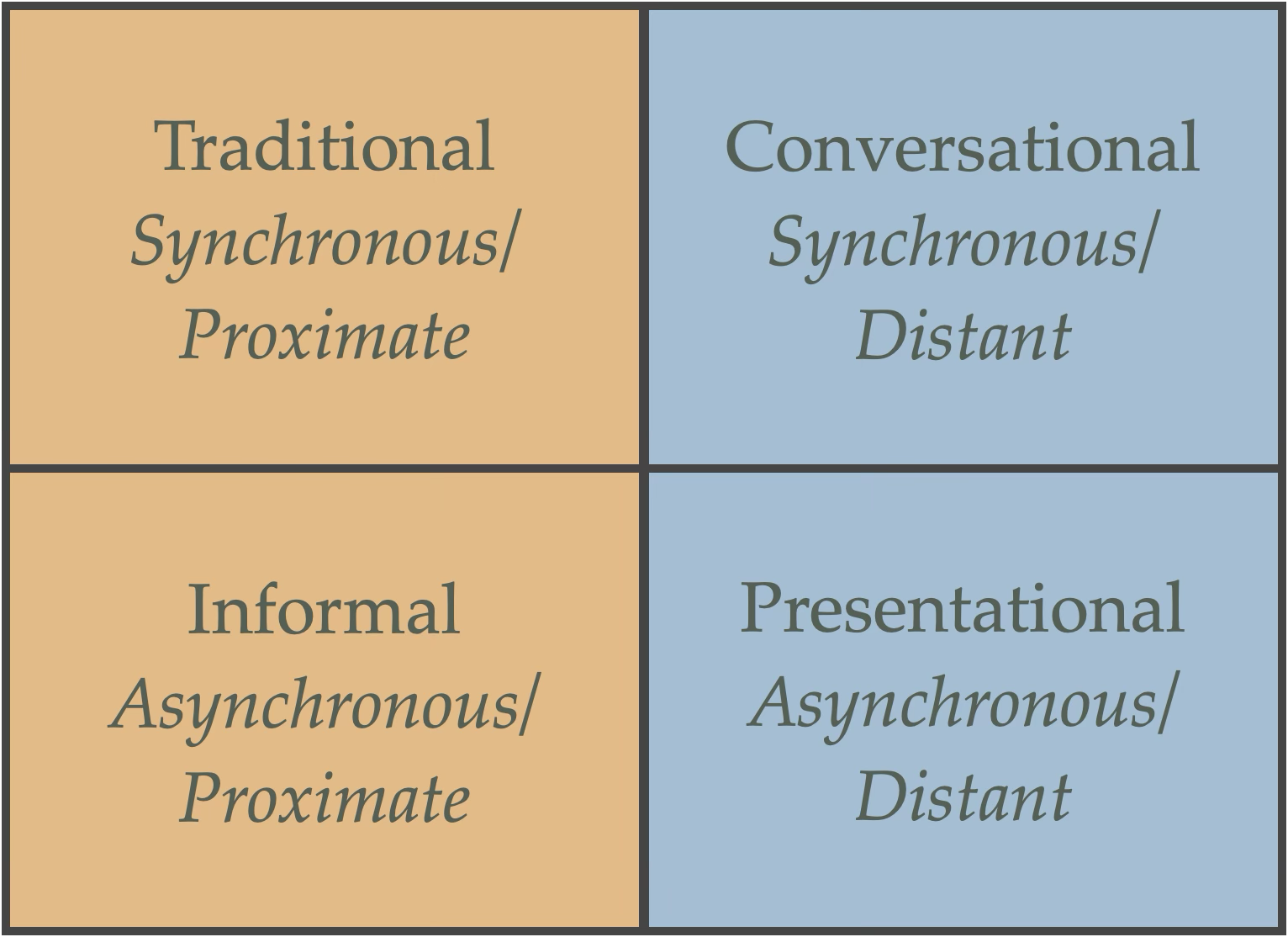
For my in-person or synchronous online classes, this structure, coupled with AI, allows me to create live experiences with immediate feedback within the bounds of the class itself. I’ve been doing this for a while, but now I’m able to shift between synchronous and asynchronous modes on the fly.

Lessons from Conversational Pedagogy

I have been working on understanding conversational spaces across all physical and virtual dimensions, which goes back to the work I did for Arizona State University’s ShapingEDU project. As I discovered, the best learning experiences shift effortlessly between all environments as needed.

Learning is not a linear process. Like the Knowledge Navigator concept, it is a web of experience. The more I can diversify that experience for my students, the better the learning will be. I am still making some tweaks this semester, but I am a lot closer to that ideal in my courses than I have been in some time. This AI process has made that possible under very tight time constraints.

The Bigger Picture: Adaptation and Antifragility

I recognize that no core structure should remain static forever. As I iteratively adapt my courses to new possibilities, having an AI partner to assist me makes change far more feasible.

There is a lot of resistance to AI within academia in various forums. A lot of this stems from a reluctance to do the work necessary to rebuild entrenched teaching methods. However, the technology provides a “cheat” that teachers can use to significantly accelerate their process of change.

I’m conservative when it comes to new technologies. I need to see their utility before I’m willing to waste my time with them. AI is different. It’s like an onion. Every time I feel like I’ve reached the limits of what it allows me to do, I find another layer. As I described in a blog a few weeks ago, I think the next frontier is on-demand coding.

AI presents real challenges to the way we teach and learn. Smart strategies are necessary to adapt and thrive using this technology. Nicholas Taleb describes this process as developing antifragility.

If we can use technology to reinvent ourselves, we can thrive under these circumstances. More importantly, by teaching these tools, we’re giving our students superpowers to face the challenging future that awaits them in a world of AI, climate change, and political uncertainty.

Part III: A Maker World

“Tools provide a path, a context, and almost an excuse for developing enlightenment, but no tool ever contained it or can dispense it. Cesare Pavese observed: to know the world we must construct it. In other words, we make not just to have, but to know. But the having can happen without most of the knowing taking place.” – Alan Kay, 1993

Technology has always shaped how we think. I’ve written before about how technology turned me into a constructivist thinker. In short, that means I believe we create the world we live in. However, I am also a systems thinker, and what that means is that I understand that we are constrained by systems of technology, knowledge, culture, and practice even if the systems are constructions.

Over the last 50 years, we’ve watched the gradual democratization of technology. AI takes this to a new level. What was once a domain dominated by a technical elite, however, now risks becoming the domain of those who have the critical thinking skills to use AI tools to solve complex problems and drive new innovations.

Ted Nelson, in his manifesto Computer Lib/Thinking Machines, envisioned computers as “Thinkertoys” to liberate us from rigid, industrial-age systems. “We do not make important decisions, we should not make delicate decisions, serially and irreversibly. Rather, the power of the computer display (and its computing and filing support) must be so crafted that we may develop alternatives, spin out their complications and interrelationships, and visualize these upon a screen.” Using Thinkertoys effectively requires critical thinking skills.

However, Bill Gates’s letter to hobbyists in 1974 pointed us to an alternative future where someone else would code for us, because that was where the money was. We traded flexibility for convenience. Applications became our gatekeepers. For most of us, the ability to shape our digital environment vanished.

We accepted the software we were given because learning to code was too difficult and too costly in time. Most importantly, we adapted to their logic instead of thinking critically about alternative possibilities.

We allow ourselves to get into traps largely driven by applications and systems over which we have no control. Most of the pain I hear from computer users stems directly from technology that fences them in, doesn’t work right, or both. Whether we’re talking about web applications that frustrate us or corporate systems that undermine productivity, we are at the mercy of those who speak the language of machines.

In parallel to this world, there’s been a hacker world of coders that have developed their own software to do exactly what they wanted to do. However, this takes a level of expertise and commitment of time that most of us don’t have.

AI will change that calculus. For the last couple of months, I have been meme coding using an AI and it’s amazing to me how fast I have progressed while developing a relatively complex program.

A few weeks ago, a professor at another institution told me that he had created customizations to his learning management system using its API and meme coding. Learning management systems are one of those inflexible apps that we struggle with as we try to create the best online learning environments for our students.

This caused a lightbulb to go off in my head. Maybe we were finally entering the world that Ted Nelson had envisioned. This was a world where anyone could create whatever functionality they needed in a computer without the limitations of their coding skills or by relying on someone else’s coding skills.

However, even if this becomes simple, it’s still going to require sets of skills because you do have to know how to get what you want. This is a logical puzzle, not a technical one, and one that even many low-level programmers struggle with.

Master programmers understand that they are mediating between human and machine worlds and design software that serves the user. However, there are lot of programmers who simply must meet a deadline for a logic imposed by those who understand neither computers nor people.

Currently, I am debugging a portion of my application and, even though the AI is helpful, it does not explore all possible pathways and often gets stuck in a loop. I need to know the right questions to ask to get it out of that loop.

That process involves a combination of logical and lateral thinking. It also opens the door to more complex problems than simply getting the code to work right.

At the same time, I am dealing with students who are having trouble following rather straightforward directions and thinking critically about their own work. The real deficit in their learning is not computing or coding, it’s critical thinking.

This has always been the Achilles’ heel of education based on an industrial model. If the primary purpose is feeding students through a system, the easiest way to do that is down a straight path. The easiest way to go down a straight path is not to encourage them to think critically or creatively.

I am excited about the prospect of a maker world where I can customize my computing (and real world) existence around my needs. However, power should not be concentrated around even an elite characterized by critical thinking skills. If we can teach people to think like makers, to design rather than merely consume, we transform technology from a set of fences into a field of possibilities.

This is the real digital divide: not access to computing, but critical thinking abilities. Access to computing is a technical problem. Access to critical thinking is societal one. Without it, AI will not liberate us. It will deepen the gap between those who can shape technology and those who are shaped by it. This is the real threat of AI that no one is talking about.

It is time to get beyond being users of AI. We need to be architects of a maker world. There is an urgent need to integrate AI tools into our learning and work processes but do so in a critical manner that teaches thinking over replacement.

We must overcome the idea that we are subject to the technologies that given to us, and that includes AI. I don’t teach my students to accept AI. I teach them to critique it and use it to critique themselves.

We stand on threshold of a maker world where you can call up digital tools to do anything you want and build a digital world customized around you. This is a truly constructed world. That’s the world I want to leave to my kids and students.

Part I: Democratizing Imagination

Part II: Making Opportunity with AI

Making Opportunity with AI: Part II of the Maker World

“To extend our abilities to think and perceive in new ways, and to translate those into tools that enable others to think and perceive in new ways, is probably the essential part of the human story.” – Howard Rheingold and Petar Jandric, 2015

I can build things I only dreamt of even a few months ago. This is both liberating and a bit intimidating because it opens whole new questions about what is possible.

If you look at technology as an evolution towards simplicity, we may have crossed a milestone in recent months or years. It used to be that coding was confined to a relatively exclusive elite. You had to have a certain kind of mindset for it, and then acquire the skills.

We need to consider how AI fits into the broader technological and societal picture. I don’t tend to believe in revolutions, either as a political scientist or as a technologist. They don’t really fit the patterns of human behavior. People are naturally conservative unless they see no other way out and change.

The same thing is true with technology adoption. There are a few who delight in doing things no one else can do, but most are more interested in getting through their workload.

This doesn’t mean they don’t have ideas or needs that technology (or writing) can express for them. It is our responsibility to continuously lower barriers to access those technologies.

Most people fear technology because it wastes their time and takes tasks out of their control. Yet this fear has never been about a lack of imagination. It’s about the barriers between them and their ideas. AI, like the PC in the 1970s, represents a massive lowering of those barriers.

For decades, education has focused on technical skills rather than logical ones, because the technology itself was hard to master. But AI changes that. We don’t think about “technical skills” when we pick up an iPhone, and soon we won’t think about them when we build with AI either.

The true revolution with AI will come with making. There are so many projects that I have thought of over the years that I have discarded because I don’t have the technical skills to code them properly. No matter how much I wanted these tools, they required prohibitive opportunity costs to realize.

A few weeks ago, I was on the T is for Training podcast where I’m a regular panelist. We were discussing the use of escape rooms for teaching and training with Laura Gehringer and Madeline Shellgren.

It suddenly struck me that I could generate escape room scenarios for my classes using a generative AI Chatbot. This is not just about games. The escape room example showed me how AI doesn’t just speed up existing workflows. It makes previously impossible things practical. That shift in feasibility is the real revolution.

I have built games for learning before. The challenge in constructing games in an educational setting is that to do it well is incredibly time-consuming. Most teachers don’t have time for that.

You also want to tailor the game around your instructional goals and style as much as possible. Therefore, sharing games across multiple subjects or pedagogical styles doesn’t always scale well.

I have been writing over the last couple of months about how AI can be used to significantly speed up logistical tasks in my teaching and classroom management. I had not thought of using it to construct games until my conversation with Laura and Madeline.

The next day, I was speaking to a fellow professor at a startup meeting, and we started talking about escape rooms. He brought up the idea of coding a game that would have the same effect but would be interactive and repeatable. My first reaction to the suggestion was that I thought it would be too hard. My brain was still in the manual coding world.

However, I recognized the connection between that and what I was already doing with the Knowledge Navigator project, which is far more complex. Given what I’ve learned about meme coding over the last couple of months I realized that this might be technically and logistically feasible for me.

It is amazing to me how much progress I’ve made on a relatively sophisticated technology project. However, with this progress, I’ve unlocked new, much tougher, questions than the technical aspects of the project.

My priority has always been focused on the task, whatever that task may be. When the tasks don’t align with the software, I inject the human element (usually me) into the equation. I’m always considering the time investment into any task and, if I can use technology to save me time, I do it.

If technology wastes my time, I have no patience for it. I am here to help my students, not fight with technology, much of which was never designed to work in a learning environment in the first place.

Thinking about AI in this way will open whole new possibilities for human employment. I’m not talking about prompt engineering here. I’m talking about operationalizing dreams.

Augmenting ourselves with AI tools will unlock creative forces that will accelerate all economies forward at a rapid pace that need not come at the expense of killing the climate. That’s because this will be an acceleration of ideas, not products.

The revolution will come in the form of human potential. AI will make it easier for everyone to define their future. We just need to recognize and grasp that (and show others the way). But realizing that future will require a different kind of literacy: learning how to think like makers.

…next up: life in a Maker World (Part III)

Part I: Democratizing Imagination

Part III: The Maker World

Democratizing Imagination: Part I of the Maker World

“Our fine arts were developed, their types and uses were established, in times very different from the present, by men whose power of action upon things was insignificant in comparison with ours. But the amazing growth of our techniques, the adaptability and precision they have attained, the ideas and habits they are creating, make it a certainty that profound changes are impending in the ancient craft of the Beautiful.” – Walter Benjamin, 1935

Less than 200 years ago, a small group of people decided what counted as art. They could do this because only a few had both the talent and the patronage to create it. The vast majority of art that was created and survived to this day was therefore images of the rich and powerful.

Speaking as an artist for a change, I also know that artists are an ornery lot. They frequently stepped out of line and painted things that they were not paid for. However, even then they represented a very small slice of the population with the imaginative and physical talents necessary to create complex works of art.

With the invention of photography, however, the level of physical talent required declined. Suddenly people who were previously excluded from expressing themselves individually had the power to do so.

Initially, the costs and time necessary to do photography limited the group of people who could create images, but with the introduction of technologies like the Kodak Brownie in 1900, suddenly the masses had access to creation tools. Now, we take over 2 trillion pictures per year.

This literally changed what we can see. Visual media are far more powerful than textual media, especially when a large proportion of the population was illiterate. But even today a picture is far more dramatic than lines and lines of text like I’m producing now.

Technology democratizes access to creation. It empowers people to do things that were impossible before. This goes against the centralization theory of technology, such as that expressed by Tim Wu, which argues that technology will inevitably be gathered into a small number of hands.

In an era of tech giants, that is an easy theory to believe. AI carries the baggage of Web 2.0, where centralized platforms like Facebook and Google built empires by controlling data and attention. Companies like OpenAI and Anthropic are explicitly modeling themselves on the first generation of Web 2.0 giants.

These companies were, in turn, modeled on industrial models where massive machines produced everything from automobiles to washing machines. In the industrial age size meant power. It manifested in systems of production that dictated how we worked and what was available to us as consumers.

Over the last 40 years, this model has been undermined as production has become far more efficient. Technology has allowed relatively small startups to become successful. Of course, the founders of these startups were raised in the industrial age and very much see size as the ultimate arbiter of success.

However, we no longer need thousands of people to produce one product. It can be produced by a few dozen people or even one person with the right technology.

We have also democratized access to art. We went from glass plate photography to the iPhone in the span of a little more than a century.

When we democratize access to creation, we empower new voices. In societies where people are increasingly frustrated by the old voices who seem to only lead them down blind alleys, this is a powerful force to counterbalance the conservative elites.

I agree that sometimes in order to build stuff you have to go big. However, why does this have to be the end state? We used to need a massive factory to do injection molding. Now I can create custom versions of the same thing in my living room with a 3-D printer.

Until recently, the biggest barrier to makerspace innovation was the complexity of design software like AutoCAD, which was needed to operate CNC machines or 3D printers. Now, I can get an AI to generate models for me with a text prompt.

As I play with the relative capabilities of large and small AI models, I recognize the power of brute force when it comes to transformer technology. At the same time, I see a narrowing of the gap between the smaller models and those that require huge server farms.

Of course, those huge server farms come with immense cost, and only large corporations and governments can shoulder that level of investment. With that, comes control. They may control the smartest models in the world, but where does the true power lie? It lies in the creative inputs they use to train the models.

I have argued before that the power of the PC revolution was in its democratizing force. It spread technology over a much wider group of people and every one of those people had a brain and experience that were unique. Kevin Kelly called this the Hive Mind. Diversity is a bedrock of innovation.

Even with today’s biggest models locked behind corporate walls, I can now accomplish things that were once impossible for me. I can run powerful models locally on my Apple silicon Mac and use the big models for a limited set of problems. This is why small, open models are the future, not massive server farms.

This is tremendously empowering for humans. AI has made me a more efficient teacher. It has made me a more efficient creator. And the only real limits are in my imagination. And this is only the beginning.

… of a three part series on our transition into an AI-driven maker world.

Part II: Making Opportunity With AI

Part III: A Maker World

Creating With Machines

“Every time there is a new technology, there is a paranoid faction of less than brilliant artists who feel that that’s the end of their career; who don’t understand that art never dies; that technology will go on and serve art.” – Stan Winston, 1993

I’ve always been fascinated by creative journeys. When people create something amazing I want to know how they got there. Technology always plays a role. Creativity comes from understanding how to augment our vision with technology, from ink to notation to paint to film to pixels.

Creative work is about being able to express your vision in a way that the rest of humanity can appreciate. Technology is how we get there as humans, whether it’s through the mechanisms of writing, music, painting, photographing, coding, and a multitude of other pursuits. These are just the ways that we tell our stories, not the vision itself.

We chase our dreams through technology. We are always pushing it to see where it can take us. AI is just the latest chapter of this journey.

No matter what I’m doing I’m always frustrated with the limits of the technology to express my creative vision. I’ve probably come closest to my ideals with my photography and my writing, but in both cases, I still struggle to tell stories that I cannot capture or express.

The limiting factor is me messing things up with the technology of words or the photographic process. In both cases, digital has closed the gap between my vision and reality. However, even there, I still run up into blind alleyways, where I just can’t seem to make it work.

AI presents a unique opportunity and challenge. It extends our creative capacities even further by taking mundane tasks off the table. I can use it to help me write. I’m using it right now to dictate this into my phone. I will use it to edit and polish this blog before I publish it.

The latest iteration of this struggle is using AI to code a prototype of the Knowledge Navigator. Ironically, my creative vision is for a technology that helps others clarify theirs. However, until AI, I lacked the tools to execute this vision.

I have never been a very good coder. I understand how it works, but I get lost and frustrated with the details of passing my thoughts into something the machine can understand. Computers are far more particular about details than I am.

I am trying to use AI to overcome those mundane detail-oriented tasks, which limit the execution of my vision. As a result, I have made more progress in a month than I likely would have in a year of reading coding manuals.

Using AI, I have learned more about coding in the last month doing it this way than I have in the last 30 years. Now I will admit that I already have a fair foundation in how code works, but it’s different to have a theoretical knowledge of something than to have a practical knowledge in using it to create something new.

This is not “cheating” or “taking the easy way out,” as some have argued. You are cheating if you’re not learning. You are cheating if you’re not growing. You are cheating if you’re not innovating. Learning, growing, and innovating all stem from the basic human impulse to create and explore. AI can supplant us, but not if we use it to learn and grow.

Almost all criticisms of how AI is disrupting society come from contexts where creativity isn’t the main goal, like standardized testing or corporate output. That’s a different conversation than what we’re having here. These are disruptions to systems, not humans.

Systems drive us with extrinsic motivators like money or grades. AI challenges extrinsic motivators, but that gives us a chance to realign our systems around intrinsic learning and creativity.

The intrinsic motivation of most students is usually clouded if not eliminated by the extrinsic motivators of grades. The purely extrinsic motivation of a quick buck creates fake art. There is no intrinsic creative motivator there. There is no creative growth there, only mindless replication.

The industrial mindset is based on mindless replication. Over the last two centuries, we’ve learned to mass produce all sorts of things. I argued in Discovering Digital Humanity that we have learned to serve machines. This is not a good role for humans.

Those of us particularly sensitive to creative thought struggle to exist in this kind of world. We are naturally non-conformist and resist becoming part of mindless machines. We recognize that only humans can truly create.

Humans are naturally curious, but extrinsic motivators dull that curiosity because it is considered a luxury not a necessity in a paradigm where we are taught to be cogs in machines.

In a world where AI is omnipresent, creativity rooted in curiosity is no longer optional, it’s essential. We must inject that creative drive into our learning and working. This is the antithesis of industrial thinking because if you are just part of the machine, creativity is a liability. You don’t want a cog spinning at its own speed

I am not an AI accelerationist. I don’t tend to get excited by any technology. I get excited about what technologies can do for me to help me grow and to make the world a more interesting place.

AI offers vast potential to augment our creativity. But like any technology, we must use it with that end in mind. If we do not, the machine will discard us. We must teach ourselves and our students to create with the machines.

What we’re doing with the technology is at least as important as what the technology does. The more powerful the technology, the more powerful the human element needs to be. AI is a powerful technology. Humans must be mindful in how they use it.

Mindfulness and creativity are deeply intertwingled. They infuse our lives with meaning and purpose. I can create photographs, writing, music, tools, and so much more to help other people through mindfulness. Without mindful creativity, we are little more than machines. With it, we can create with any technology to reach heights limited only by our own imaginations.

« Older posts

© 2026 IdeaSpaces

Theme by Anders Noren — Up ↑