
Category: Uncategorized (Page 7 of 11)

You’re all Different! I’m Not! – Open Loops, Systems of Learning and Collective IQ

It’s the beginning of the semester and I’m once again trying to bridge two incompatible systems. My students are used to closed-loop systems of education. They have had years of training in the rhythm of cram and exam (or some variation thereof). The “best” of them have mastered this pattern and start the semester trying to figure out my version of it. All of them see everything I/we do through this lens. The disconnect occurs when my class design doesn’t conform to their expectations.

The natural human reaction is to navigate the “maze” – and it is a maze – that I have set up with the minimum amount of effort necessary to get through it. Our students struggle to find meaning in the systems of education that have acculturated their habits of schooling. It is a rare student capable of looking beyond these structures. We program them not to.

One of my favorite scenes from Monty Python’s Life of Brian is the one where he tells the crowd “You’re all different!” and one guy says, “I’m not.” I feel like this a lot as a teacher. I try to convince my students that they need to engage in open-ended exploration, but they only want to know what I want them to do.

When I try to make the class expectations about them instead of me, they find this profoundly disorienting. My “final” is a web portfolio which they own. It’s a website on a server that they control. They’re creating a tangible artifact based on their own interests that they can use to show their communication and analysis skills to future classes or employers. They can take this assignment as far as they want. It’s an open loop.

Despite this, they never push the boundaries of what’s possible. Their focus is squarely on what is necessary. Necessary is always a closed loop.

Professional life today is not a set of closed loops. It is a set of problems, both large and small, that we must navigate. There are few instruction manuals on how to close these loops. The best we can hope to give our students are sets of skills that will prepare them for the unexpected.

One of the key failures of our educational system is that we structured it around routinized patterns that prepare our students for a world that doesn’t exist. Some students check out from clearly pointless routines. Others accept them and adapt their own patterns to match. Neither approach can solve complex problems. Getting through the routine motivates most of my students, not seeing what they can individually or collectively accomplish.

Perhaps most perniciously, they look upon collective effort with deep suspicion because the routine of education drives people toward zero-sum thinking. Whether you get through the system has little to do with whether I do.

This semester, and not for the first time, I had a student react strongly to the merest suggestion of graded group work. That’s because, inevitably, some percentage of the group will focus on the lowest common denominator necessary to “survive” the experience. The more engaged/savvy students don’t want to harness their wagons to drag those students along. They view peer learning as a trap.
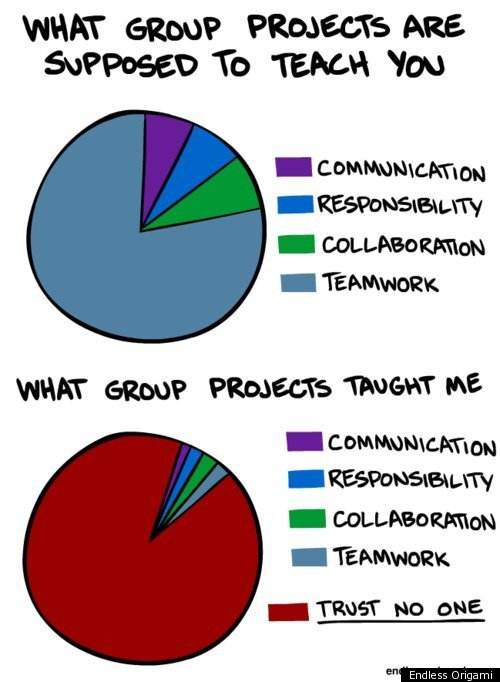
The Perils of Group Work - Infinite Origami

Isaac Asimov’s “Profession” essentially parodies how far this kind of system can go. In his story, most “students” (they are programmed with knowledge instead of working for it) are directed, based on brain scans, to their “ideal” professions. They simply download the knowledge to carry out that profession into their receptive brains.

George Platen’s brain scans don’t conform to any pattern. The system relegates him to a “House for the Feebleminded” and he finds himself overcome by the shame of not being “allowed” to conform to the system.

Rereading this story just as the semester began really brought home to me the extent to which we mirror Asimov’s dystopian vision of education. I designed my class, within the constraints of the larger system, for the George Platens of the world. The rest of the system creates programmed individuals.

Unlike Asimov, I don’t believe that Platen is an exceptional case. I think everyone has, to a greater or lesser extent, a nonconformist impulse that results in creativity across a broad spectrum of activity. It’s just been buried by our closed loop education systems that emphasize conformity to process over creative, individualized approaches to learning.

These systems are no longer sustainable. Unbridled capitalism based on scarce resources has led to resource depletion, climate change and a general disregard for the needs of individuals. Many of the systems we are used to are not sustainable in this environment. Most of them were never equitable and depended on the exploitation of those less fortunate for their success.

In theory, learning represents one of the few open loops that exists in this paradigm. Open loops represent our best hope for navigating the thicket of challenges confronting our world. Over 75 years ago, Vannevar Bush recognized that closed-loop systems could neither manage the knowledge of the world nor the challenges that science and technology were creating. Following in Bush’s footsteps, Douglas Engelbart spent decades trying to apply technology to systematize open loop thinking, which he called “Collective IQ.”

Engelbart recognized that the fusion of technology with human collaboration was a means to bring humans to the level where they might confront the increasingly complex issues unleashed by the technology itself.

Consider a group’s Collective IQ to represent its capability for dealing with complex, urgent problems – to perceive and understand them adequately, to engage the stakeholders, to unearth the best candidate solutions, to assess resources and operational capabilities and select appropriate solutions and commitments, to be effective in organizing and executing the selected approach, to monitor the progress, to be able to adjust rapidly and appropriately to unforeseen complications, and so on.

He argues that we grow Collective IQ by exploring the “anticipatable” horizon leveraging both technology and our human capacity for imagination. This is something I want my students to do, albeit on a much smaller scale.
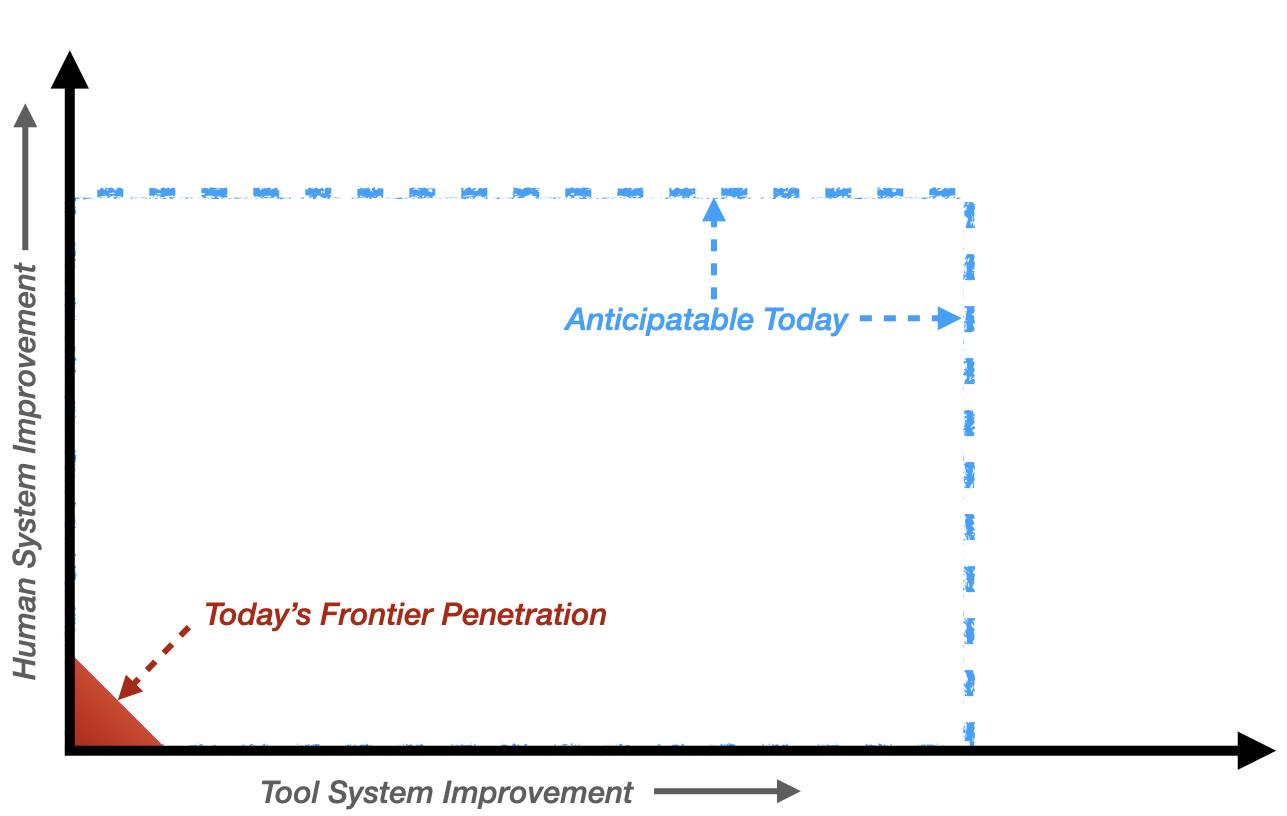
Engelbart augmentation horizon

Engelbart augmentation horizon

Adapted from Engelbart

However, like Engelbart, I encounter resistance on a wide range of fronts, from institutions that are based on getting students through closed-loop systems of instruction to students who find the opened-ended nature of exploration disorientating.

These are issues that are difficult to resolve at the instructional level. The larger systemic context needs to support this kind of learning. This is a real challenge, as these systems are driven by larger societal factors, such as the “accountability movement,” that create perverse impulses toward closed loops.

If we hope to engage our societies in the project of Collective IQ to solve our urgent and unraveling challenges, we need to start with a realization of these interconnections and create systems of open loop learning. Our students are all different, even if they don’t want to be.
Future Learning Spaces: Classrooms of the Mind

We like to think that learning takes place in a physical location. We call those places schools or colleges or universities. Often, we call those places classrooms. This is an incomplete picture. Those words describe places that can facilitate learning, but ultimately, all learning takes place in the mind.

We externalize learning because we have been trained to do so by more than a century of industrialized education. Digital thinking should liberate us from these logistical shackles, but that hasn’t happened yet. This disconnect is not a new thing. As early as the 1970s, Ivan Illich recognized how we commonly confuse learning with the physical manifestation of school when he wrote:

The pupil is thereby “schooled” to confuse teaching with learning, grade advancement with education, a diploma with competence, and fluency with the ability to say something new. His imagination is “schooled” to accept service in place of value.

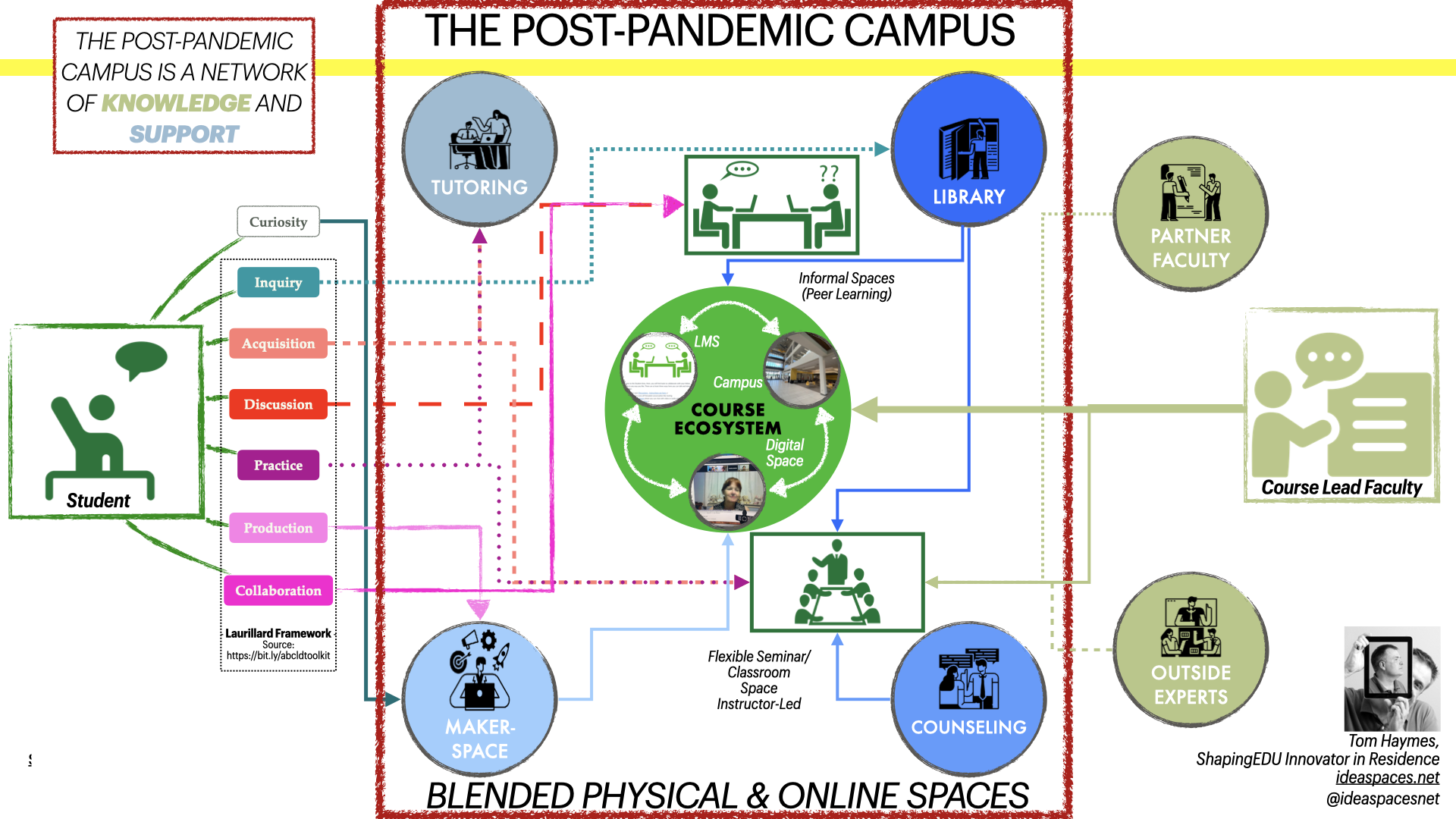
If we disconnect learning from schooling, we can apply a much more flexible mindset to our design processes. This could have profound implications for how we design our pedagogy, programs of instruction, and technologies. These technologies include all the virtual and physical spaces that we can use to facilitate learning, not just the “gadgets” that may populate them. The key is to blend spaces and technologies into a continuum of tools that we can apply to any course or any individual who needs help to learn.

Our conception of “campuses” comes from the industrial notion of the factory. Factories don’t empower humans. They make us widgets in a machine. If you want more widgets, you build bigger factories.

Technologies often go through a period where they get bigger to maximize inefficient sources of energy and our ability to turn that energy to their purpose. In early aircraft, it was common to put more and more engines on a plane to generate more lift. Then we improved the engines and the ratio of engines to lift shrunk. The same is true for our educational technologies. Consider the cost and complexity of early Polycom systems and compare them to what you need to have a conversation in Zoom or FaceTime.

But this is also true on a systemic level. As we have attempted to scale education to a wider and wider portion of the population, the schools have grown to accommodate physical bodies in physical classrooms. It is high time we applied more efficient engines to our goals of connecting learners with knowledge and skills.

Remote teaching during the pandemic showed efficiencies are possible. Teaching and learning can happen wherever the student is. There is no iron rule that says the students must congregate in a specific physical location in order to hear the voice of the teacher.

Forcing students to gather excludes large parts of the population who cannot commit to being in the same place at the same time because of work or family obligations. It aggregates learning away from the individual, leading to less diversity through a reduction in individualized learning. These realities alone should lead us to question the current strategies for scaling education.

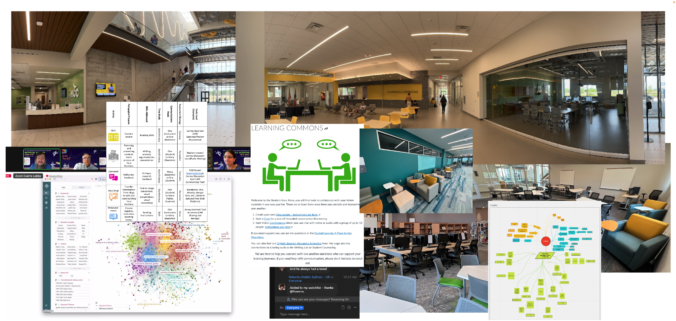
My experience as a remote teacher during the pandemic showed me the importance of community and collective engagement with the material that we were trying to learn. My students missed being able to congregate in person. What was missing, however, was not the classroom. It was the “hallway time” of informal spaces. We could move the classroom online fairly easily. Community time, however, was much more difficult to replicate. This realization led me to revisit the work I had done on informal learning for a local community college.

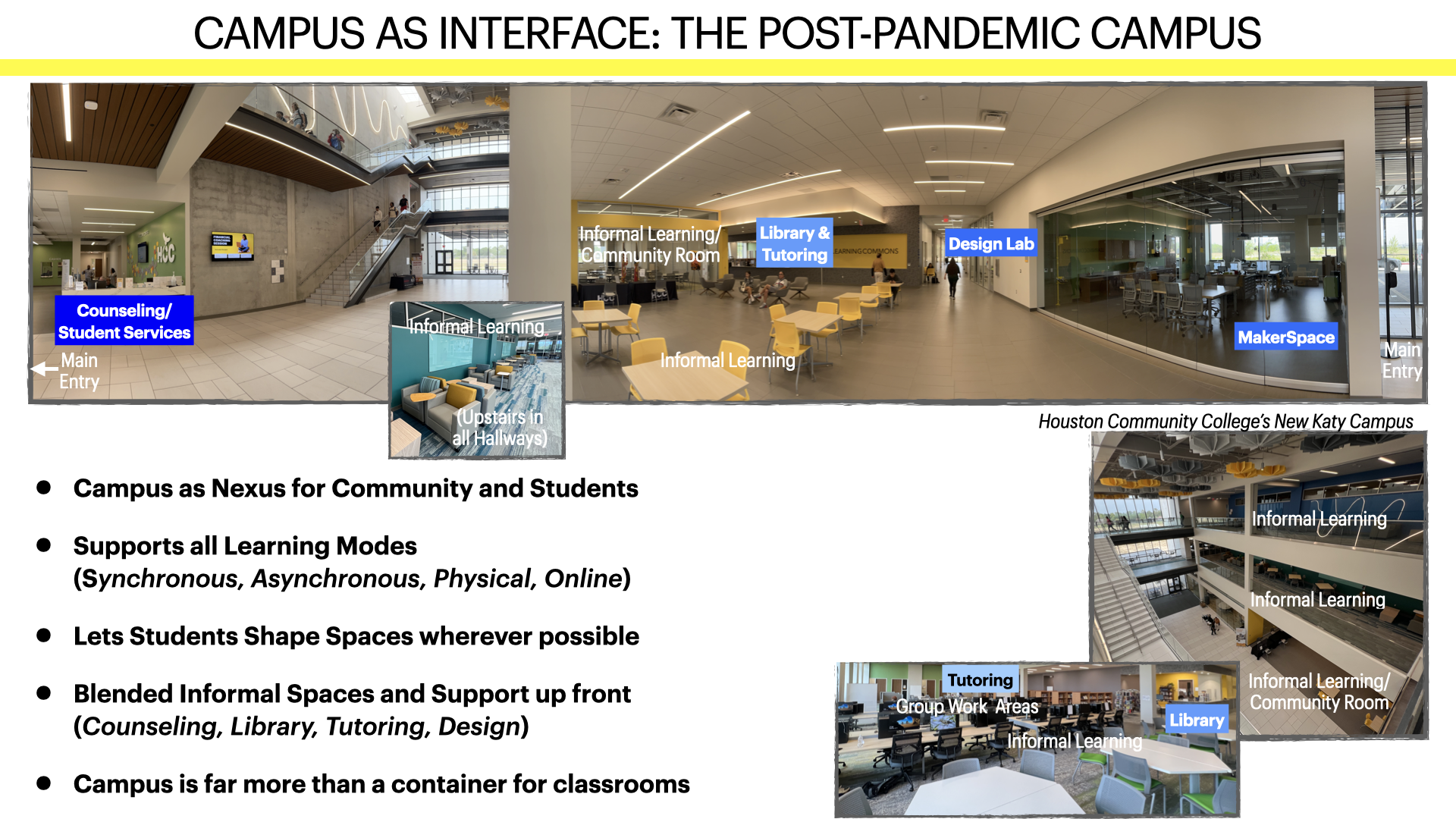
Immediately before the pandemic struck, I consulted on a new campus for Houston Community College. The brief for this campus was to maximize enrollment on a minimal footprint. Using classic measures of X number of student seats into Y number of classrooms that can be scheduled for Z number of hours did not work. This calculation showed that the desired enrollment was 50% higher than the space would accommodate, at least according to traditional measures.

Our approach to the resulting design was not to cram in more classrooms. Instead, we tacked in the opposite direction in order to maximize informal and support areas. This created a hybrid/blended environment where students taking online classes would find a place for collaboration and support. We would then effectively move much of the enrollment online but still create a hub for learning where learners could come together to form communities of practice.

This work led to many offshoots, starting with the STAC model and culminating in the Hybrid+ concept that I outlined in my 2020 book, Learn at Your Own Risk. The root of these ideas is that students need to be motivated and supported to engage in effective learning. This should form the underlying goal of any campus. Campuses with this design philosophy also support teachers that are trying to create individualized pedagogy.

That means that we should teach those things that require persistence, repetition, and convenience online. The campus would support everything from study groups to teacher-led small work groups to events that host outside experts. It would form a critical interface between students and the knowledge that they are seeking.

The other implication of this approach is that we need to rethink the nature of our courses. We should start by removing artificial distinctions between online and in person instruction. There is every reason to expect most courses to blend all modalities. The key distinction should be whether learning is expected to be synchronous or asynchronous, not whether it’s done online or in a physical space. All courses encompass both already. However, we don’t make efficient use of online resources to maximize the impact of the limited amount of synchronous time students and teachers have together.

Courses are tools used to contain discrete bits of knowledge. We build walls around them. This is another legacy of the specialization of undergraduate learning stemming from the factory model. The logistics of classrooms mean they are a scarce resource and that drives enrollment calculations and scheduling considerations. If digital learning means anyone can seamlessly teach or contribute to learning in a course, what’s the point of segregation?

Situating the Classroom/Campus in the Learning Environment

With a fluid course model, any specialist can come into the course seamlessly and enhance the experience of the students, deepening their learning. Creating this level of fluidity will require systemic rethinking of how we organize our spaces, time, and structures of learning. We can build to optimize resources in all three areas. We can already adapt existing technologies and spaces to experiment with how this might work. For example, I already have a librarian embedded in my classes using nothing more than the affordances of my Learning Management System shell.

Katy Campus features

The learning space of the future is the mind. The technology spaces we build around that should reflect the realities of how people learn more than the logistics of how we educate them. Physical spaces, like the new Katy campus, which opened in May 2022, should form part of a much larger suite of tools, technologies, and people that will support learning in all its forms. This will also give us new opportunities to humanize, individualize, and diversify the education journeys for all.

Orbiting Constructivism: 25 Books Every Technologist Should Read

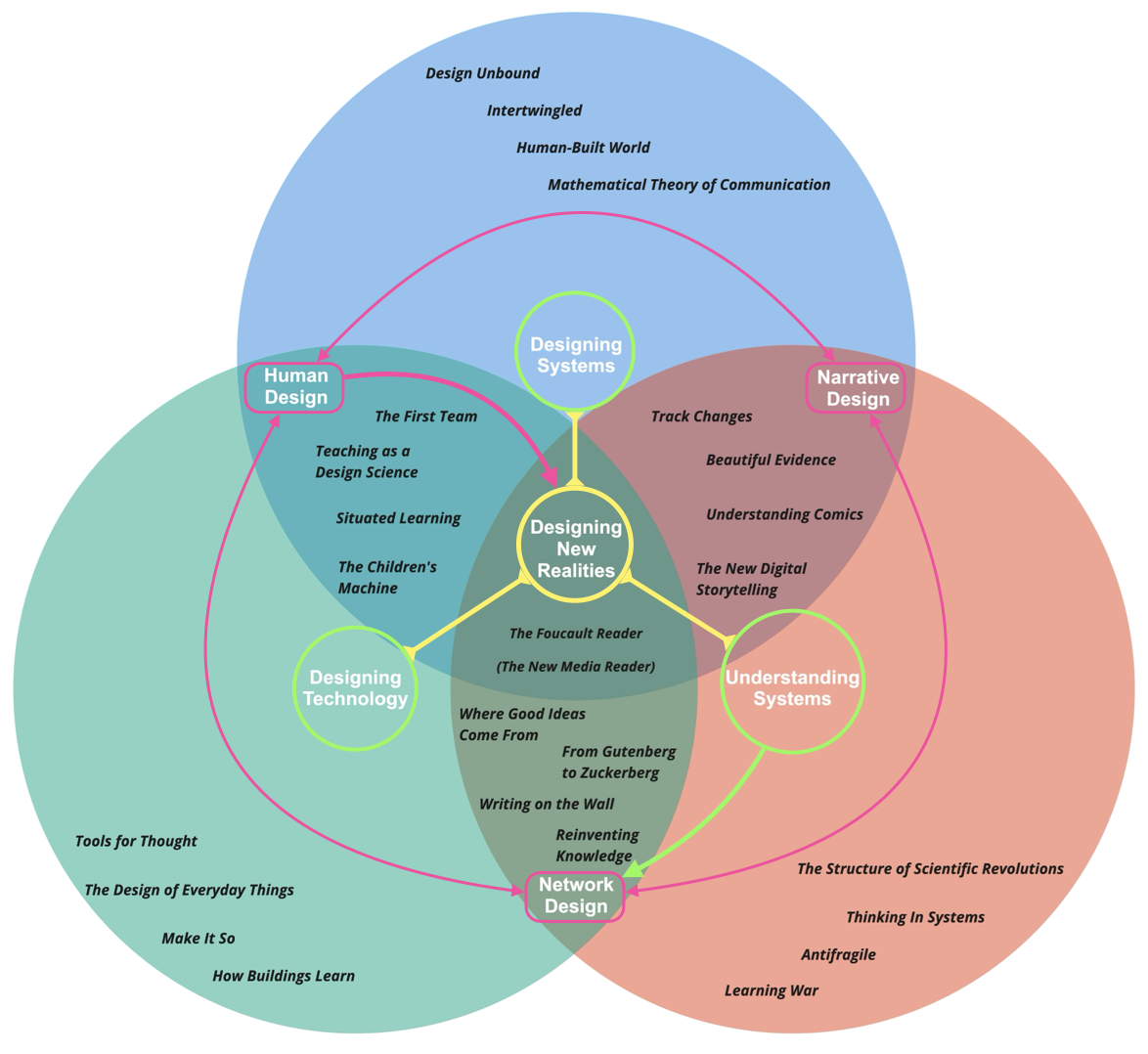
There are certain books that constantly influence how I design systems for those I teach, advise, and facilitate. As I looked at the universe of books on that make up this list, patterns emerged. The list itself told a story. It was not an unexpected story, but I must admit that it surprised me at how suddenly it came into logical focus. These books orbit around the pole of postmodernist constructivism.

I discussed how constructivism has influenced my thinking in another blog, but it bears mentioning here that I think all technologists need to approach technological change with a constructivist mentality. As technologists, we build new worlds. Postmodernism deconstructs many of the paradigms of the old industrial world that we take for granted. Stripping bare the assumptions of our industrial culture is essential if we want to design authentically digital systems.

When I was studying postmodernist theory in graduate school, it was often attacked as rejecting the rationalism upon which humans built the modern world. Like many absolutist critiques, this is only partially true. Constructivist postmodernism accepts the processes of rationalism. However, it explores the possibility that our supposedly neutral analysis of the natural or social worlds is not really neutral after all. It challenges us to examine the social and historical factors in these biases instead of accepting human-constructed systems as they are present to us.

We should question the logic of every system. The overwhelming majority of systems we take for granted today, from government to business to education, were constructed using rationalist models. These systems now find themselves challenged by the fluid and fast-moving nature of technological change. The first signs of this come as “traditional” media being overwhelmed by “social” media, but other systems are increasingly coming under scrutiny.

What is missing from this all-too-familiar conversation is the idea that we can intervene in these changes to push humans to the fore. If we refuse to criticize inhuman legacy systems, we will continue our servitude to the machines. But we also have a responsibility to go beyond criticism and build new and better alternatives that bring people together instead of driving them apart.

As we build technology systems, we inevitably bump up against systems that reject critical questioning (see the “Understanding Systems” books on the list and my own Discovering Digital Humanity). Perceiving these systemic realities is essential for designing technologies that will not be rejected as being too threatening, but still reform practice to be more inclusive, diverse, and human. Applying constructivist thinking is an essential tool in achieving these goals.

As I neared the end of this project, I recognized that a Venn Diagram would provide a useful tool for visualizing how these topic areas overlapped and that the one area where they all overlapped is in the constructivist literature. The book that emerged at the center of it all was The Foucault Reader. While this is not the only constructivist text out there, it is one of the more approachable ones and summarizes many of the key tenets of the philosophy.

Constructivist thinking can seem deeply threatening because it seeks to question everything. As humans, we instinctively grasp at patterns of familiarity. They give us the illusion of control over our environments.

We construct systems for efficiency but also to protect ourselves from the unexpected. As a result, we often construct these systems reactively. They always incorporate human fears and cultural biases.

We find ourselves in a period of immense technological flux. This reality gives technologists immense power because we are the people constructing new systems from scratch. The job of the technologist is to support digital humanity through mindful design. Building systems of technology requires that we design them to augment the human experience. I chose the books on the list because they give the reader a primer on how to design technology, navigate systems, and construct networks of humans.

Orbiting Constructivism

I organized the seven areas on the book list in such a way as to take the technologist on a journey from the concrete to the abstract. In the inner orbit, we start with technology design, progress to systems design, and then look at how systems push back against change (and strategies for working through that resistance).

The outer orbit contains books that teach us where we can use technology to create environments for human augmentation. First, we look at how we construct networks of knowledge. Second, we look at different venues of storytelling that the digital world opens up for us (word processing, visual tools, and gaming). Finally, we look at how we can design and adapt systems to achieve specific human tasks, from operating carrier battle groups to teaching and learning.

The last section returns to the center to look at the wellspring of constructivist thinking. If you progress through these areas of human-centered technology design, you can see Foucault with fresh eyes. In the coming months, I am considering reversing this journey using articles instead of entire books to show how you can use the end as the beginning as easily as you can use it as the end.

All the sections revolve in an orbit of powerful attraction around this basic idea that we construct how we see – either physically, virtually, or in our imaginations. If we understand this, we can see pathways to navigate to a mindfully designed future where the human, not technology or organizational/cultural constructions, stands firmly in the center. The alternative is that we can all become slaves in various forms of technological and systemic dystopias.

Given a choice, I always choose the humanist approach, but it often takes a lot of reflection to find that. The collective lesson in these books is that, as constructors, we can build systems that revolve around ourselves and are profoundly human. Collectively, they point us down the pathway to discovering digital humanity.

Using Storytelling to Overcome Filtered Learning Narratives

Our lives are narratives. We tell stories to learn from ourselves, to learn from each other, and for others to learn about us. A common theme emerged from the discussions at last week’s Mini-Summit on Emerging Credentials and Future Employment: Our credentialing systems’ signaling limitations distort the stories of what we’ve learned, what we do with them, and how we portray ourselves to those who might want to work with us. Our stories about ourselves are not getting where they can help us the most.

The goal of credentialing of any sort is to communicate achievement in learning (and doing) to potential employers as richly as possible. A basic tenet of the IdeaSpaces approach to technology is that we must always start with our goals and then work backwards to add the tools (technology and structures) necessary to achieve those goals. This is an iterative process, constantly looking at the technology environment to grasp new opportunities to augmenting our progress toward achieving those goals. Our tools and systems for communicating achievement at scale have never been good at telling rich stories and are long overdue for a re-examination.

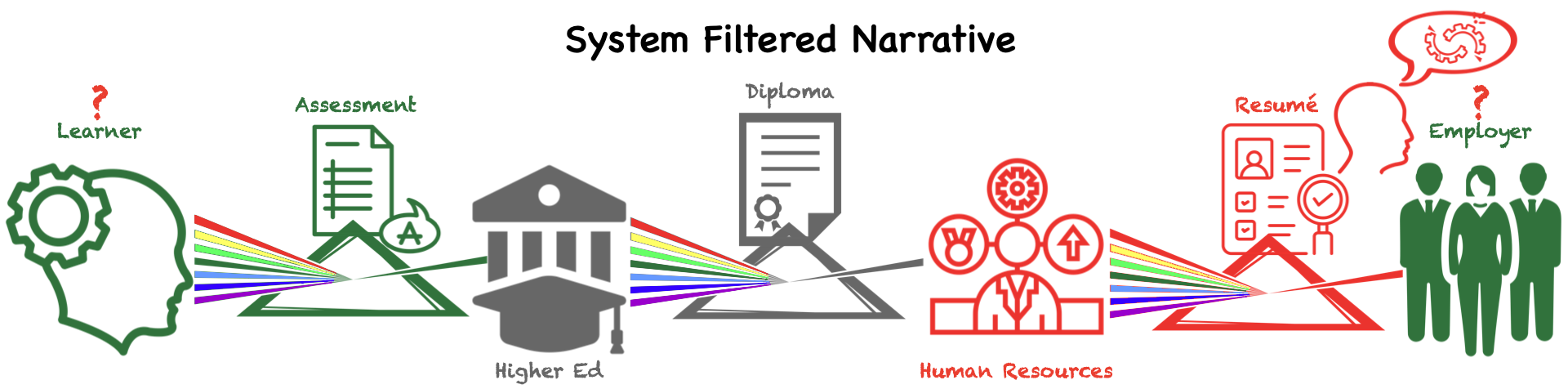
System Filtered Learning Narratives

Industrial systems of credentialing depend on cumbersome systems because the technology that they are based on, mainly paper, is an inefficient way of communicating the richness of an individual. It can be done, but the skill necessary to be a great writer/autobiographer is beyond the capabilities of most of us. Therefore, we’ve had to rely on shorthand representations of achievement that start with grades and assessment and “end” with diplomas, degrees, certificates, and resumés.

On the other end of this process, employers need high-quality employees. Once they exceed their immediately known talent pool, they have had to rely on abstractions of people to assess whether they will make meaningful contributions to the team. There is a reason that the best way to get a job has always been to know someone where you want to be hired. These shortcomings matter less for simple jobs than for recruiting innovative and creative talent. The needs of most employers are trending more and more to the latter category of worker.

Current industrial, paper-based systems of signaling create systems of connecting learning with employment. Their narratives are distorted by the mechanics of processing figurative and literal paper through normative structures. Richer canvases are available to us in the digital age. The signaling tools we have should reflect the richer learning journeys we experience in the digital age.

Iterating how we represent the data of our personal achievements is essential for relating the rich universe of ways we learn today, most of which are through informal learning. To cite just a few examples, we learn from YouTube videos, making, massively open online courses, or just by engaging in conversation within a distributed network of thinkers like ShapingEDU. These are not just passive exercises. It is possible to tell our learning stories through practical artifacts across a wide range of platforms, including videos, websites, and blogs. Learning is more transparent than ever before in human history because of these tools. Most methods of achievement signaling don’t use them.

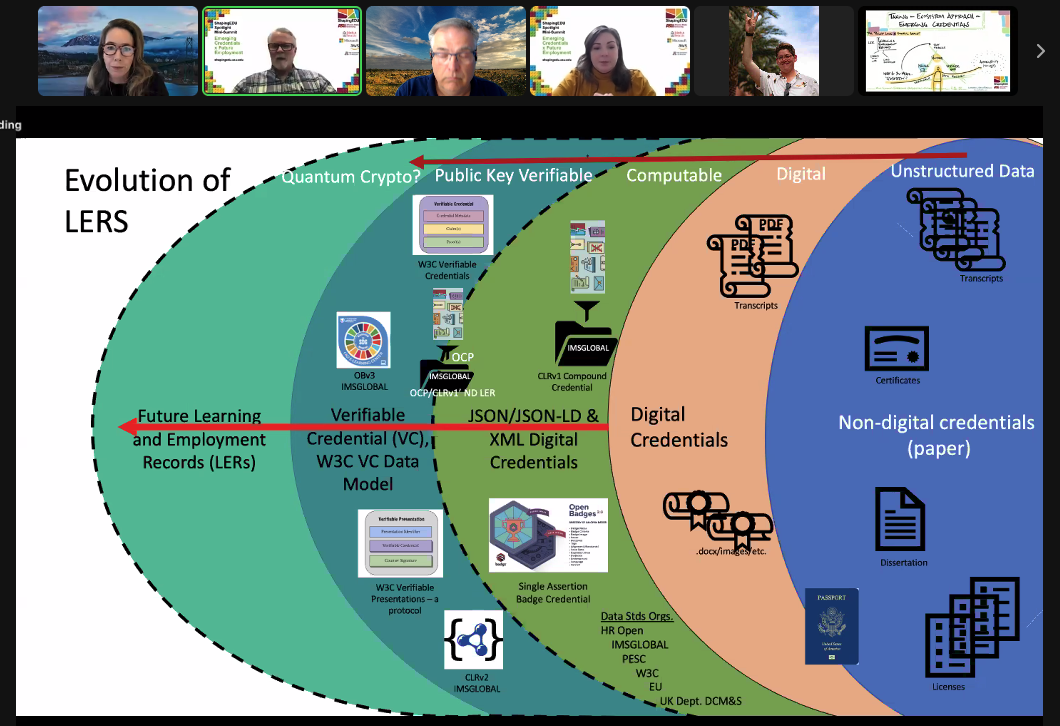
The defining characteristic of the digital age is information plasticity. Data can be shared, remixed, and combined because it is digital. The success of micro-credentialing will depend upon its utility for creating a tapestry of digital stories that connect learning, credentialing, and employment better than legacy systems. Phil Long gave us a compelling illustration of what was possible in a world of digital stories when he described the Learning and Employment Records (LERs) Project he has been working on.

Phil Long Credential Map

Our systems of schooling are only gradually grappling with these emerging realities. All systems are conservative tools. We build them to organize behavior for efficiency’s sake. We developed most of our systems of education during the industrial age, when the model was to transfer the efficiencies of the factory floor to the emerging information industries. Learners became widgets. The lubricants were the streams of paper that accompanied them at every step.

Industrial logic is deeply engrained in education’s information structures. These systems may have been computerized, but this has simply digitized paper rather than replacing it. Paper-based data streams create barriers to the richer narratives made possible by truly digital systems. Smaller bits of learning are lost. “Achievement” is expressed in the shorthand of degrees, transcripts, grades, and exams.

The third part of the story involves yet another disconnected set of systems: employers. We like to think of the market and private enterprise as being flexible and subject to easy change. The conservative nature of structures doesn’t change just because they happen to be in the private sector. Whether you are talking about education, government, or private industry, structures find efficiencies through routinization—often based on paper. The gatekeepers of employment are the human resources department. Their primary concern, and what drives them in their tool selection, is dealing with a daily deluge of paper equivalents. It is a defensive battle and defense makes for particularly conservative structures.

These systems add another narrative disconnect between learning and the ability of employers to perceive what potential employees can bring to the table. What is a better reflection of my ability, a resumé and cover letter or the rich tapestry of artifacts that I have built and shared?

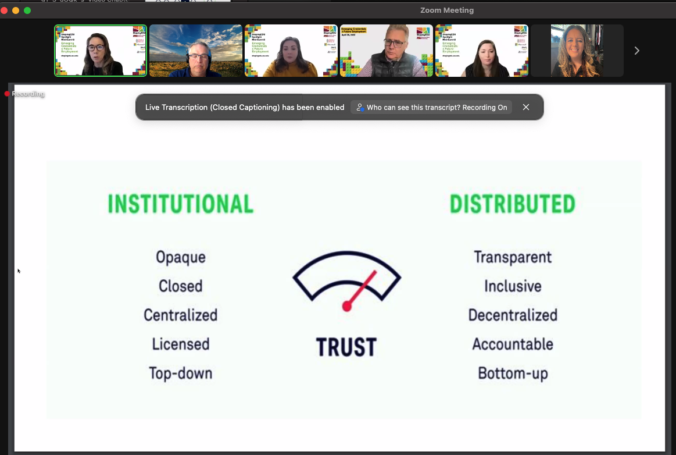
We find ourselves caught in the gears of multiple anachronistic systems based on industrial principles and predicated on the technology of paper. The thing that keeps these systems in place is their perceived legitimacy. As Cheryl Grant pointed out in her presentation, the strength of new forms of certification being proposed lie in their distributed nature. However, distributed systems rarely overwhelm entrenched systems, no matter how anachronistic they may be. Instead of challenging systems directly, we need to figure out novel ways to construct stories that bypass the normative structures of signaling that currently dominate the landscape.

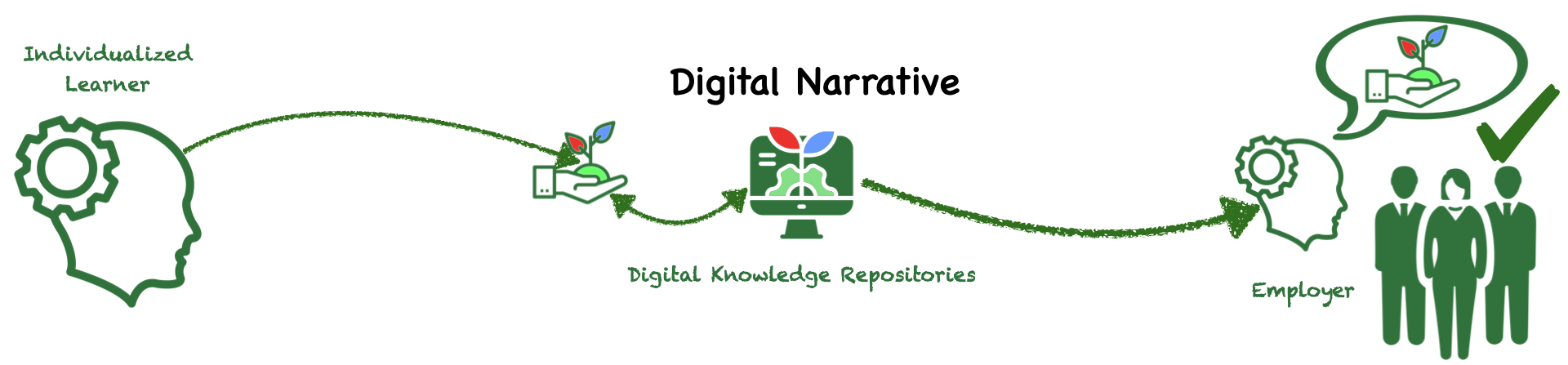
Graduates, even those with specialized degrees such as architecture or engineering, often lack the practical skills required by the employer. When degrees fail to signal specific skills, the learner’s ability to grow and learn independently is critical. Diplomas don’t signal our ability, but authentic work products do. Digital narratives offer us the potential to bypass anachronistic systems through richer mechanisms of storytelling. Labeling becomes less important if it is possible to convey actual artifacts of work.

Digital Learning Narrative

Alternative systems of credentialing could communicate to the employer the ability of a person to contribute meaningfully to their teams by providing waypoints directing them to authentic artifacts of work. The reason that the current system works so poorly is that systems of education and hiring inevitably reduce the richness of the story of the learner’s journey. Alternative credentialing should not repeat this mistake and try to emulate legacy systems of certification. As an employer, I’m interested in where you are now, how you got there, and whether you have the potential for further growth.

Instead of challenging established systems, alternative credentialing can be used to tell rich stories of growth. These stories can relate the new ways of learning and sharing that the legacy systems miss and can give employers a much clearer picture of the person they are thinking about hiring. Deepening our understanding of ourselves and each other should be the goal of all learning. There is no longer any technical reason we should limit ourselves in the telling of those stories to the world with scraps of paper.

Technology as a Constructed Reality

Digital technology introduced me to the idea that the world is an inherently constructed artifact. When I was a freshman in high school, my father gave me a blank slate called an Apple ][+. Over the next few years, I kept discovering new things that I could construct with it. When I got to graduate school a decade later, I discovered the work of postmodernist thinkers who were advancing the theory that language, stories, and structures of power construct our realities. These ideas, particularly the constructivist ones, resonated with me, because I recognized in them the same possibilities that I saw with my first computer.

If you can construct a world, you can also deconstruct the one that exists. There are no immutable laws, only human constructions. We can build our worlds anew.

Digital technology augments our ability to understand and redefine reality. By starting with basic ideas of what we are trying to accomplish, we can construct new technologies and systems to achieve those goals. We can work backwards (sideways?) from Foucault to Woz. The needs of the user should always define the shape of the constructed technology. This is the uniting philosophy of my work from IdeaSpaces to the ShapingEDU team’s work with the Teaching Toolset Project.

In postmodernist analysis, language creates and enforces power. How we define something constructs how we use it. Websters defines technology as ”a manner of accomplishing a task especially using technical processes, methods, or knowledge.” Douglas Engelbart’s conception of technology expands on this definition:

The conceptual framework we seek must orient us toward the real possibilities and problems associated with using modern technology to give direct aid to an individual in comprehending complex situations, isolating the significant factors, and solving problems.

If we start with the concept that technology is supposed to “solve problems”, we need to look much further than what we would typically refer to as “gadgets.” On one level, everything was high tech once, including the mundane like clothes, pencils, paper, walls, etc. Therefore, we need to think backwards and forwards as we consider technological solutions. On another level, human organizations, from governments to educational systems to corporations, are also technologies.

Adding human organizations runs against Don Ihde’s definition, which rejects “technology equivalent to any calculative or rational technique.” (P. 47, emphasis in original). Distinguishing technique from technology has a rational purpose because it separates the physical manifestation of technology from the mental manifestation of the task. The problem occurs when we become fascinated with the physical manifestations of technologies and overlook the mental aspects of what we use technology for. As a result, we are often frustrated in our tasks by the very technologies we create to fulfill them.

This central conundrum is the starting point of my new book, Discovering Digital Humanity, where I argue that our fascination with creating more and more technologies has overwhelmed our capacity to focus on tasks and to “augment” ourselves. If you want to drive a nail, it’s probably better to employ a hammer than a screwdriver. With mundane technologies, this seems obvious.

However, consider all the technological options we suddenly have for the task of expressing our ideas: pencils, word processors, concept mapping tools, blogging software, and that’s just the tip of the iceberg. Now take this up a level of abstraction and consider the integration of idea expression into the task of teaching someone else how to incorporate, modify, create, express, and share their own ideas and the complexity of the task of teaching becomes clear.

We need systems of technologies to approach teaching. We should also consider these systems technologies whose purpose is rationalizing and scaling the other technologies. They are ineffective in isolation from one another but share the goals of the original technologies employed.

Let us consider yet another definition of the concept of technology, that of German philosopher Martin Heidegger “as an ordering of the world to make it available as a “standing reserve” poised for problem solving and, therefore, as the means to an end. This challenging of man to order the world and in so doing to reveal its essence is called enframing” (Bijker, Hughes, Pinch, 2012, pp. 47-48).

Heidegger’s definition encompasses both physical and mental constructions of technology. Otherwise it’s impossible to “order the world.” Gadgets don’t order the world. Human structures do. Those structures fail because limited conceptions of technology limit our ability to assess how our systems fail. We like to point our fingers at broken technologies without considering the broken contexts in which they exist. We blame the tool and refuse to look in the mirror at our own failings. Technology failures almost always begin and end with humans.

Systems define relationships. Church and state define marriage, a human relationship. The “rules” of a profession often frames our relationship with technology. Frameworks shape how we express ideas. Environments shape our capacities to use technologies and technologies shape the environment that contains them. These are all systemic relationships.

Too many of our systems, from marketing to “best practices,” drive us toward thinking about technology as a thing that must be treated in isolation. This is one of the mental barriers we have had to confront with the Toolset Project. Most work in this arena takes place within systems of humans whose primary interest is the technology itself. Most of the participants in the brainstorming sessions were technologists conditioned to seeing technology as an end, not a means.

The technologist mindset is not typical of the world at large. The vast majority of humans have been taught to accept technologies and systems that compromise their goals. This is not some vast plot, but flows from this separation between physically and mentally constructed worlds. At the college level, we no longer teach people how to write in the technical sense of the word. We teach people how to express ideas and how to think about ideas. Writing is closely associated with a range of technologies and thinking closely associated with writing, but there’s an element of separation between thinking and technologies that we constantly struggle with, both as teachers and thinkers.

If we are going to create human-centered technologies and systems, we must acknowledge the centrality of the human-constructed paradigms in all our decisions. Constructing good paradigms and understanding bad ones is critical to our ability to achieve any significant goal.

All three levels of the IdeaSpaces framework are constructed paradigms. Space encompasses what most people think of when they think of technology. However, it goes much further than technical objects and includes everything that we might build into a physical or virtual environment. Time, as we understand it, is a human construct. We define the workday, the class period, and even when the sun comes up and down through our constructs of time. Structures are human constructions that establish frameworks, but they are also paradigms themselves. Therefore, just like any other technology, we can alter and adapt them to suit the needs of those who work within them.

There are many who might find this constructed world disconcerting. Digital technology creates a postmodernist technology environment. We are no longer constrained by massive built environments in the same way as we were during the height of the industrial era. We are no longer part of the machine, no longer subject to the factory clock, and therefore should not structure human organizations around these increasingly anachronistic realities.

Now is the time to drill deeply into what we need to accomplish as human beings, societies, and organizations and build up from there. There is nothing stopping us from imagining the shape of new worlds with the vast array of technology suddenly available to us. Being a part of constructing new worlds is why I love working with all the teams of creative minds exploring this terrain at ShapingEDU.

Networking Communities

Over the latter half of his career, Douglas Engelbart struggled to help organizations adopt augmented approaches to the technology that he had helped midwife in the 1960s. His Augmentation Research Center at the Stanford Research Institute focused on creating technology that would make us better, more creative, and more connected as human beings, but to the outside world he was merely “the inventor of the mouse.”

While innovations such as the mouse, the graphical user interface, and synchronous online work certainly humanized how we interacted with these new machines in profound ways, they did not change the social structures of work and innovation outlined in “Augmenting Human Intellect.” For a more detailed understanding of where he saw this effort go off the rails, see this video from 1998 (marking the 30th anniversary of the Mother of All Demos).


As I was attending the Smart Region Summit last week hosted by Arizona State University’s University Technology Office, I realized that this vision was taking shape more than half a century after Engelbart’s original work. The topics of discussion there ranged from broadband access to transportation to education in the Greater Phoenix region. The issues being addressed were not unique to Arizona. However, how they were being tackled was.

What the team at UTO has facilitated is conversations among communities that rarely interact during their normal course of business. New technologies of collaboration and discussion brought to maturity and widespread acceptance in part by the pandemic facilitated this melding of conversations that normally occur within silos. The fusion of ideas and projects that I saw last week was precisely what Engelbart had in mind as he wrote this in the 1990s.

An improvement community that puts special attention on how it can be dramatically more effective at solving important problems, boosting its collective IQ by employing better and better tools and practices in innovative ways, is a networked improvement community (NIC).

If you consider how quickly and dramatically the world is changing, and the increasing complexity and urgency of the problems we face in our communities, organizations, institutions, and planet, you can see that our most urgent task is to turn ICs into NICs.

The Smart Region group already laid the groundwork for this effort prior to the pandemic. From this foundation, the group successfully built upward, leveraging communities associated through geography. They could facilitate conversations about local, concrete challenges. It was the diversity of these conversations that technology fostered. Distributed collaboration technologies suddenly connected businesses, governments, and community groups that had never collaborated on this level before.

Over the past four years, another group within the UTO has also been attempting to create diverse, distributed communities. From the beginning, we conceived ShapingEDU as a different kind of educational community. However, ShapingEDU differs from the Smart Regions group in one key aspect: It lacks the geographic moorings of the latter group.

ShapingEDU’s strategic asset has always been its global, distributed design. The pandemic may have changed the substance of our efforts, but it did not alter our methods much. While we lost our annual in-person touchstones, most of our work and collaboration continued much as it had via technology platforms such as Zoom, Slack, and Google apps.

However, what is ShapingEDU’s greatest strength is also its greatest weakness. Localized concerns confronting community members often overwhelm the distributed efforts of the connected community. With any kind of distributed community, there is always the danger of it becoming disconnected from the immediate concerns and needs of its members. For communities concerned primarily with information distribution, this is manageable. However, for a community of doers, this presents a significant stumbling block.

There is another analogy. As teachers, we encounter similar challenges if we attempt to turn remote classrooms into anything more than information distribution mechanisms. Keeping the students actively connected to the conversations in the class has proven to be a primary challenge, as we have experimented with remote teaching. As a teacher, I’m always trying to boost the “collective IQ” of my students.

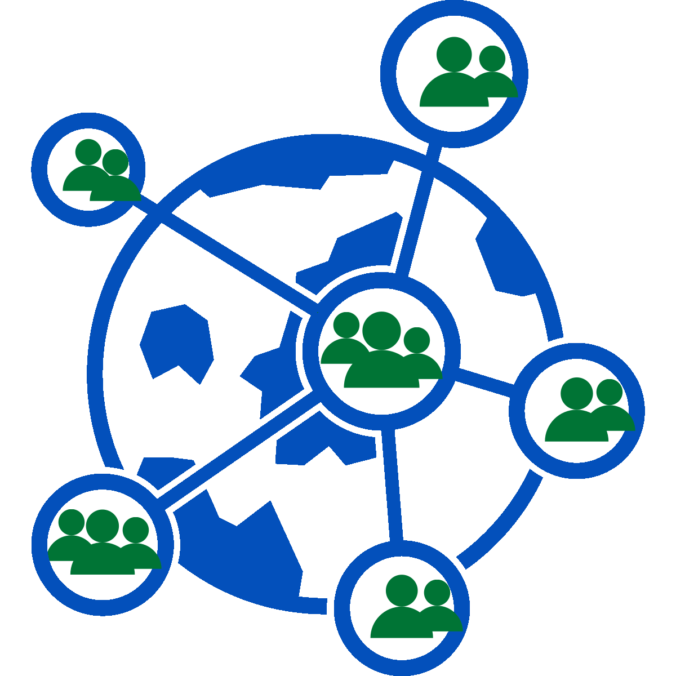
As an organization, ShapingEDU has always tried to boost the “collective IQ” of its participants and the larger education community. One approach to this challenge of distributed connection would be to adapt the model of the Smart Region project to create nodes of connected network improvement communities. These nodes would be localized and connect diverse teams. This same approach could scale the Smart Region approach to other regions.

A connected series of nodes was the vision of the short-lived FOEcast group that many members of the ShapingEDU community were a part of in early 2018. We envisioned a “distributed university” connecting and assembling insights from groups working around the globe. The global organization would facilitate conversations, collect work, and act as a distribution platform for these geographically dispersed groups.

Practically, what this means is that the doing of the working groups must be profoundly local and that the efforts of the distributed group would to facilitate global dreaming into localized doing. This is something ShapingEDU’s Universal Broadband Project Team has excelled at. Groundbreaker Lisa Gustinelli has connected national resources to profoundly local needs in Belle Glade, FL, by bringing FCC resources to a local community desperately in need of better connectivity to thrive.

ShapingEDU has always mapped out a vision where the distributed imagination of the collective group generates impactful local action. This is only possible because of the tools that technology has developed for distributed and persistent engagement. However, as Engelbart understood, our human organizations need to be optimized to take maximum advantage of the opportunities that technology creates. ShapingEDU creates fora that stimulate creative play, offers practical guidance, and provides opportunities for congregation and the sharing of insights.

The vision that Doug Engelbart consistently articulated was that we should use technology to augment our capacity to be human. In this, he echoed Vannevar Bush’s vision of using technological affordances to connect communities of thinkers. It is only through these networks of ideas that we can hope to tackle the enormous problems that were the detritus of Industrial Age thinking.

Many of the challenges that the Smart Region team are trying to address have to do with community responses to Industrial Age challenges of sprawl, pollution, and equity. Education faces similar challenges that are a legacy of systems of Industrial Age thinking. We are struggling to adapt institutions and practices designed for elite education to foster diversity and equity.

Overcoming these barriers will require a diverse community of thinkers to support a vast network of doers tackling the shifting landscape of education unique to their circumstances. As William Gibson said, “The future is here. It’s just not evenly distributed.” Supporting unevenly distributed “presents” will require creating networked improvement communities committed to building their best “futures” through deep learning and reflection. A fusion of models might just get us there.

Sense Making Through Game Design

Life is complicated. At any given moment, a thousand things are happening which impact my life. An exponential number more will impact my life in the future. Most of these things are things you only have a vague awareness of, at best. Additionally, I manage systems in my body, from the infinite complexity of my mind, to the autonomic beating of my heart, to complex interactions between the three as my fingers dance across the keyboard to type these words.

As we teach, we are also constantly abstracting. I explain the complex workings of the US government using models and simulations. A biology professor does the same as she explains the complex interactions of cells in a biological system. Neither one of us would claim that we are doing anything more than abstracting reality to make it understandable to our students. One of my favorite jokes is the one about the student who studies Intermediate French to prepare for a trip to France. When she gets there, she discovers they don’t speak intermediate French in France. The joke is that “Intermediate French” can only ever hope to be an abstraction of the richness of the living language as they practice it in France.

Games also abstract reality. Games have always fascinated and frustrated me, because they try to abstract complex actions into repeatable activities. It’s always a balancing act between accuracy and gameplay. Some games are very abstract, such as Go or Chess. Much like mathematics, they lean into gameplay and abstract mental interactions. At the other end of the spectrum, war games often attempt to model complex historical and technical interactions while acknowledging the role of chance in historical outcomes.

In his excellent book, Of Dice and Men David Ewalt argues that one attraction of more open-ended roleplaying games such as Dungeons and Dragons is that most of the activity involves storytelling rather than arguments about bounding the universe. While there are core rules, the logic of the experience is constantly evolving in the minds of the participants. Ewalt says that the frustration of war gaming is that, “only 10 percent of the match is really spent playing. Half the remaining time is spent arguing about history and the other half arguing about the game’s rules.” (Ewalt, p. 52) I find this to be a rather accurate breakdown of the experience.

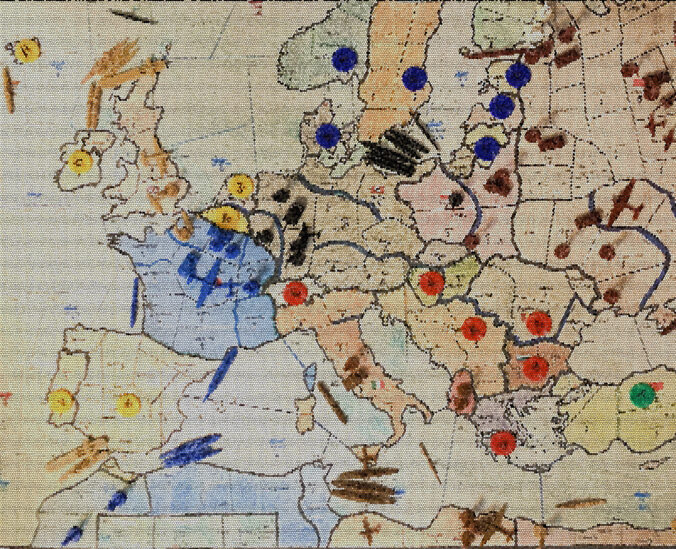
However, I think that attempts to align history with rule making are of immense value. I have been playing wargames with a group of friends (all of who work at the college with me) since the early 2000s. For most of that period, we engaged in an ongoing iteration of the classic Axis & Allies wargame. Now, if you knew the printed rules of the game, you’d hardly recognize the version we were playing.

One of those friends once reflected to me that he wondered whether we were engaged in an immense time-wasting activity. I pointed out that as administrators and teachers, the construction of systems of rules, whether we’re talking about course structures reflected in a syllabus or the design of spaces and programs in which those courses lived, was the same mental exercise we engaged in as we attempted to construct systems of rules for the game. The learning was in the invention.

We engage in a constant modeling of reality as part of our daily exercises in sense making. Rules connect our perceptions of one another. What are the rules for sharing my ideas? What rules can I construct that will connect my realities with those of my students? The projects in ShapingEDU are also trying to construct their own models of effective engagement with the world. Some do so directly, such as with Ruben Puentedura’s Black Swan and Serious Play initiatives. Others seek to model a sense of the world, such as the Pandemic Teaching Reflection project. My Teaching Toolset Project is seeking to codify a set of rules that will model interactions between actual teaching behavior and the tools we use to carry it out. The Broadband and Student Voice projects are trying to construct maps through systems of governance and education to achieve their goals.

We are dealing with seriously complex systems in these projects. Explicitly or implicitly, we are trying to create or understand sets of rules that abstract reality. This brings me back to my original conundrum: How do you model complexity while maintaining gameplay? There’s a reason that most people don’t like to play complex games such as wargames. New players must confront a steep learning curve before they even get to the part where they’re engaging in strategy. The level of detail can be overwhelming.

Technology doesn’t help us here. Modeling reality in most video games results in mental (or physical) overload as you try to mimic body movements through a keyboard that you would otherwise engage in reflexively. Extending that to a team, as many sports games do, only multiplies that effort. In contrast, competition in Dungeons & Dragons takes place almost entirely in the imagination (with a little help from the dice).

Some may argue that I’m conflating modeling with gaming, the latter being subject to the whims of chance. I would counter that by saying modeling works in a Newtonian World but that a relativistic world operating under the principles of emergent design we cannot escape probability and uncertainty. Uncertainty inevitably introduces elements of chance and randomness. Frameworks such as simulations and games help us make sense of random outcomes and to adjust the rules going forward.

We need to pay attention to the “rules” we are following and recognize that they are themselves part of the game and subject to modification. Explicitly designing sets of rules helps us better understand the compromises we are forced to make in the service of insight. We can create new and novel ways of playing games of understanding, such as the clever modeling of university leadership through matrix gaming that Bryan Alexander ran with his graduate students at Georgetown University. I am always looking for new and better ways to simulate and game systems and to systematize games. We have a tremendous opportunity to do the same with ShapingEDU.

We have too many closed games in our world that are the equivalent of Intermediate French. Understanding the mechanics of how we construct games can help us construct richer systems of understanding. To do this, we first must recognize these limitations and never stop questioning and refining the rules. Wherever possible, we should create open-ended games, such as Bryan’s matrix approach. However, sometimes the act of creating the rules/constraints provides new insights into the challenges we face. Creativity requires constraints. However, rules should be explicit and subject to iteration. We should never forget that our ability to model a complex world depends on the lenses we use to see it. The rules of the games we construct form the design parameters of those lenses. Let’s make sure we use them to see the world in new ways.

Electrifying Education (Part III) – Designing Our Way Out of the Class-Size Contradiction

Electrifying Education Part 1: Being There

Electrifying Education Part 2: If Tesla Engineers Designed Education

A common design strategy is to imagine solutions free of systemic constraints. This has several advantages. First, it focuses imaginations on the goals of the effort and may clarify them. Second, it highlights those parts of the system that may need to be adjusted to maximize outcomes. Successful electric car designs don’t simply replace the engine with an electric motor, they reimagine everything from weight distribution to safety to ideal ranges vs. battery size and cost. Under this exercise, a car has wheels and seats, but everything else is subject to radical redesign. In a digital world, it is possible to reimagine education in the same way.

To do this, we need to strip down what a “course” actually means. The word implies a journey, not a destination. Yet our courses were all about the destination (aka “getting it over with”). Classrooms are a destination. We “go to school.” We don’t “go to learn.” The first step in imagining what a learning journey in a digital world could look like is to explode the notion of school as a destination and instead imagine it as a waypoint in a much wider journey.

Classrooms are a finite resource. Resource distribution always devolves to resource rationing. Rationing drives the pace of learning and implies an end to accessing it. If we cannot get past our fixation on physical classrooms, we’re just replacing a physical classroom with a digital classroom. This is about as insightful as replacing a gas engine with an electric one and not engaging in any further design effort.

Remote teaching brought on by the pandemic stripped down instruction into its components by removing a lot of systemic constraints. I was well-placed to take advantage of this situation, because I had already begun a systematic redesign effort years before the pandemic. However, even under remote instruction, there was still one linear constraint that was very difficult for me to get past: my time. With smaller classes, the increased investment of time necessary to reach each student individually and to understand and address their specific learning needs was still manageable through creative use of technology. However, with larger classes, the systems I put in place were severely stressed.

Addressing these challenges required a greater modularization of my time. That meant that my instructional strategies must bring in additional specialist help. I talk about the potential of strategically deploying specialized support in the STAC Model. Creating a constellation of on-demand instruction and support, as well as explicitly deploying that as part of an instructional strategy, makes it possible to scale individualized instruction much more effectively.

While the STAC Model focuses on informal learning through librarians, tutors, counselors, and designers, we should also consider this model for creating teams that span disciplines within courses of study. I could spend a lot more time teaching students the nuts and bolts of government if I didn’t have to spend most of my time teaching them how to construct logical arguments. Those students who need additional help in particular areas could receive detailed help in those areas if I didn’t have to homogenize my instruction for the needs of the larger class. This is one characteristic of individualized instruction that makes it such a powerful tool, but it is very difficult to do with larger classes while working alone.

I have already done some limited experiments augmenting my class with an embedded librarian. These have yielded promising results. For certain issues, I can send students to a familiar face who also has a slightly different perspective and problem-solving approach than me. However, this is an ad hoc solution. My colleague, who is extraordinarily helpful, is often called to other duties serving the larger student body of the college.

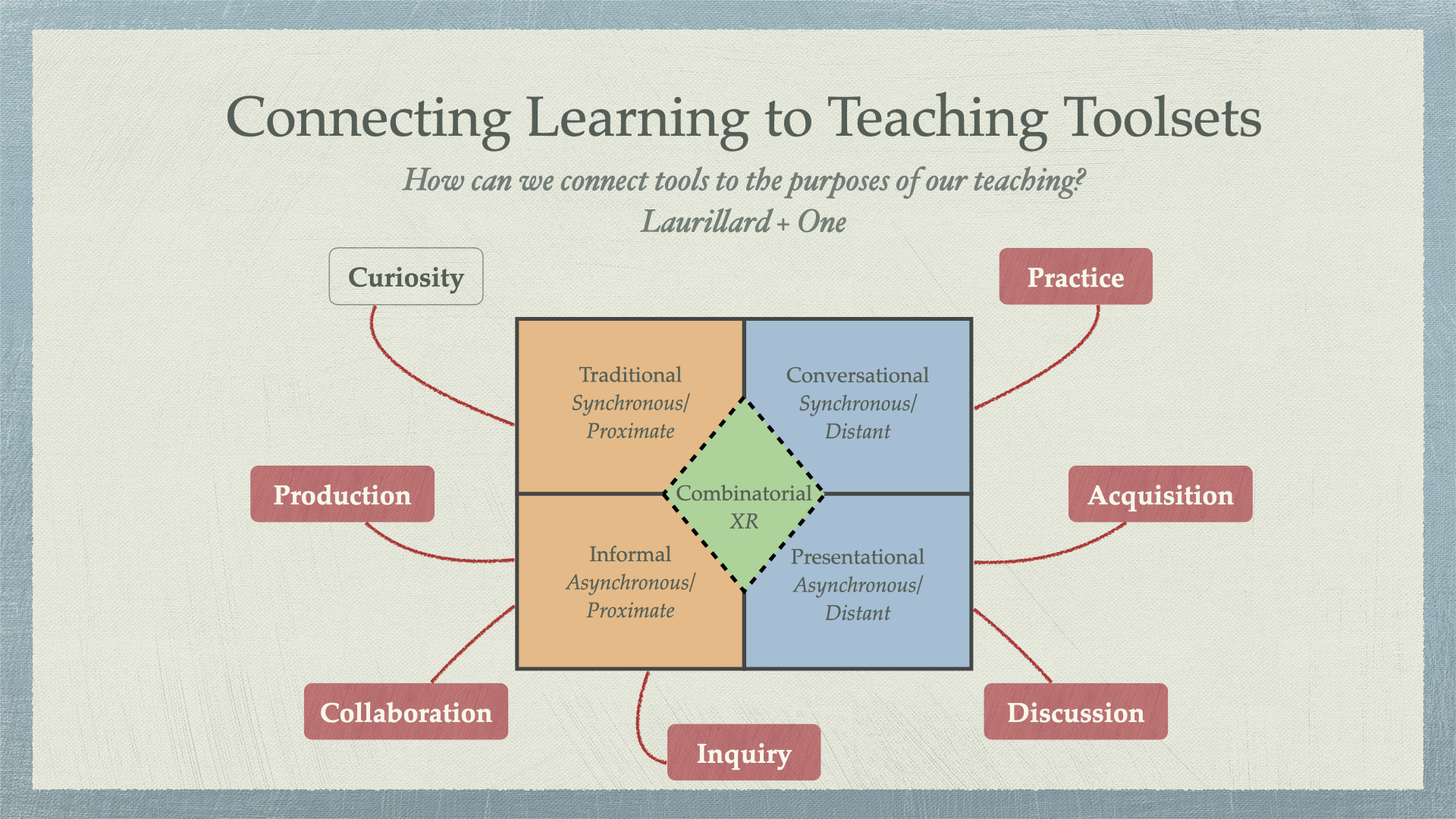
The five areas of instruction identified by ShapingEDU’s Teaching Toolset project provide one way of envisioning a learning “space” for a much more robust modularised learning team. Different team members could occupy different spaces with groups of students tailored to the immediate learning needs of that segment of the cohort. Strategically employing different modes and talents in this system means that relatively large groups of students could move through the process in parallel. With clever design, we could maintain capacity while expanding individualized instruction.


Teaching Toolset Chart with LaurillardThe Teaching Toolset Matrix

Imagine this diverse learning “space” occupied by a team with a central project. Perhaps the space is, like my class, about a student’s role as a citizen in a democracy. A political scientist leads the team. It also includes an English professor, a librarian, a designer, and a statistics professor. This team designs a course/journey for groups of students that culminates in a project, which asks students to identify a wicked societal problem, analyze some approaches to dealing with that challenge, and lay out a roadmap for dealing with that challenge in the American political system. The waypoints are a series of blogs (public writing) that deal with each one of those pieces sequentially. The final product is a website that communicates a change strategy to the public.

Breaking down that process into a set of learning waypoints creates opportunities for teaching by each of the team members:

    • The English professor would teach argumentation and logic
    • The librarian would teach digital literacy and research methods
    • The designer would assist students in figuring out how to tell their stories through a range of technological tools that maximize the impact of the storyteller on the audience
    • The statistician would teach data analysis
    • The political scientist would frame it all into the structures of the political system

Expanding the learning network to embrace a wide range of tools creates nodes between these constituent parts. It allows students to move seamlessly from one area to the next fluidly and on demand. Strategically employing toolsets, each person in the team could connect individually with students. Even working within the constraints of traditional academic terms this would significantly increase the richness of a student’s learning experience. If we explode that constraint beyond an individual course, we could link projects to meta-projects that could provide context to an entire collegiate journey.

These ideas are not novel. However, they have always come up against a range of systemic constraints, from disciplinary to economic ones. My modest suggestion to distribute the engines of learning more efficiently will surely be met with logistical objections related to scheduling and workload. These concerns inevitably lead back to systemic paradigms connected to physical classrooms and butts in seats. It takes a team to create deep learning. Depending on a “hero” teacher to do that is asking a lot. Digital technology facilitates teams. We should take advantage of that.

Arguments against this kind of approach are very similar to those who argue that we can never make electric cars work in the same way as internal combustion engine vehicles do. This is not a very productive way of thinking about the fundamental problem. With vehicles, we need to maintain our transportation infrastructures, while eliminating the problem that they are currently killing our planet. With education, we need to maintain learning in the face of demographic and equity challenges (exacerbated by climate challenges) while maintaining rigorous instruction.

For either of those imperatives to be met, we need to be prepared to jettison anachronistic vestiges of the prior system. Creative rethinking of our systemic constraints coupled with optimizing our toolset opportunities provide a pathway to realizing what education was always meant to be and could become again.

Electrifying Education (Part II): If Tesla Engineers Designed Instruction

Electrifying Education Part I: Being There

There are many parallels in how electric vehicles are disrupting the transportation industry and in how digital has the potential to disrupt the education industry. To realize the potential of electric vehicles, we must grasp changed opportunities for reaching our destinations. To realize the potential of digital, we must grasp changed opportunities to reach our students.

Electric cars change everything from the design of the car to how they’re used. With an internal combustion engine, the nature of the engine dictated the design of the car itself. Form followed function. Its impact stretches far beyond the design of the car itself. The impact of this one innovation of the 19th century still reaches into every corner of our society. So many of our systems, from fueling networks to urban planning, are explicitly or implicitly designed to support the internal combustion engine. The electric car disrupts these patterns. We just haven’t noticed it yet.

Digital education is a similarly disruptive force. It changes everything from the design of instruction to the systems where it takes place. Like the internal combustion engine, the classroom drives the design of instruction. Systems are, explicitly or implicitly, designed to support the concept of putting as many students as practical into the same physical space as their teachers. This is also an innovation of the 19th century telegraphed into today. We build campuses around classrooms and their enrollment capacity. Headcount based on contact hours dictates funding. This thinking stretches into classrooms that don’t exist in any physical sense. Everything revolves around the basic assumption that the classroom drives instruction.

Both systems are facing a reckoning. It is clearer every day that we must wean ourselves from the internal combustion engine. The pandemic has similarly shown us what happens when classrooms are wiped from the table. Much like an electric car, digital education liberates us from the constraints of form. It shifts our notions of space and time.

Moving students around from class to class and all the infrastructure built around that is dictated by the constraints of physical spaces. It’s logistically difficult to split off groups of students based on learning needs. The form of the classroom drives the shape of instruction.

Design shapes behavior. The fluidity made possible by both electric engines and digital education opens huge possibilities for design. Electric cars, liberated from the centrality of the internal combustion engine, are essentially modular. Digital education tools are also modular. Because learning can take place anywhere and at any time, teachers can plug and play instruction, employing a wide range of tools unconstrained by time and space.

Supporting electric cars is also more modular. Since any electrical outlet can charge them overnight, every house can become a gas station. If there’s anything the pandemic taught us, it’s that presence in a classroom is not a precondition for learning. Every study can become a classroom. Over the last couple of years, we discovered a vast array of modular, digital technologies that we can plug in anywhere in the learning process.

There are weaknesses to both the supporting infrastructure underlying digital learning and that supporting electric vehicles. With electric vehicles, it’s long-distance travel and charging times. Digital educational systems also face constraints. For one, the reach of broadband in the United States has shown itself to be a serious problem for a lot of communities, particularly those more economically vulnerable. Instead of constructing buildings to bring more students into educational networks, perhaps institutions should focus resources on constructing better networks of all kinds to connect learners where they are. This shift would require them to reimagine their paradigms about what constitutes a community of learning.

There is a general lack of recognition of how digital instruction is different and how this demands that we approach its delivery in novel ways. As we discussed in part 1, many institutions look at the lack of physical constraints in the digital environment as an opportunity to have a “classroom” that they can pack as many students into as they want. As a result, digital/online classes are often larger than their physical counterparts. The limited research in this area shows that digital sections should have fewer students to allow for greater personalized instruction and equity. Lower costs and greater flexibility should allow institutions to do that. However, most institutions continue to view the economics of digital instruction through an analog lens.

While we have a vast infrastructure devoted to traditional forms of education to fall back on, the last 18 months have shown us how brittle that infrastructure can be. In almost all instances, however, this brittleness comes down to a failure of imagination. To cite just one example, we continue to measure learning through various time-on-task indicators such as contact hours, which imply live, direct content delivery. This is a little like evaluating an electric car based on gas mileage.

We have so many more ways to engage our students than forcing them to sit patiently through our florid prose. There is increasing evidence that there are better ways to instill deep learning. When you are standing in front of 500 students in a lecture hall, it feels like you have little choice. But that’s because you’re looking at lecture like it’s a well-tuned (hopefully) internal combustion engine and not a compact electric motor you can plug in anywhere to the learning process. This is another example of form driving function.

Instead of being constrained by the mechanics of what you perceive to be possible because of the technology and the system that put you in that space, break it down by purpose. In a car, that purpose is to get to your destination efficiently and safely. In a course of instruction those purposes vary more widely, but in my classes my purpose is clear: I want to teach my students the skills to engage with their learning, not just regurgitate information. The actual content is useless without giving them the ability to process it meaningfully.

We must learn to recognize the commonalities of our purposes and separate them from the mechanics of the technology. Figure out how to plug your lecture into the students’ minds rather than relying on the inefficient transmission possibilities of most physical spaces. This does not mean you do away with it, but it means you think strategically about where on the engine of learning that you put it. We do not measure learning in time or space. We measure it in reception and comprehension. Instruction should reflect this.

So much of our institutional energy is focused on the modes of transmitting information to our students. We should focus on the transmission of learning itself. From invasive assessment regimes to endless, mind-numbing remote lectures, remote teaching highlighted transmission as a point of failure. It’s past time to consider how we can go digital and modular to make the transmission of learning more antifragile. We will not do that by making it more complex and trying to emulate outdated patterns found in classroom-based instruction. Much like creating an environment for supporting electric vehicles, this transition will require a shift in how our systems treat learning. Let’s hope that the pandemic has created a spark for driving learning in unexpected directions.

In Part III, we will examine what applying lessons from electric design could look like.

Electrifying Education (Part 1): Being There

The scarcest commodity in my class is me. I don’t try to make myself scarce. I make it clear to my students that they can always find me by email and that it’s no big deal to fire up a zoom session. But, despite my mastery of digital time and space, I’ve never managed to be in two places at the same time.

The focus of industrial learning has been to scale the learning experience to accommodate greater numbers of students, so that education was no longer the province of the elite who could afford personalized instruction. Unfortunately, this has been accomplished largely by putting more and more students under the gaze of a single teacher employing a large lecture hall and amplification. We scaled the voice but missed the point that talking is not synonymous with teaching.

I can still remember walking into my first 500 person class at the University of Texas at Austin as freshman there in the 1980s. I was lucky in that class for two reasons. The first was that the professor was a dynamic speaker who introduced interesting concepts about a subject I cared a lot about. The second reason was that I was used to teaching myself instead of relying on someone else to do it for me. At a young age, I developed a love of reading and the fact that my father was a university professor meant that I always had access to excellent university libraries. I gave myself a parallel education from the one I received in “normal“ school. I aced the class.

Fourteen years later, after nine years of higher education and a detour into the tech industry, I walked into my first community college classroom determined to emulate the experience of that very first government class I took at UT. It was a dismal failure. I discovered that almost none of my students shared my love and understanding of learning, no matter how dynamic my performance in front of them was. Most of the students at this urban campus did not know what it meant to educate themselves or why it mattered that they did.

That was almost exactly 20 years ago. I have spent many of the intervening years trying to figure out how to reach those students. This journey has involved treks into pedagogical design, learning space design, and the application of every technological trick in my tool bag.

The gains have been incremental. I have realized considerable efficiencies in the application of creative approaches to teaching and learning. However, my students continue to struggle. There always seem to be a percentage of them that refuse to be reached no matter what I do.

When the pandemic hit, I was teaching one of the more challenging groups of students that I had ever encountered. Now, besides daunting college course material, I had to navigate them through a technological burden that they had not signed up for. My solution was not to continue business as usual, but to lean even more heavily into individualized instruction than before.

Zoom allowed me to meet individually with students in a way that was difficult, if not impossible, in a physical classroom where the best that I could hope for was group interaction. Most community college students do not linger on campus. I can count on one hand the number of times students spontaneously walked into my office hours in any given year.

Most of my students have significant external responsibilities, such as families and jobs, that take up almost all of their non-class time. College is seen as a luxury, a bet on an ephemeral future self that must always take a back seat to present concerns. The pandemic exacerbated the concerns of their present selves as they or their relatives sickened and jobs evaporated or became extremely stressful affairs. To add to the misery, flawed technological systems, which were their only lifeline to the world of learning, often collapsed under the strain.

I was very proud of my success rate in that first semester of remote teaching. After careful analysis, I only found one student that I lost for reasons purely related to remote teaching. I accomplished this feat by meeting individually with every student. I prioritized these meetings over every other synchronous activity. The first question out of my mouth was always, “How are you doing?” It was through this emergency stopgap that I discovered the power in these interactions. Instead of insisting the students come to me, I could meet them where they were and to connect the work that they were doing in the class with what they were going through.

Since then, I have not taught a single course in person. I have made these individual meetings a fixture in my instructional method. I can do this through the power of the technology in my toolbox. These insights have altered even the group meetings where some or all of the class is in Zoom. I started using concept-mapping software like Miro to actively and explicitly connect individual projects and interests to the material of the course. In this way, I can meet the students where they are instead of trying to feed them where I am. (I am feeling some trepidation about next semester when I may be forced to give up these tools and go back to slumming in a classroom.)

Until this point, I have been lucky that all of my classes have been under 18 students. This semester, however, I have two classes with 32 students each. I knew going in that this was going to present a challenge to the teaching models I had developed for remote students. I have a pretty clear idea of how much time and attention I need to give each student. Early on, the class sizes were already impacting group activities within the class. There simply aren’t enough minutes in our scheduled meeting times to reach every student.

This has already led to attrition. Out of over 60 students, only 41 students turned in the second major assignment. Ironically, the class has right-sized itself, but there have been casualties along the way. It should not be surprising that under these circumstances that the most accomplished students will push themselves to the front of the line. Those who never make themselves heard will sit quietly and watch the class slip by.

The only way to manage large groups of students is to talk at them instead of with them. This works with the more accomplished students. A practiced learner can get through my class without ever attending an interactive session. Most of my students don’t fit into that category.

In recent years, several studies of students in distance education have shown a linkage between overall performance and the way the class is taught. They show it is almost impossible to teach the class constructively and reach at-risk students effectively with over 24 students per teacher. As Sandy Baum and Spiros Protopsaltis found in a 2019 study, “Even when overall outcomes are similar for classroom and online courses, students with weak academic preparation and those from low-income and under-represented backgrounds consistently underperform in fully-online environments.”

I can feel those numbers this semester as I struggle to find the time to reach those students that need my help the most. The economics of teacher-student ratio vary wildly from institution to institution. Administrations will argue that trimming class sizes is simply not possible from an economic standpoint. However, the problem may not lie in “class” sizes. Instead, it may lie in a failure to imagine how we might group students in ways that are not based on “butts in seats.” There is no reason that classes still need to meet that outdated industrial standard. If we ever want to get past merely educating the favored few and reach talent that is less favored by circumstance, recognizing the power of individualized instruction is the only realistic pathway. The logistics of instruction are not an excuse.

The digital world offers us new opportunities that bend time and space. Bending time and space provides many opportunities to scale individualized learning. Scaling individualized learning is the only way to create equity for those students being failed by the systems we have created. We can only scale individualized learning by reimagining how we deploy our resources in the service of all of our students, not just those most capable. To do that, we need to look far beyond the classroom itself to the infrastructure that supports its continued primacy in educational philosophy, planning, and execution. Electrifying our analog systems provides opportunities for us to re-examine this paradigm.

Next Up: Electrifying Education (Part II): If Tesla Engineers Designed Instruction

« Older posts Newer posts »

© 2026 IdeaSpaces

Theme by Anders Noren — Up ↑