Year: 2026

Building New Learning (Part 5 of 5): Back to Basics

For newcomers then the purpose is not to learn from talk as a substitute for legitimate peripheral participation; it is to learn to talk as a key to legitimate peripheral participation. – Jean Lavé and Etienne Wenger, 1992

Having to express an idea clarifies for learners what they do not fully understand, especially if their interlocutor is prepared to argue and question. – Diana Laurillard, 2002

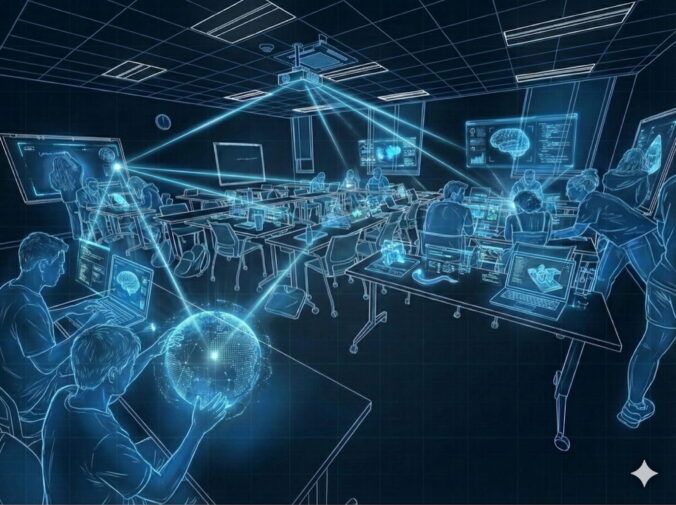
Learning is a conversation. Large language models are dialogue machines. We can dialogue with them about the design of our classes. Our students must dialogue with them as part of their learning. Our “AI-challenges” are rhetorical challenges, not technological ones.

Whether or not a technology is useful doesn’t come down to how good the teacher is at using technology. It turns on whether the teacher was able to use it to stimulate human dialogue with and among their students.

Good technologies facilitate conversation. Bad ones retard it.

Not All Technologies Facilitate Conversation

Modern education has always been technologically-based. Essays, blackboards, blue books, and classrooms themselves are all technologies. We just don’t recognize them as such because they seem “normal” to us.

Over the last 30-40 years, education has been buffeted by waves of technology, from the CD-ROM to Web 3.0. Many of those degraded conversation because they ignored pedagogy in favor of dreams of efficiency. Artificial Intelligence seems like another in the same litany of complex technologies that further isolate student conversations.

AI’s negative uses have been to try to automate the existing assembly-line methods of instruction, like automated grading or assignment creation. These seem like, at best, another attempt to make learning more efficient at the expense of authentic conversations. At worst, it’s an excuse to replace teachers.

AI is Different Because it Surfaces Tasks

AI is different because it does one thing better than any other computing technology: it lowers, and even eliminates, technical barriers to tasks. No longer do you need to know how to use Illustrator to create graphics. You don’t have to know how to code to create applications.

AI reverses teaching’s recent relationship with technologies. The task can drive the technology, not the other way around.

As you can see from the earlier blogs in this series, I have used AI to reinvent and deepen the quality of my courses. I have used it to synthesize the best of the pedagogical literature and to think deeply about the impact of my assignments on student learning.

I don’t have to be a programmer or a master of complex software systems to achieve these goals. I just have to be a good thinker and questioner.

This lesson should be extended to our students. We must teach our students to be good thinkers and questioners, not coders for them to remain competitive in the job market.

This means stripping learning down to its studs. AI is a humanities problem, not a technical one.

The humanities teach us to be better pedagogues. That makes us better prepared to teach humanity to our students.

We can either teach conformity or creativity. AIs reduce everything to a norm. If your class is normative, it can be defeated by an AI. If your class encourages human flourishing, it cannot.

The same goes for your class design. If you reduce your class to mechanical functions, you can be replaced. If you make it more human, then it will be evergreen. Learning is forever. Education is not.

My new/old approach to pedagogy was designed in conversation with texts on learning, not technology. It is not based on organizational logic. It is based on surfacing their humanity. If we surface the human, we will teach them how to surface themselves in a world where authenticity and humanity matter more, not less.

Strategy 1: Focus on Processes for Thinking

Our first goal in human learning is to develop processes for thinking. Disorganized, or sloppy, thinking undermines so many projects and products. AI is an efficient “thinker” but in the end, it requires humans to design for humans. Effective design is impossible if humans lack the scaffolding of structured thinking.

Modern education is based on evaluating products. Bowen and Watson, however, note that we need to teach dialogue(Plato would approve) as a mechanism for getting what we need out of our technological systems. This is not a technical exercise; it is a rhetorical one.

  • The Old Way: “Write a 5-page essay on Hamlet.” (AI gets an A).
  • The AI-Proof Way: “Have a conversation with ChatGPT about Hamlet. Argue that Hamlet was actually the villain. Submit the transcript of your debate and a 1-page reflection on where the AI beat you.”

We need to stop grading the essay (which is now a commodity). We should be assessing the student’s ability to steerand critique an intelligence.

Strategy 2: Use AI to Focus on Learning, not Education

We must teach our students to leverage AI tools. Banning them is counter-productive. Instead, we must use AI to teach higher level thinking skills. Bowen and Watson argue for the idea of treating AI as a “Naive intern.”

Ask the language model to generate content. It’s good at that. The student’s job is to evaluate that content. Have them generate an AI answer to your assignment. Then, their job is to vet whether that response meets all of the requirements.

Effective critiques require a deep understanding of the subject. The AI can provide a superficial (or seemingly deep) response. Even if it is substantially correct, it is still subject to confirmation and bias checks.

This shifts the cognitive load from Task Execution (writing words) to Task Stewardship (verifying truth). You don’t need to understand the code behind the bot (or even model weighting) to be able to do this. You just have to ask good questions.

Strategy 3: Reintroduce the Human Premium

Even before AI, I struggled to get my students to connect meaning with what they were doing. They operated as the cogs in the educational machine that they were. Anything that humanized that was, at best, at distraction.

However, humanity is the thing that separates us from the machines. Agentic AIs like the recent Einstein agent, exploit this mechanistic structure of education. If the class is a checking-the-box exercise, an agent can take it for them.

In the workforce, as Emad Mostaque pointed out in a recent interview, if your job is to be a machine, you will be replaced. Most office jobs are mechanical and require relatively little creativity on a day-to-day basis. Humans are expensive, especially when you can “replace” them with a bot that costs a couple hundred dollars a year.

It is our humanity that will save us from this fate. Therefore, we need to stress human connection as central to our pedagogy. In my classes, the Gold level reintroduces the “human premium.” To get to this level (equivalent to a “B”), they must relate human issues directly to the more abstract debates that dominate our political discourse.

Machines cannot replicate their lived experience, much less the combined lived experience of a group of students. This is why the insights of Lavé and Wenger’s Situated Learning and Diana Laurillard’s “Conversational Spaces” are so powerful and even more relevant in an AI-driven world.

This World is More Human

One of the things I’ve experienced as a teacher is that, by offloading so much of the logistical load of running a class, I have that much more time to focus on the human element of teaching. The conversations I’m having with my students are deeper and more meaningful than ever.

These are the things that matter in teaching. I have only given up the things that frustrate me: the assessment gaps, the lesson planning, the assignment programming, etc.

Instead, I’m digging back into pedagogical roots stretching back to Socrates. I have created a “cheat sheet” to get you started on that journey. Also, use the OER Pedagogical library I’ve assembled in NotebookLM. Even better, make your own.

AI makes so much more possible. We can reinvent the world through dialogue, not code. We just need to dig the score sheet out of our dusty pedagogical cupboards.

Our job is to be conductors of learning. I can’t wait to hear what beautiful music our students will create with their new AI-powered instruments. We just have to teach them how to make their own music.

Building New Learning (Part 4 of 5): Navigating Conflicting Currents

The pupil is thereby “schooled” to confuse teaching with learning, grade advancement with education, a diploma with competence, and fluency with the ability to say something new. His imagination is “schooled” to accept service in place of value. – Ivan Illich

ACT 1: The Local Friction

The student looked at me incredulously.

“Why can’t I do the next module?” “

“Because you haven’t mastered the last module,” was my reply.

“But I completed it.”

“Yes, you did some work but you did not demonstrate the minimum mastery necessary to continue.”

This is a common conversation with my students these days. They are used to just sliding by and are really struggling with the idea that learning is a process. How are you supposed to evaluate process when no one seems to recognize it exists?

There are two systemic challenges to assessing process over product in our current educational systems. One comes from below from the students and the other comes from above from administrators and the policymakers that are pressuring them to demonstrate “accountability” in exchange for the public funds that make public higher education possible. Both sides are squarely focused on product.

ACT 2: The Systemic Vise

My students are used to checking in and out of courses and dropping in to do the minimum necessary work to create marginal products to “demonstrate” their learning. This is a suicidal strategy in a world where AI does a lot more than getting by.

Students treat each assignment as a product. If you miss one, then you simply make up for it on the next one. One thing they really struggle with in my class is understanding that getting “0’s” on Gold and Platinum assignments is part of the process.

I have some leeway (unlike many K12 teachers) in messing with their realities, because of a natural deference to professors. However, the “best” students, who are best at playing the school game, are most likely to complain about me “messing with their GPA.” Few understand what I am trying to do.

On the other side of the coin, my college is laser focused on “student success.” This is a result of a legislative mandate for colleges to prove their worth to receive funding.

This mandate is complicated because no one seems to know what “student success” actually means. The simple answer is to fall back on credentialing and completion. Of course, no one wants to hear that the easiest way to achieve this metric is to make all the courses easy.

My course exists between these two systems. So far, I haven’t gotten a lot of pushback from the administration, but I can see that happening if my failure and drop rates spike due to students playing the old game and running up against the realities I am trying to teach.

These are systemic problems that any course that takes AI seriously has to face. Large language models challenge the logic of product-based education. Just bolting them onto outdated pedagogical practices on students who conflate school with learning will not work.

However, the vast majority of “AI-transition” policy focuses on doing just that because of the realities of being caught between the two poles of administrative/legislative priorities and student expectations. Donella Meadows, the noted systems thinker, writes, “Policy resistance comes from the bounded rationalities of the actors in a system, each with his or her (or “its” in the case of an institution) own goals.” (Thinking In Systems, p. 113)

Systemic resistance is real. Meadows goes on to say that, “[R]esistance to change arises when goals of subsystems are different from and inconsistent with each other… In a policy-resistant system with actors pulling in different directions, everyone has to put great effort into keeping the system where no one wants it to be.” (Thinking in Systems, p. 113)

In other words, no one has to love the system for it to persist. More importantly, these groups pulling in different directions actually strengthens the system’s resistance to change, because the one thing all actors can agree on is the maintenance of the system.

The students want the system of product-based credentialing to persist because they’ve staked their livelihood on it. Colleges are likewise invested in it.

Then there is the problem of valuing the process itself. If both system actors see the value in producing a product exclusively, learning becomes an “event” of production. If the course focuses on the process, the rhythm of the class must be different.

My students often have personal crises over the course of the semester. Their student existence is often precarious with family and work pressures interfering with their studies.

Within the constraints of the industrial semester system, it’s difficult to modulate the speed of the course for them. That 16-, 12-, 8-, 5-week clock is always ticking, and I can’t really change that.

Some students can play catch-up in my system, but most can’t because there isn’t enough space for them to learn the lessons they need to learn in order to proceed. After a certain point, they can no longer get to the end of the course before the semester clock runs out.

This is not the fault of the course structure. It’s the fault of the outdated industrial clock ticking.

Lately, my institution has focused on the laudable cause of “student care” to ameliorate this problem. My course risks looking “uncaring” by insisting that education requires an investment of time. Process takes time.

Is it really caring to send them out into the world without an understanding of how the learning process works? How are they going to learn the process of lifelong learning that will be essential in a shifting technological and economic world?

It is easy to see how these systems produce inferior products that will have difficulty adjusting to the processes of an AI-driven world, where product is plentiful and processes such as verification, curation, the human premium, and taste will be decisive for their chances of “life success.”

ACT 3: Surfing the Currents

My approach to this wicked problem is to have the students produce a tangible work product as a demonstration of their learning. However, I focus on and assess the importance of process in my pedagogy.

It is this discordance of pace that is central to the friction that I must surf. I’ve seen this before as my courses have been process-based for a long time. The big difference is that the weight of my assessment has continued to focus on the products of my students’ work. This has shifted with the latest course redesign.

To cite just one example, my blogs were so easily gamed by AI that they lost their functional value in the process. Students viewed them as product, not as part of the process of refining their storytelling skills before transitioning them to the visual medium of the web. They’re not part of the course anymore.

The sequence of process-building from one module to the next is central to the pacing of the class after the redesign. Even moving through the modules is a building process. This is essential pedagogical practice going back to Vygotsky’s Zone of Proximal Development.

I have already seen two students suffer crises that have knocked them off their pace. One was able to catch up. The other was not.

The only alternative to plowing on is to revert to the old, compromised system. I’ve seen colleagues do this and their life is filled with a losing battle against AI-generated product.

I worry about the systems of education being able to adapt to the frequency and amplitude of the waves striking it. Learning is still in those systems but it risks being washed away along with the vulnerable products.

Can my course survive? Only time will tell.

Building New Learning (Part 3 of 5): Teaching Augmented Humanity

“We refer to a way of life in an integrated domain where hunches, cut-and-try, intangibles, and the human ‘feel for a situation’ usefully coexist with powerful concepts, streamlined technology and notation, sophisticated methods, and high-powered electronic aids.” – Douglas Engelbart, 1962

I have been obsessed with helping humans construct better worlds, for ourselves and society in general, through the strategic use of technology throughout my career. This idea was at the core of Discovering Digital Humanity. It is also the core of my teaching philosophy.

Learning, as we have set it up, is hard and often unrewarding in any meaningful way to students. Like the bow made it easier to hunt and the fire made it possible for us to cook, computing technology should make it easier for us to think.

I have found this approach to be at odds with the way most others see technology. There are basically two camps here. One is the mechanics, those who see technology as an end to itself. This group forms the core of what we might call the IT community these days.

Then there is the camp that views technology largely with a level of fear. This is because the group that understands the technology has a vested interest in keeping its mysteries to itself. As a result, we divorce technology from humanity.

I have never liked this division. I have always straddled the divide and my approach to teaching is no different. However, until recently, much of the technology required a certain mindset (associated with the mechanics) to really harness. Most of my students felt harnessed to technology, and not in a good way.

AI changes that. It doesn’t require a technical bent to interact with. It doesn’t even require a desire to do that. It also threatens systems built with the older technological mindsets at their core.

Why read the old, often difficult to access, technology of the book, when you can just interrogate it? Why write using that same technology, when everyone’s expectations seem so unreachable? This is what keeps my students from engaging meaningfully with their own brains and learning.

This struggle has always formed the core of my pedagogical practice. Many of my students feel imprisoned by systems of all types: economic, educational, and technological.

All these things come together when we tell them they “need to get an education to get a job” and they “need to master this technology to get a job.” Unsurprisingly, this creates resistance.

No one talks about education as a liberating process anymore. It’s just fitting you for a new set of chains. This is at odds with what I’ve always thought about both education and technology.

In practice, this means teaching the students that they have real, not just performative, power. AI helps me humanize both technology and the learning process by lowering barriers to information and process.

Most students are not used to having an on-call assistant to use in their learning, This is my first set of lessons in the class: how to use AI tools and what their limits are. As José Antonio Bowen and C. Edward Watson describe it:

AI is a new eager assistant capable of finding information, creating visualizations, writing drafts, offering feedback, and analyzing data. It will alter your workflow and allow you to do other things. (Teaching with AI, p. 84)

Students are not used to having this kind of on-call help and it doesn’t help that many of their teachers call this kind of assistance “cheating.” However, this is the future that they are facing. We must teach them how to make AI their partner, not their replacement.

Bowen and Watson also point out that AI can simulate situations and allow students to interact with them. This “red team” approach challenges certainty and forces students to test their thinking.

In my class, I use the AI to simulate opposition to the students’ ideas for solving their challenges. This can take the form of a politician or interest group arguing for alternative solutions.

I still challenge them live in class but often those lessons don’t stick. However, being able to do this asynchronously, they must respond in writing to get Gold points for that section. This is a good lesson in intellectual humility taught without shaming them.

This is where the medaling system in my class comes into play. Most students (and professionals) use AI to construct things. They’re writing papers with it (or letting the chatbot write for them) or creating images.

AI can do a pretty credible job of mimicking mediocre writing and graphic creation. However, most “creation” these days is mediocre product, from cheap graphics to emails and memos (and college essays).

This is not augmentation. It is replacement.

When most professors and professionals complain to me about AI, it’s usually because of the problems (“hallucinations”) these kinds of AI use produce. I tell them, “You’re doing it wrong.”

Many students are used to operating this way because this is all that school has ever demanded from them. Convincing them that this is a pathway to disaster is tall order.

That’s where the Gold assignments come into the picture. These assignments bring the human back in by forcing the students to connect what they’re working on for their challenges back to their own lives.

Gold assignments force the students to move beyond what the AI will ever be able to do. Sure, the AI can mimic a human but it’s never going to be one. I explain to them that if all they ever do is Silver level work (the construction part), they are replaceable by AI. Some of them get it. A lot of them don’t. I worry about those who don’t.

Gold points recenter the human into the equation. Their humanity may have become lost in the systems of education or buried under technological monstrosities. AI lets me tease it back out again.

In 1962, Douglas Engelbart wrote a proposal to “Augment Human Intellect.” Note that he didn’t say “replace.” That is because Engelbart saw computers as the ultimate tool to make humans better.

His struggles centered on making them accessible in an era of punchcards and flashing diodes that only a very few knew how to interact with it. His technological vision bore fruit in the 1980s with the mass adoption of computing systems that grew out of his work in the 1960s, but he never thought his work was done.

That is because he realized that to take full advantage of this augmentation, humans needed to change the systems that held them back. AI has made technological assistance more accessible than before. I don’t have to code to interact with it. I can just talk to it.

My course is explicitly designed to help students transcend the systems that hold them back. I don’t know what the AI future holds but I do know that it will be corrosive to those systems.

Those who are stuck in them will be dragged down with them. Those who can augment themselves and other humans will thrive. I want my students to thrive.

Building New Learning (Part 2 of 5): Beyond the Mimicry Trap

“It’s the questions we can’t answer that teach us the most. They teach us how to think. If you give a man an answer, all he gains is a little fact. But give him a question and he’ll look for his own answers.” – Patrick Rothfuss

The Currency of Compliance

If questions teach us how to think, our current grading system does the opposite: it pays students to stop wondering. Wondering is at a premium in a world where AI does so much of the thinking for us.

Grades are the greatest frustration I suffer as a teacher. They kill wonder. They reduce learning to an endless conveyor belt of frustration and stress for the students.

In Learn at Your Own Risk, I call this frustration “transactional teaching.” You give me work and I give you a token grade. You can take these tokens to your certification bank.

This would make sense if grades reflected the process of learning. Standard grading often falls into the mimicry trap. We mistake a student’s ability to mirror our own voice or the textbook’s structure for actual mastery. In a world where LLMs are the ultimate mimics, mirroring is no longer a high-value skill.

The good students mimic well and are rewarded with gold coins. Those who see this as fool’s gold do the minimum necessary to get by. Those who don’t play by the rules are sent home and forced to repeat the dance.

The key term here is good/bad/indifferent “students.” What they are performing is their capacity to play the role of student, not their real talents. After all, why bother unless it makes your life easier?

This is not learning. This is performance.

Performance vs. Process

Learning is a process, not an event. Deep learning requires process. If you don’t follow it, the actual value the student carries away from the experience is almost zero. The students know this.

By the time they get to me, they’ve been trained for 12 or more years in this game. It has robbed them of the joy of learning and replaced it with the anxiety of pleasing the teacher. I don’t want to be catered to. My joy comes from their growth.

Designing for Flow and Mastery 

When I redesigned my course, the two top criteria I gave my AI partner was that I wanted to make sure the course combined Flow and Formative Assessment (and gamification and constructionism). Grading interrupts Flow because students obsess about the (for some impossibly steep) mountain and miss the point of the climb entirely.

Mihalyi Csikszentmihalyi’s Flow approach requires the balancing of challenge and boredom. Tests aren’t challenging, they’re boring. They’re just part of the endless box-checking that education has become.

“As soon as a student gets a grade, the learning stops.” – Dylan Wiliam

Formative assessment requires students to respond to feedback and practice tasks accordingly. As Dylan Wiliam writes, “As soon as a student gets a grade, the learning stops.” Feedback is usually ignored or, at best, used to complain about the assessment already taken. It’s only the next assessment that matters now.

Getting past this “peak and valley” rhythm of the class has always been the chief challenge of my learning design process. Therefore, this was a central focus of my course redesign effort.

I built this through a “leveling up” model based loosely on Scott Nicholson’s article on gamifying his class. In this model, the better learners level up to the harder assignments while those who are struggling more can at least get to the passable assignments.

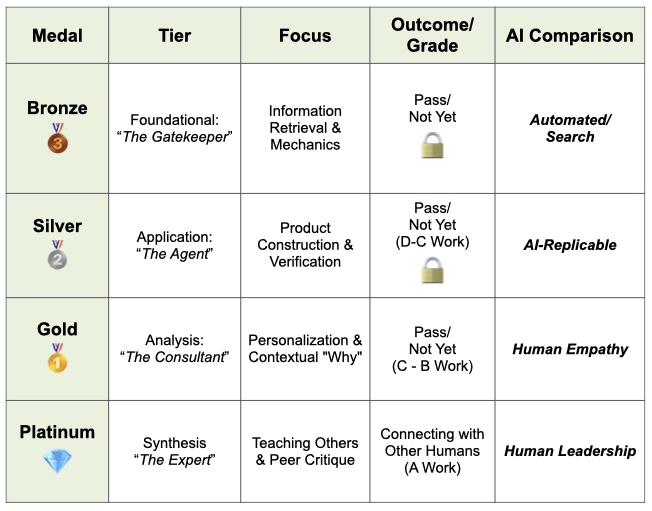
My course uses a modification of the medaling system developed by Scott Nicholson. In my version, there are four medals: Bronze, Silver, Gold, and Platinum.

The Medal System


Silver is the New Floor

The Bronze level is the foundational level. It just means you know how to find the information you need to proceed. The Silver level is the AI-level. What I mean by that is that Silver involves constructing products, it could theoretically be replicated by an AI tool.

The point structure in the class is set up so that if you just do Bronze and Silver, you will get a D in the class. I make it clear to them that this level of work is likely to be replaced by machines in an AI world. This is where most classes end their learning process (and why I’m so fearful about the consequences of that for our students).

Emad Mostaque argues that the value of “cognitive work” rapidly approaches zero in an AI-driven world. AI is good at producing products, but you must make it produce products that reflect your value to set yourself apart from assembly-line thinking. Silver level work operates at this level. This is no longer good enough.

Gold requires a level of personalization. What does this work mean to me, specifically? How does it help me move my goals forward? The AI has no empathy so it can’t do this authentically.

Finally, Platinum is about teaching others. Those of us who teach, know that the best way to learn something is to teach it. This is the A-level of the class.

All these assignments except for Platinum are all-or-not yet. What that means is that, within a certain boundary of time, the students can redo assignments to achieve that plateau. Silver is the minimum necessary to proceed to the higher levels but also the minimum necessary to proceed to the next course section.

I have noticed that a lot of students stalled at Silver in the first module. More, but not all, got to Gold in the second, and only a select few got to Platinum. You cannot get points for higher medals until you’ve done the lower ones.

This is still somewhat a work in progress, but the preliminary (small sample-size alert) results are encouraging. I think it will need to be tweaked a little bit in future iterations in terms of the mechanics of advancing through the levels (Canvas is not my friend here).

I’m also still learning how to teach this way. My feedback is critical to making the system work. After that, I also need to get my students to read the feedback.

This system does at least two things. First, it reinforces the idea of failure leading to iteration, not quitting. This is a radical departure from what they are used to but very much reinforces the modulating nature of Flow as well as the feedback loop required for formative assessment.

Second, once they get used to it, the students see this as an “easy A” (it’s not) because it looks like I’ve made their incentive mountain easy to climb. Gamification requires levels to be difficult but not too difficult, while at the same time keeping you engaged with the game.

From “Spinach” to Significance

This last part is the most difficult to achieve. My students don’t want to play this game in the first place.

Engaging them in something related to the course is like trying to get them excited about a spinach-eating contest. The system has taught them that learning is often unpleasant, especially if it’s a course you must take (mine is required of all students).

This is where connecting their learning to something they care about really matters. By researching a social issue that impacts them directly (and I make them reflect on that early on), they learn that learning and politics are struggles that must be engaged with for there to be any growth toward viable outcomes.

The design process can also be viewed as a game. The core of design is failure and iteration. These are the same mechanics that underlie any successful game. This also forms the basis of my Constructionist activity.

While my system may not be perfect, it’s clearly heading in the right direction. Flow, Formative Assessment, Gamification, and Constructionism teach essential skills necessary to work in tandem with the machines to create better versions of ourselves and our communities. This is how we use AI to become more human, not less. Next time, we will talk about teaching the students to use AI as a partner in the class.

Building New Learning (Part 1 of 5): Why I Blew Up My Class

My choices of what to attempt and what not to attempt were determined to an embarrassingly great extent by considerations of clerical feasibility, not intellectual capability.— JCR Licklider, “Man-Computer Symbiosis,” – 1960

I have known for a while that education needed to change. I could sense it as far back as the 2000’s as I was starting my career in education and technology. Education was badly out of sync with the information flows of the rest of the world, and the students knew it. Now, however, with the tools I and my students can build using AI, there is no excuse not to change if you value learning over certification.

I didn’t redesign my class because of AI. I redesigned it because content mastery is no longer the organizing principle of education. Learning the skill of process is. Along the way, I discovered that I could do things with my classes that I had always wanted to do: fold in the best ideas from deep thinkers about learning and learning strategies.

Web 2.0 was the first real warning sign that technology would undermine the way education worked, but most people ignored it. Of course, you could go all the way back to the 70s and see the glimmerings of this in the works of Ivan Illichand Ted Nelson, both of whom could speculate on the trajectory of technology but realized we weren’t there yet.

In many ways this was still true in the noughties. Building stuff, especially complex stuff, was still difficult even for those of us who had been using technology for decades. It was a lot to expect faculty to create with this technology, much less students.

It took until the early 2010s before I was comfortable asking students to create multimedia with technology. Web authoring tools had matured enough to where students (most of them at least) to where the primary struggle was with the material, not the technology.

I teach two classes everyone must take, American and Texas Government. Most of my students view my class as an impediment to stuff they “really need.” Under these circumstances, it is easy for them to slip into a compliance mindset rather than a transformational one.

Motivation has always been at the top of my list of challenges. I have tried all kinds of tricks to see if I could make the traditional method of teaching and learning work. This model had me “leading” the class to knowledge. However, I was constantly frustrated when it came to naught. Sure, there were incremental improvements, but they weren’t transformational.

In 2018, I decided to reinvent my class structure and instituted a design model. Instead of essays and tests, the students built a public website about a challenge that is important to them. This was the first time I think I really implemented a constructionist strategy in my classes.

This meant that I needed to push the content into a secondary status and focus on their learning skills. After 18 years of trying to get my students to master complex theories of government, which they immediately forgot, this was a welcome shift in focus.

I discovered that this direction was not a panacea, however (I wrote about this in Learn at Your Own Risk). Students have been so well-trained in transactional teaching (I give you a grade in exchange for work) that the course became an exercise in frustration for both the students and myself as they struggled to know “what I wanted” when what I wanted is for them to stretch themselves creatively.

However, this structure, since it wasn’t obsessed with content (content was a source, not a pretext), adapted well to remote teaching. While my colleagues were obsessing over cheating, I had no tests to protect. Everything in my class was open book, just like the real world.

When AI came onto the scene, this also served to cushion the model. However, even though I thought and wrote extensively about the impact of AI on education, it was always a bolt-on.

Last semester, I had to do a quick setup for my classes and leaned into AI to help me with language and consistency. It helped but I could tell the model had some vulnerabilities. I introduced my students to AI and how to use it responsibly, but I could tell some of the blogs were written by ChatGPT. This told me the assignments were becoming meaningless.

I had more time for reinventing my courses this semester and decided to do another 2018-level reinvention. I recognized that this was possible in a much shorter time because of the AI tools I had been exploring. It was also long overdue.

In that redesign, I tried to shift the identity of the student from passive “consumer” to “designer.” This was a big shift for them, but it was also an artificial one. I understood it, but they didn’t. They were still playing a game that I was the master of and that they had little investment in.

I knew that AI demanded that they invest in the experience. If not, there was no incentive for them to do anything other than check boxes.

I have studied pedagogy for years looking for solutions to my challenges with students but also because I was looking for opportunities to integrate technology into the process. However, operationalizing good ideas is not the same as recognizing them.

Over the years, I had thought about the ideas of Papert, Harel, Csikszentmihalyi, Lavé, Wenger, Laurillard, and Wiliambut struggled to find systematic applications for my class. They were always, at best, bolt-ons and therefore had a diminished effect on the learning experience.

Last year, I constructed a Notebook LM library with my collection of pedagogical readings. I used it to construct just-in-time active learning for my Fall classes. I would come up with an idea, operationalize it in Gemini, and then check its pedagogical efficacy against my pedagogical library in Notebook LM. I’ve recently made an OER version of this library.

Therefore, it made sense to do a root-and-branch reconstruction of the class using these resources. However, there was a further step. In my AI-developer guise, I was doing a lot of deep exploration of how AI will impact how we live and work in the future. Discovering Digital Humanity also dovetailed nicely into this approach.

Carlo Iacono’s substack on AI and learning, which I highly recommend, talks about, among other things, that “direction” matters more than speed. In Discovering Digital Humanity, I talk about how we need to let technology enable us to create. We must learn to direct it to produce what’s in our heads.

AI only makes this easier. Therefore, instead of banning technology, we must teach our students how to become architects of the future.

Instead, we are training our students to be clarinet players when what we should be training them for is to be conductors. The AI becomes the orchestra. Getting it to sing is the real challenge.

AI will not let us digest this intelligence inversion for long. We don’t have another 20 years to figure out how teach in this environment. Education must shift from artifact production to teaching cognitive architecture now.

The factory is gone. It’s time for everyone to learn to be a builder. That’s exactly what my redesigned course does. However, it goes much further than my old design-based formula because it focuses assessment on process, not product. Learning should not be what you build, it should be about how you get there. Architects design. They let others build.

There is No Why in AI

“It is in Apple’s DNA that technology alone is not enough—it’s technology married with liberal arts, married with the humanities, that yields us the results that make our heart sing.” – Steve Jobs

Humans are dreamers. Whether we are dreaming of a better life for ourselves or our children or of Middle Earth, creativity is at the center of our existence. According to Leonard Shlain, “Every child is born with a desire to re-create the world in his or her own terms. This powerful motivation for producing art has always been a means of imposing order on the disjointed pieces of the child’s emerging worldview” (Art & Physics pp. 141-142).

Lately, the news has been filled with stories about Humanities departments shutting down at universities across the country. This week at Davos Palantir CEO Alex Karp proclaimed that AI will “decimate” humanities jobs.

I couldn’t disagree more.

Morality, ethics, and the logic of “why” will be the premium human skills required to operate in an AI-driven world. Without dreams there is no “why.” Technologists like Doug Engelbart, Alan Kay, Steve Wozniak, and even Steve Jobs were dreamers first. The reason their innovations “worked” is because they baked their dreams into everything they built.

Chatbots don’t dream of electric sheep. We do. Our dreams come from within or they may come from the dreams of others. The Humanities are the stuff of dreams. Philosophers dream of a better us. Historians dream of other times. Writers just dream.

Science is also filled with dreamers. Every great scientific invention was driven by a dream of something different. Most truly successful scientific visionaries also had a “soft” side. Einstein was a talented musician. Richard Feynman was also a musician. Music is math.

So why this fascination with killing off the humanities? Our obsession with STEM (Science, Technology, Engineering and Math) over the last 30-40 years failed to grasp the need for this other side of our brain to be engaged in the development of innovation.

This is a legacy of industrial thinking and late-stage capitalism. Everything must have a purpose and turn a monetary profit or a return-on-investment (ROI). The thinking was that if you focused on the “hard” science, humans would be better at navigating and thriving in a technological world. ROI dominates everything, including the learning process.

Instead, we ended up with a lot of frustrated people because their studies lacked any purpose other than profit. We gradually stripped meaning from learning. We lost our compass in the pursuit of an elusive goal. And when society (and education) didn’t deliver that profit, it bred resentment.

I can’t tell you how many times I’ve heard students say, I can’t do math (or science or technology) because it’s too hard. I’ve had two students drop my class this semester because they were intimidated by the prospect of having to build a website. Their mantra was, “I’m not good at technology.”

They gave me very cogent ROI arguments why taking my course, which forces them to explore a different way of learning, was a risk to them. Making an argument that this technology could operationalize their dreams had little resonance with them.

This version of STEM education separates humans from their dreams. Money is not a dream. It may be a mechanism in today’s world to purchase the facsimiles of dreams but the pursuit of it doesn’t really change the world.

Now, we are faced with a situation where AI can do so many of the STEM activities that form the centerpieces of study in those areas. It’s not the artists who should be threatened by AI, it’s the engineers.

I can code with AI. I can create technical documents and drawings with AI. I can reinvent my classes with AI. I can do all these things because my education is grounded in the humanities and I have the tools to systematically dream what I’m trying to accomplish.

A curious thing happened to my courses as I worked with AI (a curated library in Notebook LM) to develop my AI-infused curriculum: The design systematically stripped ROI (the product) from my assessment strategy in favor of communication, collaboration, and inspiration (the process). Instead of assessing papers, I am assessing how they created meaningful artifacts. I am teaching the process of turning dreams into reality.

The power to actualize dreams is what education should provide and what AI forces it to provide if it wants to keep humans relevant in the job market. As Emad Mostaque said in a recent interview, “if you are part of the machine, your job is gone.”

We can automate the building of today’s world, but only the humanities gives us the power to dream of tomorrow’s world. If we learn only to exist in today’s world, tomorrow’s world will never come and all of the dystopian visions of job replacement will come to pass.

The AI may help provide the diagnosis but the doctor and nurses will still provide the care. AIs may develop solutions to long-standing problems of climate change, poverty, and preserving individual choice, but it will be humans who decide which course is the most humane one.

These are not things you get from STEM courses. Sure, they may have grafted moral or ethical requirements to their syllabi but those come from the humanities. And if those things are afterthoughts, we really will have an AI-driven, but human inspired, dystopia.

This also misses the point of STEM. Without inspiration, without purpose, without dreams, science and math become a mundane technical exercise.

My son is studying to be an engineer. He has passion for building and designing things but his courses seem divorced from that reality because they reduce dreaming to a formulaic activity.

AI is good at logistics. I love how it clears all of the low-hanging clerical things from my plate. However, while it can help me brainstorm, that spark of inspiration must come from me.

The humanities teach us to dream. Without dreams there would be no AI. AI doesn’t replace that. It never can, just like a car doesn’t quench our thirst for finding new places. AI has no “why.” We do.

© 2026 IdeaSpaces

Theme by Anders Noren — Up ↑