
Month: April 2025

Nothing In, Nothing Out: Creativity, Art, and AI

“The work of art is valuable only in so far as it is vibrated by the reflexes of the future.” – André Breton

As I’ve been exploring the AI world and using it for my own creative facilitation, I have occasionally written about its ability to help me get past the blank page phenomenon. Every creative writer, painter, and photographer struggles with this phenomenon. In my case, this can last for days or even weeks. I never know when my creative energy will emerge.

One of the frequent criticisms I hear about AI from creatives is that if you use AI to mitigate this pain, you will lessen the product of that inspiration. Has this happened to me? I don’t know. As someone who is usually insecure about his work, I’m never sure whether my output has gotten better, gotten worse, or become in some way not me.

I washed the last blog I published through ChatGPT much earlier than I otherwise would have because I had two related half-blogs, neither of which worked alone. After two or three cycles in the chatbot, I went back to editing with a much clearer vision of what I was trying to say.

At the end of that process, however, it was very difficult for me to figure out how much of that work was mine and how much of that was a product of ChatGPT. It conveyed the message I wanted to transmit.

Often when I see people (especially my students) use AI chatbots, they are using it to replace their lack of inspiration. This creates inauthentic outputs that are easily discernible from quality human work. Human inspiration is central to the human voice. AI can tune that voice, not replicate it.

I like to tell people that if they are seeking answers from AI, it will disappoint them. Instead, we should seek questions. Completing your work is to offer an answer. Suggesting courses of action should stimulate questions.

The Knowledge Navigator I am working on is at its root a platform to help surface questions. I see it as an intuition accelerator. In this way, it can inspire our writing and creating. It does so by generating the seeds of inspiration by pulling together disparate ideas and assembling them into maps that the writer or creative can then navigate to figure out what to say.

Creating has always been a product of synthesis aided and abetted by technology. We went from copying phrases of music to sampling them in the 1980s. However, you can tell which songs are the product of creative genius by what the synthesizer does with the phrases and ideas in their new creation.

Instead of Beethoven, listening to Mozart and then putting phrases of his into his own work, the artists of the 20th century could literally take the performed music itself and assemble it into whole new works of art.

This extended beyond music. Visual artists like Andy Warhol took photography and embellished it into novel art forms. Collage art is another example of synthesis in the visual sphere.

However, I’m not trying to appropriate anybody else’s work more than any other kind of creative writer or photographer. I am trying to use AI to make my own writing better and more accessible.

It’s always been a struggle for me to reduce the complexity of my thoughts to two-dimensional sentences. Even worse is trying to make those sentences convey the richness of my thought without losing the reader.

I am dictating this blog into my phone right now as I walk down the street, so in its initial draft, it’s a very unfiltered version of my thoughts. It takes a lot of hammering to get those thoughts into a format that I find understandable to others.

Is it cheating to let AI help me with that? The thoughts that are coming out of my head are genuine and a product of my creative brain at work. I use the technology of my phone to take dictation as I walk. Is that an inappropriate use of technology? How far does this go?

The more I use various AI tools, the more I realize just how much AI will change how we think and communicate our thinking. It will change how we research and assemble ideas. It will also change how we polish our ideas for others.

AI allows us to tone them for various audiences. For instance, it should allow us to translate scholarly writing into something understandable for a general audience. Applied creatively, these tools magnify our ability to exchange ideas.

But what is most important to this process, the ideas or the struggle to communicate them? Is suffering required to produce art?

Would you be able to tell the difference between something that’s never been touched by AI and something that has? Which one is better?

One thing, however, that we should hold onto as our own as a species if not individual is that genesis moment of creation. Whatever methods we use to create the spark that ignites the art, whether written or visual; it must be a human spark. That is where authenticity lies.

AI will redefine art, just like reproduction and broadcast did. It will broaden the reaches of art to most forms of human generated content.

Humans generate a lot of low-level content, such as graphics for advertising or filler writing for marketing brochures. Sometimes this reaches the level of art, but, most of the time, people paid to mass produce content generate it.

Like many creatives, I’ve done both artistic and commercial work as a photographer and as a writer. Most creators recognize the difference between the work that they do for themselves and the work that they did for a paycheck.

AI will take over a lot of that commercial space. It’s already happening.

This should prompt a deeper conversation about how we support creative work and value it in our society. Capitalism and art have always had an uneasy relationship. AI will throw that into even starker relief.

We need to build systems to incentivize humans to push themselves into new areas of thinking and creation. Right now, our educational systems dis-incentivize that kind of activity. So do most of our work environments.

The more we teach people that creativity is not worth the creative pain, the more vulnerable we make ourselves to being replaced by AI. Creativity requires a frame of mind motivated by intrinsic forces, not the promise of extrinsic rewards.

AI may simplify the process of creation, but the act of creation will always be artisanal. I’m able to do photography these days, because I have access to digital tools. I am a better writer because of word processing. AI tools are another evolution of my toolbox, not a replacement for me, any more than PhotoShop or a grammar checker are.

If we can use AI to build bridges and help us communicate our passions better, it will lead to greater innovation and understanding among all of us. That can’t be a bad thing.
Unflattening Ideas

“And today, the book is already, as the present mode of scholarly production demonstrates, an outdated mediation between two different filing systems. For everything that matters is to be found in the card box of the researcher who wrote it, and the scholar studying it assimilates it into his own card index.” — Walter Benjamin, ca. 1923-26

“Give a man a book, and you entertain him for a night. Teach a man to write, and you give him crippling self-doubt for life.” — Andy Weir, 2015


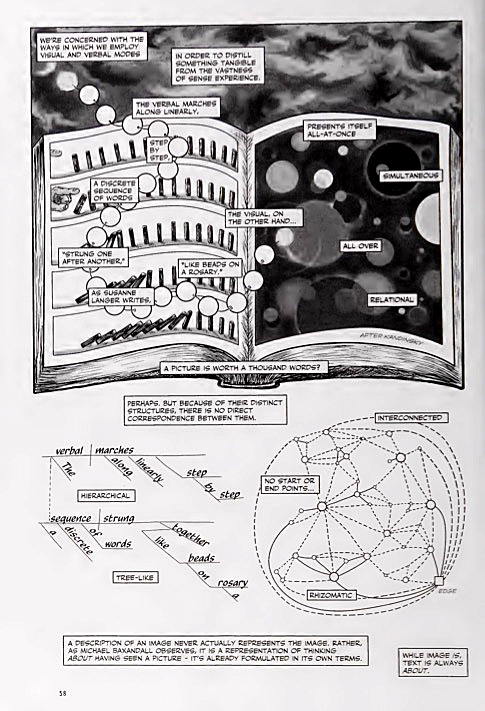
The most intimidating thing about storytelling is seeing a complex world in front of you and trying to distill it into a linear narrative. Grammar, spelling, and style are tools to make narratives more understandable—but the real challenge is the linear form itself.

Written narratives are a byproduct of a technological paradigm—paper—that forced ideas into constrained, two-dimensional forms. Though we’ve started to move beyond paper as our primary medium, we still shoehorn our thoughts into formats designed for it.

Anyone who has ever tried to write knows the world isn’t linear. Capturing the diversity of what we see, hear, and feel in a straight line of text is a hard task. Transforming our internal idea spaces into something comprehensible is even harder.

As someone who’s struggled with writing, I know how hard it is to make ideas understandable. We lose so much insight and perspective because our tools require time and skill most of us don’t have.

Digital storytelling attempts to solve this, but we still dig for meaning in incomplete records. Historiography and pretty much any kind of research requires both expertise and time to piece together coherent narratives out of fragmentary evidence.

While we now capture vastly more information than ever, our storytelling hasn’t caught up. We’re flooded with unfiltered content and disconnected data, yet we still rely on boundaries like “the document” to shape and constrain ideas.

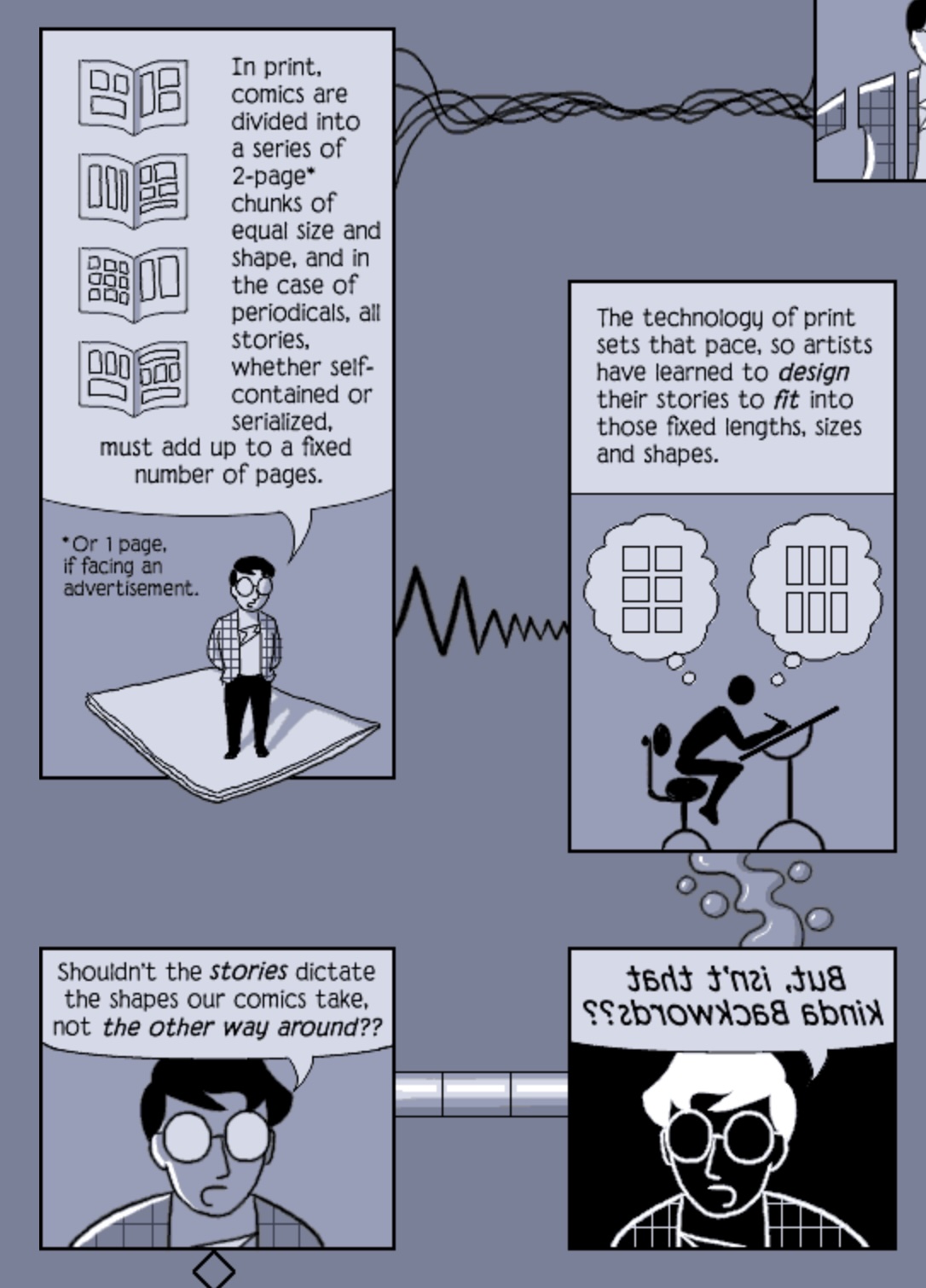
That’s a habit we inherited from paper—and we need to move on. Visual narratives, like the one constructed by Scott McCloud above, have explored what digital visualization truly means. Even visual artists, like Nick Sousanis, constrained by the page, demonstrate the possibilities of visual languages.

Nick Sousanis, the power visualization

Visualization plus digitization shows us that paper is no longer a necessary organizing metaphor. While we remain conceptually constrained, the technical reasons for avoiding this exploration have diminished. AI can illustrate connections for us and break us free from text and paper.

Our education systems still rely on carving off manageable chunks of knowledge—because we’ve given up on perceiving holistic abundance. We try to make it digestible through citations, cataloging and tagging systems. Those forms reflect a slower, flatter information space that is over matched by current information flows.

Scholarly formats—from five-paragraph essays to footnote rituals—exist because of paper’s physical limitations. They have logic and even beauty in their structure—but they’re also exclusionary. Poor writing frequently obscures good ideas. Extracting meaning requires specialized training, especially in the humanities.

Clear communication is a particular challenge in STEM fields. Most scientists lack writing training. Much gets lost in translation. Structured papers help readers extract meaning, but they still confine ideas to rigid formats. It’s no surprise that AI tools are seeing the fastest adoption in scientific domains—because those domains are desperate to move beyond their restrictive storytelling forms.

This points the way forward. Literature, statistics, code—all are more than the lines they appear on. Everything has context. Producing holistic narratives has been difficult; not anymore. The technology simply wasn’t there to break ideas free from paper systematically.

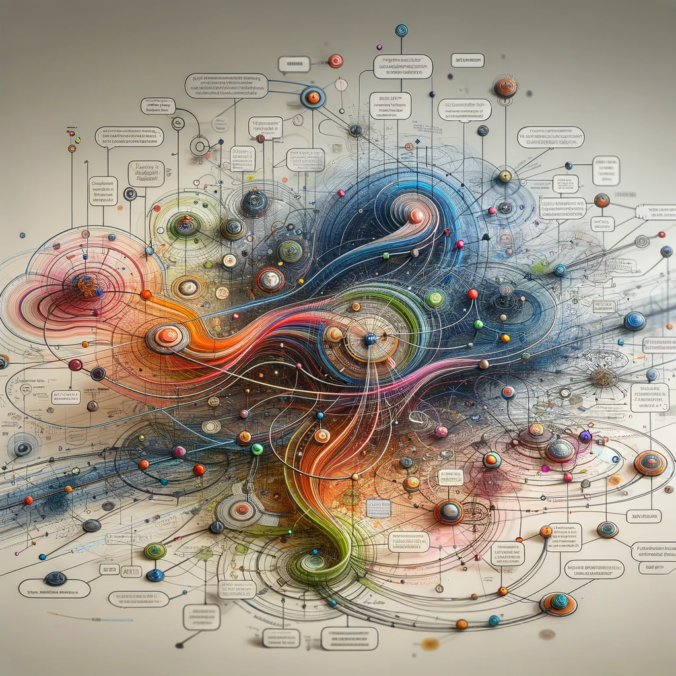
That’s the promise of large language models. They allow us to move in and out of dimensions and design narratives that aren’t stuck to a page. Scholars can now create rich, interactive diagrams of their work—instantly understandable but open to deeper exploration.

Information can now evolve beyond the technology of the book. This shift could usher in a new era of scholarship, creativity, and innovation. That’s what we’re trying to build with the Knowledge Navigator.

For a content creator—whether you’re a scholar, storyteller, educator, or entrepreneur—this shift means you don’t have to force your ideas into a rigid, linear format. Instead of starting with an essay or blog post, you might begin by building a concept map, a visual story, or an interactive explainer that connects your ideas multidimensionally (Robert Horn has been doing this for years). You might even co-create with an AI that helps you draw connections you hadn’t considered, offering insights or references in real time.

Imagine a researcher publishing a study not just as a dense PDF, but as a navigable, visual web of concepts—where a viewer can zoom in on data, click into contextual backstories, and explore connected fields without ever losing the thread. The traditional paper becomes just one mode of access—one “window” into a multidimensional landscape.

If you’re a teacher, this might require rethinking how tools reshape how students interact with knowledge. Rather than expecting them to summarize a chapter in a five-paragraph essay, you could ask them to create a dynamic timeline, an interactive comic, or a narrated walkthrough of connected events. With the help of tools like AI, students can build artifacts that reflect how they think—visually, spatially, relationally—not just how well they can conform to essay templates.

For businesses, it might mean ditching the standard pitch deck or white paper in favor of a living knowledge hub. AI could help tailor a narrative to a stakeholder’s needs, pulling from different content layers depending on interest—skimming visuals for high-level decision makers or diving into deep technical specs for engineers.

And for writers like me—those who’ve struggled with linear formats—it’s a shift from battling the blank page to collaborating with a canvas. I can explore fragments of ideas visually or conversationally and let AI help weave those fragments into coherent, nonlinear wholes. It turns writing from a rigid process into a fluid, evolving ecosystem of thought.

Too often, I’ve found that complex-sounding ideas are actually simple underneath. It’s the form that drives the complexity. Explaining paradigm shifts is especially messy—not because the ideas are hard, but because they ripple across contexts. Everyone lives in their own paradigm and in the collective one. Challenging that triggers cognitive friction.

If people don’t want to listen, even the best explanations fall flat. But visual explanations? They cut through. That’s why Knowledge Navigator is a visual tool: to finally unflatten the way we think

© 2026 IdeaSpaces

Theme by Anders Noren — Up ↑