“And today, the book is already, as the present mode of scholarly production demonstrates, an outdated mediation between two different filing systems. For everything that matters is to be found in the card box of the researcher who wrote it, and the scholar studying it assimilates it into his own card index.” — Walter Benjamin, ca. 1923-26
“Give a man a book, and you entertain him for a night. Teach a man to write, and you give him crippling self-doubt for life.” — Andy Weir, 2015
The most intimidating thing about storytelling is seeing a complex world in front of you and trying to distill it into a linear narrative. Grammar, spelling, and style are tools to make narratives more understandable—but the real challenge is the linear form itself.
Written narratives are a byproduct of a technological paradigm—paper—that forced ideas into constrained, two-dimensional forms. Though we’ve started to move beyond paper as our primary medium, we still shoehorn our thoughts into formats designed for it.
Anyone who has ever tried to write knows the world isn’t linear. Capturing the diversity of what we see, hear, and feel in a straight line of text is a hard task. Transforming our internal idea spaces into something comprehensible is even harder.
As someone who’s struggled with writing, I know how hard it is to make ideas understandable. We lose so much insight and perspective because our tools require time and skill most of us don’t have.
Digital storytelling attempts to solve this, but we still dig for meaning in incomplete records. Historiography and pretty much any kind of research requires both expertise and time to piece together coherent narratives out of fragmentary evidence.
While we now capture vastly more information than ever, our storytelling hasn’t caught up. We’re flooded with unfiltered content and disconnected data, yet we still rely on boundaries like “the document” to shape and constrain ideas.
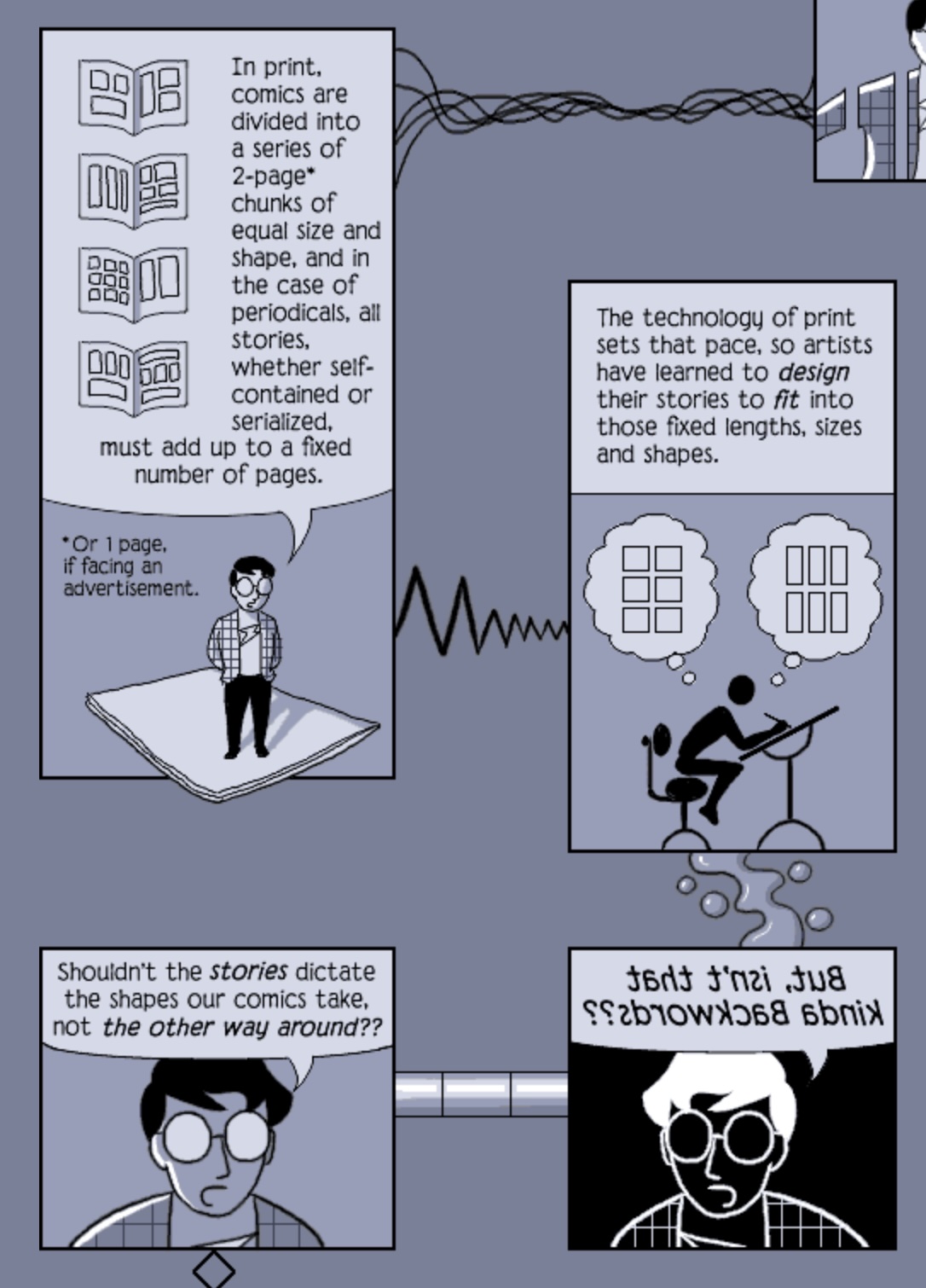
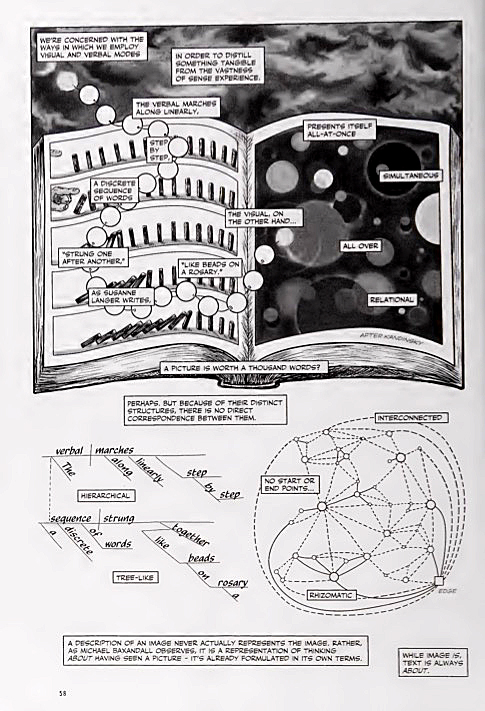
That’s a habit we inherited from paper—and we need to move on. Visual narratives, like the one constructed by Scott McCloud above, have explored what digital visualization truly means. Even visual artists, like Nick Sousanis, constrained by the page, demonstrate the possibilities of visual languages.
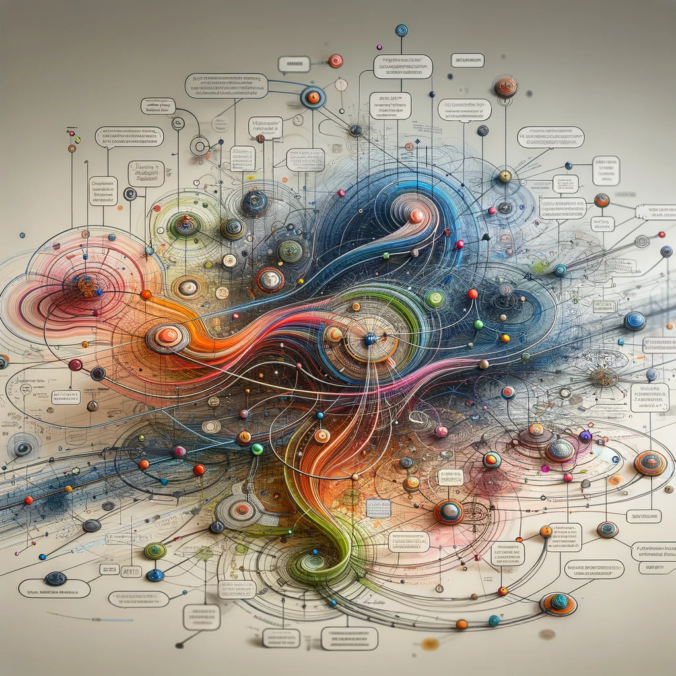
Visualization plus digitization shows us that paper is no longer a necessary organizing metaphor. While we remain conceptually constrained, the technical reasons for avoiding this exploration have diminished. AI can illustrate connections for us and break us free from text and paper.
Our education systems still rely on carving off manageable chunks of knowledge—because we’ve given up on perceiving holistic abundance. We try to make it digestible through citations, cataloging and tagging systems. Those forms reflect a slower, flatter information space that is over matched by current information flows.
Scholarly formats—from five-paragraph essays to footnote rituals—exist because of paper’s physical limitations. They have logic and even beauty in their structure—but they’re also exclusionary. Poor writing frequently obscures good ideas. Extracting meaning requires specialized training, especially in the humanities.
Clear communication is a particular challenge in STEM fields. Most scientists lack writing training. Much gets lost in translation. Structured papers help readers extract meaning, but they still confine ideas to rigid formats. It’s no surprise that AI tools are seeing the fastest adoption in scientific domains—because those domains are desperate to move beyond their restrictive storytelling forms.
This points the way forward. Literature, statistics, code—all are more than the lines they appear on. Everything has context. Producing holistic narratives has been difficult; not anymore. The technology simply wasn’t there to break ideas free from paper systematically.
That’s the promise of large language models. They allow us to move in and out of dimensions and design narratives that aren’t stuck to a page. Scholars can now create rich, interactive diagrams of their work—instantly understandable but open to deeper exploration.
Information can now evolve beyond the technology of the book. This shift could usher in a new era of scholarship, creativity, and innovation. That’s what we’re trying to build with the Knowledge Navigator.
For a content creator—whether you’re a scholar, storyteller, educator, or entrepreneur—this shift means you don’t have to force your ideas into a rigid, linear format. Instead of starting with an essay or blog post, you might begin by building a concept map, a visual story, or an interactive explainer that connects your ideas multidimensionally (Robert Horn has been doing this for years). You might even co-create with an AI that helps you draw connections you hadn’t considered, offering insights or references in real time.
Imagine a researcher publishing a study not just as a dense PDF, but as a navigable, visual web of concepts—where a viewer can zoom in on data, click into contextual backstories, and explore connected fields without ever losing the thread. The traditional paper becomes just one mode of access—one “window” into a multidimensional landscape.
If you’re a teacher, this might require rethinking how tools reshape how students interact with knowledge. Rather than expecting them to summarize a chapter in a five-paragraph essay, you could ask them to create a dynamic timeline, an interactive comic, or a narrated walkthrough of connected events. With the help of tools like AI, students can build artifacts that reflect how they think—visually, spatially, relationally—not just how well they can conform to essay templates.
For businesses, it might mean ditching the standard pitch deck or white paper in favor of a living knowledge hub. AI could help tailor a narrative to a stakeholder’s needs, pulling from different content layers depending on interest—skimming visuals for high-level decision makers or diving into deep technical specs for engineers.
And for writers like me—those who’ve struggled with linear formats—it’s a shift from battling the blank page to collaborating with a canvas. I can explore fragments of ideas visually or conversationally and let AI help weave those fragments into coherent, nonlinear wholes. It turns writing from a rigid process into a fluid, evolving ecosystem of thought.
Too often, I’ve found that complex-sounding ideas are actually simple underneath. It’s the form that drives the complexity. Explaining paradigm shifts is especially messy—not because the ideas are hard, but because they ripple across contexts. Everyone lives in their own paradigm and in the collective one. Challenging that triggers cognitive friction.
If people don’t want to listen, even the best explanations fall flat. But visual explanations? They cut through. That’s why Knowledge Navigator is a visual tool: to finally unflatten the way we think
0 Comments
1 Pingback