“We refer to a way of life in an integrated domain where hunches, cut-and-try, intangibles, and the human ‘feel for a situation’ usefully coexist with powerful concepts, streamlined technology and notation, sophisticated methods, and high-powered electronic aids.” – Douglas Engelbart, 1962
Today I want to revisit an old topic: teaching augmented with technology. I’ve been building and rebuilding classes for over 20 years now and I’ve always tried to use technology to maximize the efficiency of my work. In the early days, just knowing how to cut and paste made a huge difference. But now, I’m discovering new horizons of AI assisted pedagogy and pedagogical creation.
Before this semester, I embarked on something that in previous semesters I would’ve considered absolute folly. I did a complete course redesign in hours instead of weeks.
Rethinking Teaching in the Age of AI
In 2018, I completely revised my approach to teaching my subject (American and Texas government) to incorporate a design process into the class. This allowed me to customize the class around the interests of my students and was entirely driven by the motivation factor. I described this in detail in my 2020 book Learn At Your Own Risk.
Student motivation drove this reinvention. My classes are required, and most students don’t want to take them.
However, the best plan fails on the battlefield. Most of my students have been well-trained to expect very little and to give very little to their college courses. They’re always a few who are highly motivated, and they loved my system and benefited from it. However, the rest of the class was usually trying to game the system.
AI Chatbots only made this easier. It became clear to me that I needed to do some significant modifications. I put these off because it wasn’t clear to me whether I would be continuing in my pursuit of teaching or abandoning that in favor of the Knowledge Navigator project. Now that I have a full-time faculty position, I can do both.
Rapid Redesign Under Pressure
I did not have much time to implement the strategies between the time I found out I was going to be full-time and the beginning of classes. Major iterations always involve a balancing act between ideas and execution.
At the same time, I didn’t want to teach five classes using the old method. I needed to streamline the structure, incorporate AI directly into the learning process, and set it up for both in-person and asynchronous classes.
Normally, this process would’ve taken me weeks to do, but with all the onboarding and other meetings, I was left with three or four days. The thing that changed my approach though was the development process of coding with an AI partner to generate python code as well as the brainstorming process I use when writing.
I first took my existing course material, which involves a design process of writing three blogs and converting those into a website that the students could maintain as a tangible work product from the class. I asked the Chatbot to analyze my existing assignments and suggest ways in which I could inject AI into the creation process for the blogs.
Within a few iterations, I had a new point structure and set of assignments that simplified the somewhat cumbersome process I was using over the summer. This was essential for the asynchronous classes because I would not be there to keep them on course. I was dependent on the online materials to do that.
Testing and Refining the Model
Once I had the assignments, I dropped them into the NotebookLM library that had my collection of assessment and pedagogical literature in it. I then asked it to assess them against formative assessment and conversational pedagogy texts like Diana Laurillard’s Teaching as a Design Science and Dylan William’s Embedded Formative Assessment (and more than 50 other sources).
Since this DNA was already plugged into my original structure, the chatbot maintained that approach to teaching and learning. Every one of the assignments got high marks from my shadow teachers in NotebookLM (email me if you want access to the library).
Finally, I used the chatbot to simplify the language and develop rubrics for each of the new assignments. This whole process took three or four hours. The most time-consuming part of the process was updating my class shells in the learning management system.
Once classes started, I discovered a few mistakes along the way. However, there were probably fewer mistakes than I would have made doing it myself and none of them were structural.
Results in Practice
I am teaching two accelerated courses this semester. Both are asynchronous, so they presented an acid test of the design of my classes. Approximately 80 to 90% of the students in those classes could follow the sequence and created better than average first blogs. The extensive employment of reflection exercises dilutes the possibility for them to use AI to complete assignments unless that is the assignment.
I know this is a small sample size, but I can say with some confidence that the courses are no worse than what I was doing in prior semesters. The scaffolding exercises work better and are more logical.
For my in-person or synchronous online classes, this structure, coupled with AI, allows me to create live experiences with immediate feedback within the bounds of the class itself. I’ve been doing this for a while, but now I’m able to shift between synchronous and asynchronous modes on the fly.
Lessons from Conversational Pedagogy
I have been working on understanding conversational spaces across all physical and virtual dimensions, which goes back to the work I did for Arizona State University’s ShapingEDU project. As I discovered, the best learning experiences shift effortlessly between all environments as needed.
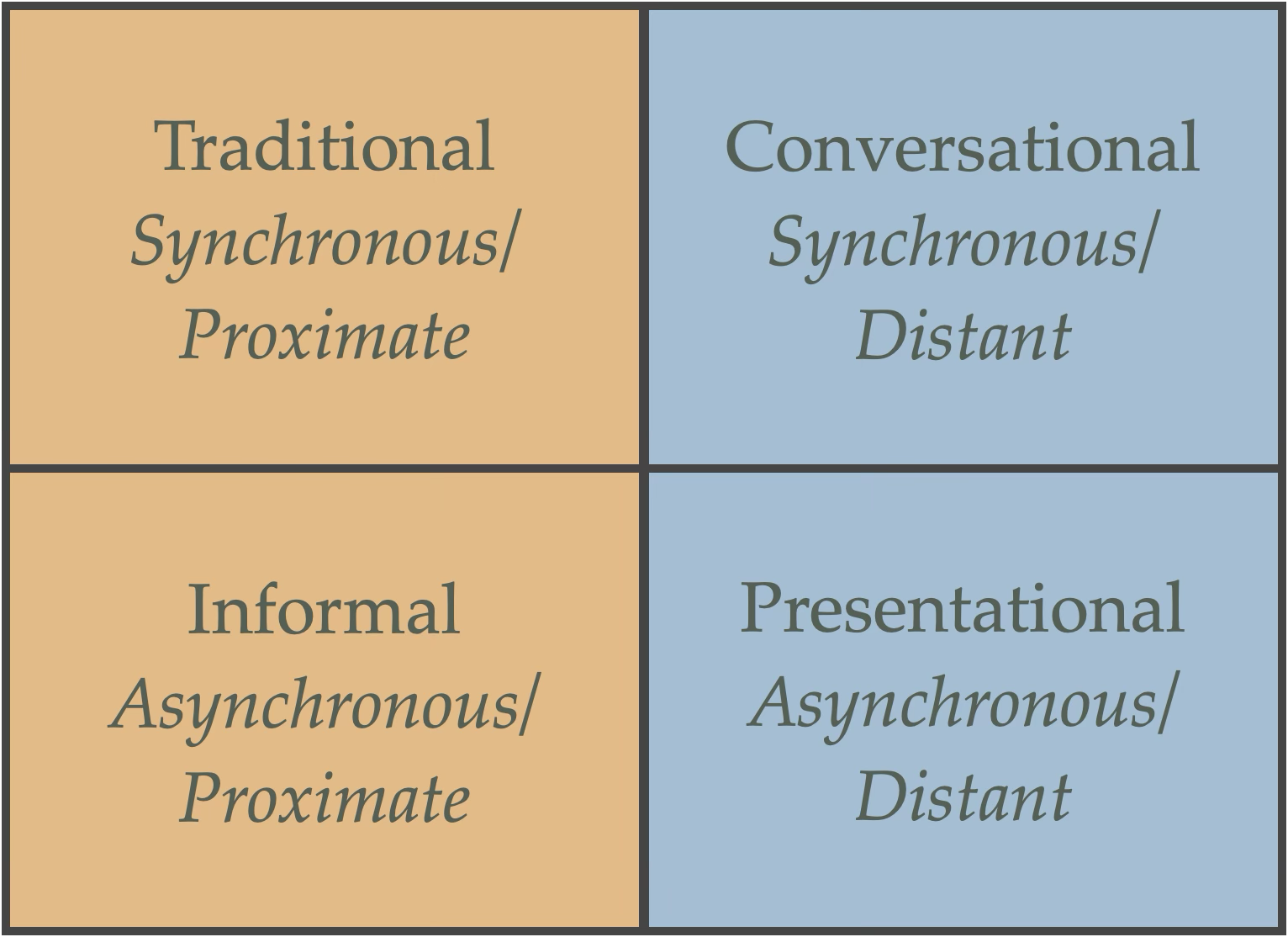
Learning is not a linear process. Like the Knowledge Navigator concept, it is a web of experience. The more I can diversify that experience for my students, the better the learning will be. I am still making some tweaks this semester, but I am a lot closer to that ideal in my courses than I have been in some time. This AI process has made that possible under very tight time constraints.
The Bigger Picture: Adaptation and Antifragility
I recognize that no core structure should remain static forever. As I iteratively adapt my courses to new possibilities, having an AI partner to assist me makes change far more feasible.
There is a lot of resistance to AI within academia in various forums. A lot of this stems from a reluctance to do the work necessary to rebuild entrenched teaching methods. However, the technology provides a “cheat” that teachers can use to significantly accelerate their process of change.
I’m conservative when it comes to new technologies. I need to see their utility before I’m willing to waste my time with them. AI is different. It’s like an onion. Every time I feel like I’ve reached the limits of what it allows me to do, I find another layer. As I described in a blog a few weeks ago, I think the next frontier is on-demand coding.
AI presents real challenges to the way we teach and learn. Smart strategies are necessary to adapt and thrive using this technology. Nicholas Taleb describes this process as developing antifragility.
If we can use technology to reinvent ourselves, we can thrive under these circumstances. More importantly, by teaching these tools, we’re giving our students superpowers to face the challenging future that awaits them in a world of AI, climate change, and political uncertainty.