
The Conceptual Framework We Work Under
Empowering ecosystems of humans to augment their capacity for creativity, learning and innovation in a Digital Age through the strategic application of technology
We miss opportunities for learning, innovation, and organizational change because of narrow paradigms of thought that are a legacy of the Industrial Age. The IdeaSpaces concept is a holistic analytical framework to help us imagine and design ecosystems of evolution, innovation, and lifelong learning.

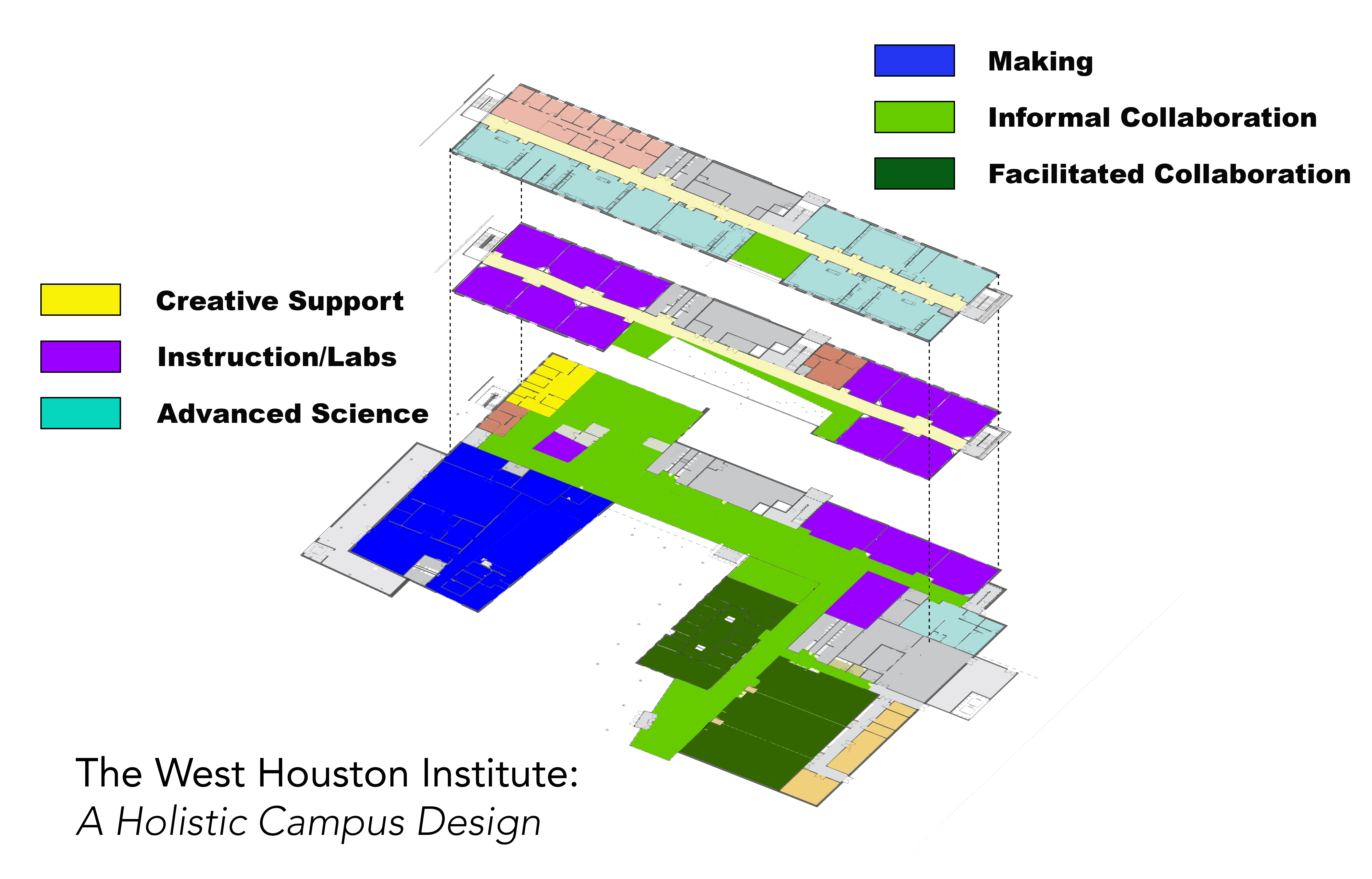 The West Houston Institute – An example of a physical SPACE |
 My Remote Teaching classroom in Zoom – An Example of a Virtual SPACE
|
• Space reflects the application of effective design into our physical and virtual spaces. •
• Effective Spaces are a precondition for innovative environments. However, they are not sufficient to realize human innovation. •
• “Innovative” Spaces fail to live up to their potential when they are seen as an end to an innovation process rather than as a means to ongoing innovation. •
• If you get this part wrong, the other parts of the innovation equation are hobbled. •

Results of hackathon integrating elements of synchronous and asynchronous TIME
• Time is critical for the iteration and formation of ideas and their formation in the first place. •
• Eureka moments only occur in fiction. People and organizations need Time to reflect on what is working and what isn’t. •
• Intertwingled Conversations change us and we need to expand Time in order to have them. •
• Brainstorming efforts followed by a process of constant iteration are essential in creating what Nicholas Taleb refers to as antifragile humans and organizations. •

The STAC Model – An example of a STRUCTURE supporting an informal learning environment
• Effective Structure requires creating human-centered networks that facilitate growth and innovation •
• Innovation Structures nurture networks of Spaces and Time to allow humans to develop liquid networks •
• Systemic antifragility requires constant attention and adaptability. •
• Organizational Structures must is flexible enough to allow for change and yet rigid enough to capture innovation. •
It is only with the mindful application of all three levels of this framework that Innovation can be sustained in any organization. Space absent Time and Structure will lead to under- or misused physical spaces and technologies, for instance. Structures without effective Spaces will be handicapped as its conversations are hobbled by a lack of gathering places for ideas.
It is my hope that through ongoing discussion and iteration, the concept of IdeaSpaces itself will help people take a holistic approach to creating the kind of change that will help us and our children survive and thrive in a world of endless possibilities and challenges.
There is mounting evidence that technology is repaving our economy. We have been saying for years that we are in a post-induslrial economy but it goes far beyond that. We are entering a post-scarcity economy and this undermines many of the fundamental principles of how people live and work that date back for centuries. MIT Economists Erik Brynolfsson and Andrew McAfee have explored this topic extensively in two books, The Second Machine Age and Race Against the Machine.
What we need to start understanding is that we are largely powerless to change the pace of change. There are strong economic factors which create demands for efficiency that will drive technological change and this, in turn, will challenge humans to adapt, both individually and societally. This means that new skill sets will come to the fore, which we need to teach, train, and embrace ourselves or risk being left behind.
In this world innovation and learning become increasingly indistinguishable. Innovation is learning about something hasn’t been invented yet. And as Alan Kay said, “The best way to predict the future is to invent it.” Teachers invent the future; innovation can be taught; and all true innovators are ultimately educators. Learners are self-innovators. Digital Transformation Services are designed to facilitate teaching others, teaching oneself, and reshaping organizations so that they will thrive and grow in the digital era.
Services We Offer

Many organizations are struggling with the implications of the digital transformation happening to human society. IdeaSpaces Services are designed specifically to bring a digital perspective to bear on the analog problems confronting institutions today and to prepare them and their stakeholders for the digital future.
- Designing Innovation Organizations – We offer leadership consulting, workshops, and organizational analysis to facilitate innovation in your organization. Space-Time-Structure
- ELITE Strategy Workshops – We offer workshops using the ELITE Strategy to connect your curricular or business needs to built or virtual environments. Space
- Paradigm Shift Workshops – As I discuss in Discovering Digital Humanity, the primary barrier to digital transformation is ourselves and our organizational cultures. Many organizations struggle to apply innovation concepts within their cultural paradigms. We offer workshops using the Paradigm Shift brainstorming strategy to teach your teams how to apply systems thinking approaches to create dynamic real world innovation strategies. Space-Time-Structure
- Digital Communication Strategies – We offer workshops on using New Media to leverage new technologies in all communications strategies, from instruction to public relations. Time
- Technology Assessment – We will analyze technology systems using the Three-E methodology to determine how effectively they support use-case needs at your institution. Space
- Faculty Professional Development – Online and in-person workshops on adapting pedagogy to changing the changing demands being placed teaching and learning in the digital transformation. Time
- Futuring Workshops – Workshops for gaming out the future of technology and how your institution can adapt to the trends. Time
- Custom events and services on demand